

Key Takeaways for Decision Makers
-
Financial Impact: Switching to LED can reduce lighting energy consumption by up to 75%, with a typical ROI payback period of just 1-3 years.
-
Operational Efficiency: With lifespans exceeding 50,000 hours, LEDs virtually eliminate maintenance labor and material costs for over a decade.
-
Productivity Boost: Superior light quality (High CRI) and optimized color temperatures reduce employee eye strain and improve safety in high-risk areas.
-
Strategic Value: LED systems serve as the foundation for IoT smart buildings and assist in meeting corporate ESG and sustainability goals.
For US-based business leaders, every operational decision is scrutinized for its impact on the bottom line. Upgrading your facility’s lighting might seem like a simple infrastructural change, but it represents one of the most impactful investments you can make. The benefits of commercial LED lighting extend far beyond basic illumination, offering a powerful combination of direct cost savings, enhanced operational performance, and a strengthened commitment to sustainability.
1. Unmatched Energy Efficiency & Direct Cost Savings
For any business, the bottom line is paramount. Traditional lighting systems, such as fluorescent tubes and High-Intensity Discharge (HID) lamps, are notoriously inefficient, wasting a significant amount of energy as heat rather than light. By contrast, LEDs are designed to convert a much higher percentage of electricity into visible light.
According to industry analyses, switching to commercial LED lighting can cut energy costs by up to 75%. This massive reduction in kilowatt-hours (kWh) directly lowers your monthly utility bills.
Quantifying the Financial Impact
Consider a practical scenario for a medium-sized facility:
-
Current Spend: If your business currently spends $2,000 per month on lighting energy with outdated fixtures.
-
Projected Savings: A conservative 60% reduction would save you $1,200 every month.
-
Annual Result: This equates to $14,400 in annual savings on electricity costs alone.
The Multiplier Effect: Lower HVAC Costs
The financial advantages extend beyond the direct energy savings. Incandescent and halogen bulbs convert approximately 90% of their energy into heat. Even fluorescents emit a considerable amount. By generating very little radiant heat, LED lighting reduces the strain on your air conditioning systems, lowering cooling costs by an additional 5-10% during summer months.
2. Superior Longevity & Drastically Reduced Maintenance
The operational lifespan of your lighting is a critical, yet often overlooked, factor in your facility’s total cost of ownership. A high-quality commercial LED fixture is typically rated for 50,000 to 100,000 hours. To put that into perspective:
|
Lighting Type |
Average Lifespan |
Comparison to LED |
|---|---|---|
|
Incandescent |
1,000 hours |
50x Shorter |
|
Halogen |
2,000 hours |
25x Shorter |
|
CFL / Fluorescent |
10,000 hours |
5x Shorter |
|
Commercial LED |
50,000+ hours |
Standard |
This longevity translates directly into reduced maintenance costs. In a warehouse with high ceilings, changing a bulb isn’t just a quick fix—it often requires renting a scissor lift and shutting down an aisle. With LEDs, you can virtually eliminate these disruptions for a decade.
3. Enhanced Light Quality for Safety and Productivity
Light quality isn’t just aesthetic; it’s operational. Modern LEDs provide superior Color Rendering Index (CRI), often 80-90+, meaning workers can accurately identify parts, read labels, and spot quality defects without eye strain.
Optimal Color Temperature (CCT) for the Job
LEDs allow you to select the exact “temperature” of light suitable for the work environment:
-
Warm (3000K): Best for hospitality, break rooms, and lobbies to create a welcoming atmosphere.
-
Neutral (4000K): Ideal for offices and classrooms, promoting alertness without harshness.
-
Cool/Daylight (5000K): The standard for warehouses, manufacturing, and outdoor security. This crisp white light maximizes visual acuity and safety.
Unlike flickering fluorescent tubes which can cause headaches, LEDs provide stable, uniform light that enhances visual quality and supports employee well-being.
4. Durability in Demanding Environments
Commercial spaces demand lighting that stands up to tough conditions. LED fixtures excel in environments like manufacturing plants and outdoor areas because they are solid-state devices with no fragile filaments or glass to break.
Whether it’s the vibration of heavy machinery or the freezing temperatures of cold storage, energy-efficient lighting solutions like waterproof linear luminaires are built to last. Many industrial LED fixtures come with high Impact Protection (IK) ratings and Ingress Protection (IP) ratings (e.g., IP65 or IP66), ensuring they are dust-tight and water-resistant. This ruggedness ensures that your safety lighting remains operational when it matters most.
5. Smart Controls and IoT Integration
Modern LEDs are the backbone of the “Connected Building.” By integrating with Motion sensors and daylight harvesting systems, lighting transforms from a passive utility into an intelligent asset.
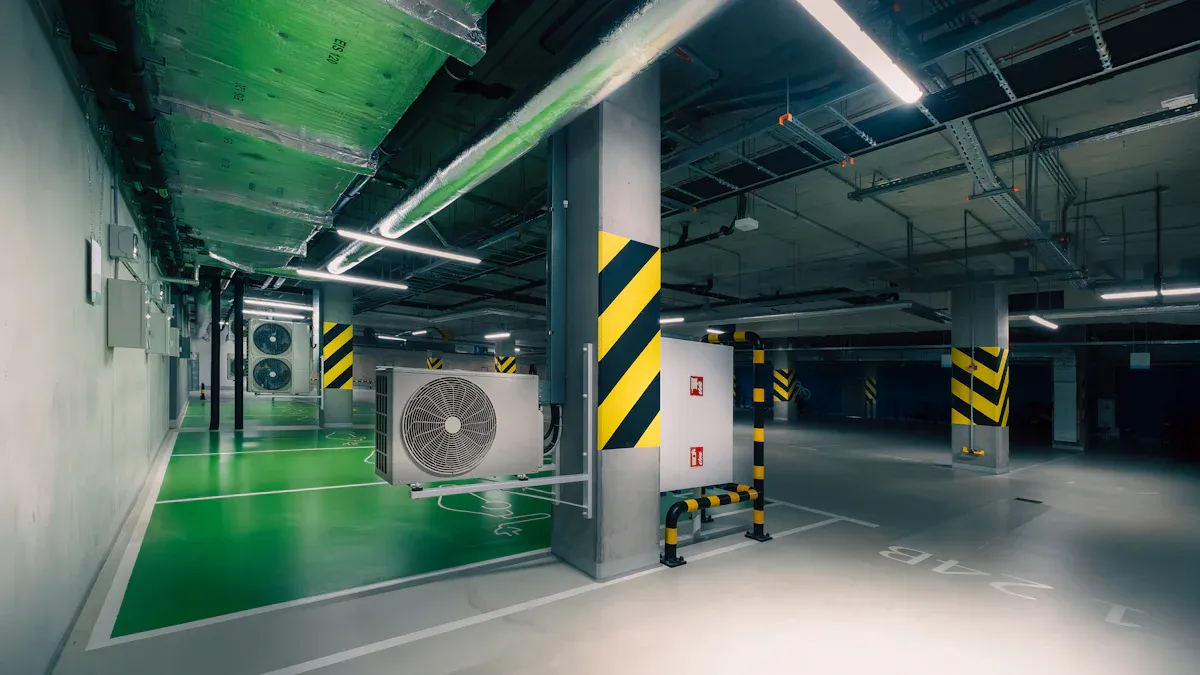
Automated energy management allows lights to dim when sunlight is available or turn off when rooms are empty. Facility managers can control systems remotely via Bluetooth Mesh or Zigbee, monitor energy usage data in real-time, and optimize schedules. Implementing these smart strategies can lead to an additional 20-30% in savings on top of the inherent LED efficiency gains.
6. Environmental Benefits and ESG Goals
For modern businesses, environmental responsibility is a core component of long-term strategy. Switching to LED is a tangible step toward sustainability:
-
Carbon Footprint Reduction: By reducing energy consumption, you directly lower your facility’s greenhouse gas emissions.
-
Non-Toxic: Unlike fluorescents, LEDs contain no mercury or hazardous materials, simplifying disposal and reducing toxic waste.
-
Waste Reduction: The long lifespan means fewer bulbs end up in landfills over the years.
7. Emergency Readiness
Safety is non-negotiable. Modern commercial LED systems often come with integrated emergency modules. Because LEDs draw so little power, battery backups can keep them running longer and brighter during power outages, ensuring safe evacuation routes and compliance with fire safety codes. Automated self-testing features in modern fixtures also reduce the burden of manual monthly inspections.
Calculating Your ROI: A Step-by-Step Guide
Making the switch is a financial decision. Use this framework to calculate your Return on Investment (ROI) and justify the expenditure.
Step 1: Calculate Annual Energy Savings
Use this formula: (Old Wattage – New LED Wattage) × Operating Hours/Year × Electricity Rate = Annual Savings
Example: Replacing a 400W metal halide (which uses ~455W with ballast) with a 150W LED, running 4,000 hours at $0.15/kWh:
(455W – 150W) × 4,000 hrs × $0.15 = $183.00 saved per fixture, per year.
Step 2: Factor in Maintenance and Rebates
Add the cost of labor and bulbs you won’t need to buy. If you replace a bulb once a year at a cost of $50 (labor + material), your total savings per fixture is now $233.
Additionally, check for utility rebates or federal tax incentives. In the US, the IRS Section 179D Commercial Buildings Energy-Efficiency Tax Deduction allows businesses to claim significant deductions (up to $5.00+ per sq. ft. in some cases) for energy-reducing upgrades.
Step 3: Determine Payback Period
Net Investment Cost / Total Annual Savings = Payback Period (Years)
For most businesses, a commercial LED upgrade pays for itself in 1 to 3 years. After this period, the operational savings convert directly into profit for the next decade.
FAQ
What is the average payback period for a commercial LED upgrade?
For most businesses, the payback period is between 1 and 3 years. Facilities with 24/7 operations (like hospitals or manufacturing plants) often see a payback in under 18 months.
Are there tax incentives for switching to LED lighting?
Yes. In the US, the Section 179D Commercial Buildings Energy-Efficiency Tax Deduction allows businesses to claim significant deductions for energy-reducing upgrades. Many local utility companies also offer cash rebates per fixture.
Can LED lights be used in cold storage?
Absolutely. LEDs perform exceptionally well in cold temperatures, turning on instantly and maintaining efficiency, unlike fluorescent lights which struggle to start and lose brightness in the cold.
Do I need to replace the entire fixture?
Not always. Retrofit kits allow you to upgrade existing fixtures to LED, saving on installation time and waste. However, replacing the entire fixture often yields better long-term efficiency and allows for smart control integration.








