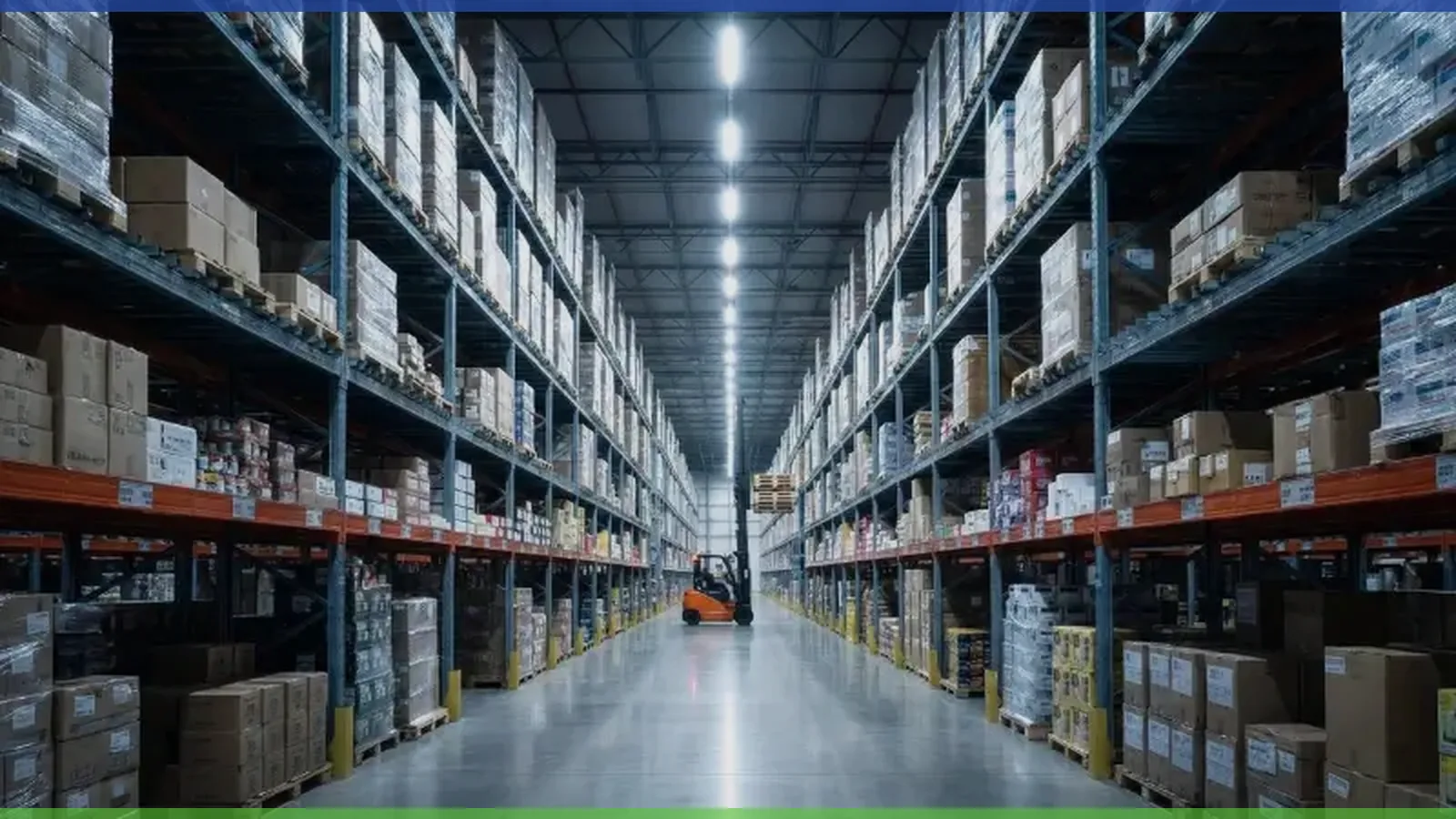
The best linear high bay lights for warehouse aisles are not the brightest fixtures on a datasheet. They are the fixtures whose optical distribution, mounting height, spacing, controls, glare behavior, maintenance access, and evidence file match the rack layout. A narrow aisle with tall racks needs a different answer from an open staging area, even if both areas ask for the same nominal wattage.
According to FEMP purchasing guidance for commercial and industrial LED luminaires, commercial and industrial LED purchasing guidance includes luminaire categories such as high-bay, low-bay, linear ambient, and troffers. According to DLC solid-state lighting technical requirements, qualified LED products are evaluated through defined technical requirements and product categories. The procurement insight is that warehouse aisle lighting should be compared as finished luminaires in a real layout, not as wattage labels.
Key Takeaways
- Linear high bay lights fit warehouse aisles best when rack geometry, mounting height, beam pattern, and spacing are known before fixture selection.
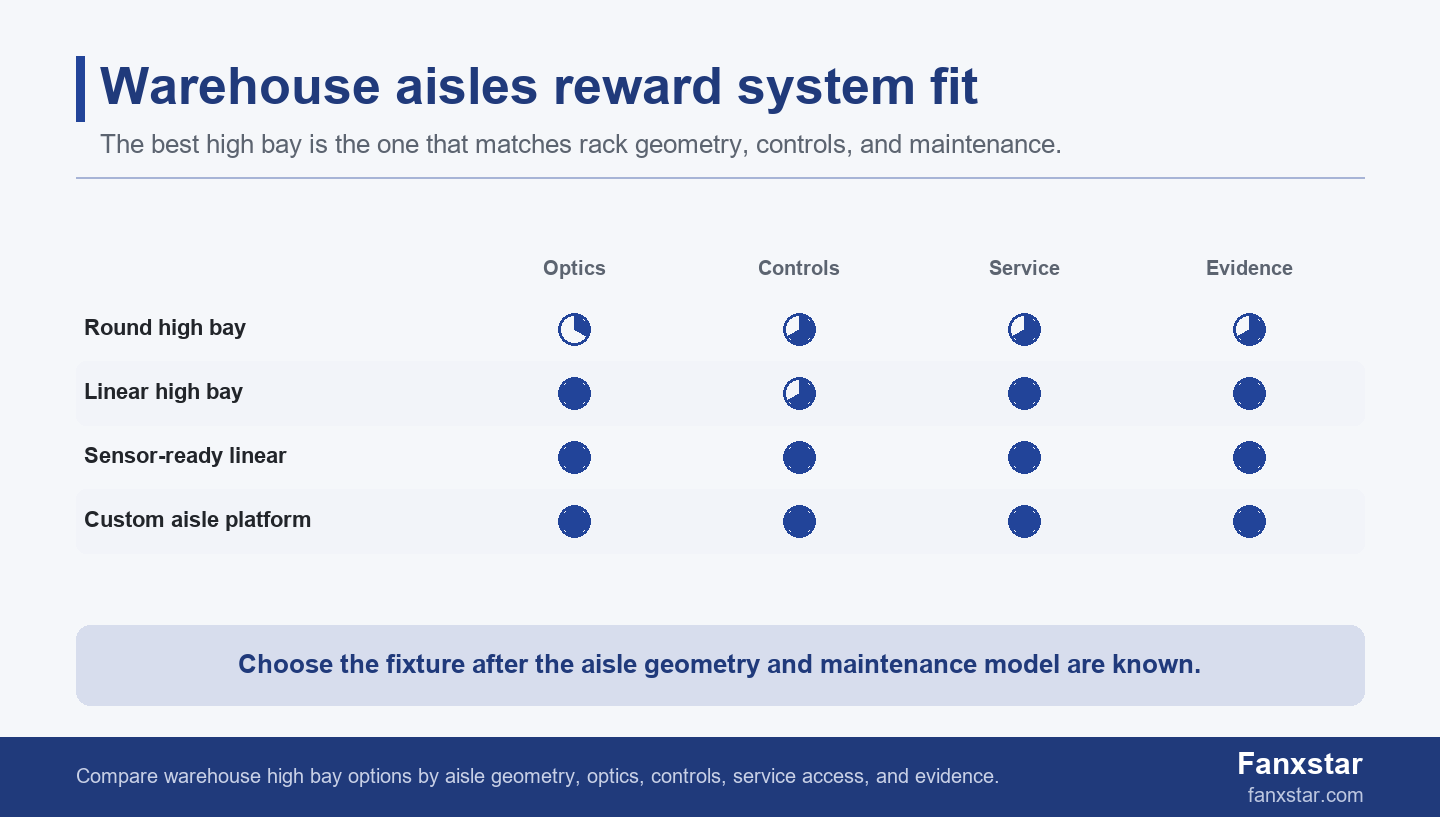
- A round high bay can work in open areas, but linear high bays usually control aisle uniformity and rack-face visibility better.
- Controls matter because warehouse occupancy is uneven; sensor grouping and hold time should be specified before approval.
- Fanxstar is most relevant when the buyer needs linear, sensor-ready, weatherproof, or custom ODM fixtures for a defined warehouse lighting plan.
Choose Aisle Lighting by Rack Geometry
Choose by aisle geometry, not fixture wattage
A warehouse aisle is a geometry problem before it is a wattage problem. The light must reach the floor, shelf faces, labels, cross aisles, and forklift path without creating harsh glare for operators. If the fixture throws too much light sideways, racks can block useful output. If it throws too little light sideways, vertical faces may be dark. If it is spaced only by wattage, the floor average may look acceptable while the actual picking task remains weak.
According to DLC product eligibility guidance, lighting products are classified by primary use and product language rather than by casual marketing labels. Buyers can use that discipline for warehouses: define whether the zone is a narrow aisle, wide aisle, open bay, loading area, cold-adjacent route, or sensor-controlled traffic lane. The best fixture type follows that definition.
For many aisle applications, a linear high bay offers a strong starting point because the fixture shape aligns with rack rows and traffic direction. That does not make every linear high bay automatically correct. Lens, distribution, glare control, mounting height, driver quality, sensor compatibility, and cable entry still need review. The final comparison should be between complete luminaires installed in the same aisle model.
Separate open areas from rack aisles
Open staging areas often tolerate wider distribution because the task plane is broad. Rack aisles are less forgiving. Light can be wasted on rack tops, blocked by shelves, or concentrated into stripes. Buyers should ask suppliers for a simple layout: aisle width, rack height, mounting height, fixture spacing, target light level, and uniformity estimate. A layout file is more useful than a claim that one product is high lumen.
According to ENERGY STAR lighting upgrade guidance, commercial LED upgrades can greatly reduce electricity used in buildings. That value is real, but in warehouse aisles it should be protected by useful delivered light. Saving watts does not help if workers add portable lights, avoid dark aisles, or keep all zones at full output because controls were never commissioned.
| Warehouse condition | Linear high bay priority | Evidence to request |
|---|---|---|
| Narrow rack aisles | aisle optics and spacing | photometric layout, beam, mounting height, and row spacing |
| Fast pick zones | visibility and sensor grouping | occupancy sequence, hold time, and override plan |
| High maintenance cost | long service interval | driver access, warranty boundary, and spare-part plan |
| Dust or semi-open loading | environmental fit | IP rating, lens, cable entry, and cleaning method |
What to Compare Before Choosing a Linear High Bay
Optics and glare decide whether the aisle feels usable
The most important comparison is optical fit. Ask whether the fixture uses a general wide lens, aisle lens, clear lens, opal diffuser, reflector, or custom optic. Ask whether the selected optic was used in the photometric file. If the buyer changes lens, CCT, power, or mounting height after the layout, the supplier should confirm whether the layout still applies.
According to GSA LED lighting and controls guidance, LED and control choices should be reviewed around life-cycle cost and energy efficiency. For warehouse aisles, life-cycle cost includes more than energy. It includes fixture access, driver replacement, lift time, downtime, sensor commissioning, and the cost of weak visibility in a busy pick route.
Glare should be checked from the driver and picker viewpoint. A luminaire can deliver enough lumens and still be uncomfortable if the lens is too bright at high angles. Buyers should ask for product photos, lens samples, and if possible a small mockup at the actual mounting height. The first sample should not only be powered on a bench; it should be judged in a realistic aisle line.
The buyer should also decide what the aisle is trying to optimize. A bulk storage aisle may prioritize uniform floor visibility and low service frequency. A pick module may prioritize vertical label recognition and reduced glare at eye level. A high-traffic forklift route may prioritize driver comfort and sensor behavior. These use cases can require different optical choices even inside the same warehouse.
Controls turn the high bay into a warehouse system
Warehouse traffic is rarely uniform. Some aisles are active all day, some are seasonal, and some are visited for a few minutes per shift. A sensor-ready linear high bay can reduce wasted full-output hours, but only when zones, hold time, sensitivity, daylight behavior, override, and emergency expectations are defined. A generic sensor added at the end can create nuisance switching or dark corners.
According to DLC solid-state lighting technical requirements, technical requirements and reporting help compare product evidence. The same principle applies to controls: ask for the exact sensor model, control interface, default setting, commissioning method, and whether the fixture can be grouped by aisle. The buyer should not discover after installation that every fixture behaves as an isolated device.
How to Write the RFQ for Warehouse Aisle Lighting
Give the supplier the warehouse map
A strong RFQ should include aisle width, rack height, mounting height, fixture row spacing, operating hours, target market, ambient temperature, dust or moisture exposure, desired CCT, sensor needs, emergency route requirements, and whether installation must reuse existing wiring. If the project is a retrofit, include the old fixture type, power, spacing, circuiting, and known complaints.
According to International Trade Administration import documentation guidance, shipment and import records can include invoices, bills of lading, packing lists, insurance proof, and certificates of origin. Warehouse lighting buyers should apply the same version-control habit to the technical file: the quote, layout, sample, driver, lens, sensor, label, and shipment documents should describe the same product version.
The RFQ should also ask what changes require a new layout. A different lens, different wattage, different mounting height, different driver, or different sensor location can change the real aisle result. If the supplier offers several wattage options in the same housing, ask whether each wattage has a separate photometric file and thermal evidence.
Use a pilot aisle before a large rollout
According to International Trade Administration special document guidance, some products may require additional certificates or special documentation. In lighting procurement, the buyer should decide before shipment whether the project needs specific electrical, performance, or market evidence. A pilot aisle helps connect those documents to real installation behavior before the whole warehouse is converted.
A practical pilot should run at least 1 representative aisle and 1 cross-aisle transition. Check floor visibility, shelf-face visibility, glare from forklift height, sensor trigger distance, dimmed state, emergency behavior if relevant, and maintenance access. Photograph the installed sample, record settings, and keep the approved sample file attached to the volume order.
The pilot should also include the maintenance crew, not only the purchasing team. Ask whether the driver compartment can be reached safely, whether the fixture can be cleaned without damaging the lens, whether the sensor settings are understandable, and whether spare parts are realistic for the site. A warehouse lighting project often fails slowly when the first installation looks fine but the first service visit becomes difficult.
According to the SBA import and export laws guidance, businesses should understand import and export rules before international sales. The same discipline is useful for large warehouse projects because the buyer may be ordering fixtures, sensors, accessories, labels, and spare drivers as one package. The approved documentation should travel with the order.
Where Fanxstar Fits Linear High Bay Projects
Match the Fanxstar platform to the aisle task
Fanxstar’s relevant starting points include the LED linear lighting platform, motion sensor LED lighting, weatherproof LED lighting product platform, and custom LED lighting ODM service. A clean dry warehouse may start with a standard linear platform. A dusty, damp, or semi-open aisle may need weatherproof details, protected cable entry, or a different housing.
For a new warehouse, Fanxstar should receive the rack plan, mounting height, aisle width, target CCT, desired controls, and service constraints. For a retrofit, the buyer should add old fixture spacing, circuit information, and any complaints about dark shelves, glare, flicker, or maintenance frequency. Those details make the recommendation more accurate than a generic best high bay list.
If the project also needs dimming, sensor zones, or building-control logic, the buyer can review LED lighting controls for industrial facilities and the LED retrofit planning checklist before requesting a sample. That keeps the product decision tied to the full warehouse operating model.
Approve the high bay as a system
A good approval packet includes the selected fixture, photometric file, layout, driver, lens, sensor, mounting accessory, wiring note, warranty boundary, and sample photos. If the project is large, the buyer should also request spare-driver strategy and production change rules. The best linear high bay is not just a product name; it is the lighting system that can be repeated reliably across the warehouse.
For a warehouse owner, repeatability is the value. The first 20 fixtures should behave like the next 200 fixtures. That means the supplier should freeze the lens, driver, sensor, CCT, CRI, mounting accessory, and packaging instruction after sample approval. If a production substitution is unavoidable, the buyer should receive a new evidence note before shipment, because a small optic or driver change can alter aisle performance.
When that file is complete, price comparisons become more useful. The buyer can compare delivered aisle performance, energy, controls, maintenance, and documentation instead of choosing by fixture wattage. That is the practical way to move from a search for best linear high bay lights to a controlled B2B purchase.
FAQ
Are linear high bay lights better than round high bays for aisles?
Linear high bay lights are often better for rack aisles because the fixture shape and optic can align with long aisle geometry. Round high bays can still work in open areas. Buyers should compare the photometric layout, glare, mounting height, and spacing before deciding.
What beam angle is best for warehouse aisles?
There is no universal beam angle for every warehouse aisle. The correct optic depends on aisle width, rack height, mounting height, fixture spacing, task visibility, and whether the buyer needs shelf-face light or mostly floor-level illumination.
Should warehouse high bays use motion sensors?
Motion sensors can be valuable when aisle traffic is uneven, but they must be grouped and commissioned correctly. Buyers should define hold time, detection zone, dimmed level, override, daylight behavior, and emergency-route expectations before approving the fixture.
What should be in a linear high bay RFQ?
Include rack height, aisle width, mounting height, fixture spacing, operating hours, CCT, controls, environmental exposure, target market, old fixture details if retrofitting, and the evidence required for layout, driver, lens, sensor, and warranty.