In the architectural design of modern educational facilities, lighting is no longer just a utility—it is a cognitive catalyst. Research has consistently demonstrated that the quality of classroom illumination directly impacts student concentration, mood, and long-term ocular health. One of the most critical metrics in this field is the Unified Glare Rating (UGR). For schools, the industry gold standard is UGR<19. Lighting that exceeds this threshold can cause “disability glare,” leading to eye strain, headaches, and a significant drop in focus. By prioritizing low-glare linear lights, school administrators can create an environment that supports both pedagogical excellence and operational efficiency.
This guide provides a technical foundation for selecting the right LED linear solutions, focusing on optical engineering, the biology of glare, and the long-term Return on Investment (ROI) for educational institutions.
Key Takeaways
-
UGR<19 is Mandatory: To comply with modern educational standards, overhead lighting must maintain a glare rating of less than 19 for desks and whiteboards.
-
Cognitive Impact: Flicker-free, low-glare lighting is scientifically linked to improved student test scores and reduced behavioral agitation.
-
Optical Versatility: Utilize micro-prismatic diffusers and deep-recessed reflectors to achieve 185 lm/W efficacy while shielding the eye from direct LED chips.
-
Durability and Safety: Specify IK10-rated fixtures for high-activity zones like gyms and technical workshops.
-
Daylight Harvesting: Integrate dual-photosensors to dim artificial lights when natural light is sufficient, saving up to 70% in energy costs.
The Science of Glare: Why UGR<19 Matters in Education
Understanding the Unified Glare Rating (UGR)
UGR is a psychological measure of discomfort glare in indoor lighting applications. It is calculated based on the luminance of the fixture, the angle of the viewer’s eye, and the background luminance of the room. In a classroom, where students are constantly shifting their focus from digital screens to paper-based materials and the front whiteboard, high-glare environments create “visual noise.” When the UGR is below 19, the light source is sufficiently shielded or diffused to minimize these distracting reflections.
Flicker and Student Health
Beyond glare, the stability of the light is paramount. Many low-cost LED fixtures produce “invisible flicker” that triggers the brain’s alpha-waves, leading to premature mental fatigue. All high-performance flicker-free LED classroom lights use high-frequency drivers that provide a steady, ripple-free current, essential for students with sensory sensitivities or ADHD.
|
Area of School |
Recommended Lux Level |
UGR Target |
Ideal CCT |
|---|---|---|---|
|
Standard Classroom |
300 – 500 Lux |
< 19 |
4000K (Neutral) |
|
Science Labs |
500 – 750 Lux |
< 19 |
5000K (Cool) |
|
Gymnasiums |
200 – 300 Lux |
< 22 |
4000K |
|
Corridors / Halls |
100 – 150 Lux |
< 25 |
3000K – 4000K |
Top 3 Low-Glare Solutions for Schools
Based on performance benchmarks and architectural feedback, these Fanxstar series represent the pinnacle of school lighting design.
1. Trilamp A3 – The Efficiency and Comfort Champion
The Trilamp A3 is the industry leader for classroom retrofits. Its patented zero-gap splicing technology allows for continuous, shadow-free runs across the ceiling. By utilizing a micro-prismatic transparent cover, it achieves a UGR<19 while delivering a world-record efficacy of up to 185 lm/W.
-
Best For: Primary and secondary classrooms, library study zones.
-
Pro Tip: Use the 90-degree optic for a perfect balance between vertical shelving light and desk-surface uniformity.
2. Trilamp A4 – Robust Durability for High-Activity Zones
In school environments where equipment is used—such as technical workshops, wood-shops, and labs—durability is as important as light quality. The Trilamp A4 features IK10 impact resistance and an integrated reflector that directs every lumen toward the workplane, maintaining a clean UGR<19 profile even at high mounting heights.
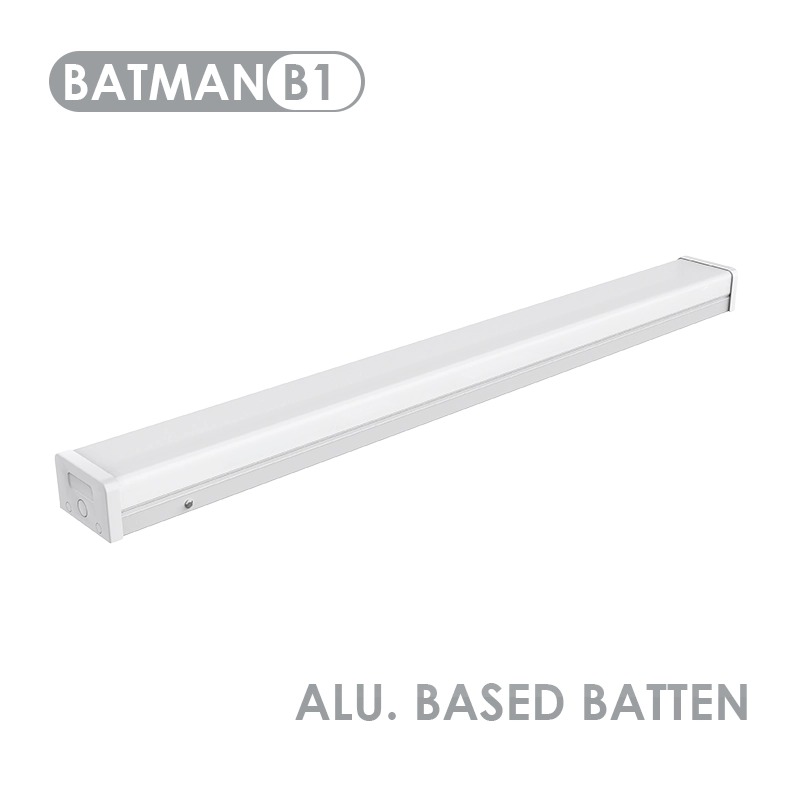
3. Batman B1-CCT – Flexible Aesthetics
The Batman series is known for its “No-Shadow” diffused lens. It is the architectural choice for school lobbies and lecture halls. Its Tri-CCT switch (3000K/4000K/5700K) allows facility managers to adjust the mood of a space post-installation, supporting different activities from evening community events to morning assemblies.
|
Model |
Max Efficacy |
Impact Protection |
Primary Feature |
|---|---|---|---|
|
Trilamp A3 |
185 lm/W |
IK08 |
Patented Seamless Splice |
|
Trilamp A4 |
165 lm/W |
IK10 |
Integrated High-Output Reflector |
|
Batman B1 |
160 lm/W |
IP66 |
Visual Comfort “No-Shadow” Lens |
Engineering Choice: Micro-Prismatic Optics vs. Louvers
To reach low-glare (UGR<19) levels, manufacturers utilize different optical strategies:
-
Micro-Prismatic Diffusers: These use thousands of tiny pyramids to bend the light, directing it downward rather than sideways into the eyes. This is the most popular choice for modern linear lighting trends as it maintains a sleek, clean look.
-
Louvers and Baffles: Physical “grids” that block light at wide angles. While effective, they often trap dust and reduce the overall efficiency (lm/W) of the fixture.
“A classroom without proper glare control is a classroom where students have to work twice as hard to process visual information. Low-glare design is an investment in human capital.”
ROI and Financial Benefits for Schools
Upgrading to high-efficacy LED systems is one of the fastest ways for a school district to reclaim their budget. A typical classroom switching from legacy T8 fluorescent tubes to 185 lm/W LED linear lights can see energy savings of up to 60%. When you add Daylight Harvesting—a technology where sensors dim the lights when the sun is shining through the windows—the savings can skyrocket to 80% per classroom.
Lifecycle Savings and Maintenance
In schools, maintenance is a major logistical headache. Replacing a burnt-out bulb in a high-ceiling library requires a lift and after-hours labor. Professional LED linear high bays and battens are rated for 75,000 to 100,000 hours. In a standard school year, this equates to nearly 20 years of maintenance-free operation.
|
Control Type |
Energy Reduction |
Implementation Cost |
|---|---|---|
|
Simple On/Off |
Baseline |
Low |
|
Dimmable (0-10V) |
10 – 15% |
Medium |
|
Occupancy Sensing |
25 – 40% |
Medium |
|
Daylight Harvesting |
50 – 70% |
High (Max ROI) |
Practical Implementation and Checklist
For school facility managers, the installation process should follow a strict technical checklist to ensure compliance:
-
Photometric Study: Conduct a DIALux simulation to verify that the UGR is truly < 19 at all desk heights.
-
Flicker Audit: Ensure the drivers are certified “Flicker-Free” (flicker index < 0.01).
-
Emergency Compliance: Integrate 3-hour battery backup modules into at least 20% of the linear runs to meet safety codes for escape routes.
-
Mounting Alignment: Ensure linear runs are perfectly level. Over a 20-meter run, even a 1-degree tilt creates visual “kinks” that ruin the architectural aesthetic.
Conclusion: Illuminating the Path to Student Success
The move toward low-glare (UGR<19) linear lights is more than just a renovation—it is a commitment to the health and productivity of the next generation. By selecting high-efficacy fixtures like the Trilamp A3 and A4, and integrating smart, daylight-responsive controls, schools can significantly reduce their environmental footprint while providing a superior learning environment. In 2026, the intersection of efficiency and visual comfort is the benchmark for all educational infrastructure. Prioritize high-quality lighting today to ensure your students have the clarity they need to succeed tomorrow.
FAQ
What is the difference between UGR<19 and standard lighting?
Standard commercial lighting often has a UGR between 22 and 25. UGR<19 lighting is engineered with specific optics (micro-prisms or lenses) that restrict light emission at wide angles, preventing the direct glare that causes eye strain.
Does low-glare mean the lights are dimmer?
No. Low-glare fixtures can be just as bright (lumen output) as standard lights. The difference is how the light is directed. It focuses the lumens on the desks while “hiding” the bright LED chips from your side vision.
Are these lights compatible with DALI 2.0?
Yes. Fanxstar’s professional series are fully compatible with DALI and DALI-2 systems, allowing for sophisticated building automation and individual classroom control.
How long does an LED linear light last in a school?
With high-quality aluminum heat sinks, these fixtures typically last 75,000 to 100,000 hours. In a school environment operating 10 hours a day, this translates to over 25 years of service.
Is suspension or surface mounting better for classrooms?
Suspension is generally preferred for high ceilings as it brings the light closer to the students’ desks, allowing for lower wattage fixtures to be used while maintaining required lux levels.