In the global drive toward industrial decarbonization, lighting is the “low-hanging fruit.” While high-efficacy LEDs are now standard, the true revolution in 2026 is the integration of high-precision sensing technology. Standard energy saving LED battens are being replaced by “intelligent nodes” that utilize microwave Doppler shift and dual-photosensor (Dual-PD) technology. These smart fixtures ensure that facilities only pay for the light they actually use, resulting in an immediate reduction of lighting-related energy consumption by 60% to 80%.
For a standard 100,000 sq. ft. warehouse, switching from legacy “always-on” T8 fluorescent tubes to 185 lm/W motion sensor LED battens can yield an annual saving exceeding $200,000. This guide provides a technical overview of the top 5 Fanxstar solutions, analyzing how microwave sensitivity, hold-time logic, and RF grouping create a future-proof industrial lighting grid.
Key Takeaways
-
Microwave vs. PIR: For industrial heights (>5m), microwave sensors are preferred due to their superior range and ability to detect motion through lightweight obstacles.
-
Daylight Harvesting: Fixtures with integrated photocells can save an additional 20% by dimming LEDs when natural sunlight is sufficient.
-
Step-Dimming (Corridor Mode): Avoid total darkness for safety; program sensors to dim to 10-20% standby levels rather than turning completely off.
-
Thermal Architecture: High-efficacy LEDs produce less heat, but integrated sensors require specialized housing to prevent signal interference from the LED driver.
-
ROI Benchmark: In 24/7 industrial environments, the payback period for sensor-integrated linear lighting is typically 12 to 18 months.
The Science of Intelligent Sensing
Microwave Sensor Physics
Unlike Passive Infrared (PIR) sensors, which detect changes in heat signatures, Microwave Motion Sensors emit low-power 5.8GHz electromagnetic waves. When these waves hit a moving object, they reflect back at a different frequency—a phenomenon known as the Doppler Effect. In high-traffic corridors and high-bay warehouses, this is critical because it allows the sensor to “see” around corners and detect subtle movements (like a person picking a box) that PIR sensors often miss. Fanxstar’s motion sensor lighting utilizes “managed flooding” logic to prevent false triggers from vibrating HVAC vents.
Daylight Harvesting and Photocell Calibration
Daylight harvesting is the practice of adjusting artificial light output in real-time based on available natural light. Research published in scientific journals on lighting technology suggests that this alone can reduce daytime energy consumption by up to 30%. Modern Fanxstar fixtures use “Dual-PD” (Dual Photodiode) technology to distinguish between sunlight and the lamp’s own light, preventing “flicker-loops” where the sensor dims the light, detects darkness, and then turns the light back up.
|
Sensor Logic |
Technical Threshold |
Operational Impact |
|---|---|---|
|
Hold-Time |
Adjustable (5s to 30min) |
Prevents nuisance switching |
|
Stand-by Dimming |
10%, 20%, 30%, or 50% |
Ensures safe ambient visibility |
|
Daylight Threshold |
2 Lux to 500 Lux |
Maximizes solar gain savings |
|
Detection Range |
Up to 15m Radius |
Covers large industrial footprints |
Top 5 Energy Saving LED Battens for 2026
The 2026 market is led by fixtures that prioritize “Fit and Forget” reliability with high-spec sensing modules. Below are the engineering-grade series currently dominating large industrial rollouts.
1. Trilamp A3 High Lumens – The Efficiency Benchmark
The Trilamp A3 is the industry leader for retail and logistics hubs. Reaching a world-record efficacy of up to 185 lm/W, it converts nearly all electrical energy into visible light. Its patented zero-gap splicing technology allows it to be linked into continuous lines of light without shadows. Combined with an integrated DALI 2.0 microwave sensor, it is the most sophisticated energy-management node in the Fanxstar catalog.
2. Trilamp A4 High Efficiency – The Industrial Workhorse
For facilities where durability is as important as efficiency, the Trilamp A4 provides an IK10 impact rating. It features an integrated high-efficiency reflector that boosts the “effective lumens” reaching the floor. It utilizes Dual-PD microwave sensors, making it ideal for factories with skylights that require consistent daylight harvesting performance.
3. Trilamp A9 Versatile Sensing – High-Altitude Specialist
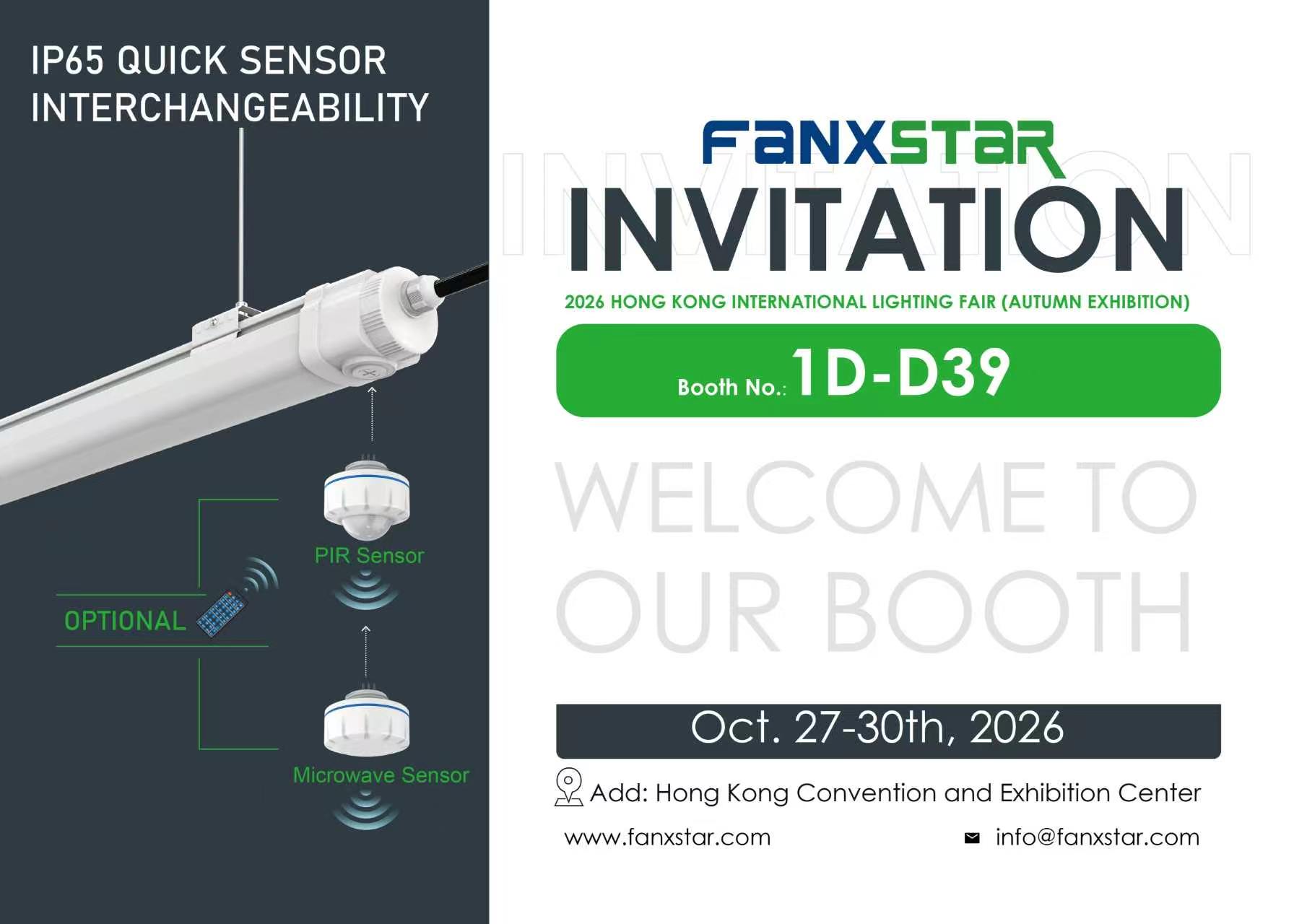
The A9 series is designed for warehouses with mounting heights up to 15 meters. It supports an external high-altitude PIR sensor module that plugs directly into the fixture end-cap. This modularity allows facility managers to choose the best sensor for the specific ceiling height of each aisle, ensuring 100% detection accuracy.
4. Trilamp A18 Integrated Design – The Rapid Retrofit
The A18 is a “3-in-1” integrated solution that combines the LED driver, emergency backup battery, and microwave sensor into one compact chassis. This design reduces installation labor by 50% compared to systems requiring separate sensor modules. Its ultra-narrow antenna prevents the “shadow-stripe” effect on the light lens common in integrated fixtures.
5. Batman B2 Industrial Series – High-Heat Performance
Designed for environments like foundries or parking garages, the Batman B2 utilizes an AL6063 aluminum chassis for maximum heat dissipation. This protects the sensitive sensor electronics from thermal degradation, allowing the fixture to operate at Ta up to 55’C. It supports series connections up to 60 meters, making it the choice for long outdoor corridors and canopies.
|
Model |
Max Efficacy |
Sensor Type |
Best Application |
|---|---|---|---|
|
Trilamp A3 |
185 lm/W |
5.8GHz Microwave |
Logistics / Supermarkets |
|
Trilamp A4 |
165 lm/W |
Dual-PD Integrated |
Manufacturing / Workshops |
|
Trilamp A9 |
160 lm/W |
Modular PIR/Microwave |
High-Bay Distribution Centers |
|
Trilamp A18 |
165 lm/W |
3-in-1 Compact |
Corridors / Stairwells |
|
Batman B2 |
160 lm/W |
Aluminum-Backed MW |
Parking Garages / Foundries |
Installation ROI: The Economics of Smart Controls
While the initial cost of a sensor-controlled LED batten is 15-20% higher than a standard “on/off” fixture, the ROI is achieved through three primary channels:
-
Reduced Burn Hours: Sensors reduce the average operational time of a fixture from 24 hours to 8-10 hours in many warehouse aisles.
-
Extended Lifespan: Since the fixture is off or dimmed for 60% of the day, the LEDs and drivers last 2-3 times longer, delaying future replacement cycles.
-
Reduced HVAC Load: In climate-controlled facilities, every watt of lighting energy saved also reduces the heat load, lowering air conditioning costs.
“An always-on light in an empty warehouse isn’t an asset; it’s a constant leak in your profit margin. Sensors are the only way to plug that leak.”
Practical Installation and Maintenance Tips
-
RF Grouping: Use 2.4GHz RF grouping to create “lighting paths.” When a forklift triggers the first sensor in an aisle, it can signal the next five fixtures to turn on ahead of the driver.
-
Avoid Signal Shielding: Never mount microwave sensor fixtures directly against thick metal beams, as this can block the signal and create “blind spots.”
-
Calibration Remotes: Utilize infrared remote controllers (e.g., MR003) to adjust sensor sensitivity from the ground. This eliminates the need for expensive lift-hire every time you want to change a hold-time setting.
-
Through-Wiring: Use fixtures with internal trunking to reduce the number of electrical home-runs by 80%, providing a massive labor-saving advantage.
|
Issue |
Probable Cause |
Technical Solution |
|---|---|---|
|
False Triggering |
HVAC/Fan movement |
Reduce sensitivity or switch to PIR |
|
Lights won’t turn off |
“Latching” interference |
Check for vibrating metallic surfaces |
|
Dimming at far end |
Voltage Drop |
Increase wire gauge or use 277V feed |
|
Sensor Lag |
Obstruction shielding |
Relocate fixture away from beams |
Conclusion: Designing a Responsive Infrastructure
The transition to energy saving LED battens with motion sensors is the most critical step any facility manager can take toward operational excellence. By selecting high-efficacy models like the Trilamp A3 and A4, and utilizing advanced microwave and Dual-PD technology, industries can achieve a safer, more productive, and environmentally responsible workspace. In 2026, static lighting is a liability. Intelligent, responsive lighting infrastructure is the new benchmark for the modern world. Prioritize high-quality sensor systems today to ensure your facility remains profitable and compliant for the next decade.
FAQ
Can microwave sensors see through walls?
Yes, microwave signals can penetrate thin drywall, glass, and wood. This is useful for “concealed” mounting but requires careful sensitivity calibration to prevent the lights from being triggered by people in an adjacent room.
What is ‘Step-Dimming’ or ‘Corridor Mode’?
Instead of turning the light completely off, the fixture dims to a safety level (e.g., 10% or 20%) when no motion is detected. This ensures that corridors always have a base level of visibility for security cameras and pedestrian safety.
How long do these sensors last?
The sensors used in professional Fanxstar fixtures are rated for 100,000+ switching cycles. Since there are no moving parts, the sensors typically outlast the LED driver itself.
Do LED battens need a neutral wire for the sensor?
Yes. All integrated motion sensors require a neutral wire to power the internal circuitry. Our 3-in-1 integrated units handle this internally, so you only need to provide standard power to the input terminal.
Is there a height limit for these sensors?
Standard integrated sensors work best up to 6 meters. For ceilings higher than 8-10 meters, specialized “High-Bay” sensor modules (like those in the Trilamp A9 series) are required to ensure reliable detection from the ceiling to the floor.