A breather valve, also called a pressure equalization vent, can help sealed LED lighting reduce condensation risk by allowing pressure to balance while limiting liquid water and particles from entering the enclosure. It is most useful when internal pressure cycling pulls moist air through weak paths or when temperature swings create repeated breathing inside a sealed fixture. It is not a replacement for IP design, gasket compression, cable-entry sealing, thermal control, or correct installation.
According to the National Weather Service dew point explainer, dew point is a direct measure of moisture in the air. That matters because condensation appears when moist air meets a cold enough surface. In LED lighting, the surface may be the lens, aluminum body, driver compartment, screw boss, or cable entry. According to Gore protective vent information, protective vents are used for pressure equalization and enclosure protection, but the vent has to be selected and positioned as part of the complete fixture design.
Key Takeaways
- A breather valve helps when the main problem is pressure cycling in a sealed LED enclosure, not when the fixture has a weak gasket or poor cable gland.
- Condensation control depends on dew point, temperature swing, enclosure volume, vent location, gasket path, cable entry, and service behavior.
- The buyer should ask whether the breather valve is included in the IP evidence for the finished fixture version.
- For Fanxstar weatherproof or vapor tight lighting, a breather valve should be specified only after the site exposure and sample test boundary are clear.
What a Breather Valve Actually Does
It equalizes pressure, not quality
When a sealed luminaire heats up, the air inside expands. When it cools, the air contracts. Repeated temperature cycles can create pressure differences that stress gaskets, lens joints, cable glands, and seals. A breather valve can provide a controlled pressure equalization path. The goal is to reduce the uncontrolled breathing that otherwise happens through weak joints, especially in outdoor, canopy, tunnel, parking, cold storage, and washdown-adjacent applications.
According to IEC IP rating guidance, IP ratings describe protection against solids and liquids by separate numerals. A breather valve therefore has to be reviewed inside the final IP design. If the fixture is advertised as IP65, IP66, or IP67, the buyer should ask whether the tested version included the vent, the same cable entry, the same gasket, and the same orientation that production will ship.
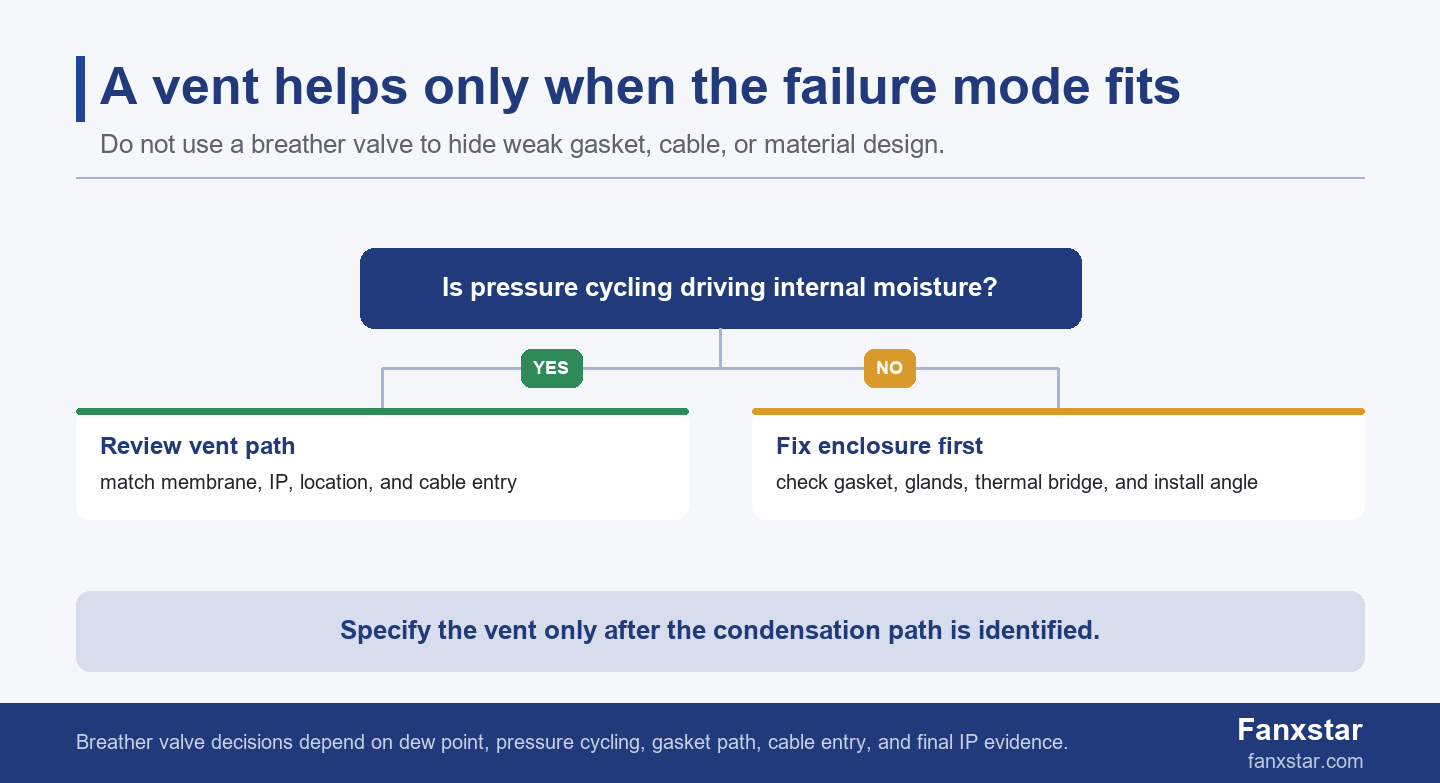
A vent does not make a weak fixture waterproof. If moisture enters because a lens is warped, a screw is loose, a gasket has poor compression, or a cable gland is undersized, adding a breather valve may simply give the buyer a false sense of safety. The first diagnostic step is to decide whether moisture is being pulled through pressure cycling or entering through a direct leak path.
Condensation is a system problem
Condensation inside an LED fixture is usually a result of 3 variables meeting at the same time: moist air, a temperature drop, and a surface below the dew point. A fixture can pass a short water test and still show fogging if it traps moist air during assembly, is installed during a rainy period, cycles from warm operation to cold night air, or is opened for maintenance without proper resealing.
According to the National Weather Service dew point explainer, dew point gives a more direct moisture reading than relative humidity alone. That explains why two sites with the same 70 percent relative humidity can behave differently if temperature changes. Lighting buyers do not need to become meteorologists, but they should ask whether the fixture design accounts for the site’s daily temperature swing and enclosed air volume.
| Question | Why it matters | Buyer action |
|---|---|---|
| Is moisture caused by pressure cycling? | Vents help when air volume expands and contracts. | Review vent membrane, placement, and IP scope. |
| Is water entering through a gasket? | A vent cannot fix a poor seal. | Check compression, clips, torque, and lens fit. |
| Is the cable entry weak? | Moisture often follows the cable route. | Specify gland, strain relief, and drip loop. |
| Is the product opened in service? | Reclosing can destroy the original seal. | Define service access and reinspection steps. |
When a Breather Valve Makes Sense for LED Lighting
Use it for repeated thermal breathing
A breather valve is most useful in outdoor LED luminaires that experience repeated heat-up and cool-down cycles. Examples include parking garage lights near open air, canopy lights exposed to hot sun and cool rain, tunnel or service corridor fixtures with airflow changes, and sealed weatherproof lights installed in humid industrial sites. In these cases, the vent can reduce stress on the gasket path by giving the enclosure a designed breathing route.
According to NEMA enclosure type guidance, enclosure type language is scope-specific and should be checked rather than assumed. The same discipline applies to breather valves. A buyer should not ask for a vent generically. The RFQ should state the enclosure rating, mounting orientation, cable entry, service access, and whether the vent must face downward, sideways, or away from direct spray.
Vent placement is not decorative. A vent placed where water can sit, where dust can accumulate, or where a pressure spray can hit directly may create a new risk. A vent placed where internal air can actually exchange pressure without being blocked by potting, insulation, or a tight driver compartment is more useful. The supplier should explain the location in the drawing, not only on a product photo.
Do not use it to compensate for the wrong fixture
If the fixture is in a heavy washdown area, a direct water-jet zone, or a chemical cleaning environment, the buyer should first decide whether the basic platform is correct. A vent can be part of a washdown-capable design, but it cannot rescue a fixture whose lens, clips, gasket, or cable gland were designed for a dry warehouse. In a sealed LED system, pressure equalization is one control, not the whole strategy.
According to DLC solid-state lighting technical requirements, commercial LED qualification depends on defined product categories and reported performance evidence. For vented fixtures, the buyer should extend that idea to mechanical evidence: the same product version should support the photometric data, electrical file, IP file, vent detail, and bill of materials. If the vent is added after the original test, evidence should be reviewed again.
The most suspicious claim is a supplier saying that the breather valve solves condensation without discussing dew point, enclosure volume, heat cycle, gasket design, or cable entry. That answer may be fine for a catalog accessory, but it is weak for B2B procurement. A buyer should expect a more complete explanation when the project involves outdoor safety, refrigerated areas, food processing, or long maintenance intervals.
How to Specify a Breather Valve in an RFQ
Ask for the vented version of the product
The RFQ should ask whether the breather valve is standard, optional, or custom. It should identify the vent material, membrane type if available, location, IP scope, installation orientation, and cleaning boundary. If the fixture has multiple lengths or wattages, ask whether every version uses the same vent strategy. A 20W fixture and a 60W fixture may have different heat cycles and internal air volume.
According to International Trade Administration import documentation guidance, import documentation can include several records for one shipment, including invoices, bills of lading, packing lists, and certificates of origin. LED buyers should use the same consistency rule for the vented fixture. The drawing, BOM, test report, quotation, production sample, and shipment documents should describe the same vented product version.
According to International Trade Administration special document guidance, some products may need additional certificates or documents tied to standards, safety, or special requirements. A vented LED fixture should be handled the same way when a project needs wet-location, IP, or market approval evidence: the vent cannot be an undocumented afterthought added after sample approval.
According to FEMP purchasing guidance for commercial and industrial LED luminaires, LED luminaire purchasing should focus on finished product categories and evidence. That is a useful insight for condensation control because the vent, enclosure, driver cavity, cable entry, and gasket are part of one finished luminaire. A buyer should not approve a vented option unless the complete version is documented.
A useful sentence for the RFQ is: quote the sealed LED fixture with pressure equalization vent included, identify vent location and orientation, confirm whether the vented sample is covered by the IP evidence, and state whether the cable gland, gasket, and driver compartment are unchanged from the tested version. This gives the supplier a clear boundary and prevents a vent from becoming an undefined add-on.
Build a 24-hour condensation screen into sample review
A simple sample screen can reveal obvious issues before the buyer commits to volume. Inspect the new sample, power it for several hours, allow it to cool in a humid condition, and check whether fogging, water droplets, or residue appear inside the lens. This is not a substitute for lab testing, but it is a practical 24-hour check that often exposes poor assembly, trapped moisture, or a weak cable route.
The buyer should photograph the lens, gasket, vent location, cable entry, and inside surface if the sample can be opened without destroying the seal. The supplier should then explain what is normal and what indicates failure. Some brief fogging can disappear when the fixture warms, but persistent droplets, pooling water, or visible residue require investigation before approval.
Where Fanxstar Fits Vented LED Fixture Design
Treat the vent as a platform decision
Fanxstar projects that may involve breather valves usually start from weatherproof LED lighting platforms, vapor tight LED light fixtures, IP65 and IP66 waterproof LED lights, or aluminum weatherproof LED luminaires. The buyer should explain whether the site suffers from fogging after temperature swings, direct leakage after rain, or moisture after cleaning. Those are different problems.
If pressure cycling is the likely cause, Fanxstar can evaluate a vented option, vent location, cable gland, and sample validation plan. If direct water entry is the likely cause, the better first step may be gasket, clip, housing, gland, or installation changes. A vent should not be the default answer until the failure path is clear.
For nonstandard fixture length, wiring, sensor integration, emergency function, or housing changes, Fanxstar custom LED lighting ODM service can define a sample boundary before tooling or batch release. The buyer should send target IP rating, installation orientation, ambient range, cleaning method, target market, and any photographs of existing condensation failures.
Keep service behavior in the design
Many condensation problems begin after the first service event. A maintenance worker opens a fixture, changes a driver, pinches a gasket, replaces a screw, or forgets a gland detail. The fixture may have been well designed, but the reclosed product no longer matches the tested condition. A vented design still needs service instructions and a way to confirm the enclosure is properly closed.
For B2B buyers, the practical release package should include a drawing showing vent and gland location, an IP evidence note, gasket and closure details, installation orientation, and service cautions. When that package is complete, the buyer can compare vented and non-vented options with a clear understanding of risk, price, and maintenance burden.
FAQ
Does a breather valve make an LED light waterproof?
No. A breather valve can help pressure equalization and condensation control, but the fixture still needs a correct gasket, cable gland, housing, lens, closure force, material selection, and IP evidence for the final product version.
When should buyers specify a breather valve?
Specify a breather valve when condensation is linked to pressure cycling, daily temperature swing, or repeated enclosure breathing. If the problem is direct water entry through a gasket, cable gland, cracked lens, or bad service closure, fix those issues first.
Can a breather valve reduce fogging inside LED lights?
It can reduce fogging in the right design because it helps balance pressure and reduce uncontrolled air movement through weak paths. It cannot remove all condensation risk if moist air is trapped, the dew point is reached, or water enters through a leak.
What evidence should a buyer request for a vented LED fixture?
Ask for a drawing showing vent location, IP evidence that includes the vented version, cable gland details, gasket and closure design, installation orientation, service instructions, and confirmation that the production BOM matches the tested sample.