A flicker-free driver is valuable only when the claim survives the real operating condition: the selected LED load, dimming method, standby level, input voltage, emergency mode, and shipped driver version. For buyers, the goal is not to ask for a comforting phrase. It is to ask for evidence that the luminaire controls temporal light modulation under the conditions users will actually experience.
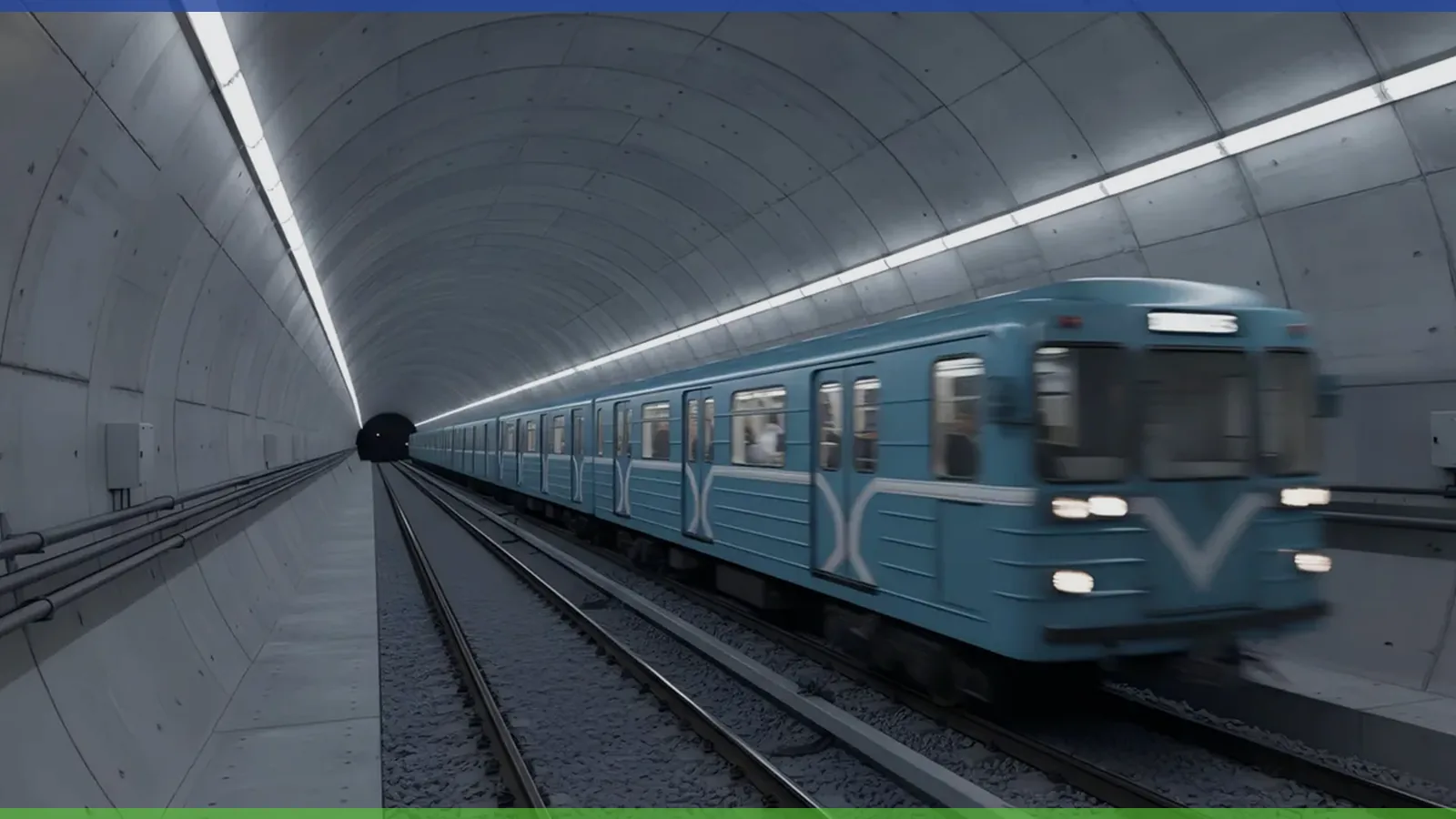
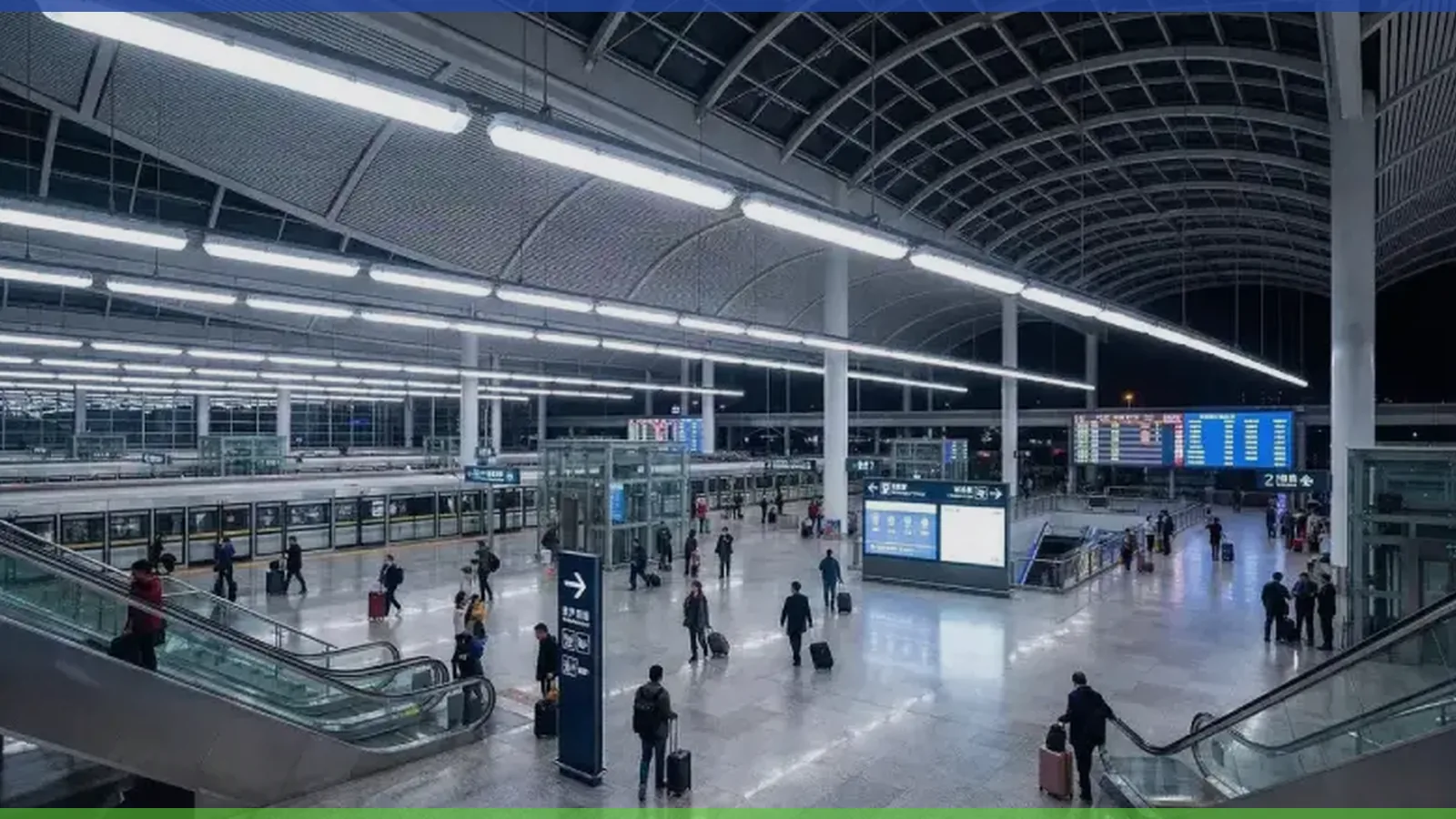
This matters in offices, classrooms, healthcare-adjacent spaces, retail, factories, warehouses, parking garages, tunnels, and data-center service corridors where moving tasks, cameras, rotating equipment, or visual comfort concerns can make poor driver behavior more visible.
Key Takeaways
- “Flicker-free” should be supported by measured driver-and-luminaire evidence, not only by a driver brand or marketing claim.
- PstLM and SVM are useful metrics, but the test condition must match the final driver, LED load, dimming level, and market requirement.
- Low flicker at full output does not automatically prove clean behavior at 10%, standby dimming, emergency mode, or with a different control system.
- For ODM projects, freeze the driver, load, and dimming sequence before releasing a flicker-sensitive sample.
What a Flicker-Free Driver Claim Should Mean
The driver controls the current waveform the LED follows
LEDs respond quickly to current changes. That responsiveness is useful for control, but it also means poor driver design or incompatible dimming can create temporal light modulation. A DOE-hosted review of flicker and temporal light modulation explains that direct flicker effects at lower modulation frequencies and stroboscopic effects at higher frequencies are better understood than some other temporal artifacts, while also noting that LED products can exhibit a wide range of modulation behaviors. The buyer takeaway is that flicker risk is a system behavior, not a loose accessory decision.
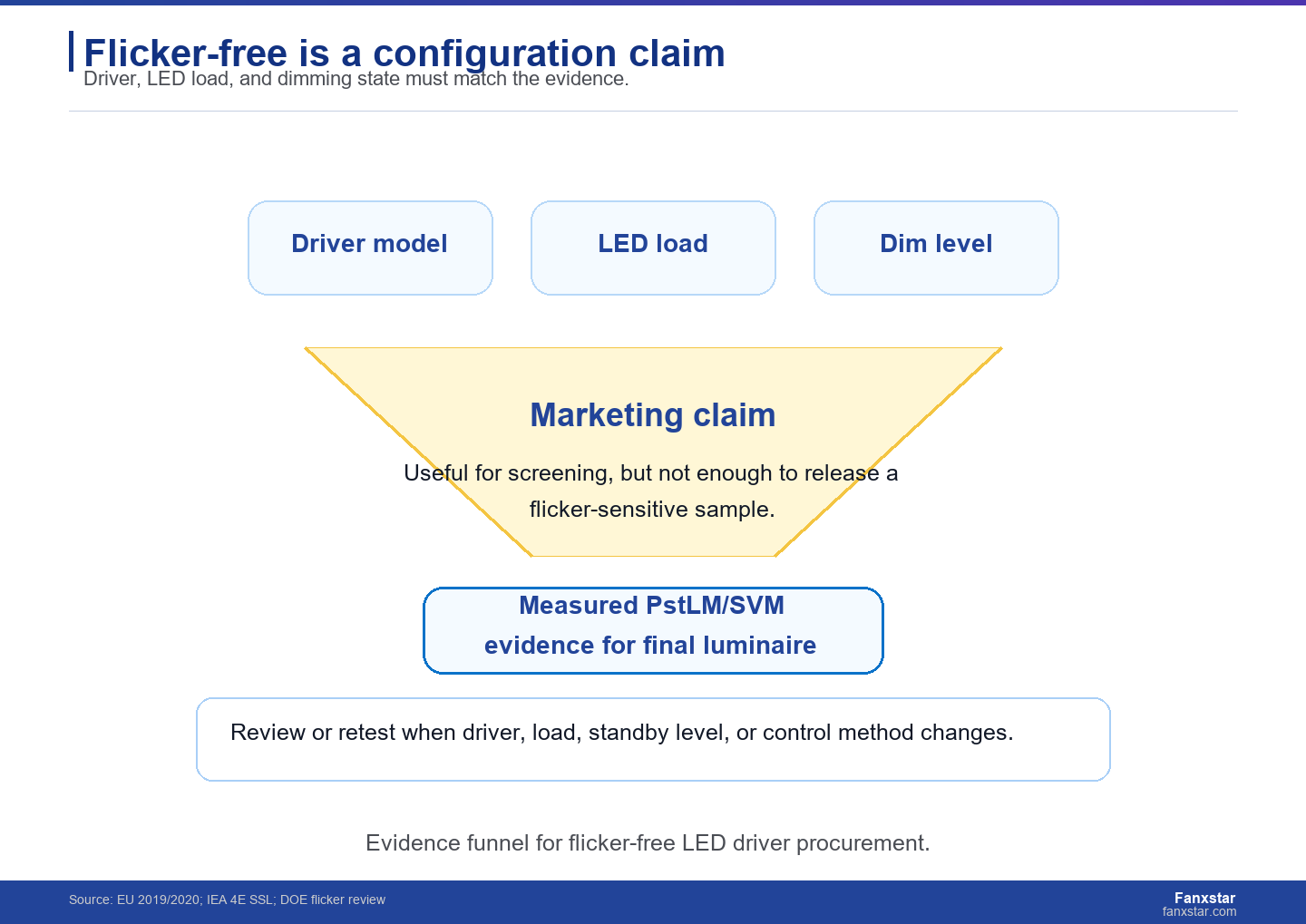
A driver that performs well with one LED board may not behave the same way with another load. A luminaire that looks stable at full output may show visible or measurable modulation at low dimming levels. A 0-10 V control curve, microwave sensor standby setting, emergency driver, or driver substitution can change the outcome. That is why “flicker-free” should be treated as a release claim tied to a specific configuration.
Health and safety language should be precise
Flicker discussions often jump quickly to health claims. Buyers should be careful. Poor temporal light modulation can affect visual comfort, task perception, and moving-object visibility, and some people may be more sensitive than others. But a procurement article should not promise medical outcomes. The stronger and safer claim is that well-controlled driver behavior reduces avoidable temporal-light-artifact risk and gives the buyer clearer evidence for visually demanding spaces.
CIE material on flicker and stroboscopic effect discusses temporal light artifacts and the use of metrics for evaluating lighting products. That vocabulary helps buyers avoid a common mistake: one generic flicker percentage cannot answer every comfort, motion, or safety concern.
PstLM, SVM, and What Buyers Should Ask For
The EU framework made the evidence conversation more concrete
Commission Regulation (EU) 2019/2020 includes ecodesign requirements for light sources and separate control gears and defines metrics including PstLM for flicker and SVM for stroboscopic effect. The EUR-Lex summary page describes the regulation’s role in ecodesign and energy labelling for light sources and separate control gear. For buyers, the key point is that flicker and stroboscopic effect are no longer only subjective complaints; they can be linked to declared values and test conditions.
The common threshold language is PstLM at or below 1.0 and SVM at or below 0.4 under the relevant condition. That does not mean every global project must copy EU documentation exactly, and it does not mean the values alone describe every visual risk. It means buyers now have a clearer way to ask suppliers for measured evidence rather than accepting vague “no flicker” statements.
Metrics are only as useful as the test condition
IEA 4E SSL library includes recent work on temporal light modulation metrics, including PstLM and SVM. IEA 4E research on PstLM and SVM measurement conditions highlights that sampling rate, filter setting, and measurement duration can affect results for measured waveforms. The procurement lesson is direct: a number without the test method, driver configuration, and operating point is not enough.
Ask which driver was tested, which LED load was connected, what input voltage and frequency were used, whether the test covered dimming or standby levels, whether the luminaire or only the driver was tested, and whether the report matches the version being shipped. If the supplier changes the driver after the report, the buyer should request review or retesting.
Where Flicker Risk Appears in Real Lighting Projects
Dimming and standby modes are common weak points
Many luminaires behave best at full output. Problems appear when the same fixture is dimmed to 10%, placed in a sensor standby mode, connected to a different control signal, or used with a control system that was not part of the sample test. That matters for warehouses, parking garages, stairwells, backrooms, tunnels, and service corridors where fixtures may spend long periods at low output and then return to full output when movement is detected.
If a buyer is specifying motion sensors or industrial controls, connect the flicker evidence to the control sequence. Fanxstar’s LED lighting controls guide is relevant because the dimming percentage, hold time, standby level, and driver interface all influence the behavior the user sees. A sensor-ready fixture should not be approved until the driver and standby behavior are verified together.
Moving tasks make stroboscopic risk more visible
Stroboscopic effects matter when objects move or rotate: fans, conveyor belts, machine parts, wheels, tools, hands, and vehicles. A fixture can feel acceptable in a static showroom but become problematic in a manufacturing aisle or maintenance area. That is why SVM evidence belongs in projects where movement and rotating equipment are part of the task environment.
Cameras add another layer. Security cameras, machine-vision equipment, mobile-phone inspection videos, and workplace monitoring can reveal modulation that occupants do not describe clearly. A lighting buyer should ask whether the site has camera-sensitive zones and whether the driver configuration has been checked at the frame rates or operating modes that matter to the project.
How to Specify Flicker-Free Drivers in an RFQ
Ask for a driver-load-control evidence package
A strong RFQ sentence is: “Provide PstLM/SVM or equivalent temporal light modulation evidence for the final luminaire configuration, including driver model, LED load, input condition, dimming or standby levels, and any emergency or sensor mode used in the project.” This wording prevents the supplier from sending a generic driver brochure that may not match the product.
The evidence package should include driver model, rated output range, LED load range, dimming interface, measured operating points, test method, report date, and change-control rule. If the project uses a custom CCT, higher-power board, emergency pack, sensor, or special dimming level, ask whether the previous evidence still applies. If it does not, the sample should be retested or at least reviewed by engineering before release.
Separate comfort-sensitive zones from normal utility zones
Not every area needs the same flicker standard. A short-use storage room may not justify the same documentation as a classroom, healthcare-adjacent room, inspection bench, control room, retail display, tunnel maintenance zone, or production line with moving equipment. The buyer should classify zones by visual task, exposure duration, movement, camera use, and occupant sensitivity.
The European Commission light-sources product page is useful for understanding how the EU frames light-source requirements and product information. For multi-market buyers, the main action is to decide which markets and zones require stricter evidence before sampling. A supplier can then choose the right driver platform instead of discovering the requirement after tooling or mass production.
Evidence Checkpoints Before Sample Release
Check full output and the lowest expected dimming level
A flicker-sensitive sample should not be checked only at full output. The buyer should ask for evidence at full output, the lowest normal dimming level, the intended standby level, and any transition state that users will see repeatedly. In a parking garage, a luminaire may spend hours at 20% standby and switch to full output when motion is detected. In a warehouse aisle, the fixture may move between standby and task output many times per shift. In those cases, the low-output condition is not an edge case; it is part of normal operation.
The same logic applies to control compatibility. A 0-10 V driver, DALI driver, sensor-integrated driver, emergency driver, and simple non-dimming driver can all create different evidence needs. The buyer should freeze the control architecture before testing. If the project later changes from non-dimming to standby dimming, or swaps one driver brand for another, the earlier flicker evidence should be reviewed again.
Connect flicker evidence to the buyer’s actual visual task
Flicker risk is not equally important in every room. A corridor with short exposure, a backroom with occasional access, a classroom, an inspection bench, and a machine area with moving parts all deserve different levels of review. The RFQ should state the task environment: static work, moving work, rotating equipment, camera use, long occupancy, or public comfort. That context helps the supplier decide whether the evidence package should emphasize PstLM, SVM, dimming behavior, camera checks, or a combination.
For OEM and ODM projects, the most useful evidence is not a perfect-looking brochure value. It is a controlled record that links the driver, board, fixture, dimming state, and final order. That record can be simple, but it must be specific. Without configuration-specific evidence, the buyer may approve a sample that looked acceptable on a bench but behaves differently in the installed zone.
Also ask how component substitutions are handled. Driver supply can change during long projects, and a substitute driver may still meet wattage and voltage requirements while behaving differently under dimming. The purchase agreement should require notification when the driver, LED board, control interface, or emergency module changes. A low-flicker claim is only durable when change control protects it after the first sample.
For camera-sensitive or machine-area projects, add a small field check after installation. The check can include visual inspection at the lowest dimming level, a short video review in the relevant camera mode, and confirmation that standby transitions do not create distracting pulses. This field check does not replace laboratory metrics, but it catches integration problems that appear only after mounting height, control wiring, and actual site behavior are present.
Fanxstar Application Fit
Fanxstar’s specialty LED lighting work often involves driver, sensor, emergency, CCT, optics, housing, and wiring choices that can affect flicker behavior. Relevant starting points include custom LED lighting design options, motion sensor lights, linear lighting platforms, and the existing Fanxstar article on EU flicker metrics PstLM and SVM for broader reading across the blog.
For a flicker-sensitive ODM project, send the application, target market, control method, standby levels, expected dimming range, emergency requirement, camera sensitivity, and visual task. Fanxstar can then review whether an existing driver platform is suitable, whether a different dimming architecture is needed, or whether the sample needs a specific flicker evidence check before approval.
FAQ
Does flicker-free mean zero flicker?
Usually no. In procurement, the phrase should mean the product meets a defined temporal-light-modulation requirement under stated test conditions. Ask for measured values and configuration details instead of assuming zero modulation.
Are PstLM and SVM the same thing?
No. PstLM is used for flicker assessment, while SVM is used for stroboscopic visibility. A product can need both values reviewed, especially where moving tasks or rotating equipment are present.
Why can flicker appear only when lights are dimmed?
Dimming changes how the driver regulates current. Some driver and control combinations behave well at full output but show more modulation at low output, standby level, or with certain control signals.
Can a driver report prove the entire luminaire is flicker-free?
Not by itself. The buyer should check whether the report covers the final driver, LED load, input condition, dimming state, and luminaire configuration. A driver-only claim may not describe the shipped product.
What should be frozen before approving a flicker-sensitive sample?
Freeze the driver model, LED load, dimming interface, standby levels, emergency mode, input condition, and report version. If any of those change, request an engineering review or retest before release.