You’ve got a project that needs 1,000 weatherproof LED fixtures. Or 5,000 emergency battens for a multi-site rollout. At those volumes, the difference between a negotiated factory-direct price and an off-the-shelf quote can run into tens of thousands of dollars — sometimes more than the freight cost itself. But how do bulk LED discounts actually work? And what are realistic expectations at each order threshold?
Most B2B buyers know that “buying more saves money” — but very few enter supplier negotiations with a clear picture of the discount tiers, what triggers them, and what other variables beyond unit price can be leveraged. This guide breaks it down from the factory level up.
Key Takeaways
- LED bulk discounts typically range from 5–10% at the 100–499 unit level, scaling to 25–35%+ at 5,000+ units — but certified industrial fixtures have different economics than commodity consumer lighting.
- Unit price is only one lever. Shipping mode, payment terms, amortized tooling costs, and warranty scope often deliver equal or greater savings than the headline discount percentage.
- Negotiating tiered pricing proactively — rather than accepting a single bulk quote — is the difference between a good deal and a great one.
How Bulk Pricing Actually Works at the Factory Level
Fixed Costs, Variable Costs, and Why Volume Matters
To understand what a factory can and cannot discount, you need to understand what makes up a unit’s cost. Every LED fixture order carries two cost types: fixed and variable.
Fixed costs — which include production setup, tooling depreciation, QC line preparation, and administrative overhead — stay roughly the same whether you order 100 units or 10,000. Variable costs, primarily raw materials (LED chips, drivers, aluminum housing, diffusers, wiring) and direct labor, scale with unit count but also benefit from bulk component purchasing. When unit volume increases, those fixed costs are distributed across more units, directly reducing the per-unit cost floor the factory needs to stay profitable.
For a specialized manufacturer like Fanxstar — producing IP66-rated weatherproof fixtures, emergency lighting with LiFePO4 battery management systems, and IK10-impact-rated industrial luminaires — the fixed cost component is higher than for commodity lighting. This means the discount curve is steeper at higher volumes, and the starting unit price reflects genuine engineering investment rather than a margin buffer waiting to be negotiated away.
The Real Discount Thresholds to Know
Industry sourcing guides and manufacturer pricing structures consistently show that meaningful price breaks don’t happen in a linear slide — they occur at specific quantity inflection points. Understanding these thresholds before negotiation allows buyers to optimize order quantities — in some cases, adding 50 units to an order triggers a discount tier that more than offsets the cost of those additional units.
The thresholds that matter most for industrial and commercial LED buyers are: 100 units, 500 units, 1,000 units, and 5,000 units. Each represents a step change in factory economics — and a step change in what you should reasonably expect to pay.
Typical Discount Tiers for LED Lighting Orders
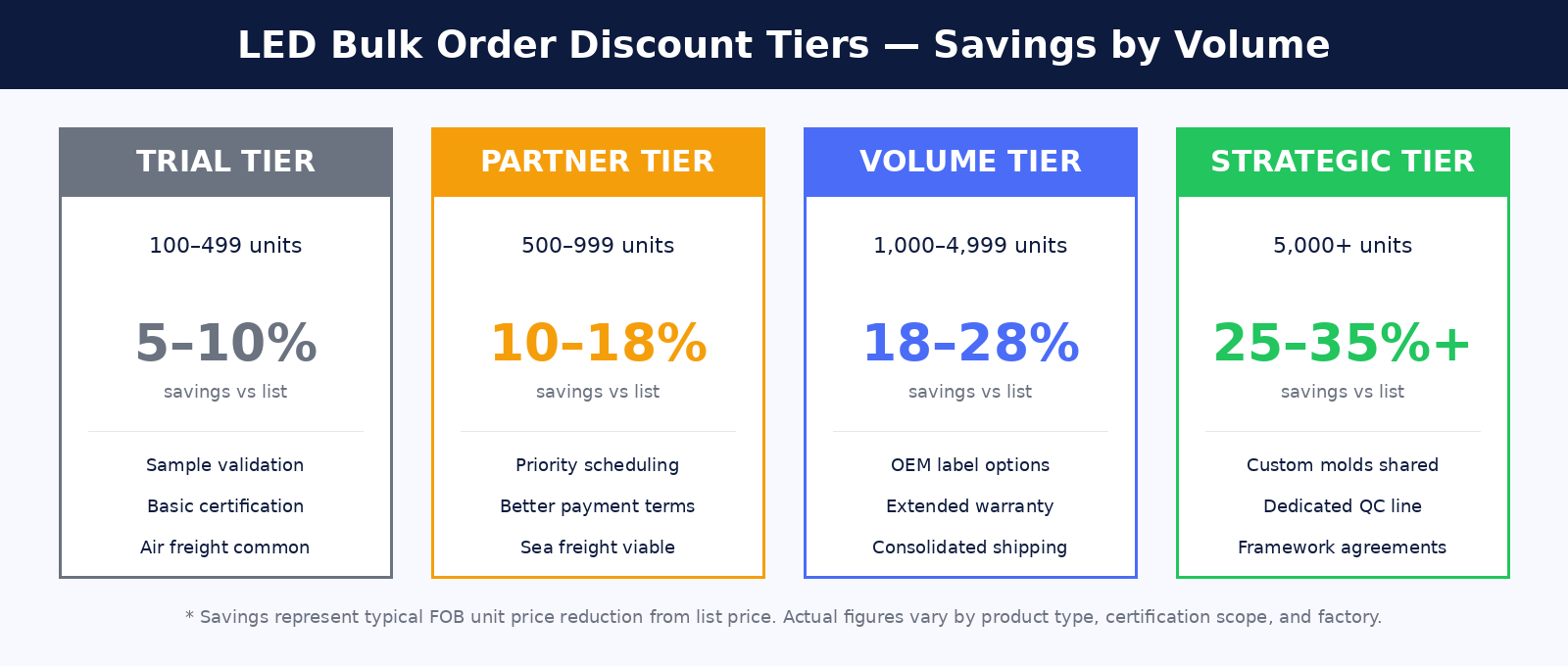
The table below presents typical discount structures for industrial-grade LED fixtures sourced factory-direct from a certified China-based manufacturer. Note that these figures apply to products with international certifications (CE, ENEC, ETL, SAA) and genuine technical specifications — not commodity consumer lighting.
| Tier | Order Volume | Typical Unit Discount vs List | What Typically Unlocks |
|---|---|---|---|
| Trial | 100–499 units | 5–10% | Standard lead times, basic product customization (CCT/wattage selection), air freight viable |
| Partner | 500–999 units | 10–18% | Priority production scheduling, custom labeling/packaging, sea freight cost-effective, extended payment terms negotiable |
| Volume | 1,000–4,999 units | 18–28% | OEM branding, extended warranty upgrades, dedicated QC inspection, favorable Incoterms negotiation (FOB or CIF) |
| Strategic | 5,000+ units | 25–35%+ | Framework agreements, shared tooling amortization, dedicated production slots, multi-shipment scheduling, joint certification support |
Note: Discounts represent typical FOB unit price reduction from standard list price. Industrial-grade products with certification scopes (ENEC, ETL, SAA) have a higher engineering cost base than commodity LED fixtures; percentage savings apply to a higher-quality starting point.
The 100–499 Unit Range (Trial Tier)
At this volume, you’re primarily in product validation mode. A factory will typically offer 5–10% off list price — enough to signal a commercial relationship, but not enough to reflect economies of scale. This is the correct tier for testing product quality, confirming IP ratings against specification, and evaluating post-shipment support responsiveness before committing to larger volumes.
Air freight is still viable at this quantity, but expect to factor its cost carefully. Sampling costs are often refunded or credited against this first bulk order — confirm this in writing during negotiation.
The 500–999 Unit Range (Partner Tier)
This is where the relationship begins to shift. A 500-unit order justifies a dedicated production run for most industrial LED factories, enabling meaningful scheduling priority and the economics to offer custom packaging or private labeling without additional tooling charges. Discounts of 10–18% are achievable, and sea freight becomes cost-effective for this volume, reducing per-unit logistics cost significantly versus air.
Buyers in this tier should begin negotiating payment terms: a 30% deposit with 70% before shipment is industry standard, but established buyers can often negotiate 60-day credit periods with a track record of on-time payment.
The 1,000–4,999 Unit Range (Volume Tier)
At 1,000 units and above, you’ve crossed the threshold where most certified LED manufacturers treat you as a volume partner rather than a transactional buyer. Discounts of 18–28% off list price become achievable, particularly for products in a manufacturer’s core range (such as weatherproof tri-proof fixtures or emergency battens where production lines are already optimized). Businesses at this volume can typically expect significant per-unit discounts ranging from 10–35% compared to individual product acquisitions, with additional opportunities for customized specifications tailored to operational environments.
At this tier, it’s worth explicitly negotiating OEM branding, extended warranty upgrades (from standard to 7- or 10-year coverage for applicable product lines), and a 100% aging test requirement written into the purchase order. For cold storage, hazardous location, or other mission-critical applications, a Dialux lighting simulation or 3D structural rendering pre-production is a reasonable request to confirm performance before mass production begins.
Inline CTA: Industrial projects at 1,000+ units often have specific environmental requirements that standard catalogue products don’t cover. Fanxstar’s engineering team works directly with project developers to specify the right IP rating, CCT, and emergency backup configuration — before production begins. Explore Fanxstar’s OEM/ODM customization process to see how specifications are handled from concept to certified product.
5,000+ Units (Strategic Tier)
At 5,000+ units, the dynamic shifts to a partnership framework. At this scale, buyers can request bulk discounts of 5–10% on top of already-negotiated partner pricing, with FOB or CIF quotes that include favorable Incoterms — and the conversation moves beyond per-unit price to broader terms: framework agreements covering multiple shipments, shared mold amortization for custom form factors, and dedicated production slot reservations for predictable delivery windows.
Distributors operating at this volume should also negotiate joint certification support — where the manufacturer co-funds or contributes documentation toward market-specific certifications like SAA (Australia), ENEC (Europe), or ETL (North America). For a factory with 42 published patents and established certification infrastructure, this is a realistic negotiation point.
Beyond Unit Price: The Hidden Savings in Bulk Orders
Shipping Consolidation and Sea Freight
Unit price discount is the most visible lever, but it’s rarely the largest one at 1,000+ units. Switching from air to sea freight on an order of 1,000 industrial LED fixtures can reduce per-unit logistics cost by 60–70% compared to air, which substantially compounds the headline unit discount. Since Q1 2023, sea freight rates from China have stabilized at $2,800–$3,500 per 20ft container, while air freight typically runs $4–$7 per kilogram — for bulk orders exceeding 500kg, sea freight provides cost savings of 60–70% compared to air.
For buyers with European warehouse infrastructure — or working with a manufacturer that has European distribution (such as Fanxstar’s offices in Spain and the Netherlands) — consolidating multiple SKUs into a single sea freight container further reduces per-unit landed cost while simplifying customs clearance.
Tooling and Certification Costs Amortized
Custom mold development for a new enclosure form factor carries upfront costs. At trial volumes, those costs sit entirely with the buyer. At 1,000+ units, most manufacturers will negotiate tooling cost amortization into the unit price — effectively distributing it across the order rather than charging it as a line item. Understanding how mold opening costs are structured is essential before entering these discussions, particularly for aluminum extrusion or die-cast designs.
Certification costs follow a similar logic. A CE or ENEC certification for a new product variant can cost thousands in lab testing and documentation. At strategic volumes, this cost is typically absorbed into the production margin rather than billed separately.
Payment Terms as a Discount Lever
Procurement teams often overlook payment terms as a savings mechanism. Sometimes, extending payment deadlines or adjusting currency terms can save more money than lowering unit costs. A 60-day credit period on a large order effectively provides working capital that offsets the carrying cost of inventory. At 5,000+ unit volumes, letters of credit (LC) are worth negotiating — they reduce buyer risk on pre-production deposits while giving the factory confidence to proceed with dedicated production slots.
What Affects Your Actual Discount — 5 Variables
Two buyers ordering the same quantity of LED fixtures from the same factory may receive very different discounts. These five variables determine where you land within a tier’s range:
1. Product complexity. A standard tri-proof vapor tight fixture with fixed wattage and CCT has minimal engineering overhead — the factory can discount more aggressively. A custom emergency batten with a LiFePO4 battery management system, DALI 2.0 dimming, and self-test functionality requires more factory-side investment — the discount ceiling is lower, but the unit is delivering significantly more value per dollar.
2. Certification scope. Products requiring multiple market certifications (CE + ENEC + SAA in the same order) carry higher compliance overhead. Tiered minimums are standard for project volumes in the hundreds to thousands of units; sensor and emergency configurations add assembly time and should be booked into production slots early. Factor certification lead times into your procurement schedule, not just unit cost.
3. Relationship history. A factory consistently prioritizes repeat buyers for production scheduling, pricing flexibility, and QC attention. Requesting tiered pricing at 100, 500, and 1,000 units is a valid negotiation approach — referencing your company’s order history and order volume potential gives the factory context to offer better terms. First-time buyers are typically quoted conservatively.
4. Order predictability. A buyer who commits to a framework agreement — “we will place four orders of 1,000 units per year” — gives the factory production planning visibility that justifies lower per-unit pricing compared to a single unpredictable order. Framework commitments don’t require formal long-term contracts; even a letter of intent can shift the negotiation dynamic.
5. Specification clarity. Vague specifications force factories to quote high to cover engineering risk. A detailed technical brief — IP rating, lm/W target, CCT range, input voltage, IK rating, emergency duration, certification requirements — signals a sophisticated buyer and removes uncertainty from the quote. If your lighting drawings or requirements are unclear, factories will quote higher to cover risks.
How to Negotiate the Best Tiered Deal from a Factory Partner
In our experience working with distribution partners across Europe, Australia, and North America, the buyers who consistently secure the best factory-direct pricing share a few common practices. They come prepared with a clear technical brief before requesting a quote. They request itemized quotes — breaking out unit cost, tooling, packaging, and certification — rather than a single “bulk price.” They negotiate payment terms alongside unit price, not after. And they signal future order potential early in the conversation, even if it’s informal.
One practical step that consistently adds value: ask for tiered pricing at multiple quantity thresholds in the same RFQ — for example, quotes at 500, 1,000, and 2,000 units. This not only helps you evaluate the cost-benefit of scaling an order, but it also communicates to the factory that you understand their economics and are a serious volume buyer.
Sample costs are a related consideration. Understanding why factories charge for samples and negotiating sample cost credit against the first bulk order is standard practice — and a signal that the factory expects to build a long-term relationship, not complete a one-time transaction.
Finally, always evaluate the total landed cost, not the FOB unit price. Certification fees, freight mode, insurance, customs duties, and inspection costs all affect the actual price per fixture at your warehouse door. A lower-priced quote from an uncertified factory often results in a higher landed cost once failed compliance testing, shipment delays, or warranty returns are factored in.
Fanxstar works directly with distributors and project developers to structure orders that make commercial sense — from sampling through to framework agreements. Our European offices in Spain and the Netherlands provide after-sales infrastructure that removes the distance risk that can make large factory-direct orders feel uncertain. Tell us about your project and get a free technical consultation.
Frequently Asked Questions
What is a realistic discount for a 1,000-unit LED order from a China factory?
For industrial-grade LED fixtures with international certifications, a 1,000-unit order from a direct manufacturer typically yields an 18–28% discount off standard list pricing on an FOB basis. The actual figure depends on product complexity, certification scope, and relationship history with the factory. Commodity consumer lighting may show larger nominal discounts, but the comparison baseline is different — always evaluate price relative to specification.
Is 1,000 units enough to justify sea freight from China?
Yes, for most industrial LED products. At 1,000 units of standard-sized weatherproof or emergency fixtures, the volume typically exceeds the break-even threshold where sea freight cost per unit is lower than air freight. The total weight and cubic volume will determine whether a full 20ft container is cost-effective or whether LCL (less-than-container-load) consolidation makes more sense. Fanxstar’s logistics team can model both options based on your specific product mix.
Can I negotiate a discount tier even as a first-time buyer?
Yes, though the discount range will typically be at the conservative end of each tier. The most effective approach is to signal future volume potential clearly — even informally — and to present a detailed technical specification. First-time buyers who demonstrate procurement sophistication consistently receive better initial quotes than those who approach with vague requirements.
How do payment terms affect the effective discount?
Payment terms effectively change your working capital cost and risk exposure. A 30% deposit / 70% before shipment is standard, but buyers with order history can negotiate 60-day credit periods. On a $100,000 order, a 60-day credit extension can be worth $1,500–$2,500 in effective financing cost savings — comparable to a 1.5–2.5% additional discount. For very large orders, letters of credit (LC) reduce risk for both parties and can be a prerequisite for favorable pricing.
Do OEM customization orders qualify for the same discount tiers?
Customized OEM products (new enclosures, custom spectrum, proprietary electronics integration) are quoted differently from standard catalogue products. Tooling and engineering costs are typically quoted separately, and unit discounts at each volume tier may be slightly lower than for standard products — because the factory’s margin on a custom product already reflects R&D investment. However, at 1,000+ units of a custom product, tooling cost amortization into the unit price is standard practice and often produces a comparable effective cost to a standard product at lower volume.