If you’ve been searching for the UK Enhanced Capital Allowance (ECA) scheme to claim tax relief on your LED lighting investment, there’s something you need to know first: the original ECA scheme ended in April 2020. It no longer exists as a standalone mechanism. Yet procurement managers and facilities teams across the UK are still asking about it — because the financial logic behind it (100% first-year tax deduction on energy-efficient equipment) very much does still exist, just through different channels.
This article explains exactly what replaced the ECA scheme for LED lighting, what the qualifying criteria look like in 2026, and how industrial and commercial buyers can structure their LED procurement to maximise available tax relief and grant funding — including criteria that directly apply to IP-rated weatherproof and specialty lighting purchased from international manufacturers.
Key Takeaways
- The Enhanced Capital Allowance (ECA) scheme ended on 1 April 2020 for companies. LED lighting tax relief is now primarily accessed through the Annual Investment Allowance (AIA), which allows 100% first-year deduction on qualifying plant and machinery up to £1 million per year.
- The ETL performance criteria still matter. Even without the formal ECA scheme, the technical thresholds from the Energy Technology Criteria List (luminaire efficacy, power factor, lumen maintenance) remain useful benchmarks for specifying qualifying products.
- Multiple complementary mechanisms exist in 2026 — AIA, BEAS grants, and the Industrial Energy Transformation Fund — which can be stacked in some cases to significantly reduce net capital cost.
What Was the ECA Scheme — and Why Did It End?
The Original Mechanism
The Enhanced Capital Allowance scheme was a first-year allowance that allowed UK businesses to write off 100% of the cost of qualifying energy-efficient plant and machinery against taxable profits in the year of purchase — rather than spreading the deduction across multiple years at the standard 18% writing-down allowance rate. For lighting, this meant that a business investing £10,000 in ETL-compliant LED luminaires could claim an immediate tax relief of £1,900 at 19% corporation tax, compared to only £342 in the first year under standard capital allowances — a cash flow difference of £1,558 per £10,000 invested.
LED lighting was included in the scheme under the “White LED Lighting Units” and “High Efficiency Lighting Units” categories on the Energy Technology List (ETL). Crucially, LED products were not individually listed because the technology evolves rapidly — instead, products qualified by meeting performance criteria defined in the Energy Technology Criteria List (ETCL).
Why It Ended
The government ended the ECA first-year allowances and associated first-year tax credits from 1 April 2020 for companies, noting that the schemes had only benefited a small number of businesses that had already fully used their Annual Investment Allowance — meaning the incremental effect was limited. The AIA, which offers the same 100% first-year deduction logic, was determined to be the primary vehicle going forward, with its threshold subsequently raised significantly.
What Replaced the ECA for LED Lighting in 2026
The good news for UK businesses is that the financial benefit of immediate 100% deduction on LED lighting investment is still fully available — it simply operates through the AIA rather than the ECA. Here’s the complete picture of available mechanisms in 2026.
Annual Investment Allowance (AIA) — The Primary Mechanism
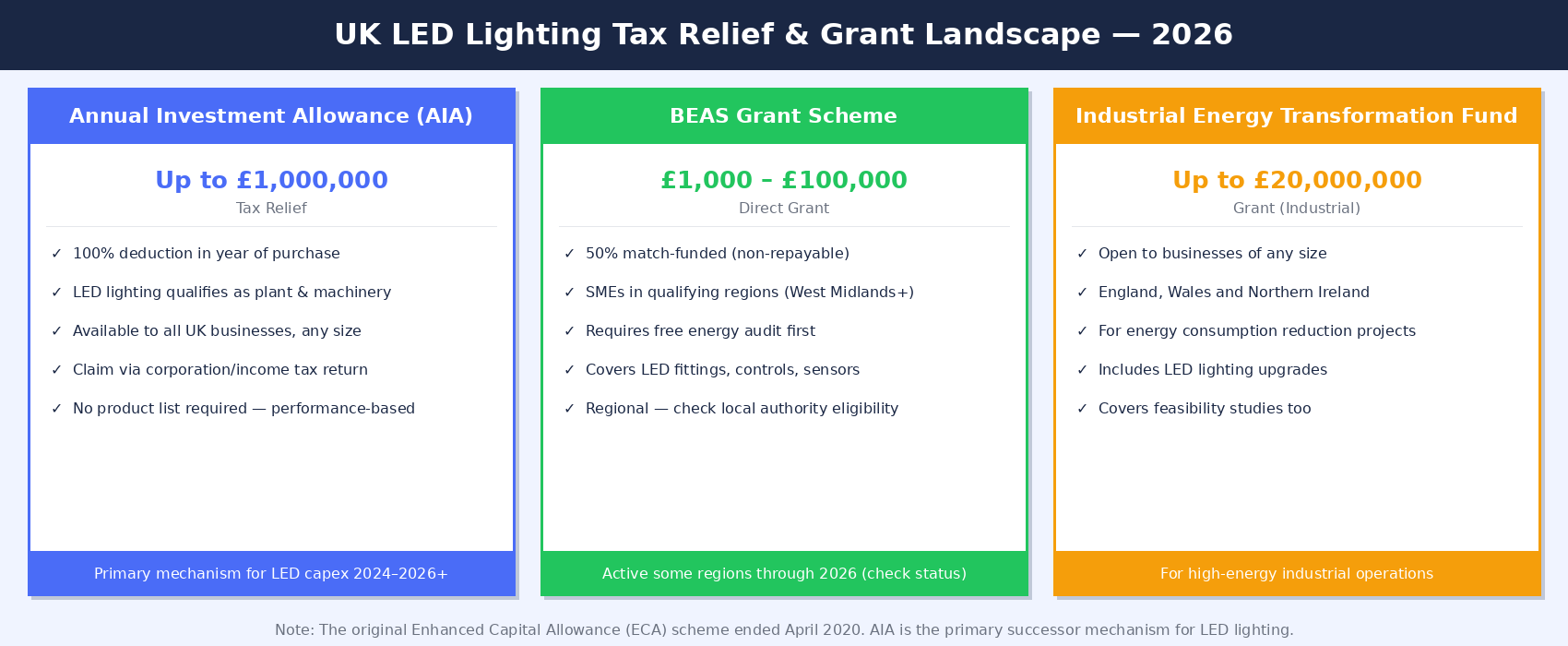
The AIA allows UK businesses of any size to deduct 100% of the cost of qualifying plant and machinery — including LED lighting — from taxable profits in the year of purchase, up to £1 million annually. For UK businesses in 2025–2026, LED lighting investments are fully deductible through the AIA — meaning 100% of the capital cost can be written off against taxable profits in the year of investment.
For a business purchasing £100,000 of LED weatherproof fixtures — for example, to retrofit a warehouse or cold storage facility — the full £100,000 is deducted from taxable profit in that tax year. At the current 25% main rate of corporation tax (applicable to companies with profits over £250,000), that represents a £25,000 direct tax saving in year one. For companies with profits between £50,000 and £250,000, the marginal rate varies, but the principle is the same: immediate full deduction rather than a years-long 18% reducing balance write-off.
LED lighting qualifies as plant and machinery for AIA purposes. Unlike the original ECA, the AIA does not require products to be listed on a specific government database or meet a defined performance threshold to qualify for the allowance — the AIA applies to all qualifying plant and machinery. However, for procurement teams wanting to demonstrate due diligence on energy efficiency (particularly for sustainability reporting, ISO 50001, or UK Net Zero commitments), specifying products that meet the former ETL criteria remains best practice.
The BEAS Grant Scheme (Regional, Active Through 2026)
The Business Energy Advice Service (BEAS) operates as a complement to the AIA — providing direct grant funding (not tax relief) for energy efficiency upgrades. BEAS grants of up to £100,000 at 50% match-funding are available for eligible businesses, covering LED fittings, control systems, and sensors — with grants requiring a free energy audit first.
Crucially, BEAS funding is regional and availability varies significantly. As of early 2026, some areas such as the West Midlands have reported their grant allocation is oversubscribed, while energy assessments continue to be offered. Regional eligibility and remaining availability must be checked with your local authority.
BEAS and AIA can both be claimed in the same year — the grant covers a portion of purchase cost, and the AIA deduction applies to the net cost (post-grant) of the equipment purchased.
Industrial Energy Transformation Fund (IETF)
The Industrial Energy Transformation Fund provides grants to the industrial sector for energy efficiency improvements, including LED lighting, with individual grants up to £20 million available to businesses of any size across England, Wales and Northern Ireland. The IETF is targeted at high-energy-use industrial operations — food processing, cold chain logistics, manufacturing — rather than commercial offices or retail. Feasibility studies toward LED retrofit projects can also be funded under the scheme.
The Technical Criteria That Still Matter
Even though the formal ECA scheme no longer exists, the technical performance criteria from the original ETCL remain highly relevant for two reasons: they represent the minimum performance threshold that qualifies a product as genuinely energy-efficient (relevant for sustainability claims and compliance reporting), and many buyers and specifiers still reference them in procurement specifications.
| Parameter | ETL Minimum (White LED / General Interior) | Notes |
|---|---|---|
| Luminaire Efficacy | ≥60 lm/W (general interior, tested after 100 hrs) | Higher thresholds apply for exterior, display, and amenity categories |
| Power Factor | ≥0.9 at highest light output | Critical for industrial electrical infrastructure compatibility |
| Lumen Maintenance | ≥90% of initial lumens after 6,000 hours | Measures long-term performance, not just initial output |
| Colour Rendering Index | Ra≥20 (general); Ra≥80 for amenity/display | Higher CRI required for food, medical, or inspection environments |
| Standby Power | ≤0.5W for dimming control gear standby | Applies when product incorporates electronically addressed dimming |
| CE Marking | Required | UKCA mark now required for Great Britain market post-Brexit |
Complete LED lighting units — with LED, driver, and control gear integrated and tested together — are required to meet these criteria. Individual components, retrofit lamps, and emergency lighting were not covered by the original ECA scheme. This means the qualifying unit must be a tested, complete luminaire — not a bare LED chip or driver replacement.
Post-Brexit: UKCA vs CE Marking
One practical consideration for UK buyers sourcing from international manufacturers: since January 2023, UKCA marking has been required for products placed on the Great Britain market (England, Scotland, Wales). CE marking alone is technically no longer sufficient for new product registrations in Great Britain, though in practice many enforcement timelines have extended. Buyers should confirm with their supplier whether products carry UKCA marking or are in a transition period. Fanxstar products carry CE marking as standard — UKCA alignment should be confirmed for any UK-specific procurement order.
What This Means for Buyers Importing LED Fixtures
Does AIA Apply to Imported Equipment?
Yes. The AIA applies to qualifying plant and machinery regardless of country of manufacture, provided the equipment is purchased and used in the business in the UK. A UK company importing weatherproof LED fixtures from a Chinese manufacturer, installing them in a UK warehouse, and recording them as plant and machinery in its accounts can claim the AIA against the full purchase cost — including the cost of the fixtures themselves, freight, and installation.
Procurement teams should document: the purchase invoice (in GBP or with exchange rate applied at transaction date), the installation date, and the asset’s classification in the fixed asset register. The AIA claim is made through the corporation tax return for the accounting period in which the expenditure was incurred.
Performance-Driven Purchasing Still Makes the Best Case
For businesses using LED upgrades as part of a broader sustainability or ISO 50001 energy management program, purchasing products that meet or exceed the former ETL technical thresholds provides a defensible audit trail for energy performance claims. Industrial weatherproof LED fixtures from a manufacturer with ISO 9001-2015 certification, published photometric data, and lumen maintenance testing to IES LM-80 standards are well positioned for this documentation requirement.
Cold storage, food processing, and pharmaceutical environments — where Fanxstar’s IP66, -40°C-rated weatherproof fixtures are commonly specified — typically benefit most from documented performance data, because the capital investment is larger and the energy savings case is clearest. Combining a detailed Dialux energy simulation (available as part of Fanxstar’s pre-sales engineering support) with an AIA claim and a BEAS grant application, where eligible, can dramatically reduce the effective net cost of a major lighting upgrade.
Fanxstar’s engineering team provides Dialux lighting simulations and photometric data for UK-bound projects. Get in touch to discuss your project’s technical and compliance requirements.
BEAS vs AIA — Which Should You Prioritize?
For most UK industrial and commercial businesses, the AIA is the first and most reliable tool — it applies universally, has a £1 million annual cap, and requires no application process beyond a standard corporation tax return. BEAS grants, where still available in your region, are a valuable complement — reducing the cash outlay before the tax claim is processed. The sequencing typically works as follows: secure the BEAS grant commitment first, procure the equipment, install, claim the grant reimbursement, then claim the AIA on the net purchase cost in your tax return for that period.
LED lighting is confirmed as a qualifying item under the AIA — businesses can deduct the full value of qualifying LED lighting assets from profits before tax. Unlike the original ECA, there is no requirement to match the product to a government product database — the AIA qualification is automatic for plant and machinery that qualifies generally.
Frequently Asked Questions
Is the UK ECA scheme still available in 2026?
No. The Enhanced Capital Allowance (ECA) scheme ended on 1 April 2020 for companies and 6 April 2020 for unincorporated businesses. LED lighting tax relief is now accessed primarily through the Annual Investment Allowance (AIA), which provides the same 100% first-year deduction logic on qualifying plant and machinery, including LED fixtures, up to £1 million per year.
Does emergency lighting qualify for the AIA?
Yes — unlike under the original ECA scheme, where emergency lighting was explicitly excluded, the AIA is a general capital allowance that applies to all qualifying plant and machinery. Emergency LED battens, exit signs, and emergency spotlights installed as business plant and machinery qualify for AIA deduction in the year of purchase. Note: the old ECA emergency lighting exclusion was specific to the ECA framework and does not carry over to the AIA.
Can a UK business claim AIA on LED fixtures imported from China?
Yes. The AIA applies based on where the asset is used and how it is classified in the business accounts, not where it was manufactured. A UK company importing CE-marked (or UKCA-marked) LED fixtures, installing them in a UK facility, and recording them as plant and machinery can claim the full AIA deduction on the purchase cost including freight and installation.
What documentation do I need to support an AIA claim on LED lighting?
You need: a purchase invoice dated within the relevant accounting period, records confirming the assets were placed in service during that period, a fixed asset register entry classifying the fixtures as plant and machinery, and (ideally) the manufacturer’s product specification confirming the fixtures are complete integrated units. Your accountant will include the AIA claim in the relevant section of the corporation tax return.
How do I check if BEAS grants are available in my area?
BEAS eligibility and grant availability are managed regionally and change frequently. Your local authority or Local Enterprise Partnership (LEP) is the first point of contact. The national BEAS programme website provides a regional eligibility checker — but availability in specific areas can close without notice when funding is exhausted. Checking early in your procurement planning process is strongly recommended.