CE marking and RoHS are different compliance signals for LED lighting, but both become useful only when the buyer can connect the mark, declaration, test evidence, BOM, and exact product version. Buyers should treat both as file-control questions, not logo questions. The usable answer is whether the exact LED luminaire, driver, sensor, packaging, label, declaration, and evidence file all describe the same product version.
Your Europe CE marking guidance says the manufacturer is responsible for ensuring the product meets applicable EU requirements and affixing the CE marking. European Commission RoHS guidance describes RoHS as EU rules restricting hazardous substances in electrical and electronic equipment.
Key Takeaways
- CE marking is a manufacturer declaration for applicable EU requirements; RoHS is one of the legal layers that can apply to LED lighting products.
- LED lighting buyers usually need to review LVD, EMC, RoHS, technical documentation, declaration wording, label evidence, and product-change control.
- A CE certificate from a third party is not the same thing as the manufacturer signing a compliant EU Declaration of Conformity.
- RoHS evidence should map to the actual BOM, especially drivers, PCBs, solder, wires, connectors, coatings, plastics, and supplied accessories.
- Fanxstar ODM projects should freeze the compliance file before private-label artwork, sensor options, emergency modules, or driver substitutions move into production.
CE Marking and RoHS Are Related but Not the Same
CE marking is the umbrella signal
European Commission CE marking overview states that by affixing CE marking, a manufacturer declares the product meets legal requirements and can be sold throughout the EEA. The important word for buyers is declares. CE marking is not a decorative export label and it is not automatically issued by a central EU office for every LED fixture. The responsible economic operator must identify applicable rules and hold evidence.
Your Europe CE marking guidance also warns that some products may fall under several EU requirements at the same time. For LED lighting, the common layers can include electrical safety under LVD, electromagnetic compatibility under EMC, hazardous-substance restriction under RoHS, ecodesign and energy labelling rules for light sources where relevant, and radio requirements if the product includes wireless functionality.
| Topic | CE marking | RoHS |
|---|---|---|
| Purpose | Declares conformity with applicable EU product rules. | Restricts hazardous substances in EEE. |
| LED lighting impact | Usually connects LVD, EMC, RoHS, ecodesign, and possibly RED. | Requires material and supply-chain substance evidence. |
| Main buyer risk | Logo appears without a product-specific declaration and technical file. | Supplier sends a generic RoHS statement with no BOM scope. |
| Useful evidence | EU Declaration of Conformity, test reports, standards list, technical file. | RoHS declaration, material declarations, test reports where needed. |
| Change trigger | Product, directive, standard, label, manufacturer, or design change. | Component, solder, cable, driver, PCB, plastic, or coating change. |
RoHS is the hazardous-substance layer
EUR-Lex Directive 2011/65/EU is the recast RoHS directive for restriction of hazardous substances in electrical and electronic equipment. European Commission RoHS Directive page explains that RoHS aims to prevent risks to human health and the environment by restricting hazardous substances in EEE. In LED lighting procurement, that makes RoHS a materials and supply-chain evidence question.
A buyer should not treat RoHS as a sentence at the bottom of a quotation. The evidence should connect to the BOM: LED board, driver, solder, wires, connectors, plastic diffuser, housing coating, packaging accessories, and any supplied control module. If the supplier changes the driver or cable after sample approval, the RoHS file should be checked again because the substance evidence may no longer describe the shipped product.
Which EU Rules Usually Matter for LED Lighting?
LVD and EMC are separate evidence paths
European Commission Low Voltage Directive guidance states that the LVD covers electrical equipment between 50 and 1000 V AC or 75 and 1500 V DC. That is why many mains-powered LED luminaires need electrical safety evidence. But safety is not EMC. European Commission EMC harmonised standards page lists harmonised standards under Directive 2014/30/EU for electromagnetic compatibility, which means emissions and immunity are a separate evidence path.
For LED fixtures, this separation matters because one product can look compliant mechanically while still having driver or controls behavior that affects EMC. A smart or sensor-ready fixture can add another layer. A wireless module can move the project toward radio-equipment requirements. The buyer should not ask, is it CE? The better question is, which directives and standards does the declaration cite for this exact version?
Ecodesign and energy labelling are not the same as CE marking
European Commission light sources policy page lists ecodesign and energy-labelling rules for light sources and separate control gears. These rules affect LED product data and market files, but they should not be collapsed into one CE conversation. A buyer may need efficiency, standby, serviceability, EPREL, packaging, and product-information evidence separate from safety and RoHS evidence.
The practical procurement problem is that suppliers often send one broad compliance pack. A stronger file separates electrical safety, EMC, RoHS materials, energy information, product label, installation instructions, and market-specific declaration language. Separation makes it easier to review what changed when a driver, light source, sensor, or private-label package changes.
The Evidence File Buyers Should Request
A declaration without technical support is thin
Your Europe technical documentation guidance says technical documentation must demonstrate compliance with all EU requirements and support the EU declaration of conformity. That line should change how buyers review supplier files. The EU Declaration of Conformity is important, but it should be backed by reports, drawings, BOM, risk assessment, standards list, photos, labels, instructions, and change-control records.
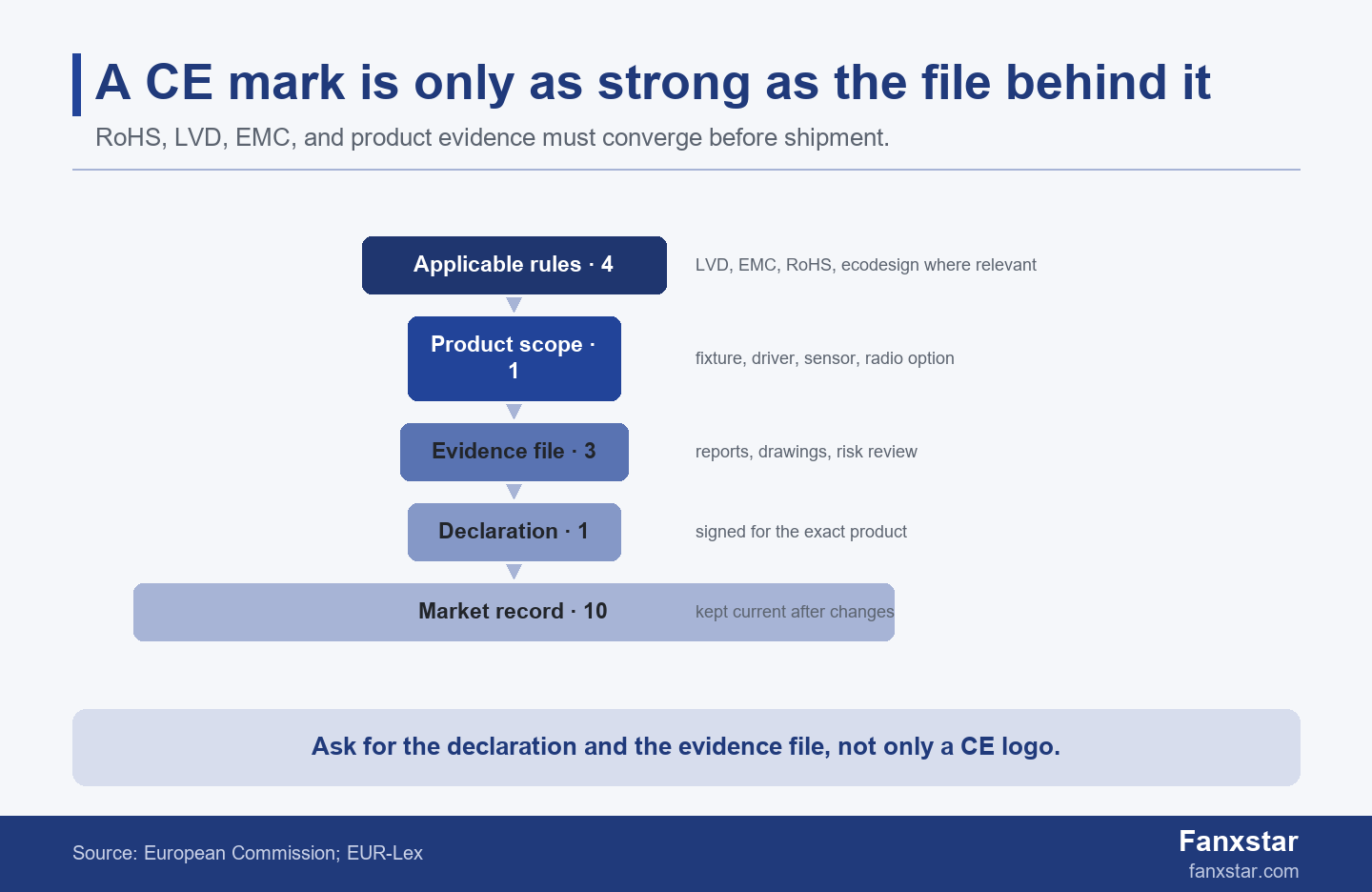
Use this as a scenario estimate for CE and RoHS LED lighting file control. Based on our analysis of this scenario, 4 layers should be checked before a buyer accepts a CE claim: LVD, EMC, RoHS, and product information where relevant. Based on our analysis of this scenario, 1 model should be tied to one declaration and one controlled BOM. Based on our analysis of this scenario, 10 years is the retention period named in EU CE guidance for DoC and supporting documentation. Based on our analysis of this scenario, 5 mm is the minimum CE marking size named by Your Europe unless product rules specify otherwise. Based on our analysis of this scenario, 2 files should be separated: regulatory declaration and engineering evidence. Based on our analysis of this scenario, 48 hours is a practical supplier response target for missing declaration details. Based on our analysis of this scenario, 30 days is a useful sample window before artwork and packaging are locked. Based on our analysis of this scenario, 1 change log should capture every driver, PCB, cable, coating, or label substitution.
RoHS evidence should follow the components
RoHS can fail quietly because the visible fixture still looks identical. A substitute driver, different PCB supplier, new solder process, changed wire insulation, or different plastic diffuser can alter the materials file. Buyers should ask how the supplier controls material declarations and whether the RoHS statement covers the exact version being ordered.
For private-label lighting, the RoHS evidence should also identify whether the buyer’s artwork, accessory pack, cable, plug, packaging, or control module changes the scope. A generic RoHS declaration for a product family is weaker than a version-specific declaration supported by BOM discipline. The more customized the project, the more important the component map becomes.
A useful component map does not need to expose every supplier secret to the buyer, but it should prove that controlled components exist. Driver, LED board, solder process, cable insulation, terminal block, diffuser resin, gasket material, coating, plug, and accessory bag should each have an evidence owner. When a factory substitutes a part for cost or availability, the change should trigger a compliance review before the shipment file is closed.
Fanxstar ODM Projects and Compliance Boundaries
Customization should not break the declaration boundary
Fanxstar’s custom LED lighting ODM service can involve CCT, optics, sensor integration, housing adaptation, wiring, and private-label presentation. Those changes are commercially useful, but they should be reviewed against the compliance file. A sample that uses one driver and a production order that uses another driver should not rely on the same evidence without review.
Buyers working with weatherproof LED lighting product platform, motion sensor LED lighting, or emergency lighting product range should be especially careful. Moisture sealing, sensors, batteries, emergency modules, and controlgear create more places where safety, EMC, RoHS, label, and instruction evidence can diverge.
Ask for evidence before packaging and labels are final
The best time to ask for CE and RoHS evidence is before final packaging, label artwork, and production release. If the buyer waits until after goods are packed, the only choices may be delay, rework, relabel, or ship with uncertainty. A compliance file should be a gate before production, not a rescue step after inspection.
Use the Fanxstar LED lighting certification checklist as an RFQ control point before artwork and packaging are frozen. The RFQ should name target market, voltage, model, customization scope, applicable compliance documents, declaration needs, RoHS component evidence, label format, and whether any wireless, emergency, or sensor option changes the route. The supplier answer should also state who owns each record after a design change, because the buyer may need the file again months after shipment.
What a Strong Supplier Answer Looks Like
The supplier should name scope, not only send logos
A strong answer says which directives apply, which standards are used, which exact model is covered, who signs the declaration, what evidence backs the declaration, and which changes require review. A weak answer sends logos, a certificate scan, or a general sentence that all products are CE and RoHS compliant. The weak answer may be fast, but it gives the buyer no release control.
The buyer should also ask whether the file covers the final label and instruction sheet. CE marking and RoHS evidence are not only lab reports. They also affect what appears on the product, packaging, declaration, and technical file. If the label and declaration name different models, the file is not ready.
Use a pre-shipment compliance gate
Before shipment, check the final model name, photos, label, declaration, RoHS statement, BOM, report numbers, market, and production date. If any record points to a different product version, stop and clarify. This gate is cheaper before shipment than after customs, distributor review, marketplace review, or customer audit. It also gives the importer a clean trail if a marketplace, distributor, or customer later asks why the shipped SKU matches the declared file.
The final rule is practical: do not buy the logo. Buy the controlled file behind the logo. CE marking and RoHS are valuable only when they describe the LED lighting product that is actually being shipped. For repeat orders, the same gate should be run again after driver substitutions, packaging changes, or private-label artwork updates because the visible product name can stay unchanged while the compliance evidence has drifted.
FAQ
Is RoHS part of CE marking for LED lighting?
RoHS can be one of the EU compliance layers that supports CE marking for electrical and electronic equipment, but it is not the whole CE file. Buyers should still review LVD, EMC, product information, declaration language, and technical documentation for the exact LED product.
Does a CE certificate prove an LED fixture is compliant?
Not by itself. CE marking is a manufacturer declaration based on applicable EU requirements, and some voluntary certificates can be misleading. Buyers should request the EU Declaration of Conformity, technical file evidence, standards list, test reports, labels, and product-version scope.
What RoHS evidence should buyers request?
Ask for a RoHS declaration tied to the exact product version and BOM. For higher-risk or customized projects, request component-level material declarations or test evidence for drivers, PCBs, solder, cables, connectors, plastics, coatings, and supplied accessories.
When should compliance be reviewed again?
Review compliance again when the driver, LED board, sensor, emergency module, radio module, cable, label, packaging, housing material, supplier, or target market changes. The mark and declarations should follow the actual product version, not the original quote.