UL versus ETL is not a question of which logo is automatically safer. For LED lighting buyers, the safer choice is the certification mark whose NRTL scope, test standard, directory listing, file number, and shipped model all match.
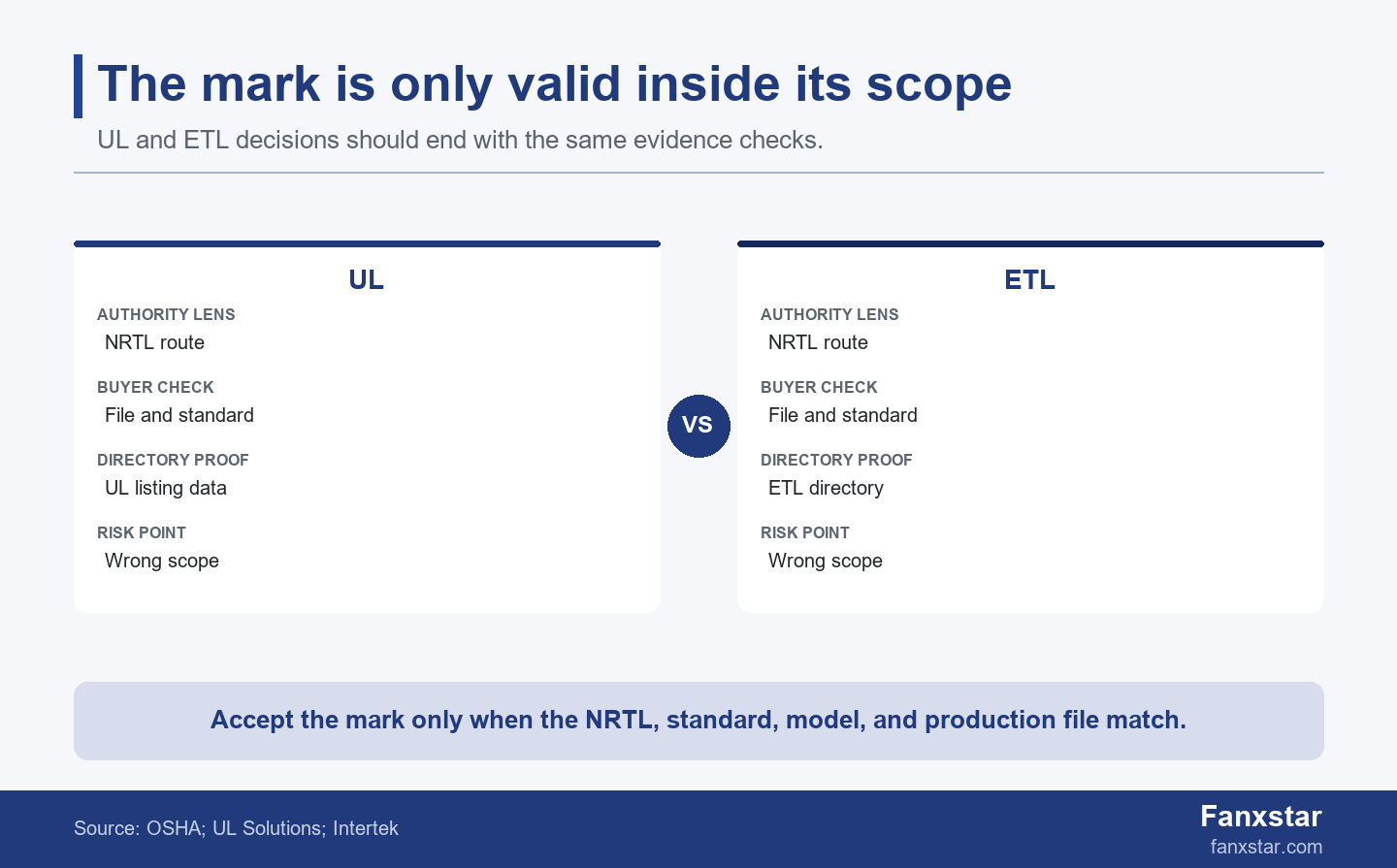
OSHA explains that each NRTL has a scope of recognized test standards and uses its own registered mark to designate product conformance. That is the buyer’s starting point, not brand familiarity. OSHA NRTL Program and the current OSHA NRTL list turn UL versus ETL into a verification workflow.
Key Takeaways
- UL and ETL are both certification routes when issued by an OSHA-recognized NRTL within the correct scope.
- The buyer should verify the testing standard, file number, directory listing, model number, and mark authorization before accepting either logo.
- For LED lighting, the relevant standard may change by product type: general luminaire, emergency lighting, LED equipment, hazardous location, or component.
- A North American RFQ should state the target market, standard requirement, AHJ expectation, and whether substitutions reopen certification review.
What UL and ETL actually mean in North American lighting
The certifier is recognized for a scope, not for every possible product
OSHA NRTL FAQ says the mark signifies that the NRTL tested and certified the product under the NRTL program and that it complies with one or more appropriate product safety test standards. The phrase ‘appropriate product safety test standards’ is the part buyers should focus on.
A mark is not a universal passport. The laboratory must be recognized for the relevant standard, the product must be tested or certified under the applicable file, and the manufacturer must be authorized to apply the mark to that product. A familiar logo does not fix a wrong standard, an expired file, or a model mismatch.
According to the current OSHA NRTL list, OSHA publishes the current recognized laboratories. That gives buyers a 2-step check: first confirm the laboratory is recognized, then confirm the product standard and model are inside the relevant file.
Intertek describes the ETL Listed Mark as widely accepted across the United States and Canada, while UL explains UL marks around UL certification marks. Both sources support the same buyer habit: verify the mark as part of a file, not as a standalone graphic.
The question is standard scope, not logo prestige
| Buyer check | UL route | ETL route | Decision rule |
|---|---|---|---|
| Recognized certifier | Check OSHA NRTL recognition and scope. | Check OSHA NRTL recognition and scope. | The logo is secondary to NRTL scope. |
| Applicable standard | Example: UL 1598 for many luminaires, UL 924 for emergency equipment. | Same product standard can be used when within scope. | Match the standard to the finished product. |
| Directory proof | Verify listing/file data where available. | Verify ETL directory data where available. | Do not rely on a quotation screenshot alone. |
| Model match | Model, rating, construction, and mark authorization must match. | Model, rating, construction, and mark authorization must match. | Hold shipment if the listed file describes another SKU. |
Many buyers ask whether UL is better than ETL because UL is more familiar in some markets. That question can distract from the real risk. A product with a well-known mark but the wrong standard is weaker than a product with a less familiar mark that is correctly certified, listed, and accepted for the application.
For LED lighting, the product category matters. A general luminaire, emergency light, exit sign, LED driver assembly, hazardous-location fixture, and wet-location luminaire may require different standard paths. The buyer should ask which standard appears on the listing and whether the finished product, not only a component, is covered.
How to verify UL or ETL evidence before ordering
Directory and file checks are part of procurement
Intertek provides an ETL Listed Mark Directory for checking ETL listed products. UL also provides mark and listing resources through its certification ecosystem. The buyer should request enough information to search or verify the file: manufacturer name, model number, standard, file number, mark type, and rating details.
Do not accept a certificate image without checking whether it belongs to the quoted model. A supplier may show a related product, a component file, a different wattage, a different housing, or an old factory name. The question is whether the shipped SKU is the listed SKU or a covered variant inside the same file.
According to UL marks guidance, UL marks are tied to certification rather than to a generic marketing promise. According to Intertek ETL directory guidance, ETL listing can be checked through a directory path. Those 2 checks make the buyer’s evidence request concrete: 1 mark, 1 directory or file path, 1 model table, and 1 rating label.
A simple file check can prevent a large problem. If a 100-unit pilot order uses the wrong listing file, the buyer can stop and repair the issue. If the same mistake is discovered after 4,000 units arrive at a jobsite, the cost includes schedule, AHJ review, replacement labels, retesting, and customer confidence.
Based on our analysis, the file check should take less than 45 minutes when the supplier has a clean package: 1 listing reference, 1 model table, 1 rating label, 1 standard name, and 1 directory path. If the supplier needs 3 days to explain which file applies to a standard luminaire, the buyer should treat that delay as a certification-control signal, not only a communication delay.
The key insight is that directory proof is not a clerical task. It tells the buyer whether the supplier’s commercial model, certified model, and production model are the same object. If those 3 names diverge, a UL or ETL mark can still appear on a label while the buyer’s evidence file becomes difficult to defend.
The applicable standard should follow the product job
According to UL 1598, the standard applies to luminaires for non-hazardous locations intended for branch circuits of 600 V nominal or less. That does not mean every LED lighting product is only a UL 1598 question. Emergency lighting may involve UL 924, LED equipment may involve UL 8750-related component evidence, and hazardous locations may require a different route.
According to UL emergency lighting testing and certification, emergency lighting certification is a distinct testing and certification context. This matters because a buyer ordering 3 fixture families cannot assume the same evidence file covers a standard vapor tight luminaire, an emergency light, and an exit-route product.
The buyer should write the intended product job in the RFQ: indoor dry location, wet location, emergency backup, exit route, parking garage, food processing, hazardous location, or custom linear platform. The supplier can then state the correct standard path and whether the existing file covers the requested configuration.
For Fanxstar projects aimed at North America, this check belongs before a sample is treated as final. Relevant product starting points include vapor tight LED fixtures, emergency lighting product range, and custom LED lighting ODM service.
According to UL emergency lighting testing and certification, emergency lighting certification has additional requirements beyond general lighting contexts. In practice, a buyer comparing 2 emergency SKUs and 2 non-emergency SKUs should expect at least 2 different evidence paths, even if the housings look similar from the outside.
When UL may be preferred and when ETL can be acceptable
Customer preference can be real even when safety logic is equivalent
Some distributors, project owners, retail programs, or AHJs may ask for UL specifically because of familiarity, contract language, or internal approval habits. That preference should be respected if it is written into the project requirement. The buyer should not argue from theory when the job specification clearly names a mark.
In other projects, ETL can be acceptable when the product is certified by Intertek as an OSHA-recognized NRTL within the correct standard scope and the directory evidence is clear. The buyer should confirm acceptance with the AHJ or customer where needed, especially for public infrastructure, emergency, hazardous, or high-liability applications.
The practical decision is not UL good, ETL bad, or ETL equal in every contract. It is: what does the project specification require, what will the AHJ accept, which NRTL scope applies, and does the listing file match the shipped product? That answer is more useful than a universal ranking.
An illustrative approval matrix reduces false confidence
Use a four-condition release rule. Condition 1: the NRTL is recognized for the relevant scope. Condition 2: the standard fits the product category. Condition 3: the directory or file data matches the model. Condition 4: the production sample uses the same construction, rating, label, and critical components. If any condition fails, the mark is not enough.
This matrix also keeps price discussions honest. A lower quote with a vague certification claim may become more expensive after retesting or relabelling. A higher quote with a clean file may be cheaper if it reduces AHJ risk and customer rejection. Certification evidence is therefore a schedule and acceptance issue, not only a compliance checkbox.
According to OSHA NRTL Program, each recognized laboratory has its own scope of test standards and registered mark. The hidden cost appears when a buyer skips that scope check: 1 wrong standard can turn a 2-week purchasing task into a retest, relabel, or AHJ clarification cycle.
A practical rule is to put certification evidence before price finalization for any order above 50 units, any public-site order, and any project with emergency, wet-location, or hazardous-location language. That threshold is not a legal rule. It is a buyer-control rule: the larger the order or the more public the installation, the less acceptable it is to discover file gaps after deposit.
How to brief Fanxstar for North American certification needs
Send the target standard and product boundary
A useful Fanxstar RFQ should state the destination market, standard expectation, mark preference, AHJ or customer requirement, fixture type, voltage, wet-location need, emergency function, sensor or dimming requirement, and whether private label is needed. For platform-based products, the buyer should ask which existing file applies and which changes reopen certification review.
Fanxstar can be a better fit when the buyer needs custom LED lighting design options around CCT, optics, sensors, wiring, housing, or application fit. But certification language must stay precise. The question is not whether the factory can print a mark. It is whether the final configuration is inside the authorized certification file.
If the buyer already has a failed or unclear certificate, send the certificate, model photo, rating label, target market, and project specification to Fanxstar custom LED lighting ODM service. The useful output is a gap map: what matches, what is missing, and which product changes require a new evidence path.
Freeze the listing evidence before mass production
Before shipment, request the listing file reference, model number, standard, rating label artwork, production photos, critical components, instruction sheet, packaging mark, and substitution rule. If the supplier changes driver, housing, gasket, emergency module, sensor, or label after approval, ask whether the listing file still covers the product.
For private-label projects, decide whose name appears on the mark, label, packaging, and documentation. A mismatch between brand owner, manufacturer, file holder, and sold model can create avoidable confusion. The certification file should be readable by the buyer, distributor, inspector, and maintenance team without private chat history.
For repeat North American purchasing, keep a 12-month certification review habit. Once per year, confirm that the listing file, critical components, label artwork, instruction sheet, and production factory remain consistent with the product being ordered. This is especially useful when the buyer changes packaging, private-label name, driver supplier, or sensor option without changing the public SKU name.
FAQ
Is ETL accepted like UL in North America?
ETL can be accepted when issued by Intertek as an OSHA-recognized NRTL for the correct product standard and scope. Buyers should still confirm project specifications, AHJ expectations, directory status, file number, and model match before treating ETL as acceptable for a specific job.
Is UL certification safer than ETL certification?
UL is not automatically safer simply because the mark is more familiar. Safety confidence comes from the applicable standard, NRTL recognition, test scope, file authorization, production follow-up, and model match. A wrong UL file is weaker than a correct ETL file.
What should LED lighting buyers check on a UL or ETL certificate?
Check the certifier, NRTL scope, standard, file number, manufacturer, model number, ratings, product category, mark type, directory listing, and whether the shipped construction matches the certified version. Also confirm customer or AHJ mark preferences before ordering.
Can a supplier use a component certification for a complete LED fixture?
A component certification can support the file, but it usually does not replace finished-product certification for the complete luminaire. Buyers should ask whether the complete fixture, not only the driver, LED module, or component, is covered by the applicable listing.