An IP65 waterproof downlight is useful only when the IP rating, installation zone, trim construction, driver location, thermal path, optic, and approval evidence all match the real bathroom or outdoor condition. The IP65 label alone does not answer the buying question because a bathroom ceiling, covered outdoor soffit, canopy, shower-adjacent zone, and humid service room do not create the same risk.
For Fanxstar buyers, the downlight decision should begin with exposure and installation limits, not wattage. According to IEC 60529, IP-code language classifies enclosure protection. According to IEC 60598-1, luminaire safety requirements cover products operating up to 1000 V. Those references help buyers separate 2 questions: whether the downlight enclosure has ingress evidence, and whether the whole installed lighting point is suitable for the location.
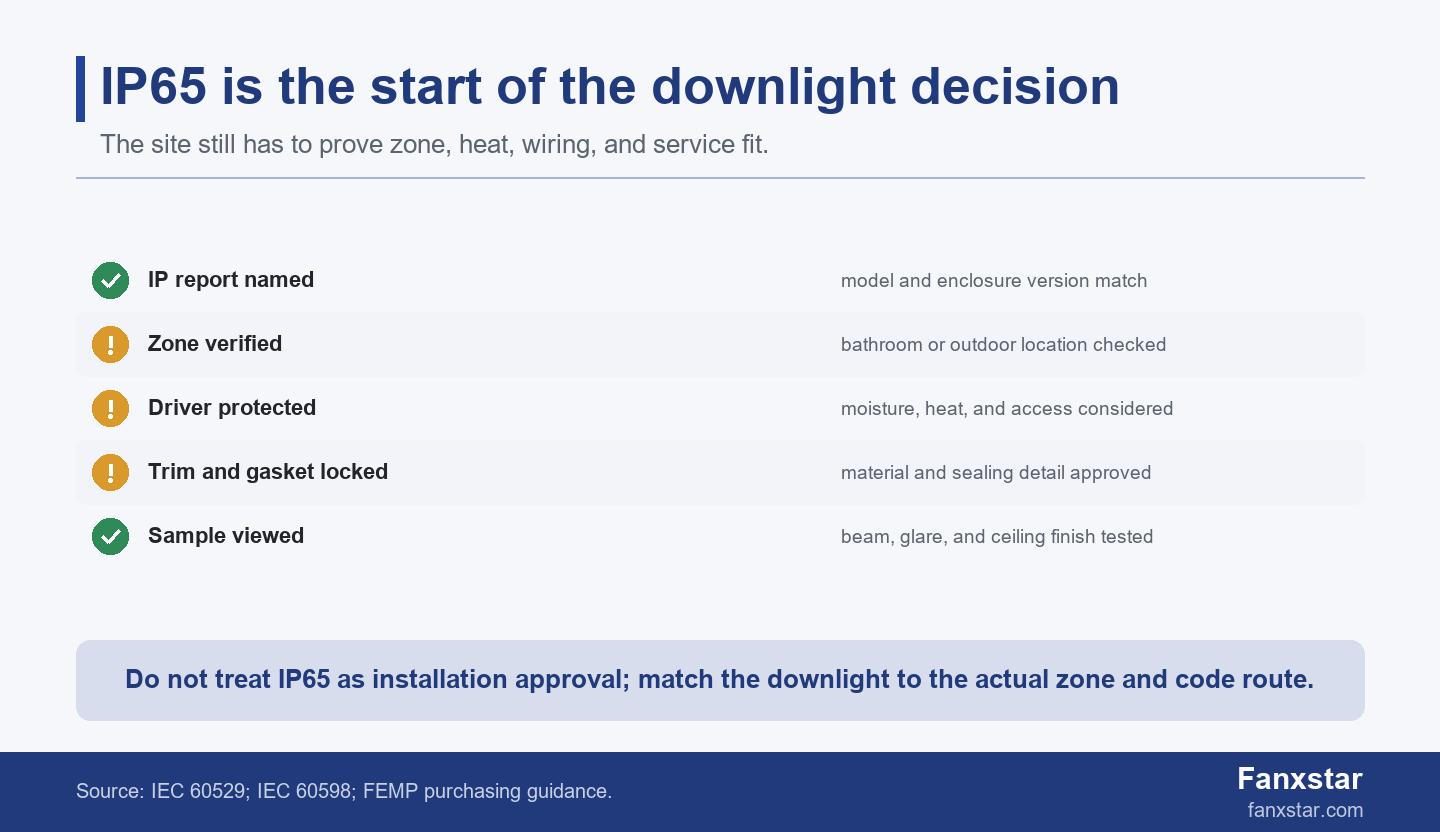
The safest procurement habit is to treat IP65 as a necessary clue, not a complete approval. The buyer still needs to check the room zone, ceiling construction, trim material, gasket design, driver location, cable entry, heat path, and maintenance access. For code-sensitive bathroom or outdoor installations, the final installation decision should follow local electrical requirements and qualified installer guidance.
Key Takeaways
- IP65 is an enclosure protection claim; it does not automatically approve every bathroom or outdoor installation.
- The downlight, trim, gasket, driver, cable entry, ceiling void, and local zone rules must be considered together.
- Outdoor soffits need weather, insects, condensation, UV exposure, corrosion, and service access checks, not only water resistance.
- For B2B orders, request the exact IP report, model code, material, driver data, and sample evidence before release.
What IP65 tells you and what it does not
IP65 is about the enclosure, not the whole room
The first number in an IP rating addresses solid particle protection, and the second number addresses water ingress protection. In procurement language, IP65 is usually treated as dust-tight with protection against water jets, but the buyer should still request the actual test report and model scope. The useful question is not whether IP65 sounds waterproof. The useful question is whether the tested enclosure matches the downlight version being purchased.
IEC 60529 frames IP ratings as degrees of protection provided by enclosures. That boundary matters. The rating does not decide ceiling vapor behavior, wiring junction suitability, bathroom zone approval, dimmer compatibility, fire rating, or how an installer seals the surrounding surface. Those are separate installation and product questions.
A common mistake is to compare two downlights only by IP65 and wattage. One model may use a stronger gasket, better cable strain relief, and a driver designed for a protected remote location. Another may use a weaker trim fit and a driver that performs poorly in a hot ceiling void. Both can be advertised with the same IP label, but they are not equal procurement risks.
For bathroom and outdoor spaces, the buyer should ask for a model-specific evidence set: IP rating report, luminaire safety certificate scope, material and finish, cable entry detail, driver data, cut-out size, trim depth, ceiling compatibility, and sample photos from the actual installation angle. The trade-off is that a compact recessed downlight gives a clean ceiling, but it also hides the driver, cable entry, and heat path where many failures start.
Bathroom zones and outdoor exposure are different problems
Bathrooms create moisture, condensation, steam, cleaning chemicals, and user-contact concerns. Outdoor soffits create wind-driven rain, insects, dust, UV exposure, temperature swings, and corrosion risk. A downlight that works well above a residential bathroom sink may not be the right fixture for an open coastal canopy. The same IP65 label can sit in very different exposure stories.
FEMP light fixture purchasing guidance includes light fixtures and luminaires in energy-efficient purchasing guidance. That is helpful because a buyer should compare efficiency, fixture role, and application fit together. An efficient downlight that fails early because the driver overheats or moisture reaches the cable entry is not an efficient purchase in practice.
A bathroom decision should begin with the location: dry ceiling, splash-prone area, shower-adjacent area, recessed niche, or commercial wet room. An outdoor decision should begin with exposure: covered soffit, open canopy, under-eave, facade recess, humid corridor, or semi-exposed walkway. Each condition changes the needed evidence.
This is also where local code matters. A buyer can shortlist an IP65 waterproof downlight, but a qualified installer or project engineer should confirm zone requirements, wiring method, RCD/GFCI expectations where relevant, ceiling fire rules, and whether a remote driver location is required.
How to compare IP65 waterproof downlights
Start with the hidden details
The visible trim is only part of the product. Buyers should compare the sealing system, body material, heat sink, driver, cable entry, spring clip, lens, beam angle, glare control, and finish durability. In a humid ceiling, small construction details decide whether the fixture stays stable after months of thermal cycling and cleaning.
IEC 60598-1 covers luminaire safety categories such as marking, mechanical construction, and electrical construction. That supports a more complete downlight checklist. The buyer is not only asking if water can enter. The buyer is asking whether the luminaire is mechanically and electrically appropriate for the intended use.
| Selection field | Why it matters | Buyer evidence |
|---|---|---|
| IP report | Confirms the enclosure claim for the exact model version. | Report or certificate naming model, test method, and enclosure version. |
| Driver location | A driver in a hot or damp void can become the weak point. | Driver data, installation drawing, temperature limit, and access plan. |
| Trim and gasket | The seal depends on material compression and ceiling fit. | Sample part, gasket material, cut-out tolerance, and mounting detail. |
| Beam and glare | Bathrooms and soffits need comfortable light, not only water resistance. | Sample view, beam option, UGR or glare notes where available. |
| Documentation | Import and warranty files need to match the actual fixture. | Invoice, packing list, and certificates aligned with ITA import documentation guidance. |
For a 100-unit project, a weak trim or driver decision may look small during quotation and expensive during service. If 5 fixtures fail in a damp ceiling, the labor cost can exceed the price difference between a generic downlight and a better-built waterproof model. The right comparison includes installation and maintenance, not just unit price.
Use samples to check the ceiling result
A waterproof downlight sample should be judged in a ceiling, not only on a desk. The buyer should inspect the cut-out fit, spring tension, trim flushness, beam spread, glare, color consistency, and driver access. If the application is outdoor, the sample should also be checked for visible corrosion-prone parts, cable entry direction, insect entry points, and whether the fixture can be removed without damaging the ceiling.
ENERGY STAR commercial lighting guidance and FEMP LED luminaire guidance are reminders that energy and procurement quality are part of the same decision. A downlight that is efficient on paper but uncomfortable, hard to service, or poorly sealed is not the best business choice.
If the project has multiple zones, do not approve one sample for all of them. A hotel bathroom, spa ceiling, outdoor entrance canopy, and humid back-of-house corridor may need different trim, output, beam angle, or driver protection. The sample record should state which zone the approval covers.
A useful sample label includes 7 fields: model code, IP rating, wattage, CCT, beam angle, trim color, and driver version. The purchase order should repeat the same fields. If a supplier changes any of them, the buyer should ask whether the IP report and sample approval still apply.
According to FEMP light fixture purchasing guidance, downlights sit inside a broader category of energy-efficient luminaires. According to FEMP LED luminaire guidance, commercial and industrial LED purchases should be evaluated as luminaire decisions, not bare lamp decisions. According to ENERGY STAR commercial lighting guidance, fixture type and application matter in commercial lighting selection. Based on our analysis, a 200-unit hotel or retail project should sample at least 2 ceiling conditions before release: the wettest zone and the hottest enclosed void.
How Fanxstar buyers can specify waterproof downlights
Connect the product platform to the installation condition
Fanxstar waterproof downlight discussions can start from waterproof downlights, then connect to IP ratings guidance, custom LED lighting design options, and waterproof LED light platforms when the project needs a broader sealed-lighting plan. For outdoor commercial spaces, the buyer may also need weatherproof linear or vapor-tight options instead of a recessed downlight.
The RFQ should define indoor or outdoor use, ceiling material, cut-out size, installation zone, moisture pattern, CCT, beam angle, trim color, driver location, dimming requirement, and certificate market. If the buyer only asks for IP65 and wattage, the supplier cannot judge the site risk with enough precision.
For international orders, International Trade Administration import requirements and special documents guidance reinforce the need to align product documents before shipment. The model on the label, certificate, packing list, and invoice should match the approved sample.
Use a release checklist before mass order
Before mass production, confirm 5 gates. First, the IP evidence names the exact product. Second, the installation zone has been checked by the project side. Third, the driver location and temperature limit are acceptable. Fourth, the trim, gasket, and cable entry match the sample. Fifth, the beam and glare are acceptable in the real ceiling.
This means the release file should be stricter than the quotation file. The quotation may say IP65, 10 W, and 4000K, but the release file should say which cut-out, driver, gasket, trim, beam angle, ceiling type, and approval zone were tested. The decision rule is simple: if the fixture cannot be described in enough detail for an installer to recognize it, the buyer has not locked the product.
This checklist is deliberately simple because waterproof downlight mistakes are often small and repetitive. A wrong cut-out, weak spring, mismatched trim, hot driver, or unverified zone can create more trouble than the light engine itself. Clear documentation prevents the supplier, installer, and buyer from assuming different products.
According to International Trade Administration import requirements, buyers should understand import requirements before shipment. According to ITA import documentation guidance, invoices and packing lists help define the commercial shipment. Based on our analysis, a 50-room hospitality project can create 3 different downlight conditions even when the visible ceiling looks similar: a dry vanity zone, a steam-prone shower-adjacent zone, and a covered outdoor transition.
That small distinction protects both visual quality and warranty discussions after installation.
The strongest buyer brief is a photo-backed one. Include ceiling photos, section drawings if available, zone description, target look, and any local approval constraints. Fanxstar can then recommend a model or ODM adjustment based on exposure and installation, not just the IP65 keyword.
FAQ
Is IP65 enough for a bathroom downlight?
IP65 can be appropriate for many moisture-prone locations, but it is not a complete installation approval for every bathroom zone. The buyer must also check the wiring method, driver location, local code, ceiling type, product certificate scope, and whether the fixture is installed near splash, steam, or direct water exposure.
Can IP65 downlights be used outdoors?
IP65 downlights may be suitable for some covered outdoor locations when the exposure, mounting, cable entry, and material finish all match the site. A covered soffit is different from an open canopy, coastal facade, or wind-driven rain condition. Outdoor projects should also check corrosion, insects, UV, service access, and local electrical requirements.
What should I ask before buying IP65 downlights?
Before buying IP65 downlights, ask for the exact IP report, model code, certificate scope, trim and gasket material, driver data, cut-out size, beam option, dimming compatibility, and a sample record for the intended installation zone. The sample should match the product that will appear on the invoice and packing list.
Does IP65 mean the driver is waterproof?
IP65 does not automatically mean the driver is waterproof because the rating may apply to the luminaire enclosure while the driver is remote, integrated, or separately protected. The buyer should confirm driver location, enclosure rating, temperature limit, cable entry, and whether the driver remains accessible after installation.