An IP ratings chart is useful only when buyers remember that the first digit, second digit, optional letters, and test method must match the actual LED lighting environment. A higher IP number is not automatically safer for every LED fixture. IP65, IP66, IP67, IP68, and IP69K answer different exposure questions, so the buyer should match the rating to dust, jets, immersion, hot washdown, chemicals, temperature, cable entry, and service access.
According to IEC ingress protection guidance, IEC 60529 rates resistance against intrusion of dust and liquids and access to hazardous parts. The first numeral runs from 0 to 6 for solid objects and dust; the second numeral runs from 0 to 9 for liquids. That means IP65 is not a vague waterproof badge. It is a specific pair of test claims.
For safety-critical, food-processing, outdoor, or electrical installation decisions, qualified engineers and local code professionals should confirm the required rating and installation method. Procurement can still do a better first screen by reading the two digits correctly.
Key Takeaways
- The first IP digit rates solid-object and dust protection from 0 to 6; the second digit rates water protection from 0 to 9.
- IP65 and IP66 are common weatherproof LED lighting choices, but IP67/IP68 immersion ratings answer a different water question.
- IP69K is associated with high-pressure, high-temperature washdown contexts and should not be used as a generic synonym for better.
- Water ratings beyond IPX6 are not always cumulative; buyers may need both jet and immersion evidence for mixed exposure.
- Fanxstar IP-rated lighting selection should include environment, cleaning method, temperature, corrosion, cable entry, mounting, and maintenance access.
How to Read the Two Digits in an IP Rating
The first digit is the dust and access gate
According to IEC ingress protection guidance, the first numeral in the IP code refers to protection against solid objects and is rated from 0 for no protection to 6 for no ingress of dust. In LED lighting procurement, that first digit matters in warehouses, food plants, parking garages, tunnels, farms, and industrial spaces where dust can enter lenses, drivers, gaskets, and cable entries.
IP5X and IP6X are often confused. Dust protected means dust ingress is limited so it does not interfere with safe operation under the test condition. Dust-tight means the enclosure is tested to prevent dust ingress under the defined method. For a buyer, the practical question is whether the fixture will face light dust, heavy dust, powder, fibers, or cleaning disturbance.
A dry office fixture with IP20 may be perfectly acceptable in a protected ceiling. The same rating would be a poor choice above a dusty loading bay or wet processing line. The IP chart is not a ladder of prestige; it is a filter for exposure.
The second digit is the water gate
The second IP digit describes water exposure under defined test conditions. Drips, splashes, jets, powerful jets, immersion, and high-pressure hot-water spray are not the same event. A buyer should ask what actually happens on site: rain, hose cleaning, condensation, freezer thaw cycles, periodic flooding, pressure washing, or sanitation washdown.
According to E2S IP and NEMA rating guidance, the first IP number covers solid objects and dust, while the second covers water ingress. According to IEC ingress protection guidance, the liquid numeral extends to 9 for high-pressure hot water from different angles. The higher number is useful only when the test resembles the real exposure.
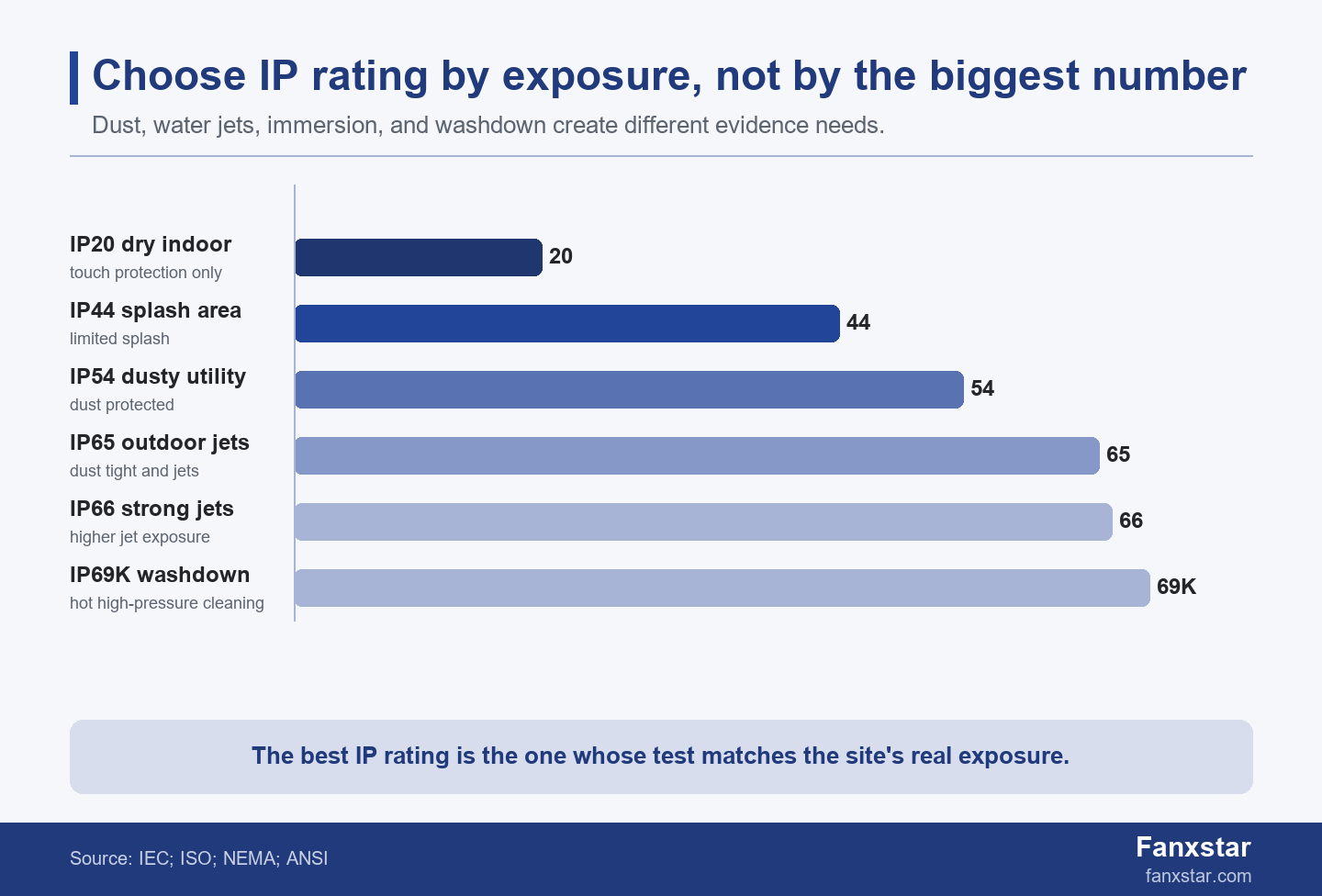
IP20 to IP69K Quick Chart for LED Lighting
Use the chart as a specification starting point, not final proof
| Rating | Plain meaning | Typical LED lighting use | Buyer caution |
|---|---|---|---|
| IP20 | Finger-sized object protection, no water rating | Dry indoor office or protected ceiling areas | Not for dust, condensation, washdown, or outdoor exposure. |
| IP44 | Small object and splash protection | Light splash zones or sheltered utility areas | Splash is not hose-jet protection. |
| IP54 | Dust protected and splash protected | Dusty indoor utility or service rooms | Dust protected is not dust-tight. |
| IP65 | Dust-tight and water-jet protected | Outdoor, damp, and many weatherproof lighting projects | Not the same as strong jets, immersion, or hot washdown. |
| IP66 | Dust-tight and strong water-jet protected | Exposed weatherproof luminaires and industrial wet areas | Still not an immersion rating by itself. |
| IP67/IP68 | Temporary or extended immersion depending on test | Flood-prone areas or special wet applications | Immersion does not automatically prove jet or washdown resistance. |
| IP69/IP69K | High-pressure, high-temperature washdown context | Food processing, vehicle, or heavy washdown applications | Confirm whether IEC IPX9 or ISO 20653 IPX9K is requested. |
This chart deliberately uses plain buyer language. It does not replace the full standard, test report, installation instructions, or site engineering review. It helps purchasing teams avoid the biggest early mistakes: using IP20 in wet spaces, treating IP65 as immersion proof, assuming IP68 handles hose jets, or treating IP69K as necessary everywhere.
According to NEMA enclosure type guidance, NEMA enclosure type documents provide general information and point users to NEMA 250 for detailed requirements. That is a reminder for North American buyers: IP and NEMA are related screening languages, but they are not interchangeable proof files. Ask which standard the project actually requires.
The common LED lighting shortlist is IP54, IP65, IP66, and IP69K
In practice, many indoor commercial fixtures stay below IP54 because the space is dry and protected. Weatherproof LED battens, vapor tight fixtures, parking garage luminaires, utility corridor fittings, and food-processing fixtures often move to IP65 or IP66. High-pressure sanitation or vehicle-style washdown discussions may raise IP69 or IP69K, but that should be triggered by cleaning method, not by a desire to buy the largest label.
Fanxstar product starting points include IP65 and IP66 waterproof LED lights, vapor tight LED light fixtures, aluminum weatherproof LED luminaires, and food processing plant LED lighting solutions. Each RFQ should still state the environment, cleaning, cable entry, and temperature boundary so the IP claim can be tied to a product version.
If a supplier says a fixture is waterproof but cannot provide the IP rating, test report scope, cable-entry method, and installation limits, the quote is not ready for technical release. Waterproof is a marketing word; IP evidence is a product file.
Why IP65, IP66, IP67, and IP68 Are Not a Simple Ladder
Jets and immersion are different tests
A frequent mistake is to assume IP68 is automatically better than IP66 for every outdoor or washdown project. IP68 concerns immersion under conditions agreed in the test scope, while IP66 concerns powerful water jets. If the site uses hose jets and never floods, IP66 may be more relevant than IP68. If the site floods or the fixture may be submerged, immersion evidence becomes more relevant.
Water testing beyond IPX6 can be non-cumulative in practical specification language. A fixture tested for immersion may not automatically be tested for strong jets unless the report says so. Buyers with mixed exposure should ask for combined claims such as IP66/IP67 or a report that clearly covers both jet and immersion exposure.
| Decision signal | Buyer implication |
|---|---|
| IP20 | Dry protected indoor use, not wet or dusty industrial use. |
| IP54 | Dust protected and splash protected, but not dust-tight. |
| IP65 | Dust-tight and jet protected for many outdoor or damp projects. |
| IP66 | Dust-tight and strong-jet protected for harsher wet exposure. |
| IP67/IP68 | Immersion question, not automatic washdown proof. |
| IP69K | Hot high-pressure washdown question, not a universal upgrade. |
Cable entry and installation can weaken the rating
The IP rating belongs to a tested enclosure configuration. Cable glands, plugs, end caps, mounting orientation, screws, lens material, gasket compression, drain strategy, and field wiring can all affect real protection. A luminaire can have a strong lab rating and still fail if the installation pierces the enclosure or uses the wrong cable entry.
Ask whether the rating applies with the supplied cable, terminal block, through-wiring, sensor option, emergency battery option, and mounting method. If the buyer asks for a custom cable entry or sensor, the IP evidence should be checked again. A small mechanical change can be a large ingress change.
For ODM projects, use Fanxstar custom LED lighting ODM service to discuss housing, lens, gasket, cable entry, sensor, emergency function, and sample testing as one file. The target is not to maximize the IP number; it is to preserve the right rating in the actual product version.
Where IP69K Belongs and Where It Is Over-Specified
IP69K is a washdown-specific question
According to the ISO 20653 preview, the standard applies to degrees of protection provided by enclosures of electrical equipment on road vehicles. According to F2 Labs on IP69 versus IP69K, IP69 and IP69K are tied to different standard contexts. These facts explain why IP69K is associated with high-pressure washdown language rather than ordinary rain.
Food processing, beverage, agricultural, vehicle, and heavy industrial cleaning can justify IP69K discussions. A dry warehouse aisle usually cannot. Over-specifying IP69K may increase cost, limit product options, or create a false sense of safety if the real problem is chemical resistance, corrosion, impact, condensation, or poor cable entry.
For washdown sites, request cleaning pressure, water temperature, chemical exposure, nozzle distance, cleaning frequency, ambient temperature, mounting position, and corrosion expectation. The IP rating is one input; material, gasket, lens, cable entry, and maintenance are the rest of the story.
Chemical cleaning is not automatically covered by IP
IP ratings are about dust, access, and water ingress under defined tests. They do not automatically prove resistance to disinfectants, oils, solvents, salt spray, ammonia, acids, alkalis, UV exposure, impact, or thermal cycling. Food plants and cold rooms often need those questions answered alongside IP.
Fanxstar application pages such as food processing plant LED lighting solutions and cold storage LED lighting solutions are useful because they connect ingress protection with real environmental constraints. Buyers should still ask for material compatibility and cleaning details when chemicals are used.
The short rule is: IP tells you what entered the enclosure in a test; it does not tell you every way the fixture can age in the field. Treat it as one line in a technical file, not the entire specification.
RFQ Language for IP-Rated LED Lighting
State the exposure before naming the rating
A stronger RFQ starts with the environment: dry indoor, damp indoor, outdoor rain, hose cleaning, high-pressure hot washdown, dust, powder, salt air, chemical cleaning, freezer condensation, or temporary immersion. Then it names the target rating and asks which fixture configuration supports that rating. This prevents a supplier from quoting a product that looks similar but was tested under different conditions.
According to International Trade Administration document guidance, import documentation should match the shipment. For IP-rated luminaires, that means the product model, label, installation instruction, test report, and quotation should all describe the same rating and configuration. A report for a standard model may not cover a custom cable-entry version.
For Fanxstar projects, send the site photos, cleaning method, target IP rating, cable-entry requirement, voltage, mounting height, ambient temperature, corrosive exposure, sensor or emergency requirement, and target market. The buyer should approve the sample only when the ingress evidence and the product version line up.
FAQ
Is IP68 better than IP66?
Not always. IP68 concerns immersion under defined test conditions, while IP66 concerns powerful water jets. If the site has hose cleaning but no immersion, IP66 may be more relevant. If the site can flood or submerge the fixture, immersion evidence becomes important.
What does IP69K mean for LED lighting?
IP69K is generally used for high-pressure, high-temperature washdown contexts, especially where ISO 20653-style testing is referenced. It is useful for certain food, vehicle, and heavy washdown environments, but it is often over-specified for ordinary outdoor rain or damp indoor spaces.
Is IP65 enough for outdoor LED lights?
IP65 is a common outdoor and weatherproof lighting rating because it combines dust-tight protection with water-jet protection. It may not be enough for strong jets, immersion, hot washdown, chemicals, salt corrosion, or incorrect cable entry. Match the rating to the real exposure.
What should buyers send Fanxstar for an IP-rated lighting quote?
Send the target IP rating, application, cleaning method, dust or water exposure, temperature, corrosion or chemical concerns, cable-entry requirement, mounting method, voltage, sensor or emergency requirement, and target market. Fanxstar can then discuss the right product platform or ODM sample boundary.