Supermarket linear lighting should be specified as a zone system, because uniform aisle brightness, fresh-food color, checkout visibility, and backroom durability ask for different evidence. A supermarket buyer usually loses clicks and project time when the lighting question is reduced to brightness alone. Linear fixtures can make aisles look even, but they can also flatten merchandise, glare on freezer doors, or leave fresh-food displays with the wrong color signal.
CIBSE lighting guidance recommends both task illuminance and uniform distribution, while EN 12464-1:2021 scope information frames workplace lighting around both quantity and quality of illumination. For retail buyers, that means the purchase file should connect lux target, uniformity, glare, color, controls, and service access before fixture spacing is approved.
SLL lighting publications are useful because they remind buyers that lighting is evaluated by visual comfort, task performance, and maintainable evidence, not by a one-line lumen claim. In a supermarket chain, those ideas become practical: the first pilot store should create a repeatable fixture schedule, but each store still needs a zone note for ceiling height, shelf type, refrigeration, signage, and maintenance access.
Key Takeaways
- Linear LED lights are useful for supermarket aisles because they can create a continuous wash, but they should not be the only lighting layer.
- The main specification decision is zone-based: aisles, fresh displays, checkouts, backrooms, signs, and service corridors do not need the same evidence.
- Spacing should be confirmed with photometric data, mounting height, aisle width, shelf height, diffuser choice, and maintenance assumptions.
- Fresh-food retail projects need color and hygiene decisions before final samples, especially when products sit near moisture, refrigeration, or cleaning exposure.
- Fanxstar is most relevant when the project needs linear, weatherproof, sensor-ready, or customized lighting evidence rather than a catalog fixture swap.
Why Supermarket Lighting Cannot Be Specified as One Brightness Level
Uniformity solves one problem and creates another if used alone
Uniform brightness helps shoppers read shelves, compare product labels, and move through long aisles without dark gaps. It also makes the store feel organized. The risk is that uniformity can become visual flatness. If every zone receives the same light level, fresh produce may lose depth, promotional end caps may not stand out, and checkout screens may fight reflections from overhead rows.
The ConTech supermarket lighting guide describes supermarket lighting as a layered design problem and notes that linear LEDs can provide an even wash over large areas. That is a useful starting point, not a final specification. Buyers should decide which layer owns ambient visibility and which layer owns merchandising emphasis.
A second risk is operational. A supermarket is not lit for one perfect photograph. Staff stock shelves before opening, customers move through aisles at different speeds, cleaners work after hours, and maintenance teams need driver access without closing half the store. The buyer should therefore request scenes or schedules: normal trading, stocking, cleaning, partial-night, and emergency circulation. If those modes are not named, a uniform layout may still waste energy or create poor staff visibility.
| Store zone | Lighting priority | Buyer evidence to request |
|---|---|---|
| Main aisles | Uniform horizontal brightness without glare bands. | Spacing layout, photometric file, mounting height, diffuser option. |
| Fresh food | Color quality, cleanable lens, and controlled accent. | CCT/CRI choice, lens material, washdown or hygiene boundary. |
| Checkout | Faces, labels, POS screens, and task visibility. | Vertical illuminance check, glare control, dimming plan. |
| Backroom | Durability, sensors, service access, and low maintenance. | Vapor-tight option, sensor logic, cable entry, driver access. |
| Perimeter signs | Accent ratio without creating dark aisles. | Accent-to-ambient plan and aiming notes. |
Aisle rows need spacing proof, not just a fixture wattage
DOE FEMP LED luminaire purchasing guidance includes indoor linear ambient products in its commercial and industrial LED luminaire guidance. The buyer lesson is that a linear fixture should be treated as a luminaire with measurable output, distribution, and efficiency evidence, not as a strip of light sold by length.
Spacing proof starts with mounting height, aisle width, shelf height, fixture distribution, target maintained lux, and the reflectance of the ceiling, floor, and merchandise. A high-output fixture may reduce quantity but create bright stripes. A lower-output fixture may improve comfort but require more rows. The right answer is the layout that gives maintained visibility and shelf-face readability, not the smallest count.
DLC product eligibility language also helps buyers avoid comparing unlike fixture types. A linear ambient luminaire, a batten, a vapor-tight product, and a decorative strip can all be called linear in sales language, but they do not serve the same mounting, optics, lens, ingress, or maintenance purpose. The RFQ should state the primary use before price comparison.
How to Build the Supermarket Lighting Brief
Separate ambient, task, accent, and service layers
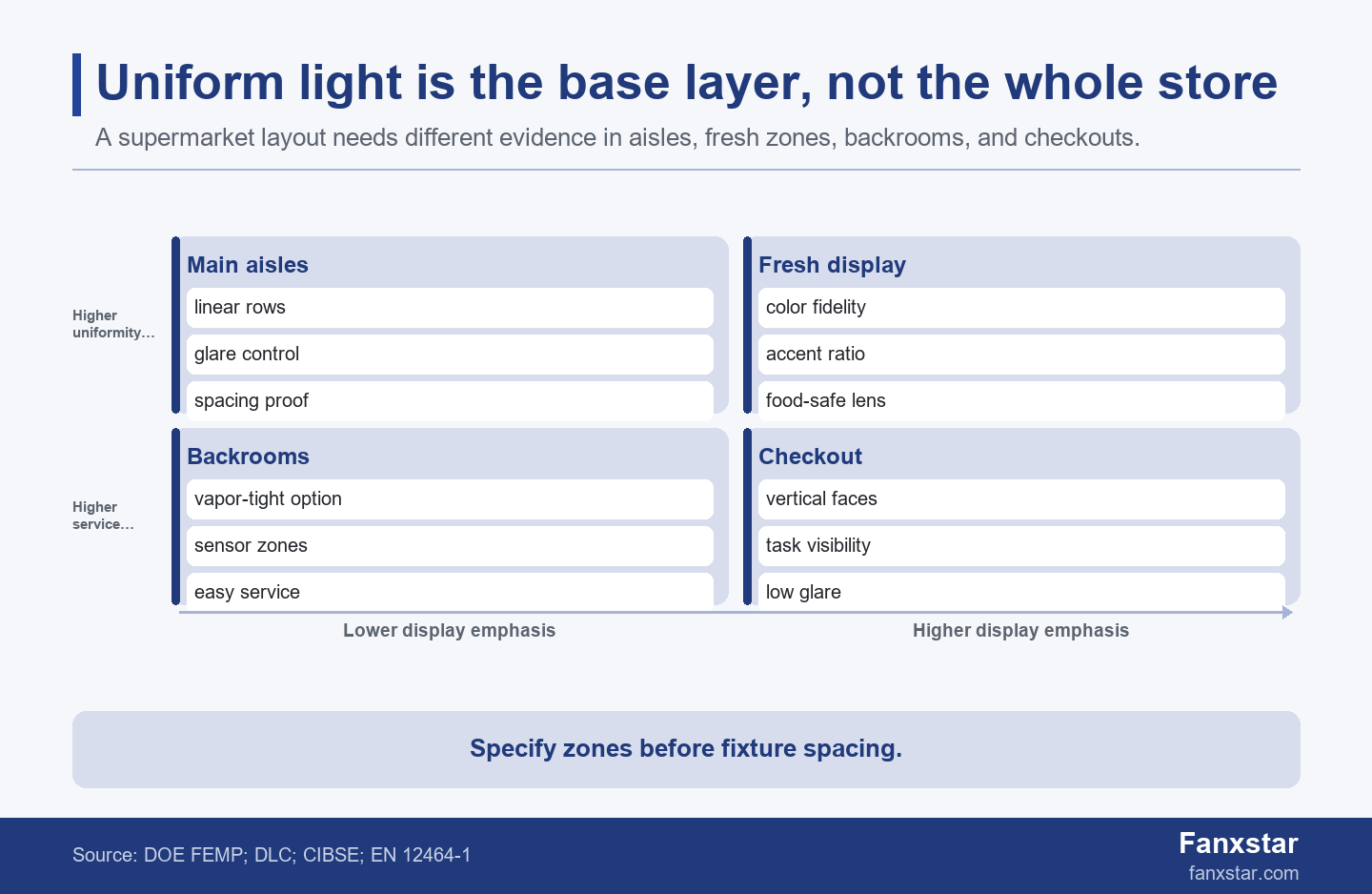
A useful supermarket brief separates four layers. Ambient linear rows make circulation and aisle reading stable. Task lighting helps labels, checkout work, preparation areas, and service counters. Accent lighting creates priority for signs, end caps, and fresh displays. Service lighting protects backrooms, loading areas, and maintenance access.
Based on our analysis of this scenario, 4 layers should be assigned before fixture spacing is finalized. Based on our analysis of this scenario, 3:1 is a useful accent-to-ambient ratio reference for signs and end-cap emphasis. Based on our analysis of this scenario, 5 zones should be reviewed: aisles, fresh food, checkout, backroom, and perimeter signs. Based on our analysis of this scenario, 1 photometric file should support every proposed linear fixture family. Based on our analysis of this scenario, 2 samples can compare diffuser and color before rollout. Based on our analysis of this scenario, 30 days is a practical window for mockup feedback before a chain rollout. Based on our analysis of this scenario, 10 percent extra allowance can be reserved for spacing refinement in early layouts. Based on our analysis of this scenario, 1 maintenance plan should define cleaning exposure and driver access.
For chain buyers, the layer brief should also name what can vary store by store. A flagship fresh-food store may need stronger display tuning, while a discount grocery may prioritize durable rows and lower maintenance. The approved family can stay consistent, but the zone schedule should allow controlled variation in CCT, optic, suspension height, sensor grouping, and sealed-housing option.
Ask for color evidence where food perception matters
Fresh food retail is not only about lux. Produce, meat, seafood, bakery, and chilled cases all create different color and reflection problems. The wrong CCT or color rendering can make products look cold, dull, or over-saturated. The buyer should request a sample scene or controlled comparison before approving CCT and diffuser choices for fresh areas.
Fanxstar’s LED lighting for fresh food retail and food processing plant LED lighting solutions are relevant when the project crosses from store presentation into hygiene, moisture, or cleaning exposure. In those zones, the sample should confirm both appearance and enclosure boundary.
Color evidence should be reviewed under real merchandise, not only on a white wall. Produce leaves, red meat, bread crust, labels, freezer doors, and stainless counters reflect light differently. A buyer can ask for a simple sample decision sheet: product category, CCT option, CRI or color requirement, diffuser, lens cleanability, and whether the selected fixture is used for display, ambient, or service lighting.
Fixture Selection Criteria for Linear LED Supermarket Projects
Choose beam shape before you choose fixture count
The beam distribution decides whether light reaches shelf faces, stays on the walking path, or creates a bright line on the ceiling. A supermarket with tall gondolas may need different row spacing from a low-shelf grocery store. A clean open ceiling may accept suspended linear rows; a low ceiling may need surface-mounted or recessed optics. The count cannot be reliable until the distribution is known.
DLC solid-state lighting technical requirements matter because they point buyers toward measurable luminaire evidence. For a supermarket buyer, useful evidence includes IES/LDT photometry, lumen output, efficacy, CCT, CRI, glare control, driver data, mounting details, and maintenance instructions.
Beam choice should also be checked against merchandising changes. A store may move shelves, change end-cap promotions, or add refrigerated cases after the first lighting design. A narrow distribution can look efficient on the original plan and become fragile after fixture rows and shelves no longer align. A wider distribution can improve flexibility but may waste light or increase glare if the ceiling is low. The final sample should therefore include a tolerance rule for layout changes.
Controls should follow shopper and staff behavior
ENERGY STAR commercial lighting upgrade guidance notes that lighting upgrades can connect to controls and incentives. In a supermarket, controls should not be added as a decorative energy feature after the layout is finished. They should follow business behavior: early stocking, open hours, cleaning, backroom movement, emergency routes, and partial-night operation.
For projects using motion sensor LED lighting or a mixture of LED linear lighting platform and weatherproof LED lighting product platform, the buyer should define which zones dim, which zones stay on, and which zones require instant full light. The controls plan should be tested with the fixture driver, not assumed from a catalog option.
Controls can also change customer perception. Aggressive dimming near fresh displays can make the store feel closed; delayed sensor response in backrooms can frustrate staff; a mismatch between emergency routes and normal sensor zones can create confusing behavior. The RFQ should therefore ask for control scenes, driver compatibility, failure behavior, and whether dimming curves remain stable across the chosen fixture family.
Fanxstar RFQ Checklist for Supermarket Linear Lighting
Send the site and merchandising constraints together
A useful RFQ should include store plan, ceiling height, aisle width, shelf height, product zones, refrigeration or moisture exposure, target market, voltage, preferred CCT, control method, installation type, and rollout timing. If the project includes fresh food, cleaning, or service rooms, say which areas need sealed or weatherproof luminaires.
The RFQ should separate required evidence from optional preferences. Required items include photometry, electrical rating, mounting method, driver access, lens or diffuser material, target CCT, control compatibility, warranty boundary, and sample deadline. Optional preferences can include housing color, suspension accessory, decorative trim, or packaging. This separation keeps the supplier from optimizing cosmetic details while the layout evidence remains incomplete.
| Input | Why it changes fixture count | What to send Fanxstar |
|---|---|---|
| Mounting height | Changes beam overlap and shelf-face brightness. | Ceiling height, shelf height, suspension limits. |
| Aisle width | Controls row spacing and edge spill. | Plan drawing and main aisle dimensions. |
| Fixture output | High lumens can reduce count but increase glare risk. | Target lumen package and diffuser preference. |
| Maintenance factor | Dust, cleaning, and depreciation reduce maintained light. | Cleaning exposure and maintenance interval. |
| Controls | Dimming and sensors change operating scenes. | Sensor zones, time schedule, daylight or dimming requirements. |
Approve samples by zone, not only by fixture family
Use Fanxstar custom LED lighting ODM service when the linear fixture needs a changed length, diffuser, sensor, cable entry, CCT, optics, or housing. Use LED linear batten lights when the project can start from a platform fixture and adapt the evidence file. The sample should show the zone decision: aisle row, fresh display, checkout, or backroom.
The final buying rule is simple: approve the layout only when fixture spacing, photometry, CCT, diffuser, driver, controls, maintenance access, and sample appearance all describe the same store zone. Uniform brightness is valuable, but a supermarket rollout needs controlled variation.
For multi-store rollout, keep a record of what the sample actually proved. A sample may validate lens appearance but not installation labor. It may prove aisle uniformity but not checkout glare. It may prove fresh display color but not cleaning durability. The approval note should state which zones are approved, which conditions are still site-specific, and which component changes require a new review.
FAQ
Are linear LED lights good for supermarkets?
Linear LED lights are a strong ambient layer for supermarket aisles because they can create a continuous and uniform wash. They still need support from accent, task, and service lighting in fresh-food, checkout, sign, and backroom zones. The buyer should check whether the same family can support different optics, mounting methods, controls, and lens options before using it across the whole store.
What should supermarket lighting buyers check first?
Buyers should check the store zones, not only the fixture wattage or lumen output. The first file should include aisle spacing, mounting height, target maintained lux, shelf height, CCT, glare control, controls, and cleaning exposure. Once those inputs are fixed, fixture output and row spacing become meaningful instead of arbitrary.
How does Fanxstar support supermarket lighting projects?
Fanxstar can start from linear, weatherproof, motion-sensor, and custom LED lighting platforms when a supermarket project needs sample evidence or fixture adaptation. The buyer should send the floor plan, zone requirements, voltage, CCT, control method, rollout constraints, and any fresh-food or cleaning exposure. That lets the recommendation connect product platform, sample, and evidence file.
Can one fixture type light the whole supermarket?
One fixture family can sometimes cover large areas, but one specification rarely suits every zone. Aisles, fresh displays, checkout counters, backrooms, and service corridors should be checked separately for uniformity, color, glare, durability, and maintenance. A controlled family strategy is usually safer than forcing one brightness level everywhere.