Key Takeaways
- Class I, Class II, and Class III are protection methods, not quality grades.
- Class I depends on a reliable protective earth path; Class II depends on insulation construction; Class III depends on a separated extra-low-voltage supply.
- Wet-location and metal-body LED fixtures need the class decision tied to cable entry, housing, service access, and certificate scope.
- ODM buyers should hold sample approval if label, wiring diagram, and physical construction point to different protection routes.
Start with the protection method before comparing safety classes
Protection method is the real decision
Class I, Class II, and Class III describe how electrical equipment protects a user from electric shock. OSHA’s wiring rules note that listed or labeled tools and appliances with double insulation may not require grounding under defined conditions, as shown in OSHA 1926.404. The Swedish Electrical Safety Authority page on protection classes explains Class III around SELV supply limits. For a lighting buyer, those definitions matter only when they are connected to the fixture body, driver, cable entry, installation environment, and market approval route.
The wrong question is “Which class is best?” The right question is “Which protection method remains valid after this exact luminaire is installed, cleaned, serviced, rewired, and inspected?” A plastic indoor adapter, a metal weatherproof luminaire, a low-voltage sensor fixture, and an emergency batten do not carry the same risk path.
Why generic appliance explanations miss the B2B lighting problem
Many basic explanations treat the classes as consumer-appliance labels. B2B LED lighting needs a procurement answer. The buyer has to decide what evidence to request, what the supplier can support, what the installer must maintain, and whether a customization changes the approval scope. A class label without supporting documents can make two quotations look comparable when they are not.
This is especially important for sealed luminaires. A metal body can make protective earth evidence more important. A plastic housing can shift attention to insulation design. A remote or integral driver can change the supply boundary. A sensor or emergency battery can change the wiring and service assumptions. The class is therefore a specification decision, not a marketing badge.
How Class I, Class II, and Class III differ in real lighting projects
Class I: the earth path must be designed and maintained
Class I equipment uses basic insulation plus a protective earth connection. In a metal LED luminaire, that means the earth path must be more than a green-yellow wire in a photo. Buyers should request terminal design, continuity evidence, conductor routing, bonding of accessible metal parts, and installation instructions that make the earth requirement clear.
The buyer should also consider field realities. If the fixture will be installed in a wet, dusty, or corrosive area, the cable gland, terminal cover, and service procedure matter. A Class I claim can become weak if the installer cannot maintain the protective earth path after cleaning, vibration, or repeated service access.
Class II: no earth wire does not prove double insulation
OSHA’s interpretation on double-insulated products says such tools use a special insulating system instead of grounding and must be distinctively marked, as described in OSHA’s double-insulation interpretation. For luminaires, the buyer should not conclude that a product is Class II merely because it has a two-wire input. The question is whether the construction provides the needed double or reinforced insulation between hazardous live parts and accessible surfaces.
Technical summaries such as XP Power’s IEC protection class explanation and Bel Fuse’s discussion of UL Class 2 versus IEC classes are useful reminders that similar words can mean different things across standards. “Class II” insulation and “Class 2” power limits are not the same procurement question. Confusing them can produce the wrong RFQ.
Class III: SELV helps only if the boundary is real
Class III equipment is supplied from a separated extra-low-voltage source. That can reduce shock risk at the luminaire, but it shifts attention upstream to the power supply. If the supply is not correctly separated, rated, installed, or documented, the fixture label alone does not solve the safety question.
For LED lighting, Class III often appears in low-voltage task lights, sensors, small modules, or controlled systems. It is less useful as a broad claim for every industrial luminaire. Buyers should ask where the mains boundary sits, who supplies the driver, whether the driver is part of the listed system, and what voltage can appear at the fixture under normal and fault conditions.
Evidence to request before approving a sample
Match label, drawing, and construction
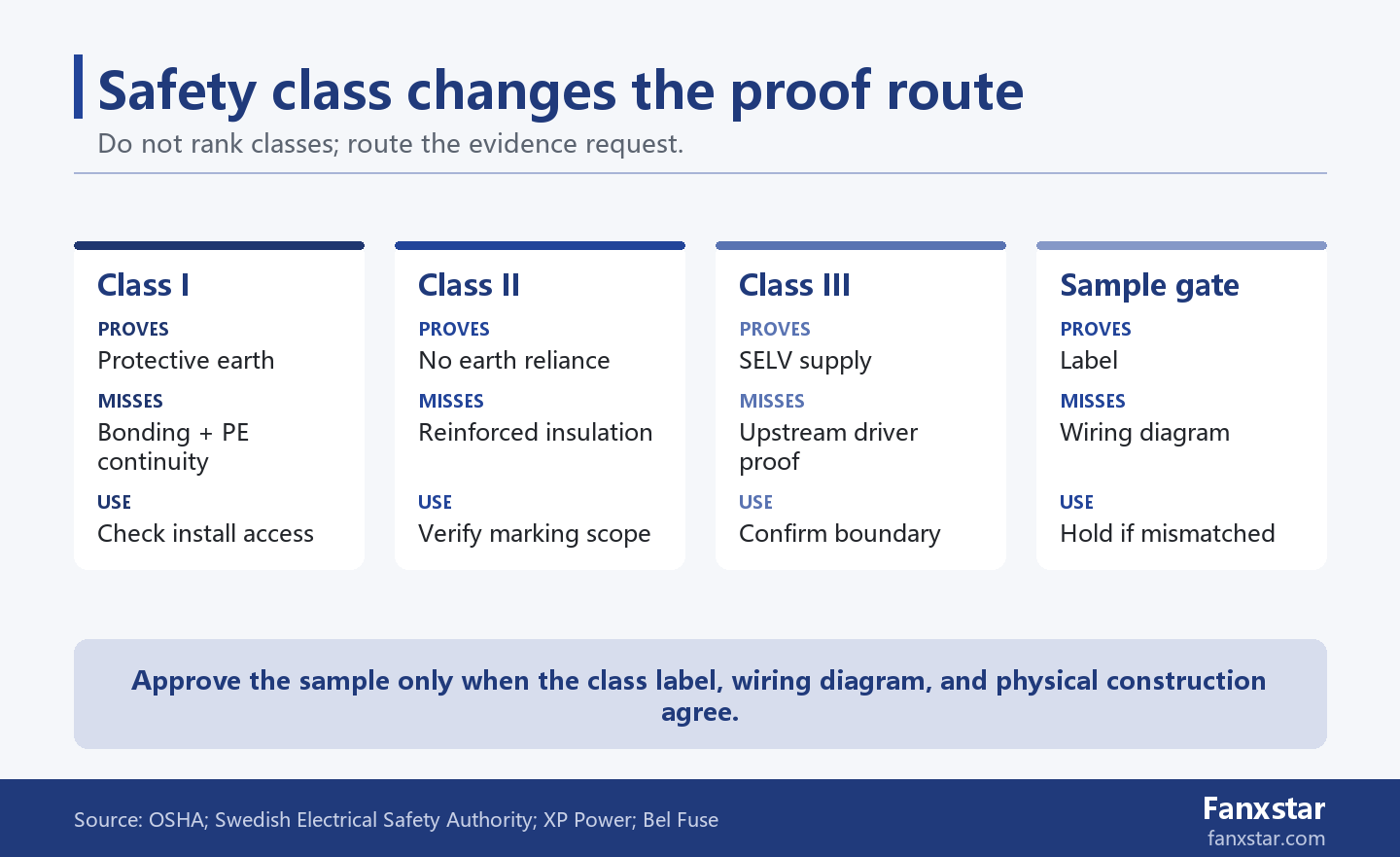
The first evidence test is consistency. The label should match the datasheet. The datasheet should match the wiring diagram. The wiring diagram should match the physical sample. If a quote describes Class II but the drawing shows a protective earth terminal, pause. If a Class I metal luminaire arrives with unclear bonding, pause. If a Class III fixture depends on a separate power supply not included in the evidence pack, pause.
A useful RFQ asks for class declaration, rated voltage, housing material, cable entry, driver location, emergency option, sensor option, certificate scope, and installation instructions. The supplier’s answer should not be a paragraph of assurances. It should produce documents the buyer can review and keep with the sample record.
Use the class to route testing questions
For Class I, ask about earth continuity and accessible metal bonding. For Class II, ask about insulation construction, creepage and clearance logic, markings, and test route. For Class III, ask about SELV supply, voltage limits, and upstream driver evidence. This routing prevents the common mistake of asking every supplier for the same certificate while ignoring the different failure mode behind each class.
OSHA also warns that double-insulated tools have limitations in some conditions, including hazardous locations and voltage-to-ground constraints, in its interpretation on grounding and double insulation. Lighting buyers should treat this as a reminder: the class must be evaluated inside the application, not outside it.
A practical comparison table for lighting buyers
Use this table to frame the RFQ
The table below is not a substitute for local electrical codes or a certification body’s decision. It is a buyer-side checklist that helps procurement teams ask the right evidence questions before they compare prices.
A supplier that answers these questions clearly is easier to evaluate than a supplier that simply says a fixture is safe. The point is not to make the buyer a test laboratory. The point is to stop preventable ambiguity before the order reaches sample approval.
| Class | Protection route | Evidence buyer should request | Release risk |
|---|---|---|---|
| Class I | Protective earth plus insulation | PE terminal, continuity, bonding, installation instructions | Earth path not maintained after installation |
| Class II | Double or reinforced insulation | Construction proof, markings, test scope | No earth wire mistaken for Class II evidence |
| Class III | SELV supply boundary | Separated supply, voltage limits, driver evidence | Upstream supply not controlled |
Why this matters for Fanxstar ODM projects
Custom lighting changes the proof path
Fanxstar works in specialty LED lighting ODM, where a project may adjust CCT, optics, sensor logic, housing material, cable entry, driver choice, or emergency function. Those changes can be commercially useful, but they also mean the safety class and evidence pack must be reviewed for the final configuration. The Fanxstar custom LED lighting ODM service is most useful when the buyer brings the target market and installation conditions before the sample is frozen.
For sealed industrial projects, start by mapping the application to a product family such as weatherproof LED lighting product platform or vapor tight LED light fixtures. Then ask which protection method the exact sample will use. That sequence is stronger than asking for a generic safe fixture and discovering the class issue after testing.
What to send before the next sample
If the project is already at RFQ stage, send the target market, voltage, installation method, metal or plastic body preference, cable entry, sensor or emergency options, and expected certificate route. Fanxstar can then align the sample recommendation with the evidence buyers need before mass production. For projects with uncertain class expectations, contact Fanxstar for an ODM lighting quote only after the installation assumptions are written down; the quote will be more useful and easier to compare.
The buyer’s goal is not to choose the most impressive class. The goal is to approve a fixture whose protection method, documents, and installation reality say the same thing.
Decision scenarios that change the recommendation
Wet metal corridor
A wet industrial corridor using a metal weatherproof luminaire often points buyers toward strong Class I evidence, unless the product is intentionally built and certified around another route. The key is not the metal body itself; the key is whether accessible metal parts, cable entry, and service conditions are controlled.
A procurement team should ask for earth continuity evidence and installation instructions before it treats a metal-bodied sample as release-ready. If the site is corrosive, the service procedure and cable gland become part of the safety conversation.
Low-voltage controlled zone
A low-voltage controlled zone can make Class III attractive, but only when the separated power supply is part of the approved system. If the buyer supplies the power unit separately, the luminaire supplier may not control the entire safety boundary. The RFQ should therefore identify which party owns the supply evidence.
This scenario is common in sensor, display, and specialty low-voltage projects. The label on the fixture is not enough. The power architecture must be documented.
When a sample should be held before class approval
Hold the sample when the class claim and service reality disagree
A sample should be paused when the protection method works only on paper. For example, a Class I metal luminaire may show an earth conductor, but the buyer still needs to know whether the accessible metal parts are bonded, whether the terminal remains protected after servicing, and whether the installation instructions tell the installer how to maintain the protective path. If the enclosure will be opened for driver replacement, cleaning, or wiring, service reality is part of the class decision.
The same rule applies to Class II and Class III designs. A two-wire product is not automatically Class II, and a low-voltage luminaire is not automatically safe unless the SELV supply boundary is included in the evidence package. The buyer should hold approval when the label, sample, wiring diagram, and certificate scope do not describe the same construction.
The sample gate should name the next proof, not only the problem
The useful response to a mismatch is not a vague request for more safety information. Name the next proof. For Class I, ask for earth continuity and bonding evidence. For Class II, ask for insulation construction, marking, and test-scope evidence. For Class III, ask for the separated supply and voltage boundary. Under these assumptions, a supplier that can answer with documents is closer to production readiness than a supplier that answers only with reassurance.
For Fanxstar ODM projects, the timing matters because customization can alter the proof route. If the sample changes from plastic to aluminum housing, adds a sensor, changes driver architecture, or adds an emergency pack, the buyer should treat class evidence as a fresh sample question. This protects both sides: procurement avoids approving a misleading sample, and engineering avoids building production around a class assumption that the final configuration cannot support.
A useful internal rule is to write the hold reason as a release condition. Instead of saying “safety class unclear,” write “release after supplier provides Class II insulation construction evidence that matches the final housing and driver arrangement.” Instead of saying “Class III needs checking,” write “release after the supplier identifies the separated supply included in the approved system.” This wording prevents the sample review from becoming an open-ended argument and gives the supplier a concrete evidence target.
The rule also helps compare quotations. If Supplier A includes the correct proof path and Supplier B only lists a class on the datasheet, the lower price is not yet comparable. The buyer is comparing a documented protection route with an unsupported label. That difference should be visible in the procurement record before price, tooling, or delivery promises dominate the decision.
FAQ
Is Class I safer than Class II for LED lighting?
No. Class I and Class II use different protection methods. The safer choice is the one whose evidence, installation conditions, and product construction match the project.
Can a metal LED fixture be Class II?
It can be, but only if the construction provides the required double or reinforced insulation. A buyer should not assume Class II status from the absence of an earth wire.
Is Class III always low risk?
Class III reduces shock risk at the equipment only when the separated extra-low-voltage supply boundary is real and documented. The upstream power supply still matters.
What should an ODM buyer ask Fanxstar before sampling?
Ask for the class route, voltage, cable entry, housing material, driver location, sensor or emergency options, and certificate scope for the final sample configuration.