
Total harmonic distortion becomes a lighting procurement problem when LED drivers, controls, and other nonlinear loads are approved as products but not checked as one electrical system. A single LED fixture with acceptable driver data can still become part of a grid problem when hundreds of fixtures, sensors, emergency modules, VFDs, UPS systems, and production loads operate together.
IEEE 519-2022 frames harmonic control around electrical systems with linear and nonlinear loads and applies voltage and current distortion limits at the user point of common coupling. That makes the buyer question different from a catalog check: the project has to connect fixture evidence to the facility electrical boundary.
European Commission light sources policy also shows why buyers should distinguish the light source or control gear evidence from the installed system decision. A luminaire can have a valid product file and still require a project-level review when the installation has many electronic loads, sensitive equipment, or utility requirements.
Key Takeaways
- THD should be reviewed at two levels: the LED driver or luminaire datasheet and the facility point of common coupling.
- A low-THD driver is helpful, but it does not replace a system study when many nonlinear loads share the same distribution path.
- DLC V5.1 uses power factor of at least 0.9 and THD of no more than 20 percent as qualification requirements for covered luminaires.
- Industrial buyers should request driver THD, PF, input voltage, load count, dimming/control mode, and measurement boundary before release.
- Fanxstar projects should treat THD as part of the electrical evidence file when lighting is sensor-ready, high quantity, emergency-backed, or used in sensitive facilities.
What THD Means in an Industrial Lighting Project
THD measures waveform distortion, not general product quality
Total harmonic distortion describes how much the current or voltage waveform departs from the fundamental sine wave. In LED lighting, the immediate product-level source is usually the electronic driver. In an industrial facility, the lighting drivers are only one contributor. Other nonlinear loads, including drives, UPS systems, chargers, computers, and power supplies, can shape the same electrical environment.
DLC SSL technical requirement tables state that DLC-qualified luminaires must have power factor of at least 0.9 and total harmonic distortion of no more than 20 percent. That is a useful product screen. It should not be confused with a guarantee that a whole facility will meet harmonic limits under every load mix.
A buyer should therefore read THD as a release clue, not a product slogan. A driver file should state whether the number is input-current THD, input voltage, rated load, dimmed state, and exact driver model. If the same fixture can ship with alternate drivers, the THD and PF evidence should follow the production driver, not the sample label from an earlier build.
| Procurement question | Why it matters | Evidence to request |
|---|---|---|
| Where is the PCC? | IEEE 519 evaluates distortion at the user point of common coupling. | Electrical single-line diagram and study boundary. |
| How many nonlinear loads? | LED drivers, VFDs, UPS systems, and chargers can interact. | Load schedule and operating modes. |
| What is driver THD? | Fixture-level THD affects aggregate current distortion. | Driver datasheet and test report. |
| What is power factor? | Low PF increases current and can hide distortion issues. | PF at input voltage and loading condition. |
| How will it be measured? | Bandwidth, source impedance, and site condition affect readings. | Power-quality measurement plan. |
The point of common coupling changes the question
IEEE 519-2022 standard page describes the point of common coupling as the interface between sources and loads. That matters because a fixture datasheet is measured under defined laboratory or product conditions, while the PCC reflects the facility’s aggregate electrical behavior. A buyer who only asks for the driver THD percentage may miss the real risk boundary.
For a small office, the product datasheet may be enough. For a plant, data hall, cold room, tunnel, or warehouse with hundreds of LED drivers and other nonlinear loads, the buyer should ask how the lighting package affects the load schedule. The answer may be simple, but the boundary should be named.
The PCC question also clarifies responsibility. The fixture supplier should provide accurate product evidence. The electrical designer or power-quality engineer should decide whether the facility needs a harmonic study. The buyer should not let either side blur that boundary, because a supplier cannot certify the whole grid from a driver datasheet and an engineer cannot evaluate the lighting package without exact driver information.
Why LED Lighting Can Matter to Power Quality
LED drivers are nonlinear loads
AIMS research on harmonic emission of LED lighting states that LED lights are nonlinear loads that can potentially affect distribution grids. The practical implication is not that LED lighting is unsafe. The implication is that electronics-based lighting should be specified with electrical evidence when installed at scale.
Measurement method also matters. Bandwidth, source impedance, input voltage, dimming state, and sample condition can change measured behavior. For buyers, that means a THD number without test condition is weaker than a driver file with voltage, load, measurement context, and product version.
Lighting buyers should be especially careful with retrofit projects. Old panels, existing neutral loading, mixed driver ages, emergency battery packs, dimming systems, and production equipment can all make the installed result different from a clean product test. The RFQ should ask whether the proposed fixture family has been used in similar load quantities and whether driver substitutions are locked before shipment.
Scale and operating mode change the risk
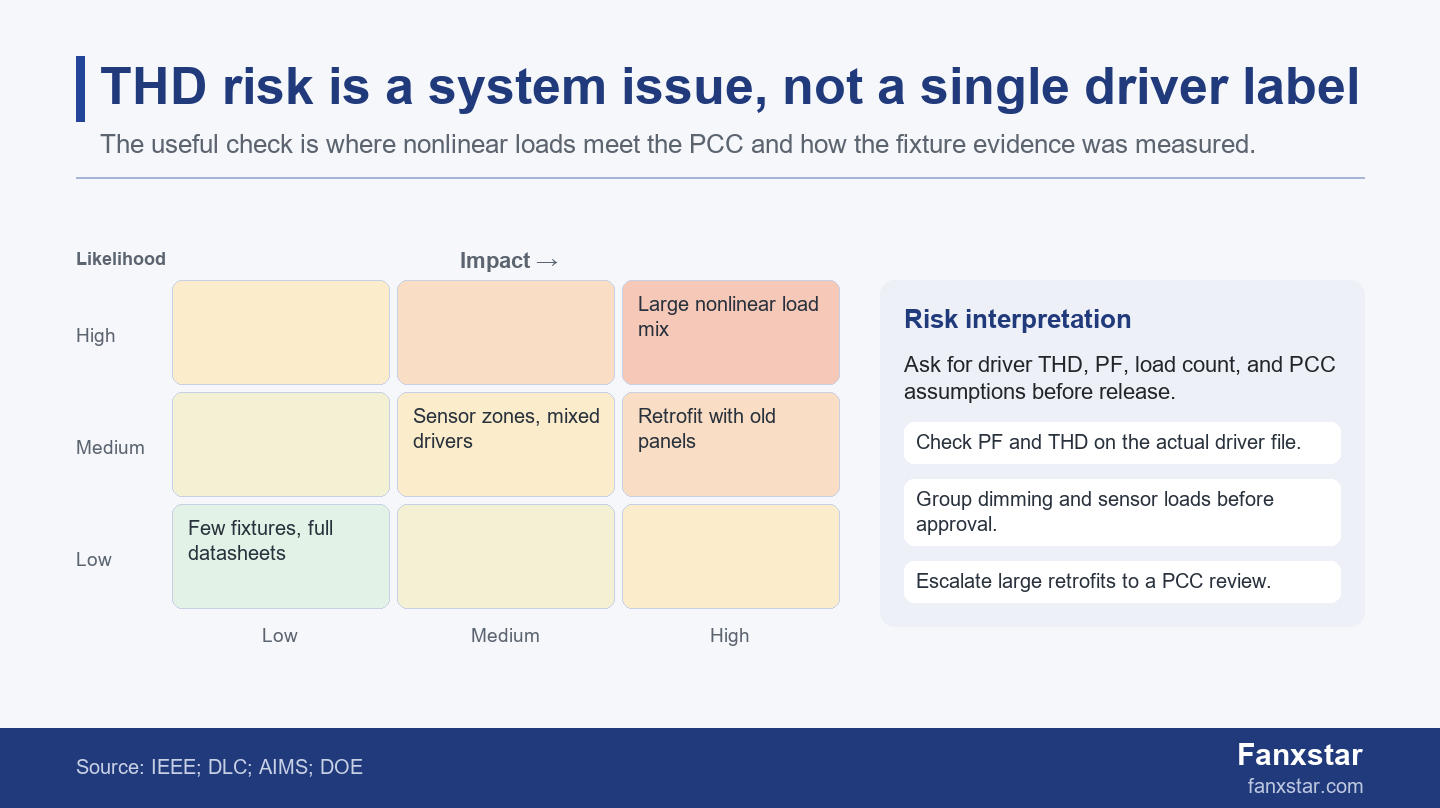
A warehouse with 20 fixtures is not the same as a production facility with 2,000 fixtures, multiple sensor zones, emergency drivers, and large motor loads. Dimming, standby, sensor switching, and partial loading can also change electrical behavior. The buyer should ask whether THD and PF are stated at full load only or under the operating modes the site will actually use.
Based on our analysis of this scenario, 20 percent is the DLC THD ceiling used for qualified covered luminaires. Based on our analysis of this scenario, 0.9 PF is the DLC power-factor floor for those same luminaires. Based on our analysis of this scenario, 1 PCC should be named before a facility-level harmonic question can be answered. Based on our analysis of this scenario, 3 load groups should be separated: lighting drivers, motor drives, and backup power loads. Based on our analysis of this scenario, 2 modes should be checked when dimming or sensor standby is used. Based on our analysis of this scenario, 10 percent site spare capacity can disappear if nonlinear loads are ignored in a tight panel. Based on our analysis of this scenario, 1 driver file should state voltage, PF, THD, and test condition. Based on our analysis of this scenario, 1 measurement plan should define analyzer location and operating state.
Operating mode is often missed because lighting quotations are written around fixture quantity. A sensor-ready project may run many luminaires at full output during shift changes and partial output during idle periods. An emergency-backed project may add charging circuits. A smart-control project may introduce many low-power standby states. Those modes should be listed before the buyer treats one full-load driver number as the whole answer.
What to Ask Before Approving LED Fixtures
Ask for THD and PF in the same evidence request
Power factor and THD are often listed near each other because both affect how the driver draws current. A high power factor does not automatically mean low distortion, and a low THD number without operating condition may still be incomplete. The buyer should request both values, the input voltage, the loading condition, and whether the values apply to the exact driver used in the production fixture.
DOE FEMP LED luminaire guidance is useful because it keeps the procurement file at luminaire level. For Fanxstar projects, the luminaire file should identify the driver, emergency module, sensor, dimming interface, and substitutions that would reopen the evidence question.
DLC solid-state lighting technical requirements add another procurement lesson: qualification programs compare defined product categories and reported performance, so buyers should not merge unlike fixtures into one electrical assumption. A vapor-tight fixture with one driver, a high-bay with another driver, and an emergency luminaire with a battery circuit should each keep its own evidence line.
Separate product qualification from facility compliance
A fixture can meet a product qualification requirement and still need a facility review. That is not a contradiction. Product qualification screens the luminaire. Facility compliance evaluates how many nonlinear loads operate together, where they connect, and what the utility or project standard expects at the PCC.
EUR-Lex light sources summary separates product rules for light sources and control gear from broader installation decisions. Industrial buyers should use the same mindset for electrical evidence: the test method, operating condition, and product version matter as much as the percentage on a datasheet.
The facility review should also name what happens after approval. If the supplier changes the driver because of availability, if the contractor changes the dimmer, or if the site adds a generator-backed circuit, the original assumption can become stale. A practical purchase file includes a substitution rule, not only a pass value.
Fanxstar RFQ Language for THD-Sensitive Projects
Tell the supplier when the electrical environment is sensitive
THD should be named in the RFQ when the project uses many fixtures, a generator, UPS, data hall, VFD-heavy plant, tunnel system, emergency lighting package, or sensor-dimming control scheme. Relevant Fanxstar starting points include LED lighting controls for industrial facilities, AI data center lighting, and LED emergency lighting product range.
The RFQ should request driver model, input voltage range, PF, THD, dimming method, emergency option, sensor standby behavior, load count per circuit, and whether substitutions require approval. If the facility needs IEEE 519 assessment, the electrical engineer should define the PCC and measurement plan. The lighting supplier should provide product evidence, not pretend to certify the whole grid.
A useful RFQ phrase is: provide PF and input-current THD for the exact production driver at the stated voltage and operating mode, and confirm whether any driver, sensor, emergency module, or dimming substitution changes the evidence file. That phrase prevents a generic catalogue value from being treated as a locked engineering record.
Approve the final driver, not a placeholder
For custom or platform-adapted fixtures, use Fanxstar custom LED lighting ODM service to define the exact driver, sensor, emergency module, wiring, and label before sample approval. A sample using one driver and production using another driver should not rely on the same THD/PF evidence without review.
The final buying rule is clear: treat THD as a release-file item when lighting quantity, control complexity, or grid sensitivity is high. Ask for product-level evidence first; use a facility-level power-quality study when the electrical boundary makes product evidence alone insufficient.
That rule is practical for purchasing teams because it keeps cost, timing, and responsibility visible. Product evidence can be collected during sample approval. Facility study questions can be escalated only for the sites that need them. The mistake is waiting until installation to discover that driver evidence, panel loading, and utility expectations were never discussed together.
FAQ
What is total harmonic distortion in LED lighting?
Total harmonic distortion describes how much the current or voltage waveform differs from the fundamental sine wave. In LED lighting, it usually comes from electronic drivers and becomes more important when many fixtures and other nonlinear loads share a facility electrical system. The useful buyer question is the driver value, the operating condition, and the point where the system will be assessed.
Is 20 percent THD acceptable for LED luminaires?
DLC V5.1 uses THD of no more than 20 percent and power factor of at least 0.9 for covered qualified luminaires. A project may still need stricter limits or a facility power-quality study depending on the PCC, load mix, utility requirement, and electrical design. Buyers should treat 20 percent as a product-screen reference, not a universal site guarantee.
Does a low-THD LED driver guarantee IEEE 519 compliance?
A low-THD driver helps, but it does not guarantee facility-level IEEE 519 compliance by itself. IEEE 519 evaluates distortion at the point of common coupling, so the number of fixtures, other nonlinear loads, and operating modes must also be reviewed. The driver evidence is necessary, but the facility boundary decides whether more analysis is needed.
What should Fanxstar buyers request in a THD-sensitive RFQ?
Buyers should request the exact driver model, input voltage, power factor, THD, dimming method, emergency option, sensor behavior, load count, and substitution rule. If the facility is sensitive, the buyer should also involve the electrical engineer to define the PCC and measurement plan. This keeps Fanxstar’s product evidence separate from the engineer’s facility-level judgment.








