Ra80 and Ra90 are useful color-rendering labels, but they do not decide a lighting project by themselves. Ra80 is often enough for utility and general commercial spaces; Ra90 is stronger for color-critical work. The buying risk appears when a specification treats the average CRI number as a complete description of color quality, efficacy, visual task, and product evidence.
The practical rule is simple: choose Ra90 when color discrimination changes the business result, safety margin, or user confidence. Choose Ra80 when the task is mainly visibility, wayfinding, storage, circulation, or utility work. In both cases, ask for spectral or color-quality evidence that matches the final CCT, driver, optics, diffuser, and fixture platform.
Key Takeaways
- Ra is the general CRI average, not a complete color-quality profile; it can hide weaknesses in specific colors such as saturated reds.
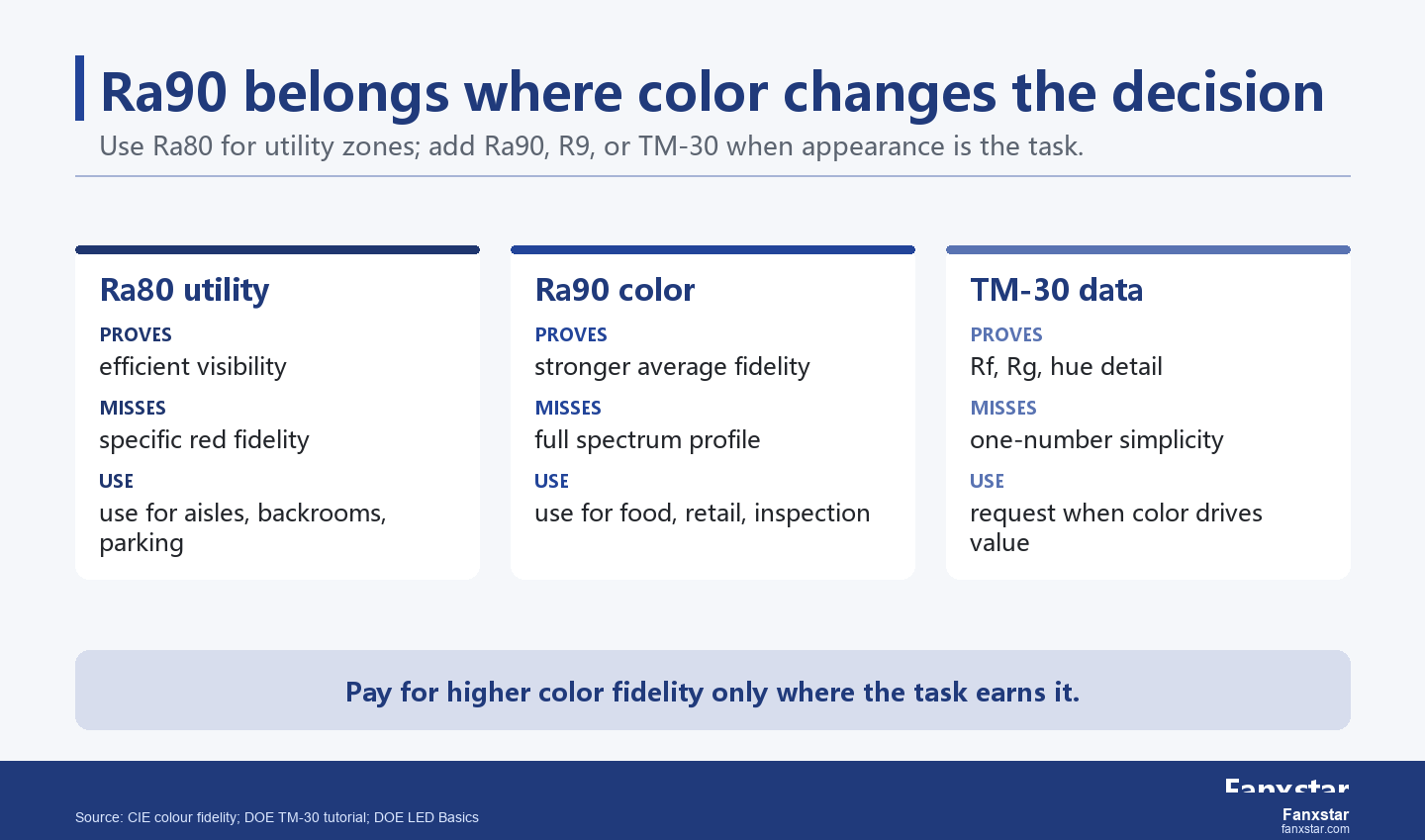
- Ra80 is normally suitable for warehouses, corridors, backrooms, parking areas, and many industrial utility zones when other lighting requirements are met.
- Ra90 is more appropriate for retail, food presentation, inspection, healthcare-adjacent areas, design review, and customer-facing color decisions.
- Buyers should compare CRI with CCT, R9 or TM-30 data, efficacy, optics, glare, flicker, thermal performance, and sample approval under the real task.
What Ra80 and Ra90 actually tell buyers
Ra is an average color-fidelity score
The CIE page on the Colour Fidelity Index explains that the CIE Color Rendering Index, especially the general index Ra, is widely used in lighting specifications and regulations, but also notes that CRI limitations have been addressed especially for solid-state light sources. This is the key procurement boundary: Ra is useful, but it is not the whole story.
Ra80 means the average color fidelity is acceptable for many interior and commercial tasks. Ra90 means the average color fidelity is stronger and usually more appropriate where colors must look accurate or trustworthy. The number does not say whether reds, skin tones, produce, packaging, labels, textiles, warning colors, or medical-adjacent visual cues are rendered well enough for the actual task.
DOE guidance separates CRI levels from color-quality complexity
DOE LED basics states that a minimum CRI of 80 is generally recommended for interior lighting, while CRI of 90 or higher indicates excellent color fidelity. The same DOE page also cautions that CRI is far from perfect and that R9, TM-30 Rf, and TM-30 Rg can provide more comprehensive color-rendering information.
That creates a practical comparison. Ra80 is not a cheap or inferior choice by default. It can be correct when the visual task does not depend on fine color discrimination. Ra90 is not automatically superior for every project because higher color fidelity can increase cost, reduce efficacy, or require a different LED package. The buyer should pay for Ra90 where the application earns it.
Where Ra90 earns its cost
Color-critical applications need more than visibility
Retail food, grocery displays, fresh meat, bakery, medical-adjacent spaces, inspection benches, laboratories, textile areas, product photography, and customer-facing showrooms are not only asking occupants to see objects. They are asking people to judge appearance. A small color-rendering weakness can change perceived freshness, defect detection, product trust, or comfort.
The DOE TM-30 tutorial explains that TM-30 provides numerical measures and graphics that complement one another and predict how a light source influences object color appearance. That matters because a Ra90 claim may still be too shallow if the project needs hue-specific behavior, gamut information, or a comparison between two spectra that share a similar average CRI.
R9 and TM-30 become important when red matters
Many buyer complaints around color rendering are not about the average score. They are about red meat looking dull, fruit looking flat, warning labels losing contrast, skin tones looking unnatural, or packaging colors failing brand review. A supplier can meet an average Ra requirement while still disappointing the task if the spectral distribution is weak in a critical color region.
The DOE TM-30 tutorial shows why average fidelity is only one part of color rendition and why buyers may need deeper color evidence for demanding applications. For a buyer, this means the RFQ should say where color matters. If the project is a food retail aisle, request Ra, R9, CCT, and ideally TM-30 Rf/Rg or a spectral report. If the project is a utility backroom, a well-documented Ra80 fixture may be a better economic fit.
Where Ra80 is usually enough
Utility zones need efficient, reliable visibility
Warehouses, logistics aisles, parking garages, tunnels, stairwells, plant rooms, cold storage corridors, loading docks, and back-of-house service areas usually need safe visibility, uniformity, low glare, reliable switching, appropriate IP/IK protection, and maintainable energy cost. Fine color judgment is often secondary. In those spaces, Ra80 with good optics and thermal evidence can be the right specification.
DOE FEMP buyer tips remind buyers to compare lumens, CCT, CRI, fixture type, and dimming compatibility rather than relying on one label. The same logic applies here. A Ra90 utility fixture with poor glare control, weak sealing, or higher watts may be worse than a Ra80 fixture that delivers stable illuminance, clean distribution, and credible reliability.
Ra90 can reduce efficacy or increase cost in some platforms
The trade-off is not universal, but it is common enough to plan for. Higher color fidelity can require different phosphor blends or LED packages, which may reduce lumens per watt compared with a standard Ra80 option at the same CCT and power. If a supplier offers Ra90 with no change in price, efficacy, spectrum, lead time, or thermal behavior, the buyer should still ask for the test report that proves the final configuration.
Use an illustrative energy screen. If a 20,000-lumen Ra80 fixture delivers 160 lm/W, it draws about 125 W. If a Ra90 version at the same lumen output delivers 145 lm/W, it draws about 138 W. The 13 W difference is small for one fixture but becomes meaningful across 1,000 fixtures running long hours. If Ra90 prevents product-quality errors or improves retail presentation, the premium may be justified. If the area is a stock aisle, the same premium may be waste.
How to write a better CRI specification
Match the color metric to the visual task
A strong RFQ does not simply say “CRI 90 required” for every room. It classifies spaces. Utility zones can specify Ra80 minimum, CCT consistency, glare control, and luminaire efficacy. Color-critical zones can specify Ra90, R9 minimum or reported R9, TM-30 Rf/Rg where appropriate, sample approval under the installed CCT, and a rule for component substitutions.
CIE notes that Ra values do not always correlate well with visual evaluation for solid-state sources. That statement should push buyers toward sample viewing, especially in spaces where appearance carries commercial value. View the sample next to the real materials, packaging, food, surfaces, uniforms, or labels. A spreadsheet score cannot fully replace the task environment.
Keep CCT and consistency in the same decision
Ra80 at 4000 K and Ra90 at 3000 K are not a clean comparison. The color temperature, chromaticity tolerance, binning, diffuser, and control state can all affect perceived quality. A buyer should freeze the intended CCT and compare color rendering inside that CCT. If the project uses dimming or sensors, ask whether color behavior remains acceptable across the expected output range.
For multi-site chains, consistency can be as valuable as the peak score. A supermarket chain may prefer a slightly lower but stable specification across stores rather than mixing several spectra that make departments look different. A warehouse chain may standardize Ra80 and use Ra90 only for inspection or customer-facing zones. The point is to avoid a blanket rule that treats all spaces as if they make the same color decision.
Build a room schedule instead of one universal CRI rule
The cleanest way to specify color rendering is to create a room or zone schedule. Put each space into a color-risk tier: utility, customer-facing, color-sensitive, or inspection-critical. Utility zones can prioritize efficacy, uniformity, glare control, and maintenance. Customer-facing zones can add tighter CCT consistency and higher appearance expectations. Color-sensitive zones can require Ra90, R9 reporting, or sample review. Inspection-critical zones may need TM-30 data, real-material viewing, and supplier change control.
This schedule prevents overbuying and underbuying at the same time. Without it, procurement teams often write Ra90 everywhere because it sounds safe, then lose energy efficiency in areas where color fidelity is not the limiting risk. The opposite mistake is to write Ra80 everywhere because it is efficient, then discover that food, packaging, labels, cosmetics, textiles, or defect inspection look wrong under the installed light.
The schedule should also define evidence. A Ra80 warehouse aisle may need only the standard photometric report and product data. A Ra90 retail display may need CCT binning, R9, TM-30 Rf/Rg, and a visual sample under real merchandise. An inspection station may need a signed approval sample and a rule that the LED package cannot be changed without review. That structure makes the color requirement easier for suppliers to quote and easier for buyers to enforce.
It also gives procurement a clean reason to reject mismatched offers. If the schedule says “Ra90 plus R9 report for fresh meat” and one supplier quotes only “high CRI” without a report, the gap is visible. If the schedule says “Ra80 acceptable for utility backroom” and another supplier pushes a costly Ra90 upgrade, the buyer can decline without appearing to ignore quality. Clear zone logic turns color rendering from a subjective preference into a controlled specification.
Finally, attach the room schedule to sample approval. Evaluate the sample in the most color-sensitive zone first, then confirm the utility-zone option separately. A single office desk test is not enough for retail food, inspection, parking, and backroom applications at once. The sample approval should name the zone it represents.
Fanxstar application fit
Fanxstar buyers can connect color-rendering decisions with fixture platform choices. Use custom LED lighting design options when the project needs a specific CCT, CRI, optics, sensor, housing, or wiring configuration. Use food processing plant lighting guidance and fresh retail lighting guidance when product appearance or sanitation zones change the visual task. Use linear lighting platforms and weatherproof LED lights for utility spaces where Ra80, high efficacy, sealing, and maintenance access may be the stronger balance.
For an ODM lighting sample, send the target CCT, Ra requirement, whether R9 or TM-30 data is needed, application photos, surface colors, required illuminance, lens type, controls, and market documentation. Fanxstar can then review whether a standard Ra80 platform fits, whether Ra90 is justified, or whether the sample should be viewed under the real product or task condition before release.
FAQ
Is Ra90 always better than Ra80?
Ra90 has higher average color fidelity, but it is not always the better project choice. Ra80 can be correct for utility spaces where visibility, efficacy, sealing, glare control, and reliability matter more than fine color discrimination.
When should I specify Ra90?
Specify Ra90 when color judgment affects the business result or user trust. Examples include fresh food retail, inspection, healthcare-adjacent tasks, textile review, display lighting, and customer-facing product presentation.
Why is R9 important?
R9 describes saturated red rendering, which can be critical for meat, produce, skin tones, warning labels, and some product colors. A high average Ra score can still hide weak red rendering, so color-critical projects should request R9 or TM-30 data.
Does higher CRI reduce LED efficacy?
Sometimes. Higher color fidelity can require LED packages or phosphor mixes that reduce lumens per watt. The buyer should compare final luminaire efficacy at the same CCT, lumen output, optics, and fixture version.
What should be checked before approving a CRI-sensitive sample?
Check CCT, Ra, R9 or TM-30 data, photometric report, diffuser, control state, LED board version, and sample appearance under real materials. Freeze the LED package and CCT before approving production.