Luminous efficacy tells buyers how much visible light a source or luminaire delivers per watt, but the number is useful only when it describes the complete product under the right conditions. A high lm/W value can reduce energy cost, yet it can also distract from optics, glare, CCT, CRI, thermal behavior, controls, and the actual illuminance the project must deliver.
For commercial and industrial buyers, the better question is not “which fixture has the highest lm/W?” It is “which fixture delivers the required light distribution, visual quality, reliability, and control behavior with the lowest credible watts?” That wording turns efficacy from a marketing number into a procurement tool.
Key Takeaways
- Luminous efficacy is lumens divided by watts, but buyers should compare luminaire-level efficacy rather than chip-level claims.
- Higher lm/W can reduce operating cost when light output, distribution, CCT, CRI, driver losses, and environment are comparable.
- A fixture with lower efficacy can still be the better choice if it controls glare, color quality, IP sealing, sensor behavior, or thermal reliability better.
- RFQs should request delivered lumens, input watts, photometric files, CCT/CRI, control state, and test condition rather than one isolated efficacy number.
What luminous efficacy really measures
Lumens per watt is a ratio, not a complete lighting design
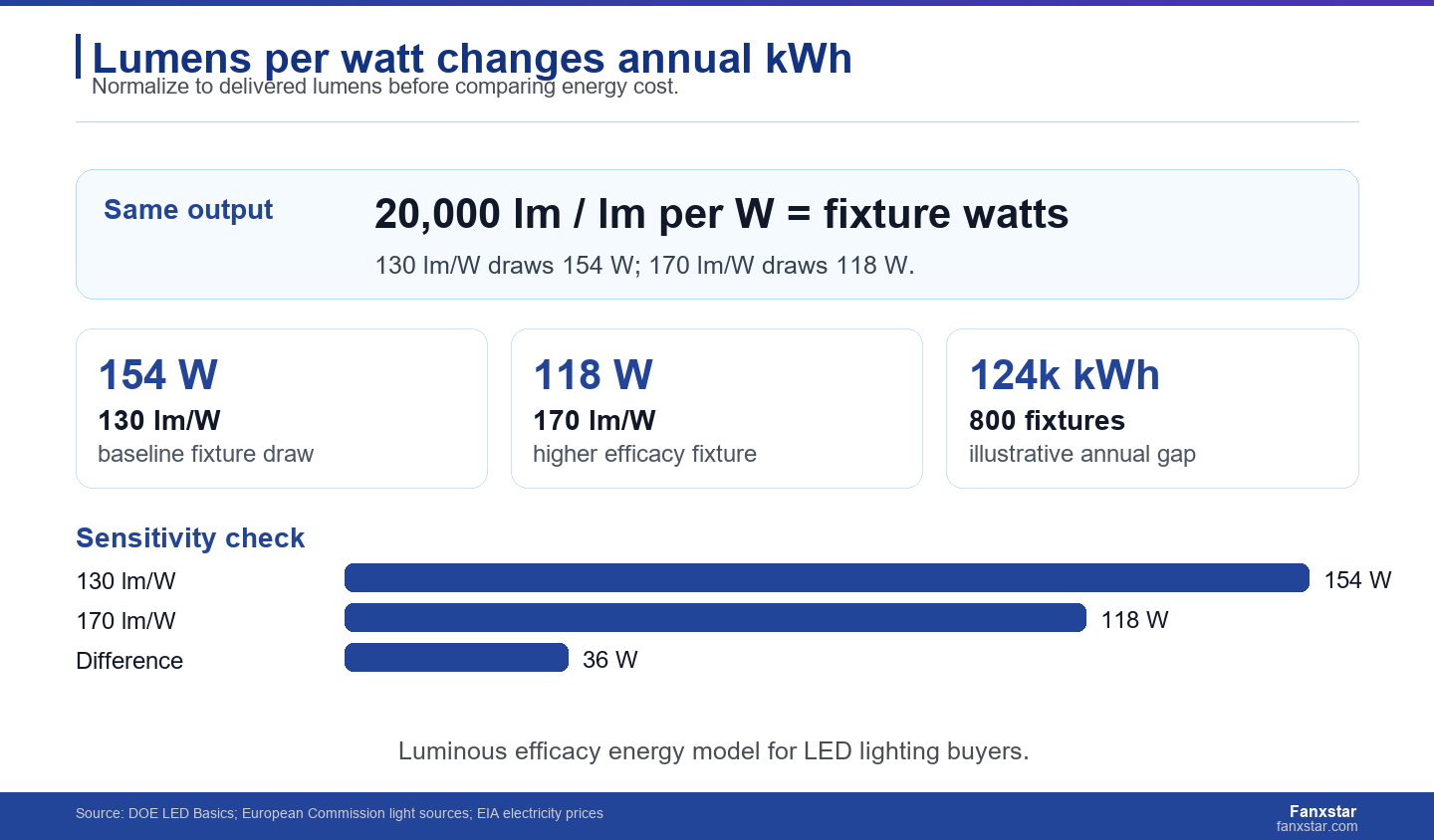
Luminous efficacy is simple: divide luminous flux in lumens by input power in watts. A 20,000-lumen luminaire drawing 150 W has a luminaire efficacy of about 133 lm/W. A 20,000-lumen luminaire drawing 118 W has about 169 lm/W. That comparison is meaningful only if both products deliver the same usable light to the task area, with acceptable glare, color quality, controls, and life evidence.
DOE’s LED basics page makes the distinction buyers need: electricity consumption depends not only on the LED device, but also on fixture design, power-supply efficiency, and features that may reduce source efficiency while providing other benefits. In other words, chip efficacy, source efficacy, and complete luminaire efficacy are not interchangeable. Procurement should compare the finished fixture the buyer will install.
Market ranges show why context matters
The European Commission light-sources page reports LED light-source efficacy in 2015 at about 80 to 140 lm/W, with future expectations above 200 lm/W, while older light-source groups such as halogen, CFL, LFL, HID, and GLS show different typical ranges. Those ranges are useful for context, but they do not decide a project by themselves. A supermarket, freezer room, car park, tunnel, data hall, warehouse aisle, and backroom can all require different trade-offs.
Because luminaires include drivers, optics, housings, seals, lenses, mounting systems, and sometimes sensors or emergency modules, buyers should expect the published luminaire-level number to be lower than an ideal chip number. A credible supplier can explain where the losses occur and why the selected optics or diffuser are justified by the application.
How efficacy changes operating cost
A simple scenario exposes the energy lever
Consider a facility that needs 20,000 delivered lumens per fixture position. At 130 lm/W, the luminaire draws about 154 W. At 170 lm/W, the luminaire draws about 118 W. The difference is 36 W per position. Across 800 fixtures operating 12 hours per day for 360 days, that difference equals about 124,416 kWh per year. At an illustrative electricity price of USD 0.14/kWh, the annual energy difference is about USD 17,418 before maintenance, demand charges, controls, or tax treatment.
This estimate is not a quotation or a universal payback promise. It is a screening model. The buyer still needs the local utility rate, operating hours, light level target, control schedule, and installed fixture count. The EIA electricity price explainer is a useful reminder that electricity prices vary by generation costs, fuel, transmission, distribution, weather, regulation, and customer class. A procurement model should therefore use the buyer’s own tariff instead of a generic savings percentage.
Controls can change the effective value of lm/W
A high-efficacy fixture running at full output all night may waste more energy than a moderately efficient fixture with an intelligent standby sequence in a low-traffic zone. Occupancy sensors, daylight harvesting, dimming, scheduling, and zoning can reduce full-output hours. The efficacy number still matters, but it is only one input in annual kWh.
The DLC technical-requirements page is useful because it connects LED product qualification with evolving requirements for high-performing, efficient, quality lighting and controls. For buyers, the principle is straightforward: compare watts at the intended output state and compare controls at the intended operating sequence. A luminaire-level efficacy value at full output does not automatically describe standby behavior, dimming losses, or emergency operation.
Where high lm/W can mislead buyers
Delivered light can be lower than headline lumens
Headline efficacy can look strong while the installed result is weak. Optical losses, narrow beam patterns, glare control, mounting height, spacing, ceiling reflectance, diffuser choice, and dirt depreciation all influence how much light reaches the task plane. A high-lumen fixture with poor distribution may force closer spacing or create uncomfortable hot spots. A slightly lower lm/W product with better optics can sometimes produce a better installed result with fewer fixtures.
For that reason, RFQs should ask for photometric evidence, not only a lumens-per-watt value. Request the IES/LDT file, beam distribution, tested CCT and CRI, input power, lumen output, power factor, driver type, ambient condition, and whether the test covers the exact diffuser, sensor, and emergency option. If the buyer is replacing old fluorescent or HID systems, ask the supplier to compare maintained illuminance rather than only initial lumens.
Color quality and efficacy create real trade-offs
DOE LED basics notes that high levels of color fidelity typically involve cost and efficiency trade-offs, and that CRI of 90 or higher indicates excellent color fidelity. A buyer who selects only the highest lm/W may unintentionally choose poor color rendering for retail food, inspection benches, healthcare-adjacent tasks, or visual merchandising. A buyer who selects only high CRI may overpay in a utility corridor where color discrimination is not critical.
The correct decision is application-specific. Use high efficacy aggressively in warehouses, parking garages, backrooms, industrial aisles, and service corridors where visual tasks are robust and operating hours are long. Reserve higher color quality, tighter glare control, special spectra, or lower flicker behavior for zones where those attributes change safety, inspection quality, product appearance, or occupant comfort.
What to request in an RFQ
Ask for a fixture-level evidence package
A useful RFQ line is: “Provide luminaire-level efficacy, delivered lumens, input watts, CCT, CRI, photometric file, driver data, power factor, ambient test condition, and the exact fixture version being quoted.” That sentence prevents a supplier from using chip-level marketing values, old test reports, or a different lens option to support a current quotation.
DOE FEMP buyer tips for efficient bulbs show the broader purchasing principle: buyers should consider lumens, wattage, CCT, CRI, fixture type, dimming compatibility, and label information rather than wattage alone. The same mindset applies to industrial and commercial luminaires, even though the form factor and certification evidence are different.
Compare like with like before calculating payback
Before deciding that one fixture saves more energy, normalize the comparison. Match delivered lumens, beam distribution, CCT, CRI, input voltage, driver type, power factor, IP/IK or housing requirement, sensor behavior, ambient rating, and warranty boundary. Then calculate annual kWh. Without normalization, the buyer may compare a bare high-output utility fixture with a sealed, optically controlled, sensor-ready fixture that solves a different problem.
For regulated or multi-market projects, the EU light-sources product page is also a reminder that energy labelling and ecodesign requirements apply to light sources, and the energy-label status of luminaires can differ from the light-source requirement. That distinction matters when a buyer asks a supplier for product information files, EPREL-related data, or market-specific declarations.
Use maintained illuminance before cutting wattage
The strongest efficacy decision still has to protect the light level people will use after the installation has aged. Initial lumens are measured when the product is new. Maintained illuminance considers lumen depreciation, dirt accumulation, room reflectance, mounting height, cleaning schedule, and replacement interval. If a buyer chooses a very high lm/W product with weak optics or poor lumen-maintenance evidence, the energy model can look good while the floor, shelf, workbench, or aisle becomes underlit later.
Ask suppliers to show how the fixture count was selected. A basic layout should include target illuminance, maintenance factor, spacing, mounting height, beam distribution, and the lumen package used in the calculation. For retrofit projects, the comparison should also show whether the new fixture count changes. Replacing 100 old fittings with 100 LED fittings is not always the right baseline; better optics may reduce count, while stricter uniformity or glare targets may require a different spacing plan.
This is where efficacy becomes a design variable instead of a catalog ranking. High lm/W lowers watts for a given lumen package, but the buyer still needs enough delivered light in the right places. When that design proof is missing, the safest response is to request the photometric file and a sample layout before approving the quoted wattage.
The maintained-light approach also helps avoid false savings from under-specification. A supplier can lower wattage by reducing lumen output, narrowing the beam, or removing optical losses, but that does not automatically reduce total project cost if the site then needs extra fixtures, more glare complaints, or earlier replacement. The buyer should ask whether the proposed efficacy saves energy at the same lighting outcome, not merely at the same product category.
For chain stores, warehouses, and industrial groups, keep the calculation repeatable. Use the same assumptions for operating hours, maintenance factor, local energy rate, dimming schedule, and target lux across all suppliers. Then compare the fixture-level evidence. This makes the procurement decision easier to defend internally because the winning fixture is not only brighter or more efficient on paper; it has the best documented balance for the site.
Fanxstar application fit
Fanxstar buyers usually compare efficacy inside a real application boundary: sealed weatherproof housings, linear light distribution, sensor standby levels, emergency options, food-processing washdown, parking garages, warehouses, and data-center service spaces. Relevant starting points include linear lighting platforms, waterproof LED lights, motion sensor lights, and Fanxstar articles on LED lighting controls for industrial facilities and custom LED lighting design options.
Send the target lumen package, mounting height, operating hours, CCT, CRI, beam distribution, IP/IK needs, sensor sequence, and market documentation requirement. The useful supplier response should not be only a high lm/W number. It should show how the fixture platform delivers the required light with credible power, optics, thermal, and control evidence.
FAQ
What does lm/W mean in LED lighting?
Lm/W means lumens per watt. It shows how much visible light a product produces for each watt of electrical power. Buyers should compare complete luminaire efficacy, not only chip or package efficacy.
Is the highest efficacy always the best choice?
No. The highest lm/W can be the best choice when light quality, distribution, controls, reliability, and certification scope are equal. If glare, CRI, optics, sealing, or thermal evidence differ, the lower-efficacy fixture may be the better application fit.
How do I calculate annual energy savings from efficacy?
First calculate watts needed for the same delivered lumens, then multiply the watt difference by fixture count, annual operating hours, and local electricity price. Controls and standby behavior should be added as a separate operating-hours assumption.
Why is chip efficacy higher than luminaire efficacy?
Chip efficacy is measured before fixture losses. A complete luminaire includes driver losses, optics, diffusers, thermal conditions, wiring, sensors, and housing constraints, all of which can reduce the delivered lumens per watt.
What evidence should a supplier provide?
Ask for delivered lumens, input watts, luminaire efficacy, CCT, CRI, photometric file, driver data, test condition, and confirmation that the report matches the quoted housing, lens, sensor, and emergency version.