CCT in LED lighting describes color appearance, not brightness, quality, or safety by itself. A Kelvin value helps the buyer choose warmer or cooler white light, but the real decision also needs CRI, optics, glare control, surface materials, product display needs, worker comfort, sample evidence, and the fixture version that will actually ship.
According to the DOE LED Color Characteristics factsheet, color temperature characterizes how cool or warm nominally white light appears, and CCT relates the light source appearance to a theoretical blackbody using Kelvin. NIST solid-state lighting metrology shows why LED performance claims belong in a measurement context. Buyers should therefore treat CCT as one controlled specification inside the lighting file, not the whole lighting decision.
Key Takeaways
- CCT is measured in Kelvin and describes whether white LED light appears warm, neutral, or cool.
- CCT does not measure brightness, CRI, flicker, glare, lifetime, or product reliability.
- A common B2B starting point is 4000K for neutral industrial spaces, but retail, food, cold storage, healthcare-adjacent, and inspection tasks may need different samples.
- Fanxstar ODM buyers should freeze CCT, CRI, optics, diffuser, driver, label, and sample approval before production.
What CCT means in LED lighting
Kelvin describes appearance, not output
CCT stands for correlated color temperature. Lower Kelvin values usually look warmer or more yellow; higher values usually look cooler or more blue-white. That makes CCT a useful shorthand for appearance. It does not say how many lumens the fixture delivers, how accurately colors appear, how much glare the optic creates, or whether the driver is reliable.
The DOE color characteristics factsheet is useful because it separates color appearance from other LED performance questions. A buyer who says ‘5000K is brighter’ is mixing appearance with output. A 4000K fixture can produce more lumens than a 5000K fixture if the LED package, drive current, optics, and thermal design differ.
The first practical rule is to specify CCT and lumen output separately. The second rule is to specify CCT and CRI separately. The third rule is to approve a physical sample under the real surface, product, aisle, room finish, or task condition. Without that sample, the Kelvin value is only a paper specification.
CCT interacts with CRI, optics, and surfaces
Two fixtures with the same CCT can look different if one has better color rendering, a different spectrum, a different diffuser, or a different beam distribution. A glossy product surface, stainless equipment, food package, medical-adjacent cleanroom wall, or cold-storage vapor barrier can all change the perceived result. That is why CCT selection is partly optical and partly environmental.
According to NIST solid-state lighting metrology, LED metrology matters because solid-state lighting performance needs measurement discipline. For procurement, this means the buyer should ask for the exact LED board, CCT tolerance, CRI, optics, and sample record rather than only a Kelvin value in a quote.
| CCT range | Common appearance | Buyer caution |
|---|---|---|
| 2700K-3000K | warm and comfortable | May feel too yellow for precision tasks. |
| 3500K-4000K | neutral and balanced | Often a safe starting point, but samples still matter. |
| 5000K-6500K | cool and crisp | Can feel harsh or blue if glare and CRI are weak. |
| Tunable white | adjustable appearance | Needs controls, commissioning, and user rules. |
How to choose CCT by application
Retail and food projects need appearance tests
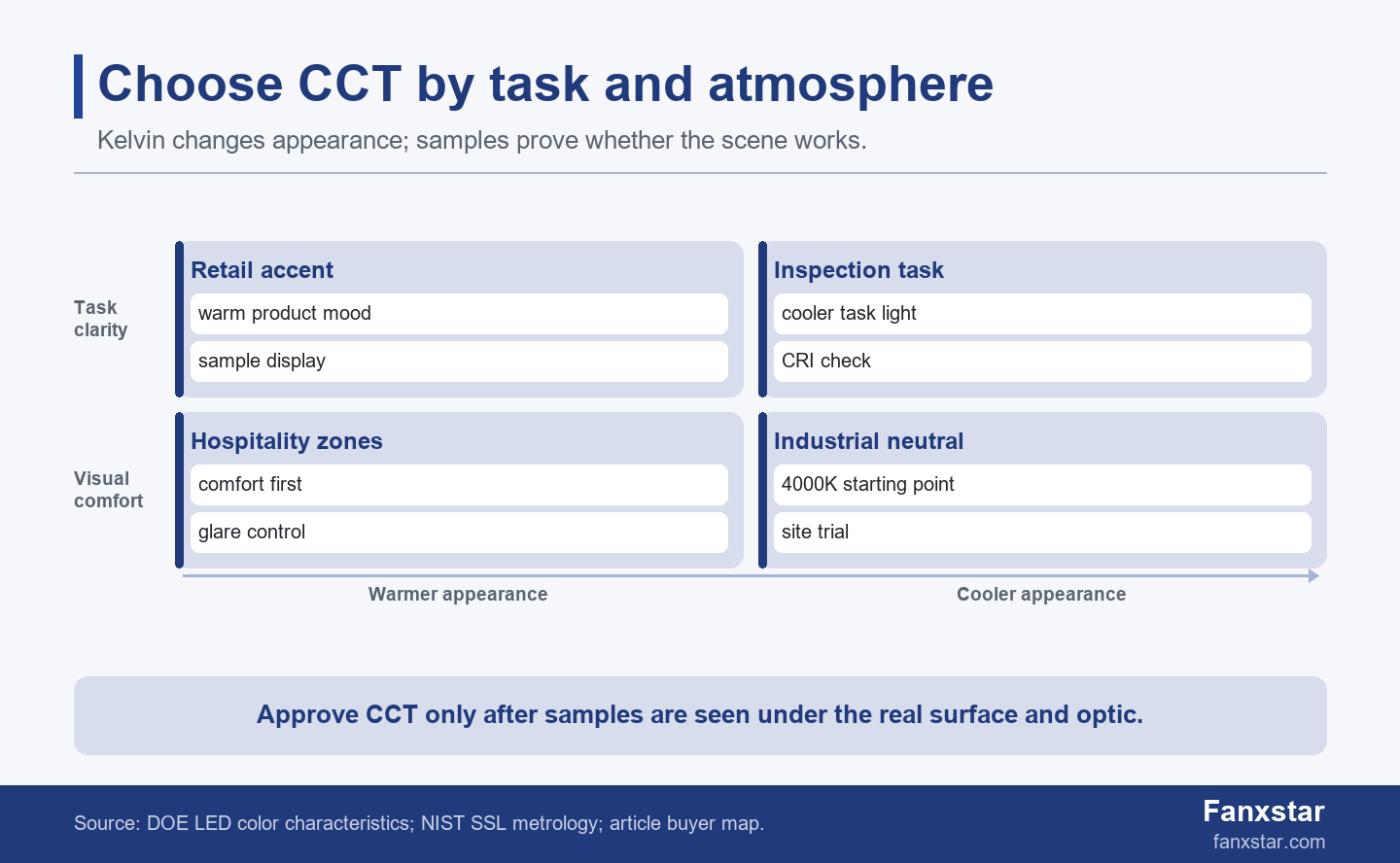
Fresh retail and food processing do not use CCT for the same reason. Retail often cares about visual appeal, product color, and customer comfort. Food processing cares more about cleanability, visibility, task performance, and hygiene-compatible fixtures. A warm display effect may be attractive in one zone and unsuitable in another.
Fanxstar application links such as LED lighting for fresh food retail and food processing plant LED lighting solutions show why CCT should be tied to the scene. The buyer should test the chosen CCT on real product surfaces or process areas, not only under office lighting. If a meat, bakery, produce, or washdown area looks wrong under the selected CCT, the specification should change before production.
A practical sample set uses 3000K, 4000K, and 5000K only when the project genuinely needs a choice. Too many samples slow decisions. Too few samples can lock the buyer into a value that looks acceptable on paper and poor on site.
Industrial and service areas often need neutral evidence
Warehouses, backrooms, service corridors, parking garages, and data center support spaces often start around neutral white because the buyer wants practical visibility without a strong color mood. That starting point is not a rule. High-detail tasks, camera systems, shift comfort, wall colors, and glare sensitivity can move the decision warmer or cooler.
FEMP LED luminaire purchasing guidance and DLC technical requirements both support evaluating complete LED products rather than isolated claims. For CCT, the complete product includes LED board, diffuser, lens, driver, thermal condition, and the shipped bin or tolerance.
Common CCT mistakes in B2B LED procurement
Mistaking cool white for better performance
Cooler light can appear visually crisp, but that does not mean it is more efficient, safer, or better for every task. If glare is high, contrast is poor, or CRI is weak, a cooler CCT can make a site feel harsh without improving useful visibility. Buyers should compare measured output and task performance, not only appearance.
According to DOE LED basics, LED performance depends on LED technology and system behavior. CCT belongs in that system. If the driver, lens, diffuser, or LED package changes, the color appearance and output can change even when the sales description still says 4000K.
A useful procurement note is to state CCT tolerance. If the buyer expects 4000K but accepts a wide bin range without knowing it, fixtures installed across the same site may look inconsistent. That matters in retail, clean corridors, public parking, and any application where visual consistency affects trust.
Using one CCT for every zone
A single CCT can simplify purchasing, but it can also flatten the lighting strategy. A front retail display, a cold room, a packing area, a service corridor, and an emergency route may not need the same appearance. The buyer should choose between simplification and zone-specific performance deliberately.
IEA 4E SSL Annex product tiers shows why LED quality and performance should be evaluated with multiple requirements rather than a single number. CCT is one part of the product quality file. It should not replace CRI, glare control, distribution, lifetime, or driver evidence.
A scenario estimate: if a 200-fixture site uses 1 CCT everywhere to save 2 sample days, but 20 fixtures in a display or inspection zone need replacement because products look wrong, the sample saving disappears. The better approach is to test CCT only where appearance affects the buyer’s operation.
The trade-off is standardization versus zone accuracy
The trade-off in CCT selection is standardization versus zone accuracy. Standardizing on 4000K can reduce purchasing complexity, spare inventory, and installation mistakes. Zone-specific CCT can improve product appearance, inspection comfort, or visual orientation. Neither path is automatically right; the buyer should decide which operational problem matters more.
According to DOE LED Color Characteristics factsheet, CCT describes the warm or cool appearance of nominal white light. This means a buyer should not use CCT as a shortcut for brightness, quality, or worker comfort. A 5000K fixture may look crisp and still perform poorly if glare is high, CRI is weak, or the optic sends light into the wrong surface.
In practice, a 4-zone site can use a simple CCT map: customer-facing area, task or inspection area, storage or service area, and emergency route. The buyer may still choose 1 CCT for all 4 zones, but that choice is now deliberate. If the project uses 2 or 3 CCT values, the purchase order should lock the zone map so installation teams do not mix cartons on site.
A practical rule is to approve CCT only after checking the surface that matters. For fresh retail, that surface may be produce or packaging. For a clean processing area, it may be stainless equipment and white wall panels. For data center corridors, it may be cable labels and floor markings. The best CCT is the one that helps the site read its own work accurately.
This means the buyer should also define who has authority to change CCT after sample approval. Purchasing may see 4000K and 5000K as interchangeable stock choices, while operations may see the difference immediately on labels, food surfaces, or inspection benches. A simple 3-field approval record can prevent confusion: approved CCT and tolerance, approved sample location, and substitutions that require written review. For repeat orders, that record is often more useful than a long email history.
For ODM orders, add one more field: whether mixed CCT cartons are allowed on the same shipment. If the answer is no, the packing list should separate model code, CCT, quantity, and label version. That small control prevents installers from discovering color mismatch only after fixtures are mounted.
How Fanxstar buyers should specify CCT
Lock CCT with the fixture version
Fanxstar buyers should specify CCT together with product platform: custom LED lighting design options, weatherproof LED lighting product platform, LED linear lighting platform, AI data center LED lighting solutions, and cold storage LED lighting solutions. A CCT decision is stronger when it is tied to the housing, diffuser, optics, driver, and target application.
The RFQ should state desired CCT, acceptable tolerance, CRI target, lumen output, optics, control method, target environment, sample need, and whether the buyer wants one CCT across all zones or a zone map. If the project involves private label, the label and datasheet should use the same CCT language as the approved sample.
According to GSA LED and controls guidance, lighting decisions should account for life-cycle cost and controls behavior. Tunable-white or dimming projects need this especially: CCT choice interacts with control scenes, user habits, and commissioning, not just the fixture.
Use a sample rule before mass production
A practical sample rule is: approve CCT under the real surface and optic before approving production. If the supplier changes LED package, diffuser, lens, driver, or CCT bin, ask whether the sample still represents the shipped product. This is especially important for repeat orders where a small supply-chain substitution can create visible color drift.
According to International Trade Administration import documentation guidance, import documents can include invoices, packing lists, and certificates. Lighting buyers should keep the CCT-approved sample record, datasheet, label, and packing file aligned with the same model. If a special certificate or market document is required, International Trade Administration special documents guidance supports checking those documents before shipment.
Before asking Fanxstar for an ODM recommendation, prepare the target zones, preferred CCT range, surfaces or products to be viewed, CRI expectation, optic requirement, control method, and sample deadline. That gives the engineering team a practical color brief rather than a vague ‘warm’ or ‘cool’ request.
FAQ
What does CCT mean in LED lighting?
CCT means correlated color temperature, a Kelvin-based description of whether white LED light appears warm, neutral, or cool. It describes color appearance, not brightness or quality by itself, so buyers should also check lumens, CRI, optics, glare, and sample appearance.
Is 4000K the best CCT for industrial lighting?
4000K is often a practical neutral starting point for industrial spaces, but it is not automatically best. The right CCT depends on task detail, surface color, worker comfort, product appearance, glare, controls, and whether the same fixture will serve multiple zones.
Does higher CCT mean brighter light?
No. Higher CCT can look visually cooler or crisper, but brightness depends on lumen output, optics, driver settings, fixture spacing, and surface reflectance. A lower-CCT fixture can be brighter than a higher-CCT fixture if the product design delivers more useful light.
What CCT evidence should buyers request?
Request the target CCT, tolerance, CRI, lumen output, optics, diffuser, LED board, sample record, label language, and whether production substitutions affect the approved color. For sensitive retail or inspection areas, approve samples under the real surfaces before mass production.