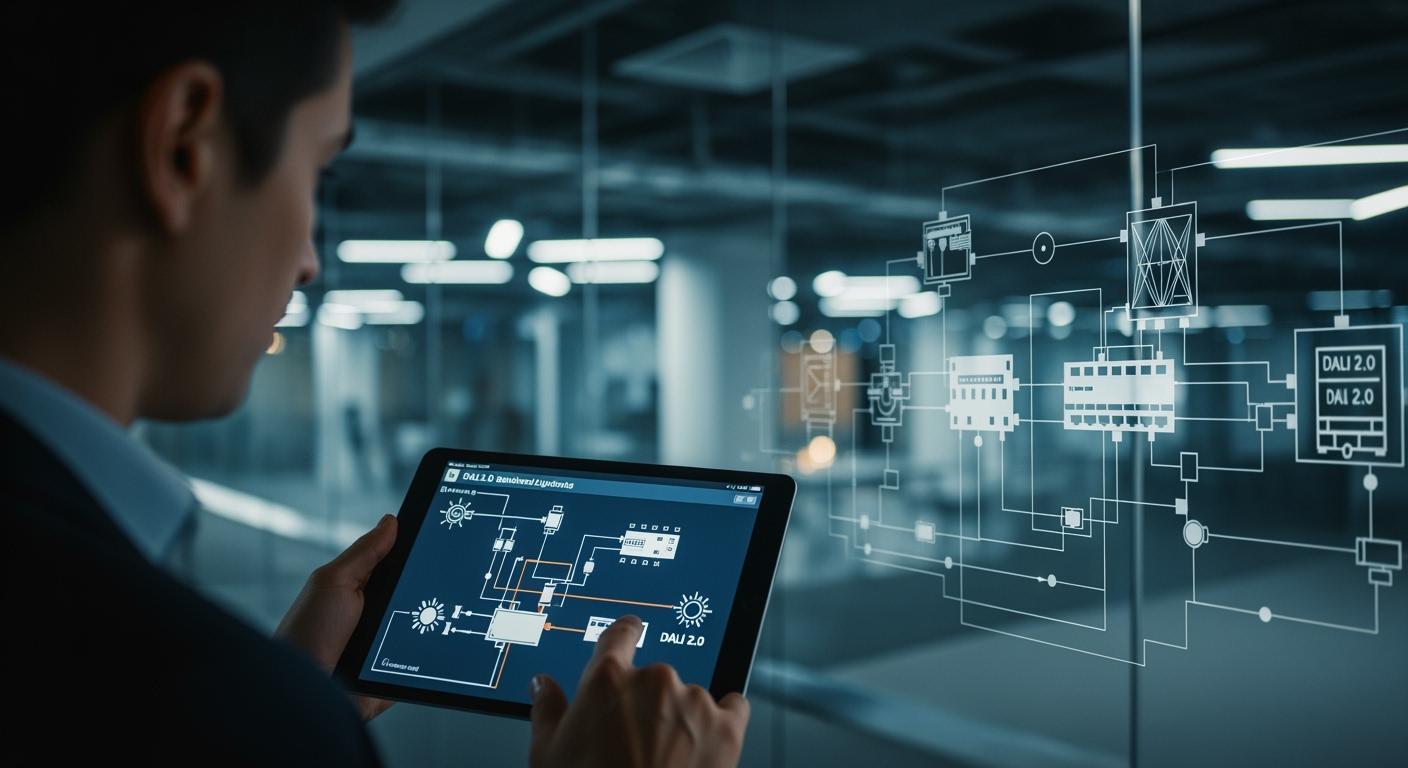
In the rapidly evolving landscape of smart architecture, lighting control has transitioned from a basic utility to a sophisticated digital backbone. Building managers today face a critical challenge: how to implement a system that is robust enough for modern demands but flexible enough for future upgrades. The answer lies in DALI-2 (Digital Addressable Lighting Interface). As the premier global standard for lighting control, DALI-2 provides the necessary framework to ensure that devices from hundreds of different manufacturers can communicate flawlessly within a single smart building ecosystem.
Research published in Scientific Reports highlights that the benefits of standardization extend beyond mere compatibility; they are essential for achieving the energy efficiency targets required by modern green building certifications. By utilizing a standardized protocol, facilities can implement advanced diagnostics, proactive maintenance, and highly granular control strategies that were previously impossible with analog systems.
Key Takeaways
-
Interoperability: DALI-2 ensures that drivers, sensors, and controllers from different brands work together without custom programming.
-
Reduced Complexity: Standardization simplifies wiring, potentially reducing installation labor costs by up to 50%.
-
Future-Proofing: An open standard means the building owner is never “locked in” to a single vendor for the life of the building.
-
Advanced Data: DALI-2 provides bidirectional feedback, including real-time energy monitoring and automated failure alerts.
-
Emergency Compliance: DALI-2 DT1 standards automate the mandatory testing of emergency lighting, ensuring safety and legal compliance.
Technical Deep Dive: The Physical Layer of DALI-2
A Simple 2-Wire Bus
The core of DALI-2’s success is its physical simplicity. It utilizes a basic 2-wire bus that carries both data and low-voltage power to control devices. Unlike many other digital protocols, DALI-2 is polarity independent, meaning installers do not have to worry about which wire goes to which terminal, significantly reducing wiring errors during the high-pressure phase of construction.
A single DALI “universe” or subnet can support up to 64 individual addresses for control gear (like LED drivers) and an additional 64 addresses for control devices (like sensors and switches). For large-scale projects, multiple universes are linked via IP gateways, allowing a single building management system (BMS) to control tens of thousands of light points across a high-rise facility.
|
Building Type |
Specific Standardization Benefit |
Impact |
|---|---|---|
|
Offices |
Daylight Harvesting Integration |
Reduces HVAC and lighting energy load |
|
Schools |
Tunable White (Circadian) Control |
Improves student focus and alertness |
|
Hospitals |
Centralized Emergency Testing |
Ensures 100% compliance with zero labor |
|
Retail |
Dynamic Scene Scheduling |
Enhances customer mood and purchasing behavior |
Standardization vs. Proprietary Systems
In the past, many lighting control companies sold “closed-loop” proprietary systems. While these often worked well, they created a vendor lock-in scenario. If the manufacturer went out of business or discontinued a product line, the building owner was forced to rip out and replace the entire system for a minor repair. DALI-2 standardization eliminates this risk. Because it is an open standard (IEC 62386), any certified DALI-2 component can replace another, regardless of the brand. This long-term security is one of the most cited reasons for DALI’s dominance in the global market.
The Role of Certification
Unlike the original DALI protocol, DALI-2 requires rigorous third-party certification. Manufacturers must submit their products to the DALI Alliance for testing. This ensures that every command—whether it is a “Fade to Level” or an “Energy Report”—is executed exactly the same way by every device. This level of precision is what makes DALI-2 waterproof lighting a reliable choice for harsh industrial environments.
Advanced Features: DT6, DT8, and Beyond
DALI-2 introduces specialized “Device Types” (DT) that standardize how different lighting technologies are handled:
-
DT6 (LED Drivers): The standard for basic dimmable LED control.
-
DT8 (Color Control): Standardizes Tunable White and RGB color control. With DT8, a single DALI address can control color temperature and intensity, saving address space and simplifying programming.
-
D4i (DALI for IoT): The latest expansion that standardizes how drivers store and report data like energy usage, diagnostic info, and fixture hardware details.
“DALI-2 isn’t just a dimming protocol; it is a data protocol that turns every light fixture into a smart node on the building’s network.”
ROI and Cost Analysis of Standardized Control
While the upfront cost of digital components can be slightly higher than 0-10V analog systems, the Return on Investment (ROI) is achieved through labor and operational savings. Analog systems require a “home run” wire for every dimming zone, leading to massive amounts of copper cabling. DALI-2 uses a shared bus, which can reduce total wiring by 30-50% in large-scale office or hospital projects.
|
Comparison Metric |
Analog (0-10V) |
Digital (DALI-2) |
|---|---|---|
|
Wiring Topology |
Star (Dedicated zones) |
Bus (Shared line) |
|
Feedback Loop |
None (One-way) |
Bidirectional (Status/Energy) |
|
Dimming Precision |
Voltage drop dependent |
Software defined (0.01% resolution) |
|
Re-zoning |
Physical rewiring required |
Software reconfiguration only |
Addressing the “Legacy” Challenge
One common concern for facility managers is how to handle existing buildings that were not designed for digital control. DALI-2 provides a clear path forward through its backward compatibility with original DALI drivers. Furthermore, new DALI-to-Wireless gateways (Bluetooth Mesh or Zigbee) allow owners to enjoy the benefits of standardization without the need for invasive rewiring. This hybrid approach allows for a staggered upgrade of building systems, spreading out the capital expenditure while immediately reaping the benefits of energy-efficient controls.
Integrating DALI-2 with Building Management Systems (BMS)
In a truly “Smart Building,” lighting does not exist in a vacuum. It must interact with HVAC, security, and fire safety systems. Because DALI-2 is standardized, it integrates seamlessly with protocols like BACnet and KNX via gateways. This allows for cross-system automation: for example, when a DALI-2 motion sensor detects a person has left a room, it can signal the BMS to also lower the air conditioning in that zone, compounding the energy savings across multiple building sectors.
Practical Implementation and Maintenance
Maintaining a standardized system is significantly easier for facility staff. DALI-2 drivers can report exactly which lamp has failed and why. Instead of a technician walking the floors of a 50-story building to find a burnt-out driver, they receive an automated email with the exact room number and fixture ID. This data-driven maintenance approach reduces “time-to-fix” and ensures that lighting levels are always at 100% in critical areas.
Conclusion: Investing in a Standardized Future
Choosing DALI-2 is more than just selecting a dimming method; it is a strategic decision to prioritize the long-term health and flexibility of your building. By embracing the benefits of standardization, project managers can ensure interoperability, reduce operational costs, and provide a superior environment for occupants. As smart buildings continue to integrate IoT and data analytics, DALI-2 remains the most stable and reliable foundation for the future of light. Whether you are planning a new construction or a renovation, standardized digital control is the key to unlocking the full potential of your facility.
FAQ
Is DALI-2 better than 0-10V dimming?
For large projects, yes. While 0-10V is simple for small rooms, DALI-2 offers bidirectional feedback, simpler wiring for large zones, and the ability to reconfigure the system without moving wires. It also avoids the “flicker” and voltage drop issues common in long 0-10V runs.
Can I mix different brands of DALI-2 sensors and drivers?
Absolutely. That is the primary benefit of standardization. As long as the devices carry the official DALI-2 certification logo, they are guaranteed to work together.
How many lights can I have on a single DALI-2 line?
Standard DALI-2 supports 64 addresses for control gear (drivers) and 64 for control devices (sensors/switches) per line. By using IP gateways, you can link hundreds of these lines together.
Does DALI-2 support color-changing lights?
Yes, via the DT8 (Device Type 8) standard. This allows for precise control of RGB colors or Tunable White (warm to cool) using a single DALI address.
Is DALI-2 a wireless protocol?
DALI-2 is primarily a wired 2-wire bus protocol. However, the DALI Alliance has recently introduced DALI+ which allows the protocol to run over wireless carriers like Bluetooth Mesh or Thread.