
Installing linear lights in a 10-meter warehouse is not mainly a fixture question. It is an access plan, an electrical safety plan, a mounting plan, a lighting layout plan, and a maintenance plan. A buyer who only asks how many watts are needed can end up with a fixture that is difficult to install, difficult to aim, unsafe to service, or poorly matched to rack aisles.
OSHA scissor lift guidance emphasizes equipment maintenance, manufacturer instructions, training, and safe work practices. OSHA aerial lift guidance also warns workers to stand on the basket floor and not climb or lean over guardrails. Those safety principles belong in the buyer’s lighting brief before the project reaches site.
Key Takeaways
- A 10-meter warehouse linear light installation should be planned by qualified local professionals under applicable electrical and work-at-height rules.
- The RFQ should include access method, ceiling structure, mounting hardware, fixture weight, circuit control, aisle geometry, rack height, glare risk, sensor zones, and future service access.
- Linear lights can work well at height when optics, spacing, suspension, and controls are matched to warehouse aisles rather than selected only by wattage.
- The best procurement file includes a pilot bay, lift-access check, driver replacement method, and commissioning checklist before full rollout.
Start with site safety before fixture selection
The access plan changes the lighting decision
At 10 meters, a fixture that looks easy on a catalog page can become difficult on site. The installer may need a scissor lift in open areas, a boom lift near obstructions, scaffold in special zones, or phased work because racks, conveyors, or production lines block access. The access method affects fixture length, packaging, lifting points, mounting hardware, and whether a driver should be remote or integrated.
OSHA 1910.67 covers vehicle-mounted elevating and rotating work platforms. The exact legal requirement depends on the country, site, and equipment type, but the procurement lesson is universal: do not approve a high-ceiling lighting plan without knowing how installers will safely reach every fixture position.
The buyer should ask for a method statement from the installer or project team. It should identify lift type, floor load limits, obstruction zones, aisle closures, fall protection requirements, electrical isolation, emergency response, tool tethering where required, and how materials are lifted. A supplier cannot replace local site safety responsibility, but a good supplier can help make fixture selection compatible with the installation plan.
Power isolation and commissioning need equal attention
High-ceiling work creates a rework penalty. If circuit mapping is unclear, sensors are wired incorrectly, or driver access is poor, every correction requires another lift operation. That is why electrical planning belongs in the buyer checklist. Define circuit groups, emergency lighting boundaries, dimming or sensor wiring, surge protection, junction box position, and commissioning steps before the installation team arrives.
For a retrofit, check whether old high-bay circuits can support the new layout. A linear lighting project may reduce power load but increase the number of fixtures, sensors, zones, or control points. If the site wants aisle-level dimming or occupancy control, the wiring and commissioning plan should be part of the quote, not an afterthought after the fixtures arrive.
Choose linear fixtures by aisle geometry
Fixture wattage is a weak first filter
Warehouse buyers often start by asking whether 100 W, 150 W, or 200 W fixtures are enough for a 10-meter ceiling. Wattage is only a power input. The better starting point is aisle geometry: rack height, aisle width, mounting height, target work plane, beam distribution, glare tolerance, and whether the space is open storage, picking aisle, loading dock, or service corridor.
DOE FEMP guidance treats commercial and industrial LED luminaires by application categories. For a 10-meter warehouse, the buyer should translate that into a layout request: photometric file, ceiling height, fixture spacing, beam angle, expected illuminance, uniformity, and glare review. A narrow aisle may need a different distribution than an open loading zone even when both use linear fixtures.
Mounting method can make or break the result
Linear fixtures may be surface mounted, suspended, chain mounted, cable mounted, or bracket mounted depending on ceiling structure and application. At 10 meters, small errors in alignment become visible over long rows. The fixture can also swing in drafts, twist during maintenance, or create uneven aisle brightness if the suspension points are not controlled.
The RFQ should name fixture weight, fixing points, bracket material, suspension length, anti-swing need, ceiling structure, and whether installers need pre-wired through-cable, quick connectors, or end-to-end wiring. For waterproof or vapor tight linear fixtures, the mounting plan must not compromise the IP seal, cable gland, gasket, or diffuser latch.
Installation evidence that belongs in the RFQ
Write the 10-meter access plan as a procurement requirement
OSHA technical manual guidance discusses fall protection across elevated work methods reinforces the same procurement lesson as the scissor lift and aerial lift documents: the access method is not a small site detail. At 10 meters, the buyer should name the expected lift or platform type, floor condition, aisle closure rule, working radius, obstruction zones, and who approves the method before fixtures arrive.
The practical implication is that the lighting supplier should know the access constraint before recommending fixture length or mounting accessories. A 1.2-meter fixture may be easier to handle from a lift basket than a longer body in a narrow rack aisle. A pre-wired through-cable may reduce time in the air. A quick connector may simplify replacement. A separate driver box may help service access, but only if the site can reach it safely.
A good RFQ includes at least 7 site fields: ceiling height, rack height, aisle width, ceiling structure, lift route, floor load or obstruction concern, and whether work happens in an operating warehouse. These fields do not replace the installer’s safety plan, but they keep the fixture selection compatible with that plan.
Commissioning should be measurable, not just visual
GSA LED and controls guidance treats controls and commissioning as part of a lighting project, and ENERGY STAR lighting upgrade guidance supports looking beyond first-cost fixture replacement. For a 10-meter warehouse, this means the buyer should decide how many zones, scenes, sensors, and manual overrides will be tested after installation.
The commissioning file should record at least 5 checks: circuit group, sensor response, standby dimming level, emergency-route behavior, and measured light level in representative aisles. If the warehouse has 2 aisle types, 3 rack heights, or a mix of loading docks and storage rows, one measurement point is not enough. The sample zone should prove the layout before the full ceiling is converted.
DLC solid-state lighting technical requirements are often used by efficiency programs as performance evidence. The buyer can use that mindset even when a rebate is not the goal: request the photometric file, driver data, control compatibility, and installation instructions for the exact model. The result is a lighting package that can be installed, checked, and serviced with fewer lift returns.
Plan controls and maintenance before installation
Sensors should follow warehouse zones
Fanxstar projects often connect fixture choice with controls, especially in warehouses where aisles, docks, backrooms, and service corridors behave differently. Useful references include LED lighting controls for industrial facilities, warehouse and logistics LED lighting guidance, B4 motion sensor splice battens, and LED linear lighting platforms.
A 10-meter installation is a good time to set zoning rules. Some aisles may need occupancy sensors with standby dimming. Loading areas may need manual override. Emergency routes may need separate logic. Maintenance teams may need a way to test sensors from the ground. If the control plan is added after installation, the site may need new lift work or rewiring.
Future service access is part of the specification
A warehouse lighting installation should not be judged only on day-one brightness. Ask how the driver is replaced, how the lens is cleaned, how sensors are accessed, and how the fixture can be removed without damaging brackets or cable entries. If a lift cannot safely reach a fixture after the warehouse is fully racked, the design has a service problem.
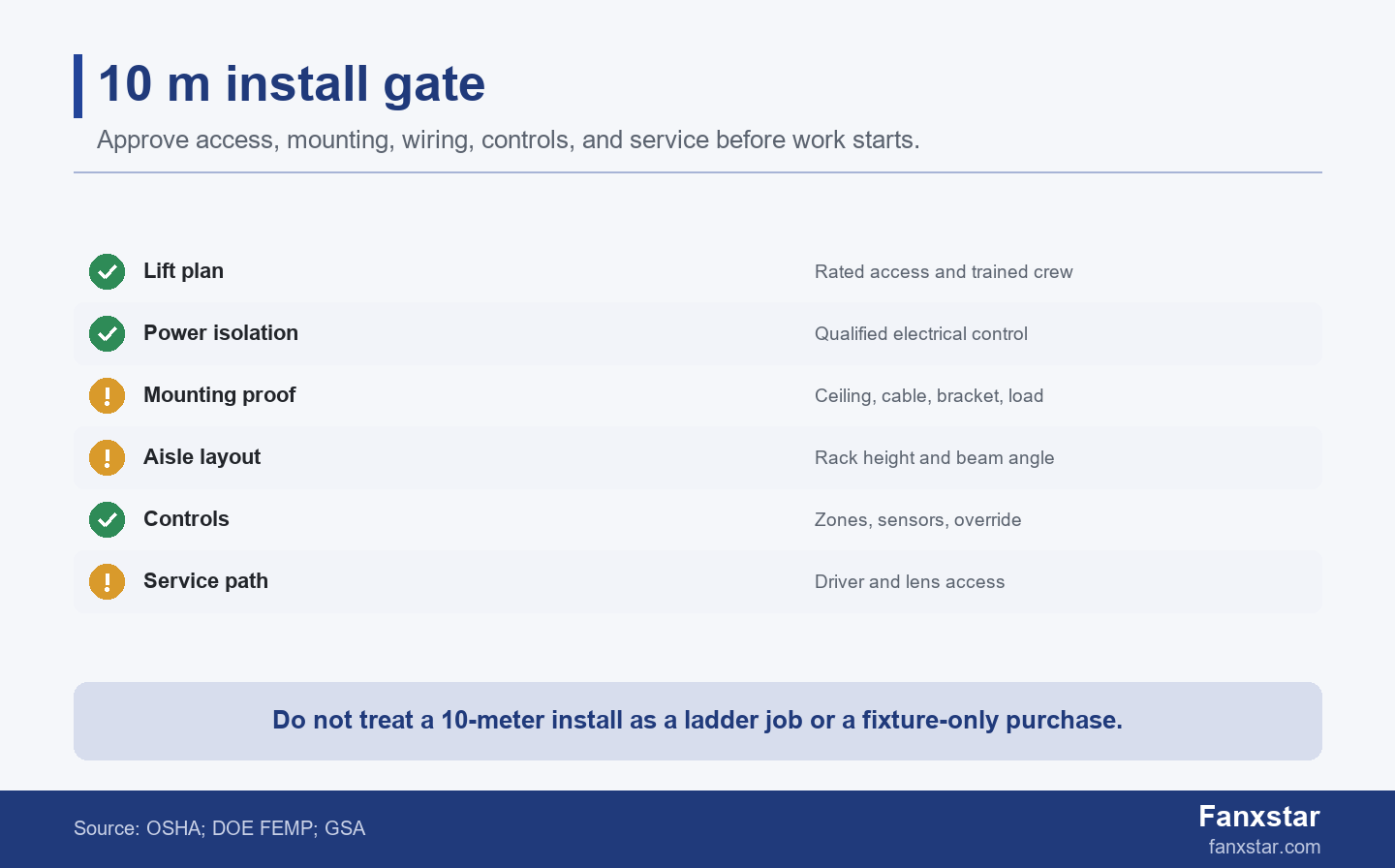
| Planning gate | What to confirm | Why it matters at 10 meters |
|---|---|---|
| Access method | Scissor lift, boom lift, scaffold, or other approved access method. | A ladder-style plan is usually not realistic for repeated ceiling work at this height. |
| Electrical control | Qualified installer, isolation procedure, circuit map, and commissioning plan. | High-bay work magnifies the cost of rework and unsafe shortcuts. |
| Mounting hardware | Ceiling type, fixing point, bracket load, cable suspension, and anti-swing need. | Linear fixtures can twist, sag, or misalign if the mount is improvised. |
| Lighting layout | Aisle width, rack height, beam angle, spacing, glare, and emergency routes. | The fixture may be safe to install but still poor for warehouse operations. |
| Maintenance access | Driver location, lens access, sensor replacement, and lift path after racks are loaded. | The installation is not complete if future service requires disruption. |
A practical Fanxstar RFQ for a 10-meter warehouse should include layout drawings, ceiling photos, rack dimensions, mounting height, target lux, control zones, emergency routes, ambient temperature, dust or moisture exposure, installation access, and preferred service method. That allows the fixture recommendation to support both installation and long-term operation. When the project has a pilot bay or sample aisle, Fanxstar can align fixture, optic, driver, sensor, and mounting evidence before the site commits to a full lift schedule.
Implementation Note for Buyers
A 10-meter warehouse project should leave behind an installation record, not just brighter aisles. The record can include 8 items: access equipment, installer qualification, circuit isolation, mounting hardware, fixture model, control zone, commissioning measurement, and future service method. That record helps the owner explain why the selected linear fixture can be installed and maintained without repeating the same lift work after handover.
If the project uses Fanxstar LED linear lighting platforms with sensors or dimming, the buyer should separate the pilot aisle from the full rollout. A 1-aisle or 2-bay test can confirm alignment, glare, sensor response, standby dimming, and driver access before dozens or hundreds of fixtures are installed across the whole ceiling.
According to OSHA scissor lift guidance, lift use depends on maintenance, manufacturer instructions, training, and safe work practices. According to OSHA aerial lift guidance, workers should not climb or lean over guardrails from a lift basket. According to OSHA 1910.67, vehicle-mounted elevating and rotating work platforms sit inside a defined safety framework.
According to OSHA technical manual fall protection guidance, access and fall protection should be treated as part of the work method. According to GSA LED and controls guidance, controls and commissioning belong in the project plan. According to DLC solid-state lighting requirements, fixture evidence should connect performance data with the exact product category.
The decision rule is to test one representative aisle before the whole 10-meter ceiling is converted. According to DOE FEMP luminaire purchasing guidance, industrial luminaire purchasing should be tied to the application category, and according to ENERGY STAR commercial lighting upgrade guidance, lighting upgrades should consider operational savings as well as equipment replacement.
According to GSA LED and controls guidance, a controls plan should be commissioned rather than assumed, so the buyer should record the sensor response and standby level during the pilot.
FAQ
Can linear lights be installed in a 10-meter warehouse?
Yes, but the project should be planned by qualified local installers with safe access equipment, electrical isolation, mounting evidence, and a layout calculation. The fixture choice should follow aisle geometry and service access.
What is the safest way to install warehouse lights at 10 meters?
There is no single universal method. The site team should choose approved access equipment, trained workers, electrical controls, and local safety procedures for the building. The buyer should not treat a 10-meter project as a ladder job.
Should I choose high bay or linear fixtures for a 10-meter warehouse?
Choose by aisle layout and task. Linear fixtures can be strong for rack aisles and long runs when optics and spacing are correct. High bays may fit open zones. Many warehouses use different fixtures by zone.
What should be included in the RFQ?
Include ceiling height, rack height, aisle width, mounting method, target lux, uniformity goal, circuit map, sensor zones, emergency routes, ambient conditions, lift access, service method, and required certificates.








