DALI becomes useful when the buyer needs addressable control, device evidence, and commissioning discipline, not when the project only needs a dimming word in the quotation. The right first question is not ‘Does the fixture support DALI?’ It is ‘Which devices are addressable, how will they be commissioned, and what evidence proves they will work together after installation?’
According to DALI Alliance, IEC 62386 is the international standard for the Digital Addressable Lighting Interface. According to DALI Alliance systems guidance, each DALI subnet can have 64 control gear and 64 control devices. Those 2 facts show why DALI should be specified as a system file, not a single driver feature.
Key Takeaways
- DALI is a digital lighting-control protocol defined by IEC 62386, used to address and control lighting devices.
- DALI-2 improves interoperability expectations because certified products complete DiiA verification before using the trademark.
- A DALI project should include device list, addressing plan, bus power plan, scene logic, sensor logic, and commissioning records.
- Fanxstar buyers should specify DALI only when the application needs controlled zones, sensors, diagnostics, or repeatable commissioning evidence.
How DALI Works in a Lighting Project
DALI puts control messages on a dedicated lighting bus
The DALI Alliance introduction explains that IEC 62386 was restructured in late 2014 for DALI-2 and added new commands and features. That history matters because DALI is not only a dimming curve. It is a standardised control layer that lets control gear and control devices communicate in a lighting system.
According to DALI systems guidance, the DALI bus carries power and data on the same pair of wires, with a bus power supply typically providing 16 V and up to 250 mA. For a buyer, those numbers are not trivia. They define why the bus power supply, device count, wiring distance, and commissioning file belong in the RFQ.
Addressability is the reason to pay attention
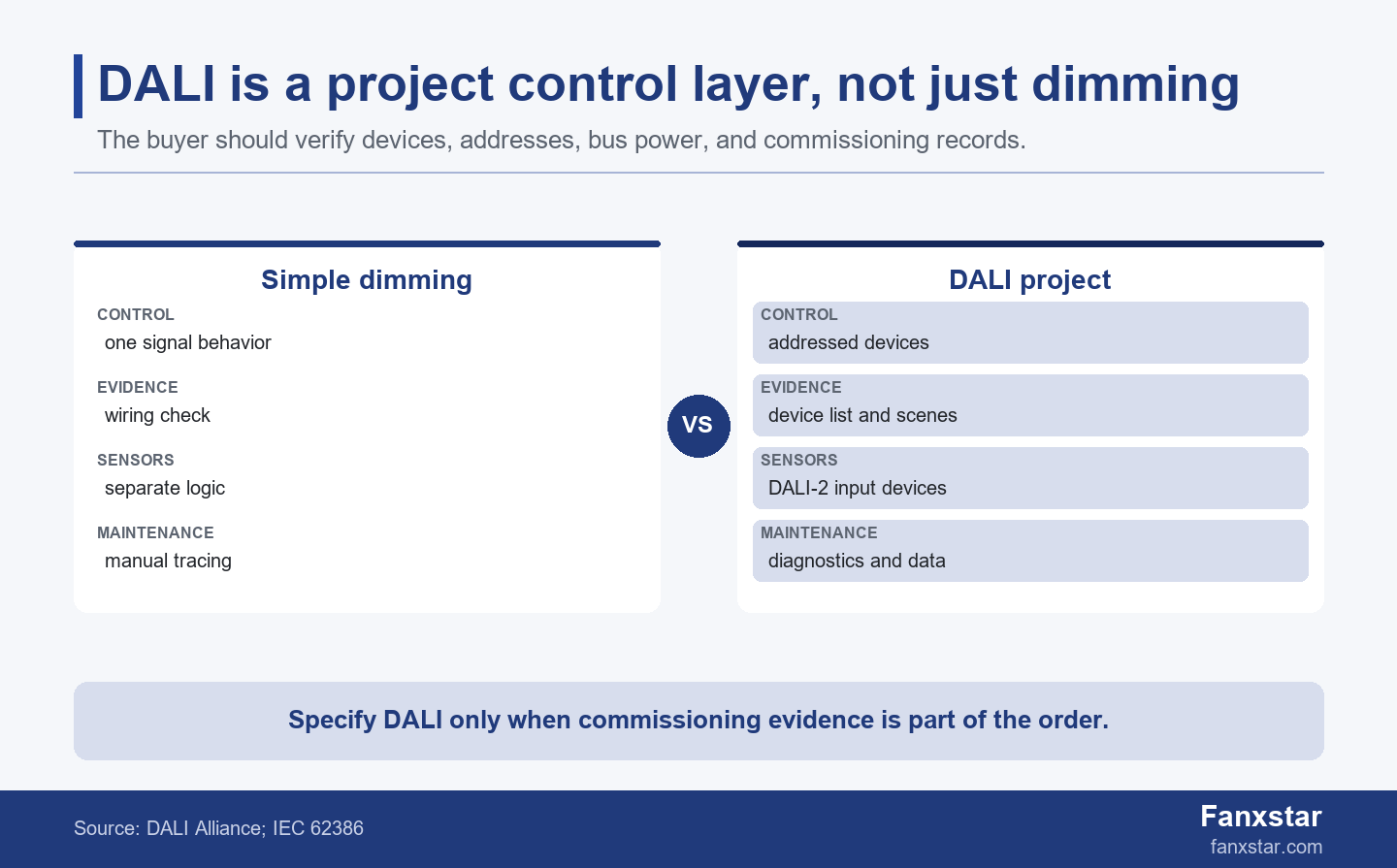
A simple dimming signal can lower or raise a group of lights, but it does not create the same level of device identity. DALI becomes valuable when the buyer needs addresses, groups, scenes, sensors, feedback, emergency logic, or maintainable zones. The project should therefore define what needs to be individually addressable and what can remain a simpler group control.
According to DALI Alliance systems guidance, each subnet can contain 64 control gear and 64 control devices. A project that needs more than one subnet, many sensors, or complex area behavior should not be planned from a driver catalog line alone. It needs a wiring and commissioning plan.
DALI, DALI-2, and D4i Are Not the Same Buyer Promise
DALI-2 is a certification and interoperability signal
DALI-2 certification overview says certified products have completed the DALI-2 certification process, including verification by DiiA, and only certified products can carry the DALI-2 trademarks. For procurement, this changes the evidence request. Ask what is certified, not only whether the sales sheet says DALI.
According to DALI Alliance control-device guidance, control devices are standardized in DALI-2 but did not exist in DALI version-1. That means a sensor, switch, application controller, or input device should not be treated as DALI version-1 just because it sends commands. The buyer should identify whether it is DALI-2 certified and which role it plays.
D4i adds luminaire data and intelligent-luminaire context
D4i overview from the DALI Alliance explains that D4i enables DALI inside intelligent, IoT-ready luminaires and that D4i LED drivers can store and report luminaire, energy, and diagnostics data. That makes D4i relevant when the buyer wants maintenance data, asset records, energy reporting, or smart-city style integration.
The common mistake is to specify DALI when the buyer really wants D4i-style data, or to specify D4i when the project only needs stable indoor dimming. The RFQ should state whether the desired outcome is zone control, sensor input, emergency testing, diagnostics, energy data, or an open protocol for later integration.
What to Put in a DALI RFQ
A DALI quote should include commissioning evidence
| Buyer question | DALI evidence to request | Why it matters |
|---|---|---|
| How many devices are on the bus? | Control gear, control devices, bus power plan | Prevents a design that exceeds practical subnet planning. |
| What is DALI-2 certified? | Product database entry or certification statement | Separates tested devices from generic DALI wording. |
| How are scenes commissioned? | Address list, group list, scene schedule | Makes the installed behavior repeatable. |
| What data is needed later? | D4i or diagnostic capability statement | Supports maintenance, energy, or IoT integration. |
A useful DALI RFQ names the number of luminaires, control gear, sensors, switches, application controllers, power supplies, groups, scenes, and emergency functions. It also states whether the buyer expects DALI-2 certification, D4i data, Zhaga-D4i compatibility, or only DALI dimming. Without those details, two suppliers can quote very different systems under the same word.
Fanxstar fit starts when DALI affects the fixture platform
Fanxstar is relevant when the lighting product needs DALI-ready driver selection, sensor integration, emergency lighting behavior, waterproof housing, or application-specific control zones. For example, a parking garage lighting project may need sensor zones and emergency routes, while a data center lighting corridor may need service-friendly zoning and diagnostics.
If the buyer is still choosing between DALI, 0-10 V, sensor-only, or basic switching, pair this decision with Fanxstar’s LED lighting controls guide. Then send the area plan, control objective, driver preference, fixture type, and target market through Fanxstar customization so the team can map the control requirement to an actual product platform.
Where DALI Creates Real Project Value
Use DALI when the building needs repeatable behavior, not just dimming
The strongest procurement insight is that DALI earns its complexity when a project needs repeatability across many fixtures. A small storage room may be fine with local switching or a simple dimming line. A supermarket, logistics aisle, public corridor, data-center service route, or parking garage may need scenes, occupancy response, emergency behavior, device identity, and future maintenance records. In those cases, DALI is not decoration; it is the control file that lets the site be commissioned and serviced consistently.
According to DALI Alliance sensor guidance, DALI-2 standardizes input devices such as sensors. That means sensor logic should be written into the project rather than assumed after the fixture is selected. The RFQ should say whether sensors are standalone, DALI-2 input devices, gateway inputs, or part of a luminaire-level module because each path changes wiring, addressing, and commissioning ownership.
Specify what must survive handover
A DALI design is weak if the installer understands it but the owner cannot maintain it. The buyer should ask what survives after handover: device addresses, group map, scene list, firmware or configuration notes, sensor thresholds, emergency-test logic, replacement-driver rules, and a contact path for future changes. Without that handover, a service technician may replace one driver and break the intended behavior for a whole aisle or corridor.
The buyer should also decide how much data is actually needed. D4i-style diagnostics and energy data can be valuable in an intelligent luminaire program, but they add little value if nobody will read or integrate the information. Conversely, a buyer who wants asset data later should not approve a basic DALI driver today and expect the same maintenance workflow tomorrow. The control objective needs to be written before sample approval.
Use DALI to reduce rework in multi-zone applications
Multi-zone lighting projects fail when electrical, fixture, and controls teams treat their decisions as separate. A warehouse may divide aisles by occupancy behavior, a grocery chain may divide sales floor, backroom, and service counters, and a public building may separate emergency routes from normal scenes. DALI can help, but only if the zone map is part of the supplier brief. A fixture quote alone cannot solve a weak zone map.
According to DALI systems guidance, a subnet has device-count and bus-power boundaries. Those numbers turn zone planning into a measurable design task. If the project needs many luminaires, sensors, and control devices, the buyer should ask whether the proposal uses one subnet, multiple subnets, or a higher-level gateway architecture before the quote is accepted.
When DALI Is the Wrong Shortcut
Do not use a protocol name to hide a weak controls brief
A DALI line item cannot rescue a vague lighting-control brief. If the buyer has not defined occupancy behavior, daylight response, emergency route expectations, manual override rules, commissioning responsibility, or maintenance workflow, the protocol name may only make the quote look more advanced. The better sequence is to write the control objective first, then choose whether DALI is the right way to deliver it.
A practical example is a chain store roll-out. The sales floor may need stable scenes, the backroom may need occupancy dimming, the service counter may need manual override, and emergency routes may need a different fail-safe behavior. If all four areas are described only as DALI lighting, the supplier cannot know which driver, sensor, controller, and commissioning evidence are required.
Keep simple projects simple when there is no handover value
Some projects do not need DALI. A small mechanical room, temporary work area, or basic utility space may need reliable luminaires, clear switching, and durable installation more than addressable control. Over-specifying DALI can add cost, commissioning time, and future confusion when the site owner does not have anyone to maintain the configuration.
The decision rule is simple: specify DALI when the buyer needs addressability, repeatable scenes, sensor logic, diagnostics, emergency testing, or a handover file that preserves behavior. Use simpler controls when the space has one behavior, few fixtures, low maintenance complexity, and no meaningful value from device identity. This keeps the specification honest and easier for suppliers to quote.
Commissioning Checks Before Site Release
Do not approve DALI from a driver label alone
Before release, the buyer should have the driver model, certification or compatibility statement, bus power plan, device count, address list, group list, scene list, sensor behavior, emergency behavior if relevant, and a commissioning owner. If the order is an ODM fixture, the driver and control interface should be frozen before production photos and inspection are approved.
According to DALI-2 certification status, DALI-2 tests are derived from IEC 62386 parts and DiiA specifications. That evidence trail matters because a project can fail from a small mismatch: a certified driver paired with non-certified control devices, a missing bus supply, or an undocumented sensor role.
Use a three-file handover
A practical handover has 3 files: product evidence, commissioning evidence, and maintenance evidence. Product evidence names the driver and fixture. Commissioning evidence names addresses, groups, scenes, tests, and owners. Maintenance evidence explains how a future technician identifies devices, replaces parts, and preserves behavior after service.
The buyer does not need to overcomplicate every project. A small backroom may need simpler controls. A warehouse, supermarket, parking garage, data hall, or emergency route can justify the extra DALI planning because one wrong control assumption can create rework across many fixtures. The cleanest rule is to require the handover file whenever a later service action must preserve the same behavior after replacement.
FAQ
Is DALI the same as 0-10 V dimming?
DALI is not the same as 0-10 V dimming because 0-10 V is an analog dimming signal, while DALI is a digital lighting-control interface with addressable devices. A buyer should choose DALI when the project needs groups, scenes, sensors, diagnostics, emergency logic, or commissioning evidence that simple dimming cannot provide.
Does DALI require special wiring?
DALI uses a dedicated bus pair for power and data, so wiring and bus power planning matter before installation. The buyer should ask the supplier or controls designer for a bus layout, device count, power supply plan, address schedule, and commissioning owner before treating a DALI line item as complete.
What is the difference between DALI and DALI-2?
DALI-2 is the certification program based on the updated IEC 62386 protocol and DiiA test procedures, and it adds stronger interoperability expectations. It also brings standardized control devices into the buyer conversation. Buyers should ask which products are DALI-2 certified and verify each driver, sensor, switch, or controller role in the project.
When should Fanxstar buyers request DALI support?
Fanxstar buyers should request DALI support when the fixture itself needs a DALI driver, sensor interface, emergency behavior, waterproof housing, diagnostics, or a market-specific control configuration. Send the control intent, fixture type, zone plan, target market, and commissioning expectation so Fanxstar can recommend a platform and evidence path.