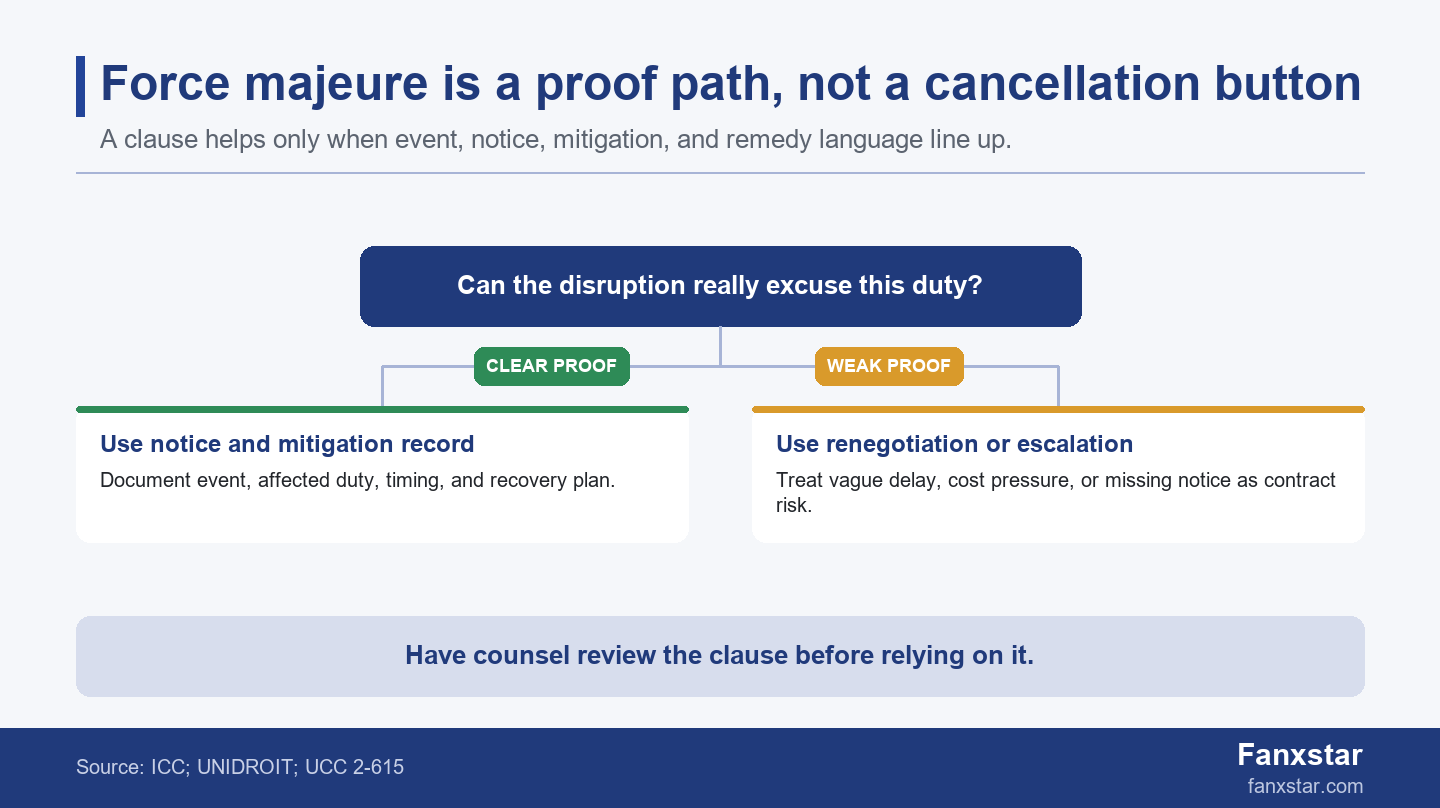
A force majeure clause protects a B2B supply contract only when it creates a provable pathway from event to notice, mitigation, allocation, and remedy. A clause that only says natural disasters, war, or government action is too shallow for an overseas supply order. The buyer needs event wording, notice timing, mitigation duties, allocation rules, and a remedy path that still works when production, documents, port movement, or freight space is disrupted.
According to ICC force majeure clause guidance, the impediment must be beyond reasonable control, not reasonably foreseeable at contract conclusion, and not reasonably avoidable or overcomeable. According to UNIDROIT force majeure principles, notice must be given within a reasonable time after the affected party knows or ought to know of the impediment. Those requirements turn force majeure from a label into a proof file.
Qualified counsel should review contract language under the governing law and market, especially when the clause may affect payment, termination, damages, or customer obligations. The buying value is still immediate: before counsel finalizes the clause, a B2B buyer can identify which facts, notices, and supplier records must be collected before a disruption becomes a dispute.
Key Takeaways
- Force majeure should not be treated as a general escape button; it is a clause that must connect a covered event to a specific duty that cannot be performed.
- Notice language is as important as event language because late or vague notice can turn a real disruption into an avoidable contract argument.
- Hardship, price pressure, and market inconvenience are different from true force majeure unless the contract clearly says otherwise.
- Lighting buyers should define sample, production, document, shipping, and allocation duties separately so a disruption does not freeze every part of the order.
- Fanxstar RFQs should keep force majeure discussion tied to product evidence, sample timing, certification documents, and recovery plans rather than broad disaster wording.
What a Force Majeure Clause Must Actually Prove
The event has to affect a specific contract duty
The common drafting mistake is to describe the event but forget the duty. A port strike may block shipment but not production. A power outage may interrupt assembly but not document preparation. A government export restriction may affect a component but not every SKU in an order. The buyer should ask which obligation is truly prevented: sample delivery, tooling approval, mass production, inspection, shipment, document handover, payment, or warranty service.
According to Canadian procurement guidance on force majeure, force majeure protects against events outside normal business risk when the clause applies. That boundary matters because supplier inconvenience, margin loss, and normal seasonal delay are not the same as an external impediment. If the event does not stop a named obligation, the clause becomes a negotiation claim rather than a clean proof path.
For lighting procurement, this distinction is concrete. A factory may still be able to build a standard LED linear batch while a special driver is unavailable for a custom emergency batten. A buyer should not accept a whole-order force majeure position if only one optional component is blocked and an agreed substitute exists. The clause should force the discussion down to affected duty, affected model, affected quantity, and expected recovery date.
The proof path should be visible before anyone invokes the clause
According to ICC force majeure and hardship model clauses, force majeure analysis turns on conditions such as control, foreseeability, and whether the impediment can be avoided or overcome. If a supplier can reasonably overcome the issue by alternative routing, partial allocation, documented substitution, or schedule adjustment, the clause may not excuse the whole delay.
A clause that lacks proof steps creates the wrong incentive. Both parties wait until the disruption is severe, then argue over labels. A better clause requires a notice that names the event, the affected duty, the expected duration, the mitigation steps, and the next update date. That record lets the buyer decide whether to extend time, approve a substitute, split shipment, or escalate.
| Clause question | Why it matters | Buyer evidence to keep |
|---|---|---|
| What event is covered? | Generic disaster wording may not cover port closure, export control, material shortage, or power interruption. | Event definition, local notice, supplier statement, carrier message |
| Which duty is affected? | The event may delay production, shipment, documentation, or payment without excusing every obligation. | Affected line item, order stage, promised date, alternative plan |
| When was notice sent? | Late notice can reduce protection even when the event is real. | Timestamped notice, recipient, contract clause reference, expected duration |
| What mitigation was attempted? | The buyer needs proof that delay was not simply poor planning or price pressure. | Alternate routing, partial shipment, substitute material review, revised schedule |
Notice, Mitigation, and Allocation Decide Whether the Clause Works
Notice should be a timed obligation, not a courtesy email
According to UNIDROIT Principles 2016, notice must be given within a reasonable time after the affected party knows or ought to know of the impediment. The procurement lesson is simple: a late message after the missed ship date is weaker than a prompt notice while the buyer still has choices.
A buyer should define the notice channel, minimum content, update frequency, and consequence of late notice. The first notice can be short when facts are incomplete, but it should still identify the event and the affected duty. The second notice should update duration, mitigation, and revised dates. Without that rhythm, the buyer cannot plan replacement stock, customer communication, freight booking, or payment risk.
The notice rule should also cover buyer-side events. If the buyer changes artwork, delays deposit, withholds certificate requirements, or pauses sample approval, the supplier should have a record too. Balanced notice language reduces finger-pointing because it makes both sides state what they know while a recovery path is still available.
Mitigation and allocation language prevents hidden priority decisions
According to UCC 2-615, when only part of capacity is affected, allocation should be fair and reasonable within the rule’s scope. It is not a universal global contract answer, but it is a useful reference because the hardest disruption question is often who receives limited output, freight space, certified component stock, or finished goods.
A B2B lighting buyer should therefore write allocation into the commercial discussion. If the supplier has limited drivers, batteries, housings, or certified labels, how will stock be allocated across customers? Will the buyer receive partial delivery of standard SKUs first? Can custom units be delayed without delaying standard weatherproof or emergency fixtures? Is the supplier allowed to substitute components, and who approves certification impact?
- 1 affected duty: keeps the event from freezing unrelated obligations
- 2 notice moments: initial notice plus recovery update keep the buyer informed
- 3 remedy paths: extension, allocation, or termination should be named
- 4 evidence files: event proof, affected model list, mitigation record, revised schedule
- 10 percent deposit: can become material exposure on a larger custom lighting order
- 21 day delay: may trigger customer, freight, or project handover consequences
Hardship Is Not the Same as Force Majeure
A cost increase may require renegotiation rather than excuse
According to UNIDROIT hardship provisions, hardship addresses a fundamentally altered contract equilibrium rather than automatic non-performance relief. That is different from a force majeure event that prevents performance. For buyers, the difference is commercially important: a supplier facing higher raw material cost may need a price discussion, but that does not automatically excuse non-delivery.
The clause should separate physical or legal impossibility from economic hardship. If aluminum, drivers, batteries, or freight rates rise, the parties may agree a renegotiation mechanism, price review window, or alternative specification. If a government restriction or plant shutdown prevents a specific duty, force majeure language may be relevant. Mixing the two creates an argument over whether a bad bargain became impossible.
The buyer should avoid a clause that lets ordinary market movement become automatic relief. A better draft lists which cost changes trigger renegotiation, who must provide evidence, how long the parties have to agree, and what happens if they cannot agree. That path keeps price pressure out of the force majeure lane while still giving both sides a practical way to save the order.
Import documents and special documents are part of the risk map
According to International Trade Administration import documentation guidance, import requirements can include commercial documents, permits, and other entry materials. According to ITA special documents guidance, special documents may be required depending on the product and market. Cross-border supply is therefore not only factory output.
A force majeure clause for overseas lighting orders should therefore include document and compliance handover duties. If an emergency luminaire, hazardous location fixture, or custom weatherproof product needs market-specific documentation, the clause should say whether document delays are treated separately from production delays. Otherwise both sides may argue over whether a shipment is late because the goods are unfinished or because the document file is incomplete.
For small businesses, the same point appears in practical export planning. According to SBA import and export law guidance, companies should understand import and export laws before selling internationally. The contract should not wait until disruption to decide who owns the missing document, certificate update, customs answer, or customer notification.
How Lighting Buyers Should Write the Commercial Clause
Separate sample, production, shipment, and document duties
Lighting projects often fail when one word tries to cover too many stages. A sample may be delayed by a custom lens, a mass-production run by battery supply, a shipment by vessel space, and release documents by a marking or certificate mismatch. The clause should treat each stage as a duty with its own notice and remedy path.
Relevant Fanxstar projects may involve weatherproof LED lighting product platforms, LED emergency lighting product range, explosion-proof LED lighting, or custom LED lighting ODM service. These categories can involve different parts, certifications, and test documents, so the contract should not assume every delay has the same root cause or remedy.
A practical clause schedule can include: sample approval date, bill of materials freeze date, document submission date, production start date, inspection date, shipment booking date, and final delivery duty. When force majeure affects one date, the notice should state whether later dates move automatically or require written confirmation. This prevents a small early disruption from silently extending every downstream obligation.
Use a recovery plan, not only a legal position
The best commercial clause does not end with relief. It asks for a recovery plan. The plan should name the affected products, current stock, alternate components, certificate impact, revised sample date, revised mass-production date, and whether partial shipment is available. If a substitute changes driver, battery, gasket, lens, housing, or label scope, the buyer should require approval before the substitute is used.
This is where contract language meets procurement discipline. The buyer should not argue force majeure and product approval in separate email chains. A delay notice that proposes a substitute should include product evidence. A recovery plan that depends on a new component should include the document impact. A revised delivery date should state whether freight space has been booked or merely estimated.
Fanxstar buyers can make this practical by sending an RFQ that names target market, application environment, certification boundary, sample deadline, and what can or cannot be substituted. The contract then supports the same evidence path the technical team needs for release. That is stronger than a dramatic clause that looks impressive but gives no one a next action.
Scenario Estimate: The Cost of a Vague Clause
Delay cost is usually a decision-cost problem first
Consider an illustrative USD 40,000 custom lighting order with a 10 percent deposit, a 21 day disruption after sample approval, and no written allocation rule. The immediate cash exposure is USD 4,000, but the larger risk is decision paralysis: the buyer does not know whether to wait, approve a substitute, split shipment, or source backup stock.
The formula is simple: exposure equals committed cash plus recovery cost plus customer or project delay consequence. The deposit is visible. The recovery cost may include premium freight, re-testing, re-labeling, new samples, or a second supplier. The project consequence may be a missed handover, retail opening delay, or inability to install emergency or weatherproof lighting before site inspection.
| Scenario estimate | Assumption | Decision meaning |
|---|---|---|
| USD 40,000 shipment | ODM emergency or weatherproof lighting order awaiting production release | A 10 percent deposit exposure can be USD 4,000 before freight and replacement cost. |
| 21 day delay | Event blocks one production input after the sample was approved | The buyer should separate excused delay from rework, substitution, or supplier priority risk. |
| 2 notice windows | Immediate notice plus updated recovery notice | The second notice keeps the remedy path current when facts change. |
| 3 remedy choices | Extension, partial allocation, or termination right | The clause should name the remedy rather than leave both sides guessing. |
The clause should turn uncertainty into a timed choice
The decision implication is not that every contract needs the harshest termination right. The implication is that the buyer should know when the choice changes. A seven day delay may justify monitoring. A 21 day delay after sample approval may justify alternate routing or partial delivery. A delay that threatens certification documents or installation deadline may justify termination or replacement sourcing.
The limitation is equally important. No article can decide the governing law, enforceability, or best remedy for a particular contract. Counsel should review the final clause. But buyers can still improve the commercial file before legal review by naming the event types, notice windows, mitigation evidence, allocation rule, and recovery plan they need from the supplier.
The decision rule is this: if a disruption happens tomorrow, both sides should be able to identify the event, affected duty, notice recipient, mitigation owner, next update date, and remedy options within 1 working day. If not, the force majeure clause is not yet a business-protection tool.
FAQ
Is force majeure the same as a delivery delay?
No. A delivery delay is a factual problem; force majeure is a contract relief path that may apply only if the event, affected duty, notice, mitigation, and remedy requirements are satisfied. A supplier can be late for ordinary reasons that do not qualify. Buyers should ask for the event proof and recovery plan before accepting the label.
Should a force majeure clause include supplier shortages?
It can, but the wording should be precise. A shortage may be ordinary business risk, hardship, or a true impediment depending on cause, foreseeability, mitigation options, and contract language. Buyers should avoid broad shortage wording unless it also names evidence, allocation, substitute approval, and the remedy path.
What should lighting buyers add to the clause?
Lighting buyers should add stage-specific duties: sample, production, document, inspection, shipment, and substitute approval. They should also define notice timing, affected model lists, mitigation evidence, allocation rules, and recovery updates. That structure is more useful than a long list of disasters that never explains what happens to the order.
Can Fanxstar give legal advice on force majeure?
No. Fanxstar can discuss lighting order evidence, sample timing, document needs, component substitution, and recovery planning, but contract enforceability should be reviewed by qualified counsel. The commercial value is to prepare a cleaner RFQ and evidence file so the legal clause matches the real supply-chain workflow.