China Plus One is not a slogan for leaving one country and buying randomly from another. For B2B buyers, it is a supply-chain design method: keep the strengths of an established China manufacturing base while adding one or more qualified alternatives for resilience, tariff exposure, lead-time control, customer policy, or regional service. The strategy works only when the buyer knows which products must be diversified and which evidence proves that an added supplier can actually perform.
For LED lighting procurement, the best question is not “China or not China?” It is “Which part of the product, tooling, certificate, sample process, and delivery plan creates the highest concentration risk?”
Key Takeaways
- China Plus One should reduce single-point dependency without destroying the quality, engineering, and documentation advantages of a proven supplier base.
- Not every SKU deserves the same diversification plan; classify by volume, customization, certification, tooling, margin, and failure cost.
- A second supplier is useful only when samples, certificates, packaging, warranty terms, and shipment evidence can match the market requirement.
- For specialty LED lighting, a strong China ODM can remain the core platform while buyers diversify inventory, assembly, market coverage, or selected commodity items.
What China Plus One Means in a Real Procurement Plan
The strategy is about dependency mapping
The World Bank explains global value chains as production systems where a finished product often results from manufacturing and assembly steps across multiple countries. That is the normal setting for modern lighting, electronics, packaging, logistics, and components. China Plus One simply adds a resilience question to that setting: where is the buyer too dependent on one location, one supplier, one component source, or one route?
The WTO Global Value Chain Development Report 2025 frames current supply chains as being rewired rather than abandoned. For buyers, that distinction matters. The point is not to dismantle a supplier base that works. The point is to make the system less fragile when a tariff change, port disruption, capacity shortage, currency move, material issue, or customer policy affects one lane.
In LED lighting, dependency can sit in different places. It may be a driver supplier, aluminum extrusion, diffuser material, motion sensor, emergency battery, certification file, mold, packaging language, cable gland, or a factory’s know-how for sealed assembly. A buyer who only adds a second country without mapping those dependencies may gain a new purchase order but not true resilience.
China Plus One is not the same as lowest-cost sourcing
Some buyers treat diversification as a price-shopping exercise. That usually fails. A plus-one supplier may quote a low unit price but lack the certificate scope, test lab relationships, tooling tolerance, packaging discipline, export documentation, or engineering response time needed for the product. In specialty lighting, a late sample failure can erase the apparent saving.
OECD work on trade dependencies shows why dependency analysis has become more data-driven: production concentration can occur at the product level, and import dependencies can be hard to see from a single country label. The practical lesson is that diversification should be based on product-specific risk, not a general impression about a region.
Which LED Lighting Products Should Be Diversified First?
Start with concentration risk and customer consequence
Use a simple four-factor screen: revenue exposure, supply difficulty, customer penalty, and qualification time. A low-margin commodity lamp with many qualified substitutes may be easier to diversify quickly. A certified waterproof fixture with custom optics, sensors, cable entries, and market-specific documentation may need a slower strategy because switching suppliers can change the evidence behind the product.
The highest priority items are not always the highest-volume SKUs. A low-volume emergency fixture or hazardous-area-related product can deserve more attention if a failure blocks a project, damages customer trust, or requires a long certificate review. A high-volume but simple accessory may be easier to dual source. The buyer should rank products by switching difficulty and failure consequence before asking for new quotes.
Separate product diversification from route diversification
Sometimes the right plus-one move is not a second fixture factory. It may be a second logistics route, regional stock plan, alternative component approval, packaging split, or market-specific assembly partner. The OECD Economic Outlook for Southeast Asia, China and India 2024 discusses supply-chain diversification as expanding and varying supply chains to reduce reliance on singular sources and locations susceptible to disruption. That definition supports a broader view than just changing the purchase country.
For lighting, this broader view is often more practical. Keep the complex ODM platform where engineering and documentation are strong. Add redundancy for cartons, plugs, cable sets, regional warehousing, or selected commodity items. That can reduce disruption without forcing every product through a new validation cycle.
How to Evaluate a Plus-One Supplier Without Weakening Quality
Use sample evidence as the first filter
A second supplier must prove more than willingness. Ask for a sample that matches the target fixture body, LED engine, driver, optics, CCT, cable entry, label, packaging, and certificate assumptions. Compare light output, thermal behavior, sealing, assembly quality, finish, screws, clips, lens fit, and documentation. If the supplier cannot produce a controlled sample, it is not yet a supply-chain solution.
World Bank research on U.S. trade policy and supply chains found only weak evidence of diversification for certain products and no robust evidence of reshoring in the studied context. The buyer implication is useful: supply chains do not move cleanly just because strategy language says they should. Real movement depends on capabilities, suppliers, costs, and qualification steps.
Compare certificate scope, not only unit price
Lighting is not a generic metal-and-plastic purchase. UL, ENEC, CE, IP, EMC, LVD, RoHS, driver files, and warranty promises can all define whether a shipment is acceptable. A plus-one supplier with a cheaper price but weaker certificate scope may create a hidden market-entry risk. Fanxstar’s LED lighting certification checklist is a useful framework for asking what evidence belongs in the buyer file before switching or adding a supplier.
Documentation should include model numbers, component lists, rated input, driver identity, label artwork, packaging, test reports, declaration documents, and warranty assumptions. A buyer should also ask whether the supplier can keep those files stable when components change. Supply-chain resilience depends on change control as much as geography.
Where a China Supplier Can Still Be the Strongest Anchor
China Plus One does not mean China minus quality
A mature China supplier may still be the best anchor for specialty LED lighting because the platform, engineering speed, supply ecosystem, tooling familiarity, and export workflow are already proven. Replacing that base too aggressively can increase risk. The better strategy is often to define what China does best in the portfolio and what the plus-one layer must cover.
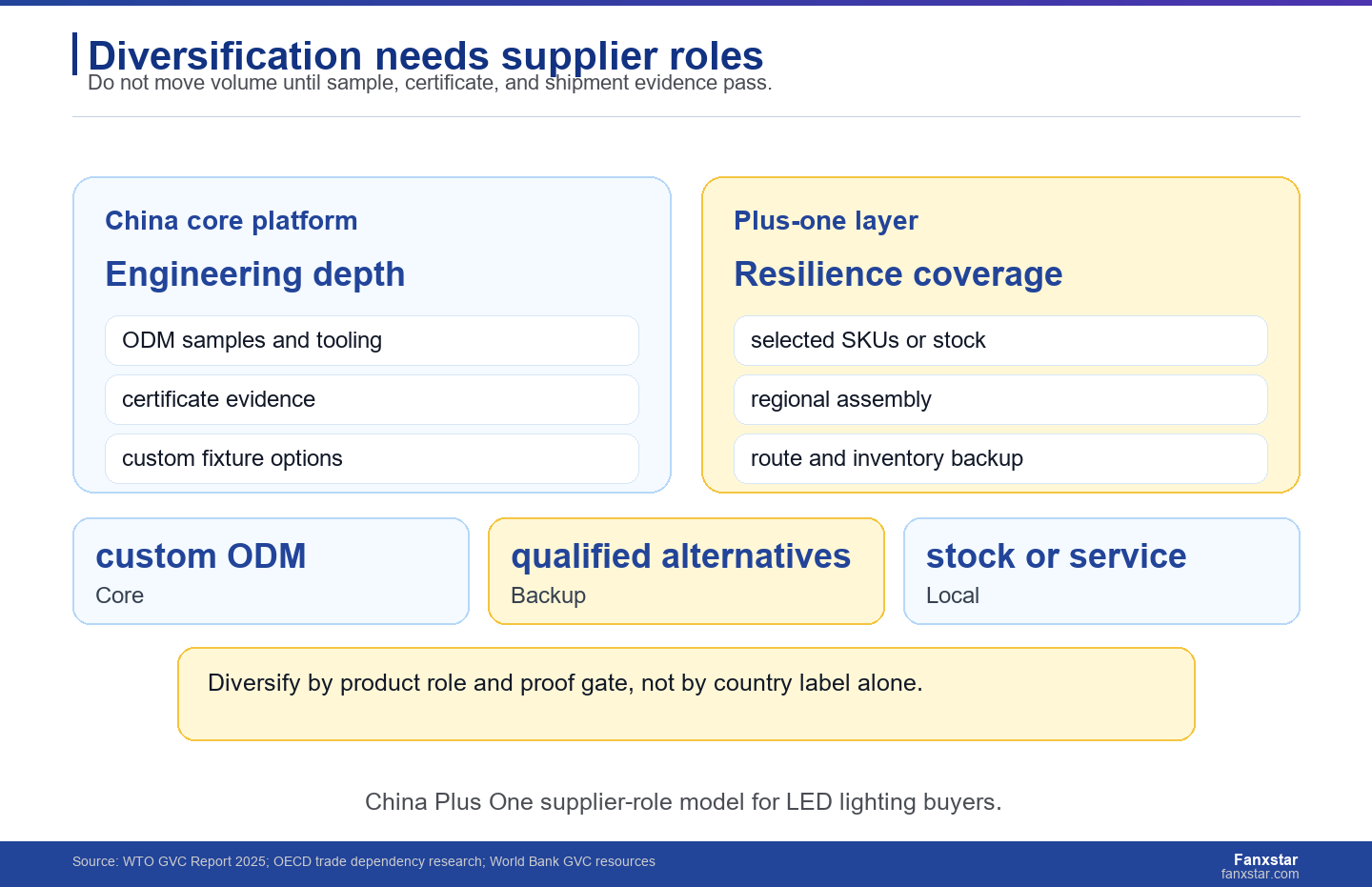
For example, a buyer may keep customized waterproof fixtures, vapor tight luminaires, motion sensor variants, and sample-intensive ODM projects with a proven China platform. The plus-one layer may handle simple stock SKUs, regional final assembly, buffer inventory, or customer-specific country policy requirements. That split keeps engineering depth while reducing exposure.
The wrong move is to ask a new supplier to copy the most complex item first. A better route is to qualify the plus-one layer with products that have stable construction, lower certificate complexity, and fewer customer-specific options. Once the supplier proves communication, packaging, label discipline, shipment accuracy, and warranty response, the buyer can decide whether more complex fixtures deserve a second-source project. Resilience should be earned through evidence, not assumed from a new factory address.
Buyers should also protect the incumbent relationship. A strong China supplier can help standardize drawings, clarify product families, and create documentation that makes future diversification cleaner. If the buyer treats diversification as a threat rather than a portfolio design exercise, the supplier may become less willing to share engineering support. The better conversation is about role clarity: which products remain core, which products need backup, and which changes must be frozen so every supplier works from the same approved specification.
Use platform discipline to make diversification easier
The more standardized the platform, the easier diversification becomes. If the fixture family has controlled drivers, defined optics, stable housings, repeatable packaging, and clear test evidence, a buyer can compare alternatives without losing visibility. If every order is a one-off interpretation, diversification becomes expensive and unreliable.
Fanxstar’s custom LED lighting ODM service can support this platform approach. Rather than treating customization as uncontrolled variation, buyers can use a standard base fixture and define controlled options: CCT, optics, sensor, housing material, cable entry, plug, label, packaging, and market documentation. That structure makes the China base easier to manage and makes any plus-one comparison more rational.
A Practical China Plus One Matrix for Lighting Buyers
Classify SKUs into core, backup, and local-support roles
Use three roles. Core platform products stay with the supplier that has the best engineering and evidence base. Backup products are qualified at a second source because volume, customer exposure, or lead-time risk justifies redundancy. Local-support items are handled through regional stock, assembly, packaging, or service partners. This role-based plan is more useful than forcing every SKU into the same diversification rule.
The WTO resilience and reglobalization chapter describes supply chains becoming more digital and regionally diversified as firms seek reliability and resilience. For buyers, the phrase “regionally diversified” should be converted into specific operating choices: where inventory sits, who owns component alternatives, how samples are released, and which documents prove the product is still the same approved item.
Set evidence gates before moving volume
Do not move meaningful volume to a plus-one supplier until the evidence gates are passed. Gate one is sample equivalence. Gate two is certificate and label match. Gate three is pilot order performance. Gate four is packaging and shipment documentation. Gate five is warranty and change-control behavior after the first order. Skipping these gates can turn a resilience strategy into a new quality problem.
The decision should also reflect customer communication. If a buyer sells to public infrastructure, retail chains, data centers, or industrial facilities, the customer may care about certificate scope, country of origin, warranty process, and traceability. A second supplier that cannot support those conversations is not yet ready for customer-facing volume.
Finally, assign a trigger for when backup capacity is actually used. Some buyers qualify an alternative source but never define the release condition, so the plan stays theoretical until a disruption has already started. A useful trigger can be a lead-time threshold, tariff threshold, stockout risk, customer policy change, or component shortage. The trigger should be written before pressure arrives.
Fanxstar Application Fit
Fanxstar is most relevant where buyers want a China-based specialty lighting ODM platform that can support controlled customization, sample evidence, and export documentation. Starting points include weatherproof lighting, vapor tight fixtures, motion sensor lights, linear lighting, and Fanxstar’s custom LED lighting design options.
For a China Plus One plan, Fanxstar can be positioned as the engineered core supplier or as the supplier that helps clarify which products are too customized to move casually. Buyers can send a portfolio list, target markets, annual volume, certificate needs, customization options, and risk concerns. The output should be a supplier-role map, not just a price comparison.
FAQ
Does China Plus One mean stopping purchases from China?
No. It usually means keeping a China base while adding another qualified source, route, inventory point, or assembly option. The goal is resilience, not a symbolic country switch.
Which LED lighting products should be diversified first?
Start with products that combine customer importance, supply difficulty, long qualification time, and high failure consequence. The highest-volume item is not always the first priority if it is easy to substitute.
Can a second supplier use the same certificates?
Only if the certificate scope, product construction, model identity, and issuing rules allow it. Many changes require separate review or documentation. Always confirm certificate scope before moving volume.
What is the biggest mistake in China Plus One sourcing?
The biggest mistake is treating a low quote as a qualified supply chain. A plus-one supplier must prove sample quality, documentation, packaging, shipment discipline, and change control.
How can a China ODM fit into a diversified strategy?
A China ODM can remain the core engineered platform while the buyer diversifies selected SKUs, inventory, assembly, logistics, or market support. The right split depends on product complexity and customer risk.