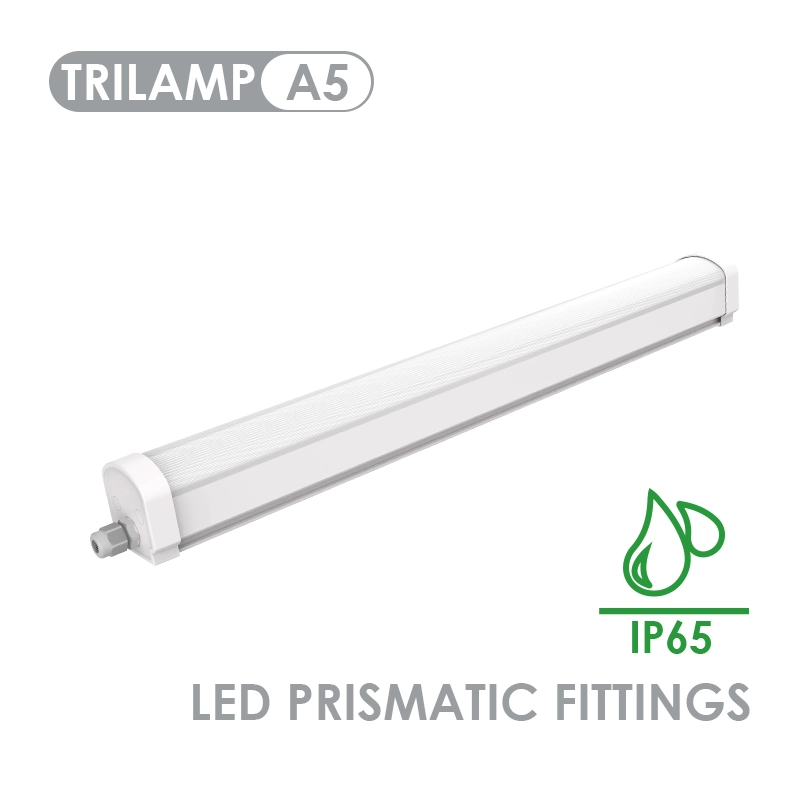
Your prospective distributor in Germany asks for a sample of your LED tri-proof fixture. You agree to send it. Two weeks later they report it was held at Frankfurt customs for a week, they received a €150 duty bill they were not expecting, and the product description on the invoice read “electrical parts.” That first impression — before the product even reached their hands — just cost you a relationship. Sample shipping sounds simple but it sits at the intersection of courier account management, customs documentation, and international trade compliance. Getting it right is a competitive advantage. Getting it wrong delays deals and signals operational inexperience to the buyers you most want to impress. This guide covers how to set up and manage DHL and FedEx business accounts for sample shipping, what documentation protects your shipments, and the specific practices that experienced lighting manufacturers use to ensure samples arrive clean.
Key Takeaways
- Use your own courier account (not the buyer’s) — shipping on your account gives you rate control, full tracking visibility, and account credit history that drives future discounts.
- The commercial invoice is the most important document — vague descriptions like “samples” or “electrical parts” cause customs delays; specific descriptions reduce them.
- DDP (Delivered Duty Paid) removes friction for buyers — especially for relationship-building sample shipments to new distributors who should not face unexpected duty bills.
- HS codes must be correct — LED luminaires typically fall under HS 9405 (lamps and lighting fittings); incorrect classification causes clearance delays and may trigger customs examinations.
- ATA Carnets enable duty-free sample shipments to over 87 countries for up to 12 months — a powerful tool for high-value prototype samples sent to trade shows or evaluation programs.
Setting Up a Business Courier Account
DHL Express Business Account
DHL Express business accounts are available through DHL’s online registration portal or via a local DHL sales representative. The application requires basic business information (company name, address, tax registration number, EORI number if shipping to/from the EU), estimated shipping frequency, and in some markets, proof of business registration. Approval is typically granted within 24–48 hours. Key features of a DHL business account include:
- MyDHL+ — DHL’s web platform for booking shipments, generating labels and commercial invoices, tracking shipments, and managing account settings. For China-origin shippers, MyDHL+ is available through DHL Express China.
- MyGTS (My Global Trade Services) — DHL’s trade compliance tool that helps classify products (HS codes), check prohibited/restricted goods lists, calculate duties and taxes, and generate compliant commercial invoices and certificates of origin. Available to DHL account holders at no additional cost.
- Volume-based rate tiers — DHL adjusts rates based on annual shipping volume. Manufacturing companies shipping multiple samples per week can negotiate rate structures that reduce per-shipment cost significantly compared to ad-hoc rates.
FedEx Corporate Account
FedEx corporate accounts offer comparable features through FedEx Ship Manager — the web and desktop application for booking international shipments, generating documentation, and managing account billing. For Chinese exporters, FedEx Ship Manager accommodates multi-origin shipping from China and provides direct access to FedEx International Priority (typically 1–3 business day delivery to most major markets) and FedEx International Economy services.
FedEx’s account setup requires business documentation similar to DHL’s. One distinction relevant to lighting manufacturers: FedEx offers specific handling configurations for oversized or irregularly shaped packages, which can be important for fixtures that do not fit in standard courier packaging dimensions. For very heavy samples (large industrial fixtures above 30 kg), both DHL and FedEx may require pre-booked oversized shipment handling.
Which Carrier to Use: DHL vs. FedEx for Lighting Samples
Both DHL and FedEx are viable for sample shipping from China, and most established manufacturers maintain accounts with both to leverage competitive rates and coverage breadth. Some practical considerations:
| Factor | DHL Express | FedEx International |
|---|---|---|
| EU coverage | Strongest — dense European network, including smaller markets | Strong — better for US and Canada routing |
| Australia / NZ | Strong direct service from China | Competitive on transit time |
| Middle East | Very strong — established hub in UAE | Available, DHL is dominant in region |
| Trade compliance tools | MyGTS — comprehensive and free | FedEx Global Trade Manager |
| Paperless Trade | Full electronic docs for 220+ countries | Electronic commercial invoice available |
For Fanxstar’s international sample program serving distributors in Europe, Australia, the Middle East, and North America, DHL Express is frequently the default for European and Middle Eastern deliveries; FedEx or DHL are comparable options for North America and Southeast Asia.
Billing: Who Pays for Sample Shipping?
Three Billing Models
There are three standard billing structures for sample shipping:
- Ship on manufacturer’s account (prepaid) — You book and pay the courier on your own account. The buyer receives the package without any customs bill. This is the DDP (Delivered Duty Paid) approach at the courier level. It maximizes the buyer’s first-impression experience but requires you to account for duties and taxes in your sample budget.
- Ship on buyer’s account (freight collect) — The buyer provides their courier account number and all charges (shipping + duties + taxes) are billed to their account. This is appropriate for established distribution relationships where samples are routine, or for large-scale evaluation programs. It eliminates your cost exposure but puts the billing burden on the buyer.
- Prepaid shipping, duties collect (DAP — Delivered at Place) — You pay the shipping cost but the duties and taxes are collected from the buyer at delivery. This is the most common structure but creates friction — the buyer receives an unexpected duty bill at the door, which is a poor first impression for new relationships.
For new distributor or specifier relationships — the typical sample request scenario for LED lighting products — the DDP model (manufacturer pays everything) produces the cleanest experience. The cost of a €50–150 duty bill per sample shipment is trivial compared to the cost of a delayed or abandoned distribution relationship. Reserve DAP or freight-collect arrangements for high-volume, established accounts that understand and expect the arrangement.
Documentation: The Commercial Invoice
Why the Commercial Invoice is Everything
The commercial invoice is the primary document that customs authorities use to assess duties, classify goods, and decide whether a shipment requires further examination. According to DHL Express’ commercial invoice guidance from their Global Trade and Customs Compliance team: “Providing complete and accurate electronic data on the Commercial Invoice is essential. A clear, accurate and detailed description for each item is needed for fast customs clearance. Putting ‘samples’ or ‘parts’ is not an adequate goods description.”
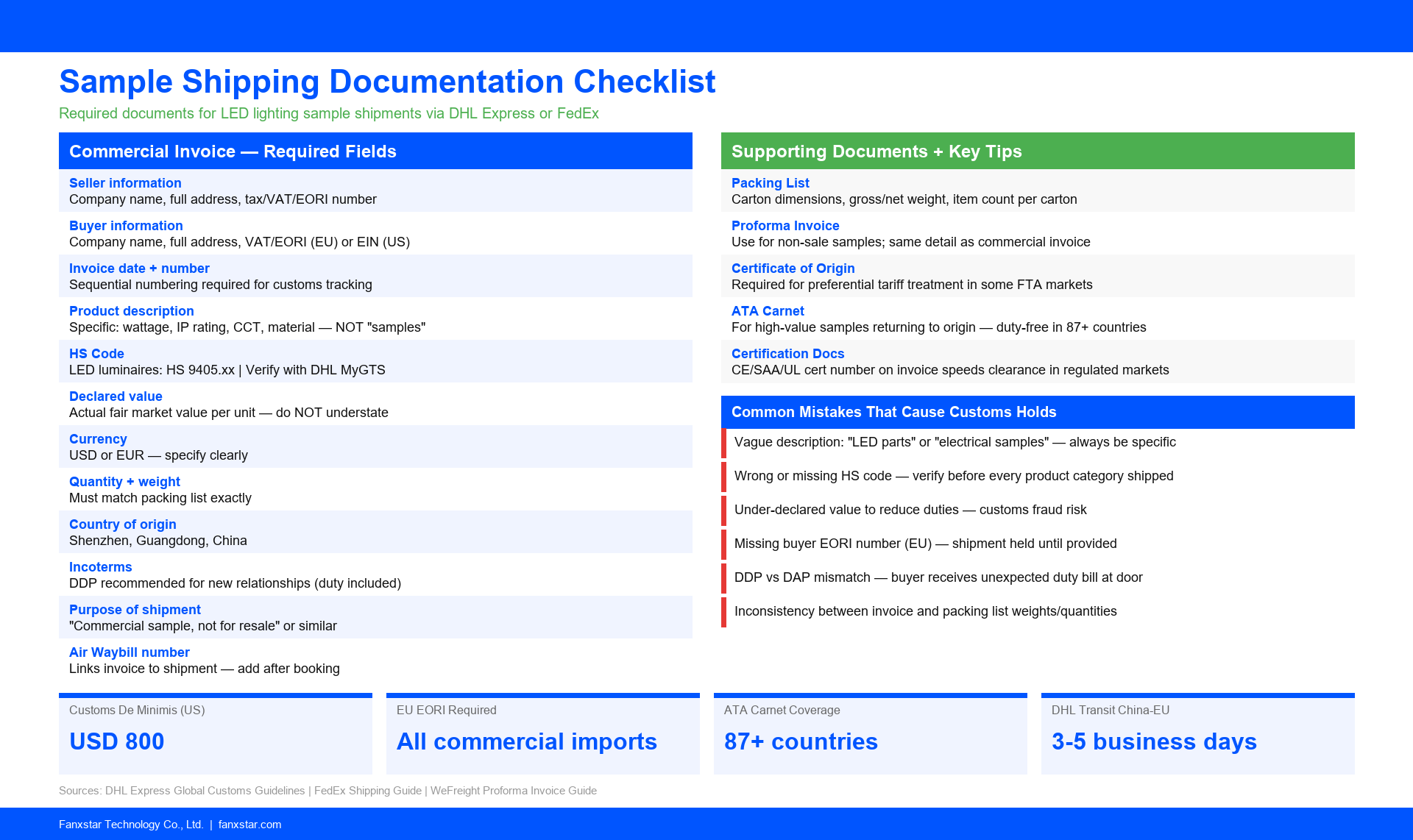
A customs-ready commercial invoice for LED lighting sample shipments must include:
- Complete seller and buyer information — company names, full addresses, tax/VAT/EORI numbers (EU buyers need EORI; US importers need EIN; UK importers need EORI GB).
- Specific product description — not “electrical parts” or “LED samples” but “LED weatherproof batten light, 50W, IP65 rated, 4000K color temperature, aluminum housing, for evaluation purposes” — enough for a customs officer to classify it accurately.
- HS code — LED lamps and luminaires typically fall under HS Chapter 94 (lamps and lighting fittings). The specific heading varies: HS 9405.40 covers LED lamps; HS 9405.10 and 9405.20 cover luminaires. Use DHL’s MyGTS or FedEx’s Global Trade Manager to verify the correct 6-digit HS code for your specific product before shipping.
- Declared value and currency — for genuine sample shipments (not for resale), declare the actual fair market value of the item, not an artificially low figure. Under-declaring value to reduce duties is customs fraud and can result in shipment seizure and account suspension.
- Incoterms — state the agreed delivery terms (DDP, DAP, etc.) and the named place of delivery.
- Country of origin — “Made in China” with the specific manufacturing location (Shenzhen, Guangdong, China).
- Purpose of shipment — “Commercial sample, not for resale” is the standard declaration for sample shipments. This affects duty classification in some markets.
- Number of packages, gross weight, and dimensions — must match the packing list precisely.
Customs Considerations by Destination
European Union
EU customs require an EORI (Economic Operators Registration and Identification) number from the importer of record. If your buyer does not have an EORI number (common for small firms or individuals receiving initial samples), the shipment will be held at customs pending registration, causing significant delays. Before shipping to any EU recipient who is receiving goods commercially for the first time, confirm they have an active EORI number. Per DHL’s customs clearance guidance, formal entry (over $2,500 in the US context, or above the EU customs threshold) requires full electronic data submission and a formal customs declaration. For LED fixtures above the de minimis threshold, formal entry is the norm.
EU importers of Chinese-origin goods must also be aware of CBAM (Carbon Border Adjustment Mechanism) reporting obligations, which began in the transitional phase in October 2023. While LED lighting is not currently a CBAM-covered category, this regulatory landscape is evolving and worth monitoring if your European distribution relationships involve large volumes.
United States
US customs uses three entry types for courier shipments: de minimis (under $800, consolidated pre-clearance), informal ($801–$2,500, managed under a DHL bond), and formal (over $2,500, requires Automated Broker Interface entry). LED fixture samples are typically formal entries due to their unit value. US importers receiving Chinese-origin lighting goods face Section 301 tariffs in most product categories — as of 2026, tariffs on Chinese-origin luminaires can range from 25% to higher rates depending on the specific HTS classification. Ensure the buyer understands the duty exposure before shipping, and consider DDP to remove the surprise factor.
Australia and New Zealand
Both Australia and New Zealand require safety certification (SAA in Australia; E-Mark or equivalent in NZ) for luminaires offered for commercial distribution, but sample shipments for evaluation purposes are typically admitted under temporary import or sample provisions. DHL and FedEx both have established direct routes from China to Australian capital city hubs with transit times of 3–5 business days. For Fanxstar products holding SAA certification, confirming the certification details on the commercial invoice (listing the relevant certification number) can accelerate customs clearance for Australian sample shipments.
ATA Carnets: The Sample Shipper’s Secret Weapon
What an ATA Carnet Does
An ATA Carnet (Admission Temporaire / Temporary Admission) is an international customs document that allows you to temporarily export goods — including samples — to over 87 participating countries and return them to the origin country without paying customs duties or taxes. The carnet is issued by a local chamber of commerce (in China, through the CCPIT — China Council for the Promotion of International Trade) and is valid for up to 12 months. As long as the goods return before expiry, no duties are assessed at any point in the journey.
For high-value LED fixture prototypes or pre-production samples sent to trade shows, product demonstrations, or evaluation programs — where you expect to recover the physical unit — an ATA Carnet eliminates the customs cost entirely. A 70W explosion-proof fixture worth $800 sent to a European distributor for evaluation would attract roughly €150–200 in EU duties under a standard commercial shipment. An ATA Carnet shipment costs the carnet application fee (typically $200–350) but eliminates the duty on each destination visit.
When to Use vs. When to Skip the ATA Carnet
ATA Carnets are not the right tool for every sample shipment. The administrative overhead — obtaining the carnet, maintaining the counterfoil sheet for each country entry and exit, and ensuring the goods return on time — makes them impractical for routine low-value samples that you do not expect to recover. They are most valuable for: high-value demonstration samples ($500+ unit value) traveling to multiple markets; trade show samples that will be transported across multiple countries; and prototype units that represent significant R&D investment and must be returned for engineering analysis.
Managing Your Sample Shipping Program
Standardize a Sample Shipment Template
Every team member who ships samples should work from a single approved commercial invoice template that has been reviewed for customs compliance. The template should pre-fill the standard product descriptions for each product line (with correct HS codes), the declared value per unit, the Incoterms, and the shipper’s details. Variable fields (buyer name, address, EORI number, quantity) are filled in per shipment. This eliminates the single most common source of customs delays: inconsistent or insufficient product descriptions on the invoice.
Track Account Costs and Volume
Both DHL and FedEx offer online account management platforms with per-shipment cost tracking, invoice history, and volume reporting. Reviewing monthly sample shipping spend — by destination market, by product type, and by billing model — gives procurement and sales leadership visibility into sample program ROI. Companies that track this data can identify which markets generate follow-on orders from samples and which are low-conversion, allowing them to adjust sample approval criteria accordingly.
Build Recipient Information Into Your Sample Request Process
When a distributor or specifier requests a sample, collect their full shipping address, contact person, phone number, and VAT/EORI number (for EU recipients) as part of the request workflow. Attempting to obtain this information after the package is booked delays shipping and creates errors on the commercial invoice. A simple sample request form — even via email template — that requires these fields before a sample order is processed will eliminate the most common operational bottleneck in sample shipping.
Fanxstar’s sample program supports evaluation requests from global distributors and project specifiers across Europe, Australia, the Middle East, and North America. If you are evaluating Fanxstar’s weatherproof lighting solutions or emergency lighting products for a specific project or distribution opportunity, contact the team to discuss sample availability, shipping arrangements, and any certification documentation required for your market.
Frequently Asked Questions
What value should I declare on the commercial invoice for a sample?
Declare the actual fair market value — what you would normally sell the item for, or a reasonable cost-based value if the item is not yet commercially available. Some companies declare a nominal “sample value” (e.g., $1 USD) to avoid duties, but this is customs fraud and can result in shipment seizure, fines, and account penalties. If the sample is genuinely no commercial value (promotional material, color chips, spec sheets), state “No Commercial Value” with a description and token value like $0.01. For any item with functional commercial value — a working LED fixture — declare its actual value.
What happens if my sample is seized at customs?
Customs seizure is most commonly triggered by: incorrect or missing HS classification, incomplete commercial invoice details, declared value that appears inconsistent with the goods, or the goods appearing on a restricted/prohibited list for that market. The recovery process is time-consuming: the importer typically must provide additional documentation, pay assessed duties and penalties, and in some cases hire a customs broker to clear the goods. Prevention is substantially less expensive than recovery. DHL’s Paperless Trade service and FedEx’s Electronic Trade Documents allow full commercial invoice data to be transmitted electronically before physical arrival, allowing customs pre-clearance in many markets.
Can I use a proforma invoice instead of a commercial invoice for samples?
A proforma invoice is appropriate for shipments that are genuinely not for resale — samples sent for evaluation that will be returned, goods sent for repair, or items being exported temporarily. It should include the same detail as a commercial invoice (full product description, HS code, value, origin) but is marked “Not for Commercial Use — Sample Only.” Many markets accept proforma invoices for sample shipments; some (notably the US for formal entries) require a standard commercial invoice regardless of whether the goods are for sale. When in doubt, use a full commercial invoice marked for the appropriate purpose. For more guidance on international shipping documentation, review Fanxstar’s application and project support resources for your market.
How do I get DHL or FedEx volume discounts?
Both carriers offer volume-based pricing that improves automatically as your annual shipping spend crosses defined thresholds. However, proactively negotiating with a carrier sales representative — rather than waiting for automatic tier upgrades — typically produces better rates faster. Come to a negotiation meeting with 12 months of shipping data: total weight shipped, number of shipments, average shipment weight, primary destination regions, and a forecast for the coming year. Carriers are more willing to offer aggressive rates to shippers who can demonstrate both current volume and growth trajectory. For a China-based manufacturer shipping globally, consolidating all sample shipping onto one primary carrier account also produces better rates than splitting volume between carriers.