LED ghosting usually means a tiny off-state current or stored charge is still feeding the LED driver, so the fix starts with the circuit and control path rather than the lamp name alone. A faint afterglow can be harmless if it fades quickly, but a steady glow, repeated flash, buzzing, or dimming instability means the off-state path needs diagnosis. In commercial lighting, the fixture, driver, sensor, switch, and dimmer should be approved as one control system.
Lutron minimum-load application note says insufficient minimum load may cause glow when off, sometimes called ghosting. ETC LED dimming compatibility guidance says compatibility between LED fixture technology and dimming/control systems is often a specification and implementation challenge. Those two signals point to the same answer: ghosting is usually a circuit and compatibility problem, not proof that all LEDs are defective.
For Fanxstar-style projects, the first business anchor is the control file: final driver, sensor, dimmer, neutral wire assumption, load quantity, and off-state test. A fixture sample that skips those 6 items can look ready in a showroom while creating nuisance glow in the installed project.
Key Takeaways
- LED ghosting is a faint glow or periodic flash after switch-off, usually caused by leakage current, stored charge, dimmer minimum-load issues, or control wiring.
- A glow that fades quickly is often different from a steady glow or repeated flash; the symptom pattern guides the diagnosis.
- Two-wire dimmers, illuminated switches, smart controls, neutral wire availability, long cable runs, and incompatible LED drivers are common places to investigate.
- Commercial projects should approve the final driver, sensor, dimmer, and control protocol together instead of testing the fixture alone.
- If there is heat, damaged wiring, abnormal smell, tripping, or unsafe uncertainty, stop and use a qualified electrician or local code professional.
Why LEDs Can Glow After the Switch Is Off
LED drivers react to tiny currents that old lamps ignored
LEDs need very little current to produce visible light. That efficiency is normally the benefit, but it also means tiny off-state currents can become visible. An incandescent lamp might absorb the same small current without glowing, while an LED driver capacitor can charge slowly and feed a faint light output or brief flash.
Lutron ghosting and blinking troubleshooting emphasizes dimmer and bulb compatibility for better LED performance. The point for fixture buyers is broader than residential bulbs. A commercial LED fixture includes a driver and sometimes sensors, emergency packs, dimming leads, wireless modules, or 0-10 V controls. Any part of that system can create or reveal an off-state path.
This is why replacing the LED fixture first is not always the smartest move. If the control device leaks current, if the dimmer needs a higher minimum load, or if the switch powers its electronics through the load, the new fixture can show the same symptom. The diagnosis should follow the current path before the purchasing team blames the lamp.
Ghosting and flashing are related but not identical
Ghosting usually means a steady faint glow when the circuit is supposed to be off. Flashing means the LED turns on briefly, goes off, and repeats. The mechanism can be similar: a tiny leakage current charges the driver input until the LED fires, then the charge discharges and the cycle restarts. The symptom tells the installer whether the problem is continuous leakage, stored charge, or a compatibility threshold.
Lutron application note 048487 describes both glow when off and flashing when off in the context of minimum load and leakage current. That makes the first diagnostic question practical: does the glow fade, stay steady, or pulse? A fade may be stored energy. A steady glow points toward a continuous leakage path. A flash points toward a charging cycle.
Common Causes of LED Ghosting
Map the symptom to the circuit path
| Likely cause | Visible symptom | What to check first |
|---|---|---|
| Stored charge in LED driver | brief glow that fades after switch-off | driver behavior and normal discharge time |
| Two-wire dimmer leakage | steady low glow or periodic flash | minimum load, dimmer type, approved compatibility list |
| Illuminated or smart switch path | glow even when switch appears off | neutral availability and switch wiring method |
| Cable capacitance or multi-way wiring | faint glow on long or parallel cable runs | circuit layout, shared conduits, switching arrangement |
| Control mismatch | ghosting plus flicker, buzz, or poor dimming range | fixture-driver-dimmer compatibility as a set |
Leviton LED compatibility selector guide frames LED performance as a pairing problem between lamps and dimmers. In commercial luminaires, the same principle applies to fixtures and controls. A driver that behaves well on one dimmer may ghost, flicker, or buzz on another because the off-state electronics and minimum-load behavior differ.
Illuminated switches and some smart switches can also create a small current path when off. The switch may need power for a locator light, wireless module, sensor, or internal electronics. If the wiring method powers that device through the load, the LED can become the visible indicator of a circuit design problem.
Cable layout and multi-way switching can make a weak problem visible
Long cable runs, parallel conductors, and multi-way switching can introduce capacitive coupling or unexpected paths that charge a high-impedance LED driver. In many cases the current is tiny, but LED electronics can reveal it. This is especially relevant in corridors, stairwells, parking areas, and retrofit projects where existing wiring was designed for older loads.
The safest article-level advice is not to prescribe a wiring fix from a distance. The correct repair depends on the local code, switch type, neutral availability, dimmer design, driver, and circuit layout. A qualified electrician can identify whether the answer is a compatible dimmer, neutral-powered control, bypass module approved by the control manufacturer, driver-level dimming, corrected wiring, or a different fixture-control combination.
How to Diagnose Ghosting Without Guesswork
Test one variable at a time
| Test step | Question answered | Buyer-safe conclusion |
|---|---|---|
| Replace dimmer with a plain switch for test | Is the dimmer the leakage path? | If ghosting disappears, specify a compatible control strategy. |
| Check minimum load | Does the circuit meet dimmer requirements? | Low LED load can be enough to cause off-state symptoms. |
| Confirm neutral and switch type | Is electronics power flowing through the load? | A neutral-powered control may be needed in some designs. |
| Test final driver and fixture | Does production hardware behave like the sample? | Do not approve a sample with temporary control gear. |
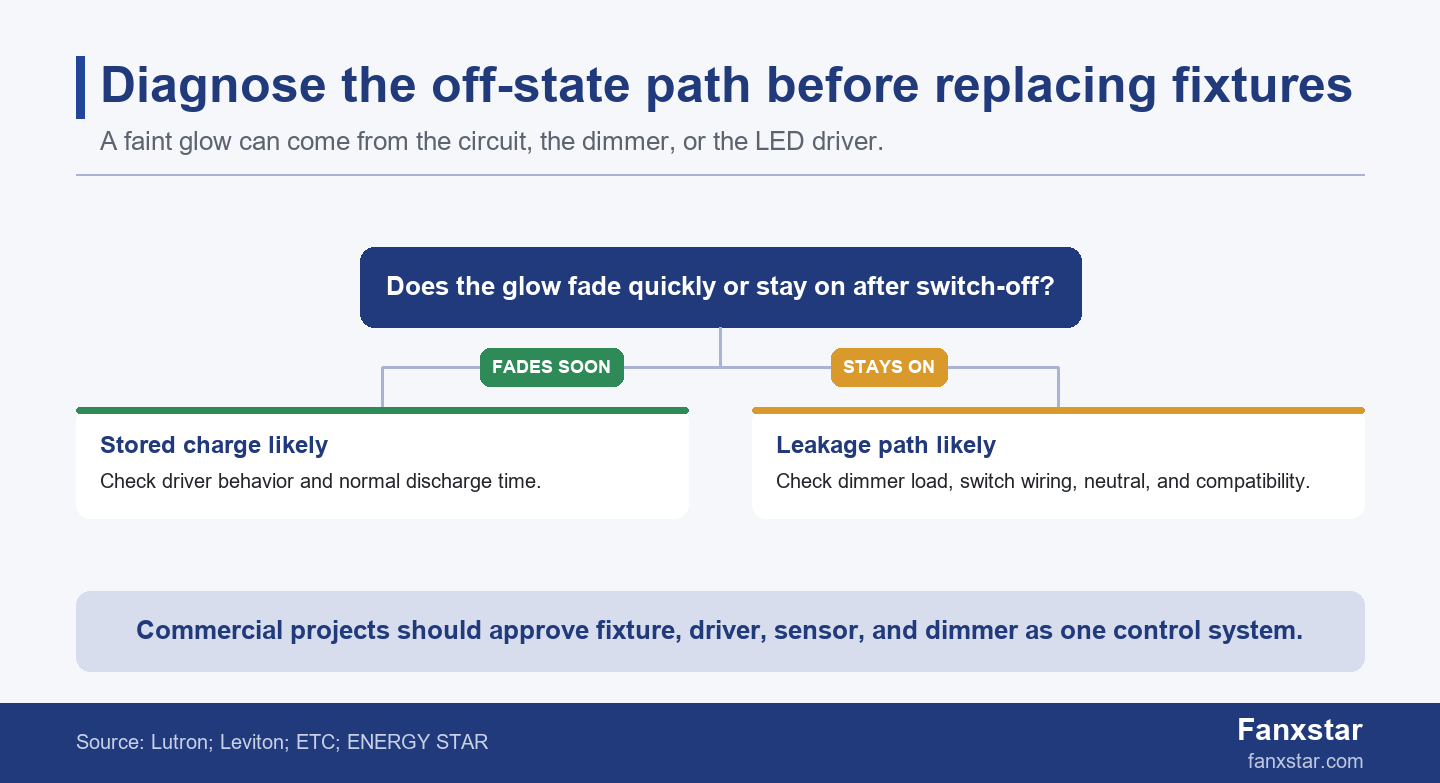
A useful diagnostic path starts by separating fixture behavior from control behavior. Test the fixture with the final driver on a plain switching circuit if the electrician can do so safely. Then test the intended dimmer, sensor, or smart switch. If the ghosting appears only with the control device, the specification should focus on compatibility and off-state leakage rather than changing the fixture body.
Commercial projects should test the final control package
ENERGY STAR-hosted NEMA LED dimming material discusses LED dimming compatibility criteria. DOE FEMP commercial and industrial LED luminaire guidance also keeps buyers focused on luminaire-level performance in commercial and industrial categories. Those sources matter because dimming performance is not a decorative feature. It affects off-state behavior, flicker, audible noise, low-end trim, user comfort, and service calls. For a hotel corridor, parking garage, data hall, or warehouse aisle, a nuisance glow can become a maintenance complaint.
The sample gate should use the final driver, final dimmer or control module, final sensor, and expected load quantity. A bench test with one fixture may not reveal the same behavior as a circuit with many fixtures. The procurement team should record dimmer model, driver model, fixture quantity, control protocol, wiring assumptions, and observed off-state behavior before approving production.
Based on our analysis, a practical off-state test for a commercial batch should include at least 10 units on the intended control type, a 24 hours burn-in, a switch-off check after 1 hour of operation, and a repeat test after 7 days if the circuit uses sensors or a new dimmer family. Those numbers are a scenario estimate, but they force the buyer to test the system rather than a single loose sample.
For a buyer-side diagnosis estimate, test enough conditions to catch the weak link. Based on our analysis, 10 units should be connected before approving a multi-fixture circuit. Based on our analysis, 24 hours of burn-in is useful before the first off-state check. Based on our analysis, 1 hour of operation can reveal heat-related driver behavior before switch-off. Based on our analysis, 7 days is a reasonable repeat-test window for sensor or dimmer changes. Based on our analysis, 2 control methods should be compared when the project still has design freedom. Based on our analysis, 3 observations matter most: steady glow, periodic flash, and delayed fade. Based on our analysis, 1 final compatibility file should travel with the production order.
Use the estimate as a control-system check. Based on our analysis of this scenario, 10 units should be tested together before buyer approval. Based on our analysis of this scenario, 24 hours of burn-in can reveal early driver behavior. Based on our analysis of this scenario, 1 hour of operation before switch-off makes the test more realistic. Based on our analysis of this scenario, 7 days is a useful repeat-test window after a control change. Based on our analysis of this scenario, 2 control methods can expose compatibility limits. Based on our analysis of this scenario, 3 symptom patterns should be recorded before diagnosis. Based on our analysis of this scenario, 1 compatibility file should travel with the order. Based on our analysis of this scenario, 6 final control inputs should be frozen before production.
Design Choices That Reduce Ghosting Risk
Select controls and drivers as a system
ETC compatibility guidance states that LED fixture and control compatibility can be challenging during specification and implementation. For B2B buyers, this means the lighting schedule should not list fixtures on one page and dimmers on another page with no compatibility check. The driver, dimming method, sensor, and control device should be selected together.
Where possible, use manufacturer compatibility lists, driver-level dimming such as 0-10 V or DALI when appropriate, neutral-powered controls where the wiring supports them, and a sample test that matches final load count. Phase-cut dimming can work well when parts are compatible, but it is less forgiving when the dimmer minimum load, driver design, or wiring path is wrong.
For Fanxstar projects involving sensors, dimming, or smart zones, use LED lighting controls for industrial facilities to define the driver and control package before sample approval. A sensor-ready luminaire should be approved with its control package, not as a bare fixture that later receives an unknown switch. That is especially important for parking garage lighting, warehouses, service corridors, and backrooms where motion control is common.
Do not hide a control issue inside a product warranty dispute
A warranty claim should identify whether the problem follows the fixture, driver, switch, dimmer, circuit, or installation. If a fixture ghosts on one control circuit but not another, the evidence points toward compatibility. If the same fixture ghosts on a plain mechanical switch, the fixture or driver deserves closer inspection. If multiple brands ghost on the same switch, the switch or wiring path may be the shared cause.
This distinction protects both buyer and supplier. The buyer avoids repeated replacement of healthy fixtures. The supplier avoids being blamed for a circuit condition outside the product. The installer gets a clearer test path. The final goal is not to prove fault; it is to eliminate the off-state current path or approve a fixture-control combination that does not create the symptom.
How to Brief Fanxstar About LED Ghosting or Off-State Glow
Send the control context, not only a video of the glow
If a project needs Fanxstar support, send the fixture model, driver, control method, switch or dimmer model, wiring diagram if available, circuit quantity, sensor setting, input voltage, and a short video of the off-state behavior. For new ODM work, relevant starting points include custom LED lighting ODM service, motion sensor LED lighting, and smart lighting ODM routes.
The useful answer may be a compatible driver choice, different control strategy, sensor-ready fixture configuration, low-voltage dimming method, or an electrician-led wiring correction. Fanxstar can help define what belongs in the fixture and sample file, but site wiring and code decisions must be handled by the proper local professionals.
Make off-state behavior part of sample approval
For a production project, add off-state behavior to the sample checklist. Turn the circuit off, observe immediate glow, check again at 5 minutes and 15 minutes, test for periodic flashes, test the lowest dimming level, and record the control model. This simple evidence step can prevent a nuisance issue across hundreds or thousands of fixtures.
The final decision rule is straightforward: ghosting is not solved by a slogan such as LED compatible. It is solved by proving the final fixture, driver, switch, dimmer, sensor, and wiring assumption together. If the sample file does not include the control package, the off-state result is still unproven.
FAQ
Is LED ghosting dangerous?
A faint glow is often caused by tiny leakage current or stored charge and may not be dangerous by itself. However, heat, damaged wiring, burning smell, breaker trips, or uncertainty about the circuit should be handled by a qualified electrician because the cause cannot be confirmed from appearance alone.
Why do LED lights glow when a dimmer is off?
Some dimmers allow a small off-state current through the load to power internal electronics or because the LED load is below the dimmer’s minimum requirement. That current can charge the LED driver enough to create a faint glow or periodic flash.
Can changing the LED fixture fix ghosting?
Changing the fixture can help if the driver is the main issue, but it will not fix ghosting caused by the switch, dimmer, wiring path, or control compatibility. Test the fixture and control separately before replacing products in bulk.
What should commercial buyers test before approving LED controls?
Commercial buyers should test the final fixture, driver, dimmer or sensor, load quantity, wiring assumption, low-end dimming behavior, and off-state behavior. A sample that uses a temporary driver or different control device does not prove the production system.