A US LED upgrade rebate is not a funding promise until the program rule, product eligibility, preapproval timing, and post-installation evidence all describe the same lighting project. The buyer’s first job is not to ask whether LED rebates exist. The useful question is whether the exact fixtures, building location, utility program, order date, installation date, and claim documents can survive the program review.
ENERGY STAR Rebate Finder lets buyers search rebates and special offers by ZIP code, while ENERGY STAR commercial rebate guidance points commercial buyers to rebate tools for equipment categories. That is the right starting point because US rebate availability changes by location, utility, product category, and program cycle.
Key Takeaways
- US LED rebates are usually local, utility, or program-specific; a national guide can explain the evidence path but should not promise a fixed payout.
- Product eligibility is often tied to ENERGY STAR, DLC, or a program-specific approved list, so the model number matters as much as the wattage saving.
- Many commercial projects should check preapproval before purchase because a late application can make a technically strong upgrade ineligible.
- Section 179D is a separate tax deduction route, not a utility rebate, so finance should review it as a different file.
- For Fanxstar projects, rebate readiness starts with selecting a fixture platform that can provide the model, performance, certification, and installation evidence the program requests.
What Counts as a Government Rebate for LED Upgrades?
A rebate is a program decision, not a product feature
According to ENERGY STAR upgrade lighting guidance, utilities and energy efficiency program sponsors offer incentives such as rebates, buy-downs, and instant rebates. That language matters because a rebate is not attached to every LED product. It is attached to a program rule that names eligible customers, products, installation conditions, dates, and claim evidence.
Commercial lighting buyers often use the word government rebate too broadly. A utility incentive, state energy program, instant distributor buy-down, custom energy-saving incentive, tax deduction, and depreciation treatment can all reduce project cost, but they do not work the same way. Mixing those mechanisms creates a weak purchase case because the buyer may subtract money that has not been approved.
According to DSIRE, the database is a comprehensive source for incentives and policies supporting renewable energy and energy efficiency in the United States. Use that kind of database to find program possibilities, then go to the utility or program administrator for the live application rules. The database is a map; the program application is the contract.
Prescriptive and custom paths create different evidence needs
A prescriptive lighting rebate usually starts with a defined product type and a fixed or formula-based incentive. A custom incentive usually starts with a calculated energy saving, baseline, operating hours, control strategy, and sometimes a pre-installation review. The product and documentation burden can be very different even when both are called LED upgrade rebates.
This distinction changes how buyers compare quotes. In a prescriptive path, the priority is whether the product category, listing, wattage, and installation date match the program. In a custom path, the priority shifts toward baseline evidence, operating schedule, controls behavior, measurement assumptions, and program approval before the work starts. A supplier quote that ignores the path may look cheaper while leaving the buyer to rebuild the claim file later.
The Rebate File Buyers Should Build Before Choosing Fixtures
Start with the evidence gates, then choose products
| Evidence gate | What to verify | Why it affects rebate risk |
|---|---|---|
| Program fit | ZIP code, utility, building type, product category, prescriptive or custom path | A national article cannot promise funding because many programs are local or utility-specific. |
| Product eligibility | ENERGY STAR, DLC, or program-specific product listing where required | A fixture can save energy and still miss the rebate if it is not in the approved category. |
| Timing | Preapproval, purchase date, installation date, invoice date, and submission deadline | Some commercial programs require approval before order or before installation. |
| Installed evidence | Model number, quantity, photos, invoices, disposal or baseline notes, contractor documents | Payment usually follows proof that the approved product was installed. |
| Tax treatment | Separate review of Section 179D, depreciation, and local incentive interactions | A utility rebate and a tax deduction are different mechanisms with different files. |
According to DLC quick facts, DLC Qualified Products Lists are required by nearly 700 utility and energy efficiency programs to be eligible for rebates. That does not mean every Fanxstar or other supplier fixture automatically qualifies. It means the buyer should ask whether the exact quoted model, wattage, category, and listing status match the program before treating the incentive as part of the budget.
According to DLC solid-state lighting technical requirements, commercial LED product qualification is organized around product categories and documented performance requirements. This means the rebate conversation should name the exact category and model evidence, not only the supplier’s general promise that the fixture saves energy.
The most common mistake is putting rebate work after fixture selection. The better sequence is to identify program rules first, then choose fixtures that can satisfy the program evidence. If the program requires a specific listing, model family, wattage range, control capability, or installation date, the RFQ must state those limits. A supplier cannot protect an incentive requirement that the buyer never described.
Model identity is the quiet risk in lighting rebates
LED fixtures often have many versions: wattage switch settings, CCT settings, diffuser options, emergency backup, sensor modules, driver options, mounting kits, and private-label model names. A rebate application can fail when the installed version does not match the approved version, even if the difference seems small to the project team.
For weatherproof LED lighting, linear LED lighting, parking garage lighting, or food-area upgrades, the buyer should ask for the exact model identity that will appear on the invoice, label, datasheet, and evidence file. If a platform-based ODM change is needed, the rebate file should say whether the change affects listing, certification, or program eligibility.
Timing Gates That Can Protect or Destroy the Incentive
Preapproval belongs before the purchase decision when the program asks for it
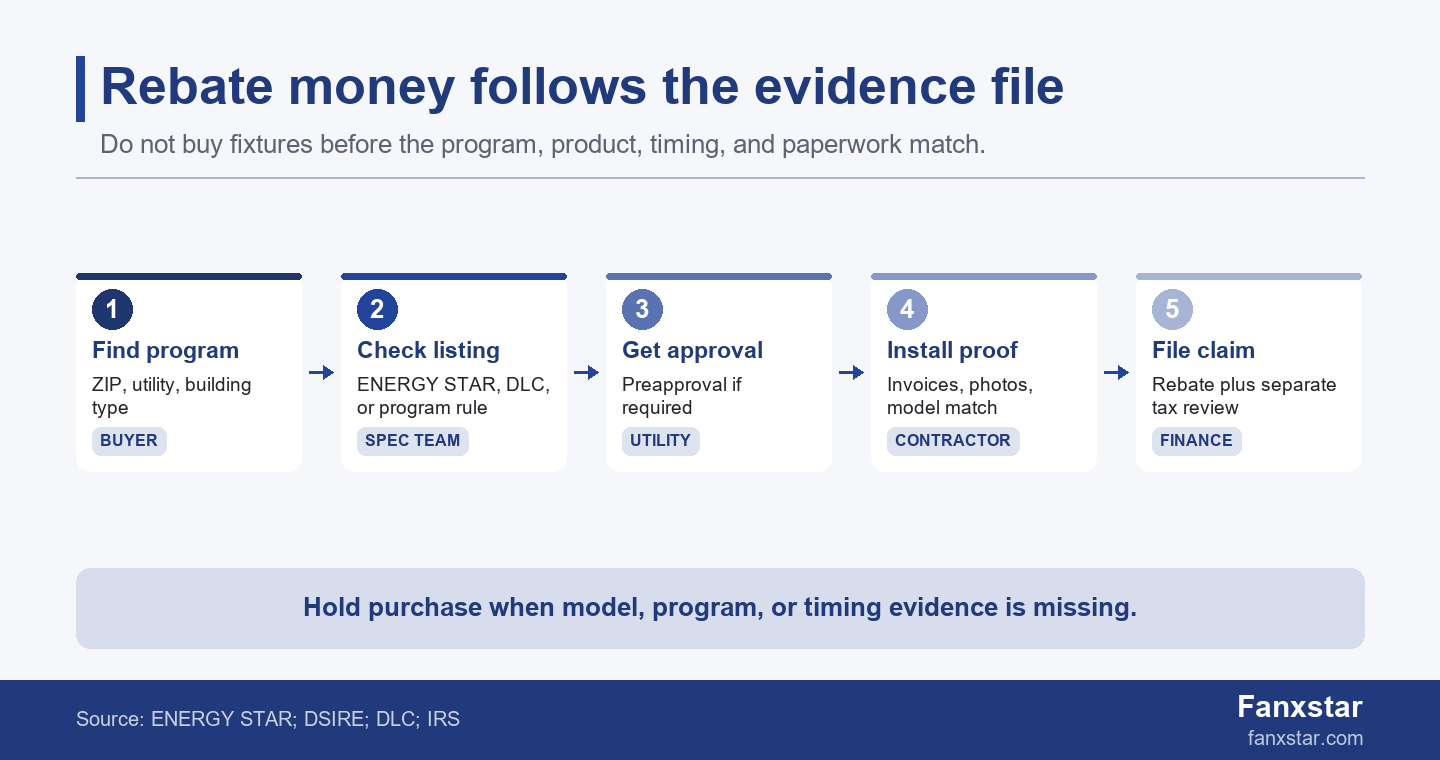
Many lighting incentives are not simple refunds after installation. A program may require preapproval, pre-inspection, an approved contractor, a product list check, a reservation of funds, or installation by a deadline. The buyer should not assume that an invoice and a photo are enough. The safe rule is to ask the program administrator what must happen before purchase, before installation, and before final claim.
According to ENERGY STAR commercial rebate guidance, commercial buyers should start with rebate tools for eligible commercial equipment categories. The actual claim still depends on the program administrator. That is why the internal project calendar should include at least 5 dates: program search date, application date, approval date, purchase date, and installation completion date. If those dates are missing, finance cannot know whether the incentive is real.
A simple calculation should include the failure case
| Scenario input | Illustrative value | Buyer decision |
|---|---|---|
| Fixture count | 200 commercial LED fixtures | Confirm the program pays per fixture, per watt reduced, or per kWh saved. |
| Published rebate | $35 per eligible fixture | Treat this as conditional until product listing and timing are verified. |
| Possible gross incentive | $7,000 before exclusions | Do not subtract it from project cost until the utility confirms the application. |
| Documentation failure | wrong model or missed preapproval | The incentive can fall to zero even if the lighting upgrade is technically good. |
This illustrative calculation is intentionally conservative. If a buyer expects $35 per eligible fixture on a 200 fixture project, the gross incentive looks like $7,000. But that number should be held outside the approved budget until the utility confirms eligibility. A missed preapproval gate, wrong model number, or nonqualified fixture version can reduce the expected rebate to zero.
The practical conclusion is not that rebates are unreliable. The conclusion is that rebate value depends on process control. A buyer who spends one hour confirming program and product evidence before ordering can protect thousands of dollars of expected funding. A buyer who treats the rebate as automatic may discover the gap only after the fixtures are already installed.
How Section 179D Fits the LED Upgrade Decision
179D is a tax deduction route, not a utility rebate
According to IRS guidance on the Energy Efficient Commercial Buildings Deduction, building owners who place in service energy efficient commercial building property may be able to claim a deduction under IRC Section 179D. This is not the same file as a utility rebate. It belongs with tax advisors, building ownership, placed-in-service timing, energy modeling, and project documentation.
According to DOE 179D guidance, deduction rates can vary with energy savings and prevailing wage or apprenticeship requirements. A lighting buyer should therefore avoid saying the project has a fixed tax benefit unless finance has checked the rules. The decision rule is to keep tax benefit, utility rebate, and procurement evidence separate until each reviewer has approved its own file.
Keep rebate, tax, and procurement files separate but consistent
A good LED upgrade file has 3 layers. The procurement file proves what was bought and installed. The rebate file proves the project matched the program rule. The tax file supports whatever deduction or depreciation position the building owner and tax advisor choose. These layers should use the same model numbers, quantities, dates, and performance data, but they should not be treated as one generic incentive packet.
For multi-site buyers, consistency becomes more important. One state may have a useful utility rebate, another may not. One site may have enough operating hours to justify controls, another may not. One building owner may be positioned to review 179D, another may not. A repeatable evidence template lets the buyer make these decisions without forcing every site into the same financial story.
Where Fanxstar Fits in Rebate-Ready LED Upgrade Projects
Ask for the rebate evidence before sample approval
Fanxstar is most useful when the buyer has a defined application and needs a fixture platform that can be checked against program and project evidence. Relevant starting points include IP65 and IP66 waterproof LED lights, vapor tight LED light fixtures, LED linear batten lights, and motion sensor LED lighting. The RFQ should state whether rebate eligibility is mandatory, preferred, or only a future option.
The safest message to send is practical: target utility or program, project location, fixture category, old fixture type, expected operating hours, control need, installation date, and any required product listing. Fanxstar can then advise whether an existing platform, a modified platform, or a different fixture family is the better evidence route. That is more useful than asking for a generic energy-saving quotation.
Do not let customization silently break the incentive path
Customization can be a strength, especially through Fanxstar custom LED lighting ODM service, but it has to be controlled. A changed driver, sensor, emergency module, diffuser, label, or wattage setting may affect the program evidence. The buyer should ask what remains identical to the listed or approved version and what must be rechecked before order.
The final buyer rule is simple: quote the lighting project with a rebate scenario and a no-rebate scenario. If the project only works financially when the incentive is guaranteed, wait for written program confirmation before committing. If the project still works without the incentive, the rebate becomes upside rather than a hidden dependency. This means the supplier choice can be judged on product fit and evidence quality instead of on an unapproved funding assumption.
FAQ
Are US LED lighting rebates available everywhere?
US LED lighting rebates are not available everywhere because eligibility varies by utility, state, building type, product category, funding cycle, and program rule. Buyers should use national tools only to find possible programs, then confirm the live application requirements with the utility or program administrator before ordering fixtures.
Do LED fixtures need DLC listing for rebates?
DLC listing is required by some commercial lighting programs, but not every program uses the same eligibility rule. Buyers should check the exact utility requirement and confirm that the quoted model, wattage, category, and installed version match the approved evidence before subtracting the incentive from project cost.
Is Section 179D the same as a lighting rebate?
Section 179D is not the same as a lighting rebate because it is a federal tax deduction route for qualifying energy efficient commercial building property. A project may need both files reviewed separately by finance, tax, and project teams, especially when utility incentives and tax assumptions affect the same budget.
What should Fanxstar buyers send for a rebate-ready RFQ?
Fanxstar buyers should send project location, utility or program name, fixture category, old fixture type, expected quantity, operating hours, control requirement, installation schedule, and any listing or documentation requirement. That lets Fanxstar check whether a product platform can support the rebate evidence path.