
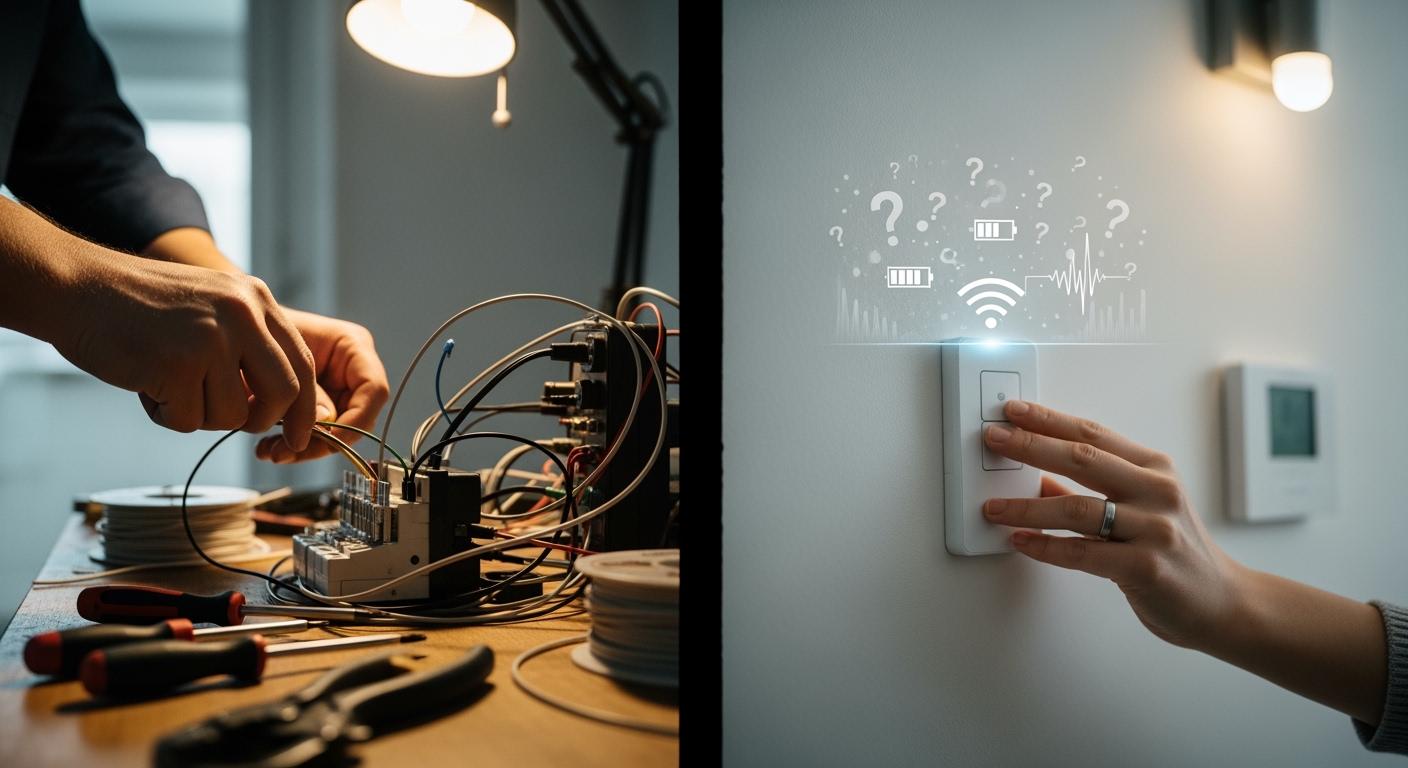
When budgeting for an industrial or commercial lighting project, facility managers often focus on the “luminaire price.” However, in professional environments, the most significant financial variables are hidden within the control infrastructure. The decision between wired (e.g., DALI-2, 0-10V) and wireless (e.g., Zigbee, Bluetooth Mesh) controls impacts everything from initial labor hours to the “Copper Tax” of extra cabling and the long-term cost of system reconfiguration.
In many retrofit applications, the hidden costs of a wired system can effectively triple the per-fixture price when accounting for conduit, junction boxes, and licensed electrician hours. This guide analyzes the total cost of ownership, helping stakeholders move beyond the initial price tag to evaluate the true financial impact of lighting control selection.
Key Takeaways
-
The Labor Gap: Wireless systems can reduce installation labor hours by 60% to 80% compared to traditional wired DALI or 0-10V networks.
-
Infrastructure Costs: Wired systems carry the “Hidden Bill” of extra conduits, CAT5/6 cabling, and wall repairs that often go unquoted in the hardware phase.
-
Retrofit ROI: For concrete structures or parking garages, wireless is often the only viable choice that avoids the massive expense of trenching or surface-mounted conduits.
-
Commissioning Costs: While wireless saves on physical wiring, it requires “digital labor” for software commissioning. Understanding this trade-off is vital for project scheduling.
-
Flexibility as Value: Wireless systems allow for “soft-patching,” where zones can be changed in software rather than by moving physical wires, saving thousands in future facility modifications.
A Deep Dive into Wired Controls: The Cost of Physicality
The “Copper Tax” and Physical Routing
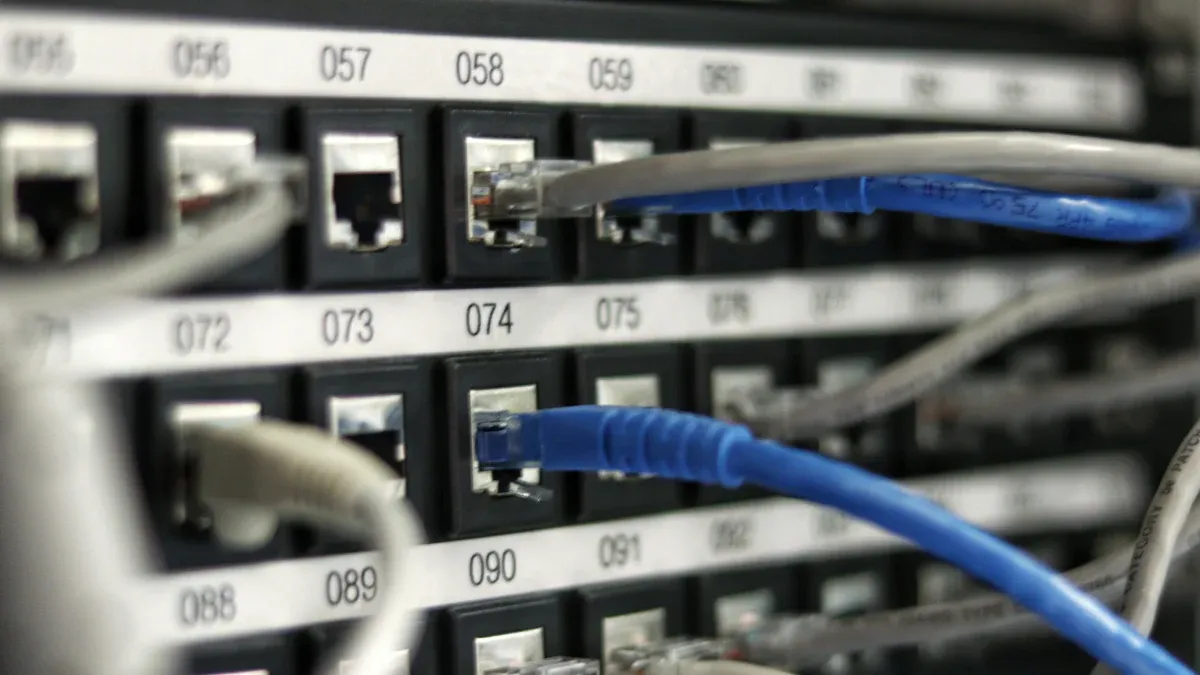
Wired lighting controls, such as DALI (Digital Addressable Lighting Interface) or 0-10V dimming, require a physical path for the signal to travel. This means that for every fixture, an electrician must run not just power (Line, Neutral, Ground), but also a control pair. In large warehouses, this equates to kilometers of extra cabling.
The cost drivers for wired systems include:
-
Conduit and Trunking: Extra materials to house control wires, especially in industrial spaces that require EMT or rigid conduit.
-
Junction Boxes: Increased quantity of hardware points to manage complex splicing.
-
Licensed Labor: Wired systems often require “High Voltage” and “Low Voltage” segregation, sometimes necessitating two different labor types or more complex inspections.
Estimated Cost per Control Point (Wired)
A typical wired control switch or sensor installation in a commercial setting can cost between $150 and $500 per unit when factoring in labor, cabling, and potential wall repairs ($50-$250 per switch). In contrast, a wireless switch “sticks” to the wall and requires zero infrastructure.
Wireless Controls: The Digital Revolution in Installation
Wireless controls, utilizing protocols like Zigbee or Bluetooth Mesh, utilize radio frequency (RF) to communicate. The primary “hidden” benefit here is the radical reduction in physical materials. Since the sensors and controllers are often embedded directly into the Fanxstar tri-proof fixtures, the only wiring required is the primary power feed.
Tool-Free Quick Connect Features
Modern wireless fixtures are increasingly designed with “Quick Connect” or “Click-and-Play” terminals. This allows a technician to hang the fixture and provide power in a fraction of the time. Because there is no 0-10V dimming pair to strip and terminate, the error rate during installation drops significantly, reducing the cost of troubleshooting and “re-work.”
Commissioning: The New Labor
It is important to note that wireless is not “cost-free.” While you save on copper and conduit, you invest in software commissioning. A technician must walk the site with a tablet or gateway to group the fixtures into zones. However, because this is done at floor level and doesn’t require ladders or scissor lifts for every adjustment, the “Commissioning ROI” is significantly higher than physical re-wiring.
Quantitative Comparison: Wired vs. Wireless
|
Expense Category |
Wired (DALI / 0-10V) |
Wireless (BT Mesh / Zigbee) |
|---|---|---|
|
Materials (Cabling/Conduit) |
High (Extra 2-5 conductors) |
Minimal to None |
|
Initial Installation Labor |
Base + 50-80% Complexity |
Base (Standard Power only) |
|
Commissioning Difficulty |
Low (Physical) |
Moderate (Digital/App-based) |
|
Future Layout Changes |
High (Requires Rewiring) |
Very Low (Software Remapping) |
|
Scaling Costs |
Linear (Price per foot of wire) |
Logarithmic (Price per node) |
Special Considerations for Industrial Applications
Reliability and Environmental Factors
A common concern with wireless is “Signal Propagation.” In a warehouse filled with metal racking, RF signals can be blocked. Professional-grade wireless systems use “Mesh Networking,” where every fixture acts as a repeater, effectively creating a self-healing web of connectivity. This eliminates the “Dead Zone” risk often associated with old-school wireless hubs.
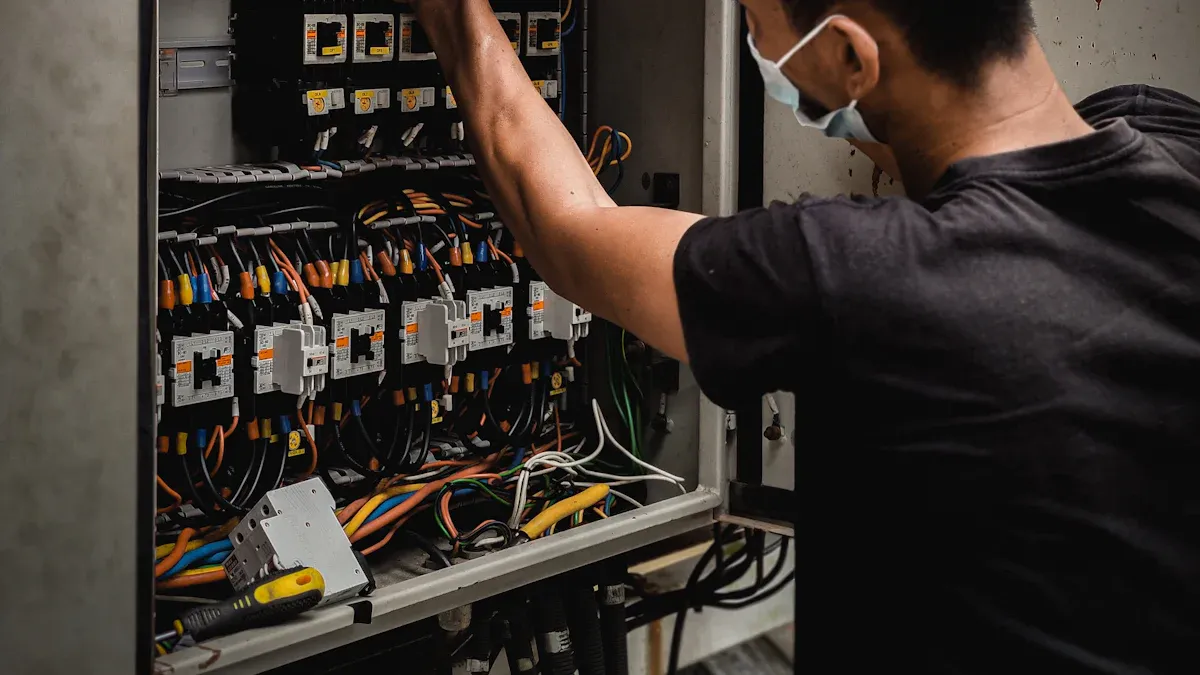
Conversely, wired systems are susceptible to “EMI” (Electromagnetic Interference) from heavy machinery. If a 0-10V line is run too close to a high-power motor cable, the lights may flicker. Shielding this interference adds another layer of hidden cost to wired installations.
Through-Wiring vs. Single-Ended Connections
Whether wired or wireless, the use of through-wiring fixtures is a massive labor saver. By allowing fixtures to be “daisy-chained,” installers reduce the number of ceiling junction boxes. When combined with wireless sensors, this creates the ultimate low-cost installation architecture.
Sustainability and the “Long-Term” Budget
From a sustainability standpoint, wireless controls are superior because they significantly reduce the consumption of copper—a resource-heavy and expensive commodity. But the true value appears during the first “Tenant Fit-out” or warehouse reorganization. If a warehouse changes from bulk storage to racking, a wired system might require a full decommissioning and new cabling. A wireless system simply requires a “re-grouping” in the control app.
“Flexibility is the most undervalued asset in commercial lighting. A system that cannot be changed in 10 minutes from a smartphone is a system that will cost you thousands in future contractor fees.”
When Should You Still Choose Wired?
Despite the labor savings of wireless, wired systems (specifically DALI-2) remain the gold standard for high-security environments where RF signals are restricted (such as high-security government facilities or specialized labs). Furthermore, in very small spaces where only 2-3 fixtures are being controlled, the “Commissioning” overhead of a wireless gateway may not be justified compared to a simple wired dimmer switch.
Summary: Choosing the Right Strategy
For large-scale industrial projects, retrofits, and spaces with frequently changing layouts, wireless controls offer the most predictable and lowest total cost of ownership. For fixed-layout, high-security, or ultra-simple single-room applications, wired controls offer unmatched stability and simplicity.
Frequently Asked Questions (FAQ)
1. What are the main “hidden” costs of a wired lighting system?
The biggest hidden costs are the extra conductors needed for the dimming signal (0-10V or DALI), the labor to pull those wires through conduits, and the cost of conduits themselves. Additionally, any change to the lighting zones in the future will require an electrician to physically open the ceiling and move wires.
2. How much can wireless controls save on installation time?
Industry data and Fanxstar’s project feedback suggest that wireless controls can save 30% to 50% on total installation time. Because fixtures only need a 3-wire power connection instead of a 5-wire connection, terminations are faster and less prone to error.
3. Do wireless sensors need batteries?
Most industrial wireless sensors are “embedded,” meaning they draw power directly from the luminaire’s driver. There are no batteries to change. Wireless switches (wall-mounted) may use batteries, but many modern versions are “energy-harvesting,” meaning the kinetic energy of the press powers the signal.
4. Can wireless signals travel through concrete walls?
While concrete does attenuate (weaken) RF signals, modern Bluetooth Mesh and Zigbee networks use every fixture as a signal repeater. This means as long as the fixtures are spaced reasonably (within 10-15 meters), the signal will find a path around or through obstacles.
5. Is DALI-2 better than wireless for large-scale projects?
DALI-2 is incredibly robust and offers standardized interoperability between brands. However, its “Hidden Cost” is the complexity of the commissioning and the physical wiring. Wireless is generally preferred for the “Total Cost of Ownership” unless the project has specific RF-free requirements.








