
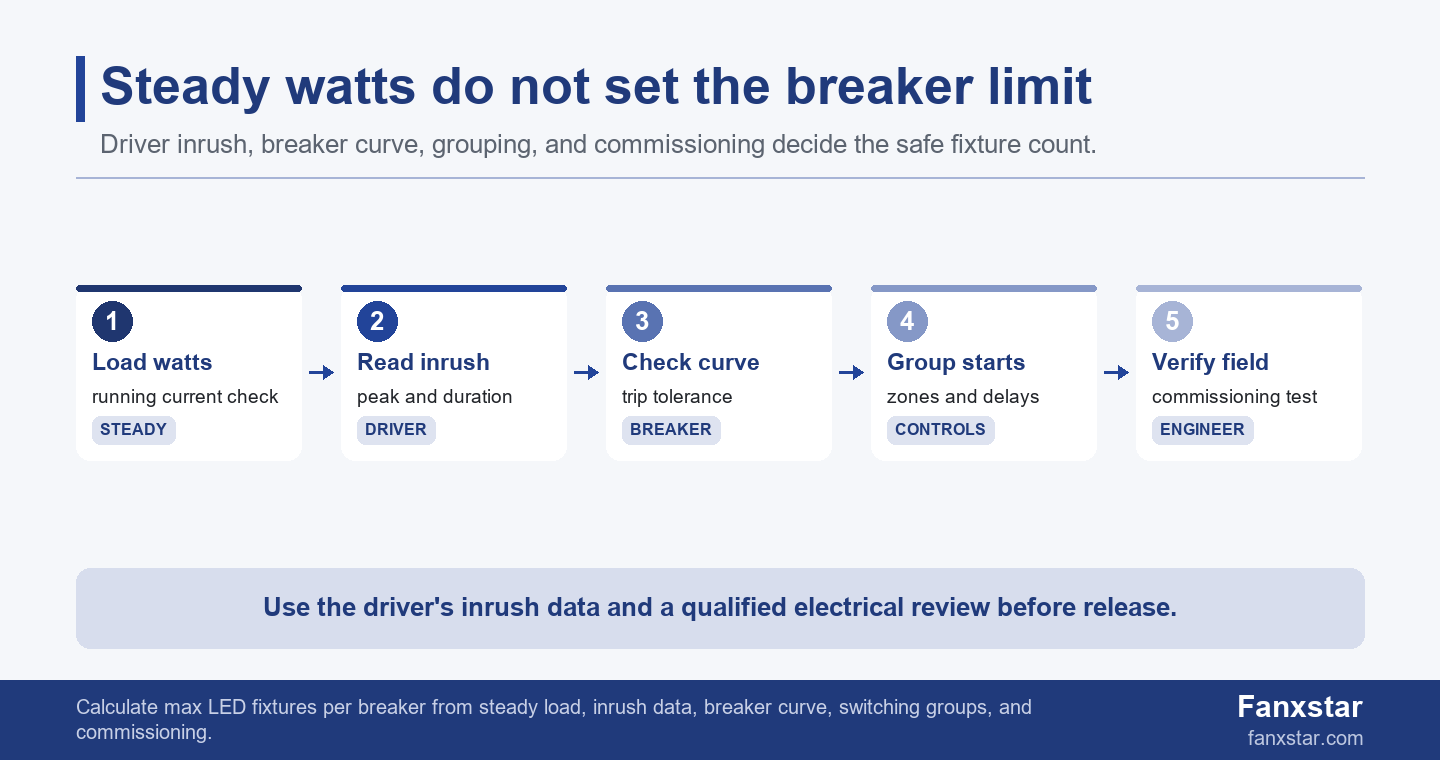
Calculating the maximum number of LED fixtures per circuit breaker requires more than dividing breaker amps by running watts. LED drivers can draw a short inrush current when energized, and that startup pulse can trip a breaker even when the steady-state load looks acceptable. The safe fixture count depends on driver inrush data, breaker type, trip curve, voltage, power factor, wiring, grouping, and qualified electrical review.
According to FEMP purchasing guidance for commercial and industrial LED luminaires, LED luminaire purchasing guidance treats commercial and industrial luminaires as finished products. According to GSA LED lighting and controls guidance, LED upgrades should be considered with controls and life-cycle cost. The practical insight is that fixture count is a system calculation: driver, breaker, control sequence, and field commissioning must agree.
Key Takeaways
- Do not calculate LED fixtures per breaker from steady wattage alone; startup inrush can be the limiting condition.
- Ask the supplier for driver inrush peak, pulse duration, steady current, power factor, and whether all fixtures start together.
- Breaker selection and circuit quantity should be reviewed by a qualified local electrical professional against applicable code.
- Fanxstar can support the lighting side by defining driver data, control grouping, fixture platform, and sample evidence for the project.
Fixture Count Depends on Current and Protection
Check running load and startup behavior separately
The running-load check is familiar: total fixture watts, supply voltage, power factor, circuit rating, and continuous-load rules where applicable. That check tells the buyer whether the circuit can support the fixtures after they are operating. It does not answer the startup question. When many LED drivers energize at once, capacitors inside the drivers can create a brief current pulse that is much higher than steady current.
According to DLC solid-state lighting technical requirements, LED products are evaluated through defined technical requirements and reporting pathways. For inrush planning, the buyer needs the same evidence discipline: do not accept only fixture wattage. Ask for the driver model and inrush current data for the exact luminaire version being quoted.
A rough rule of thumb can be useful for early budgeting, but it should not be used as final electrical design. Breaker trip curves, supply impedance, temperature, driver tolerances, and switching sequence can change the result. A site engineer or qualified electrician should decide final circuit design. The supplier’s job is to provide accurate fixture and driver data.
A simple formula is only the starting point
For steady load, a buyer may estimate total running current as total watts divided by voltage, adjusted for power factor if the required data is available. For example, 20 fixtures at 100 W each equal 2000 W of connected load. On a 230 V supply, the simple current before power-factor adjustment is about 8.7 A. That estimate can look safe on paper, but it says nothing about whether 20 drivers starting together will trip the breaker.
According to ENERGY STAR lighting upgrade guidance, LED upgrades can reduce electricity used in commercial buildings. That energy benefit should not lead buyers to ignore electrical startup behavior. A low running load can still have a high instantaneous startup pulse, especially when many drivers are switched together from one control zone.
| Step | What to collect | Why it matters |
|---|---|---|
| 1. Steady current | fixture wattage, voltage, power factor | checks running load but not startup trip risk |
| 2. Inrush data | peak current and duration from driver datasheet | reveals startup stress on the breaker |
| 3. Breaker curve | type, rating, trip curve, local code review | decides what short pulse can tolerate |
| 4. Switching sequence | all-on start or staggered groups | changes how many drivers start together |
What Data to Request From the Fixture Supplier
Ask for driver-level data, not only fixture power
The supplier should identify the LED driver model, rated input voltage range, steady input current, power factor, total harmonic distortion if relevant, inrush peak current, inrush duration, and recommended maximum driver quantity per breaker if the driver manufacturer provides it. If the fixture can use different drivers, the answer should be tied to the exact driver in the quoted sample.
According to FEMP LED luminaire purchasing guidance, buyers should compare complete luminaires in defined commercial and industrial categories. Inrush planning extends that idea: the fixture body, driver, controls, and wiring should be treated as one product package. If the driver changes after sample approval, the inrush calculation should be reviewed again.
Buyers should also ask whether the fixture has built-in surge protection, whether the driver is isolated or non-isolated, whether dimming or sensor control changes startup behavior, and whether the product will be switched by a wall switch, contactor, relay, sensor group, or control panel. The switching method can decide how many drivers energize at the same instant.
Controls can reduce or worsen startup stress
If every fixture in a warehouse aisle starts at the same moment, the inrush pulse is concentrated. If groups start in stages, the breaker may see a smaller combined pulse. However, staging must be designed intentionally. A random mix of sensors, relays, and manual overrides can create confusing behavior, especially after a power outage when many zones restart together.
According to GSA LED lighting and controls guidance, LED lighting and controls should be considered together rather than as separate afterthoughts. For inrush current, that is not only an energy issue. It is a reliability issue. The buyer should know how occupancy sensors, dimming drivers, emergency circuits, and control panels behave during energization.
For large projects, the buyer can ask for a staged-start recommendation: which fixtures start together, whether a delay is needed between rows, and whether emergency or safety zones have separate behavior. The exact sequence must be reviewed locally, but naming it in the RFQ prevents the supplier from assuming a simple all-on start.
How to Build a Practical Fixture-Per-Breaker Calculation
Use a conservative worksheet before final engineering
A useful worksheet has at least 10 fields: fixture model, driver model, input voltage, steady input current, fixture wattage, power factor, inrush peak, inrush duration, breaker rating, breaker curve, number of fixtures starting together, and control sequence. The worksheet should separate steady-load pass or fail from inrush review. Combining them into one line hides the actual risk.
According to International Trade Administration import documentation guidance, shipment records can include several documents for one import. Lighting buyers should keep the electrical calculation tied to the same document discipline. The approved sample, driver model, BOM, circuit plan, packing list, and invoice should not describe different versions of the fixture.
A conservative worksheet should also state what is unknown. If the buyer does not know breaker curve, cable length, supply impedance, ambient temperature, or whether all fixtures restart together after a power outage, the fixture count should be treated as preliminary. The supplier can give driver evidence, but the local engineer must turn that evidence into a circuit decision.
For early procurement comparison, the buyer can ask each supplier to state the recommended maximum fixture count per breaker for a named breaker type and voltage, then ask what assumptions support that number. A supplier that gives a number without inrush data, driver model, or switching assumption is giving a weak answer.
Confirm final design locally
According to International Trade Administration import regulations guidance, rules and documentation vary by country and product type. Electrical circuit design also depends on local codes and professional judgment. Fanxstar or any lighting supplier can provide luminaire data, but the buyer should not treat a blog article or supplier estimate as a substitute for local electrical design.
According to the SBA import and export laws guidance, businesses should understand import and export rules before international sales. The procurement insight is that imported LED fixtures should arrive with the driver data needed for local approval and installation review. Missing driver data can delay installation even when the physical shipment arrives on time.
The final review should also account for what happens after the first day. If the breaker is close to its limit, later driver substitution, added fixtures, colder startup, or a different control panel can create nuisance trips. A buyer who records the original assumptions can identify when the project has changed enough to need a fresh circuit review instead of blaming the fixture after the site expands.
According to International Trade Administration special document guidance, some products may require additional certificates or special documentation. In LED lighting projects, the buyer should decide before shipment whether circuit, driver, emergency, dimming, or market approval documents need to be part of the release file.
Where Fanxstar Fits Inrush Planning
Give Fanxstar the circuit and control assumptions
Fanxstar can support projects using LED linear lighting platforms, weatherproof LED lighting products, motion sensor LED lighting, and custom LED lighting ODM service. To make the fixture recommendation useful, the buyer should provide supply voltage, target wattage, fixture quantity, expected zones, sensor plan, emergency needs, and whether fixtures start together or in groups.
For warehouse, parking, tunnel, and industrial projects, inrush planning should happen before mass production. If the buyer later changes driver, sensor, or control method, the circuit plan may need review. That is why the driver model and inrush data should be included in the sample approval file, not only in an email after a breaker trips on site.
If the project is a retrofit, the buyer can combine this topic with the LED retrofit planning checklist and LED lighting controls guide. Existing circuits may limit fixture count, and the easiest product to install may not be the best product to run reliably.
Keep the final recommendation evidence-based
A useful Fanxstar RFQ sentence is: quote the fixture with driver model, steady input current, inrush peak and duration, recommended maximum fixtures per breaker under stated assumptions, and any required control grouping. That sentence gives the lighting supplier a clear data obligation while leaving final circuit design to the qualified local professional.
The buyer should also ask whether the quoted fixture count assumes a cold start, warm restart, simultaneous energization, or staged start. These conditions can produce different results. If the site has emergency circuits, contactors, or central switching, the startup condition after power restoration may be the worst case. That worst case should be reviewed before a large shipment is released.
The count should be recalculated whenever a material project variable changes. A different driver, different breaker type, added emergency module, added sensor relay, changed voltage, longer circuit run, or larger startup group can invalidate the previous number. Treat the approved fixture count as a controlled project assumption, not a universal catalog rating.
When fixture count, driver data, breaker assumptions, and switching sequence are recorded together, the buyer can avoid the common mistake of treating watts as the whole electrical story. The result is a safer, easier-to-commission lighting project.
FAQ
Why can LED fixtures trip a breaker at startup?
LED drivers can draw a short inrush current when energized, often higher than their steady running current. If many drivers start together, the combined pulse can trip a breaker even when the normal operating load appears acceptable. The supplier should provide driver data, and the final circuit should be reviewed locally.
Can I calculate max LED fixtures by wattage only?
Wattage is needed for the steady-load check, but it is not enough for final fixture count. It does not capture inrush peak, pulse duration, breaker curve, control grouping, voltage, or local code requirements. Final circuit design should be reviewed by a qualified electrical professional.
What data should the LED supplier provide?
The LED supplier should provide fixture wattage, driver model, input voltage range, steady input current, power factor, inrush peak, inrush duration, recommended maximum drivers per breaker if available, and whether controls or sensors change startup behavior. The answer should be tied to the exact quoted driver.
How can controls reduce inrush current problems?
Controls can help when fixtures start in staggered groups rather than all at once. The sequence must be designed and commissioned carefully, especially after power restoration, because uncontrolled simultaneous startup can recreate the same breaker trip risk. The buyer should record the intended startup sequence before shipment.








