Power factor correction matters in LED lighting when a project is large enough for apparent power, utility rules, panel capacity, driver substitution, and compliance evidence to affect the buying decision. PF above 0.95 can be a strong target, but it should be specified with load state, THD, dimming behavior, voltage range, and exact driver configuration.
According to DOE guidance on power factor and VAr, power factor links real power and apparent power, and utilities may use penalties for poor power factor. According to a DOE power factor fact sheet, PF can be described as kW divided by kVA. This means a 100 kW lighting load can place very different apparent-power pressure on the electrical system depending on driver PF.
For Fanxstar buyers, the useful question is not whether PF > 0.95 sounds impressive. The question is whether the project scale, market, utility rule, tender document, or electrical design needs that threshold, and whether the chosen LED driver can prove it in the final fixture.
Key Takeaways
- PF above 0.95 is most important in large projects where apparent power, utility penalties, or electrical capacity matter.
- DLC V5.1 requirement tables list PF at least 0.9 for qualified luminaires, so PF > 0.95 is often a stricter buyer or tender target rather than a universal baseline.
- PF should be reviewed together with THD, dimming state, voltage, load range, and exact driver model.
- The production order should lock the driver or require updated evidence when the driver changes.
What PF actually changes in a lighting project
PF changes the apparent power behind the same real lighting load
A lighting buyer usually thinks in watts because watts describe the real power consumed by the luminaires. The electrical system, however, also sees apparent power. When PF is lower, the same kW load requires more kVA. In a small room, this may not change the purchase. In a warehouse, campus, data center corridor, or multi-building retrofit, the difference can become relevant to panels, transformers, utility rules, and tender scoring.
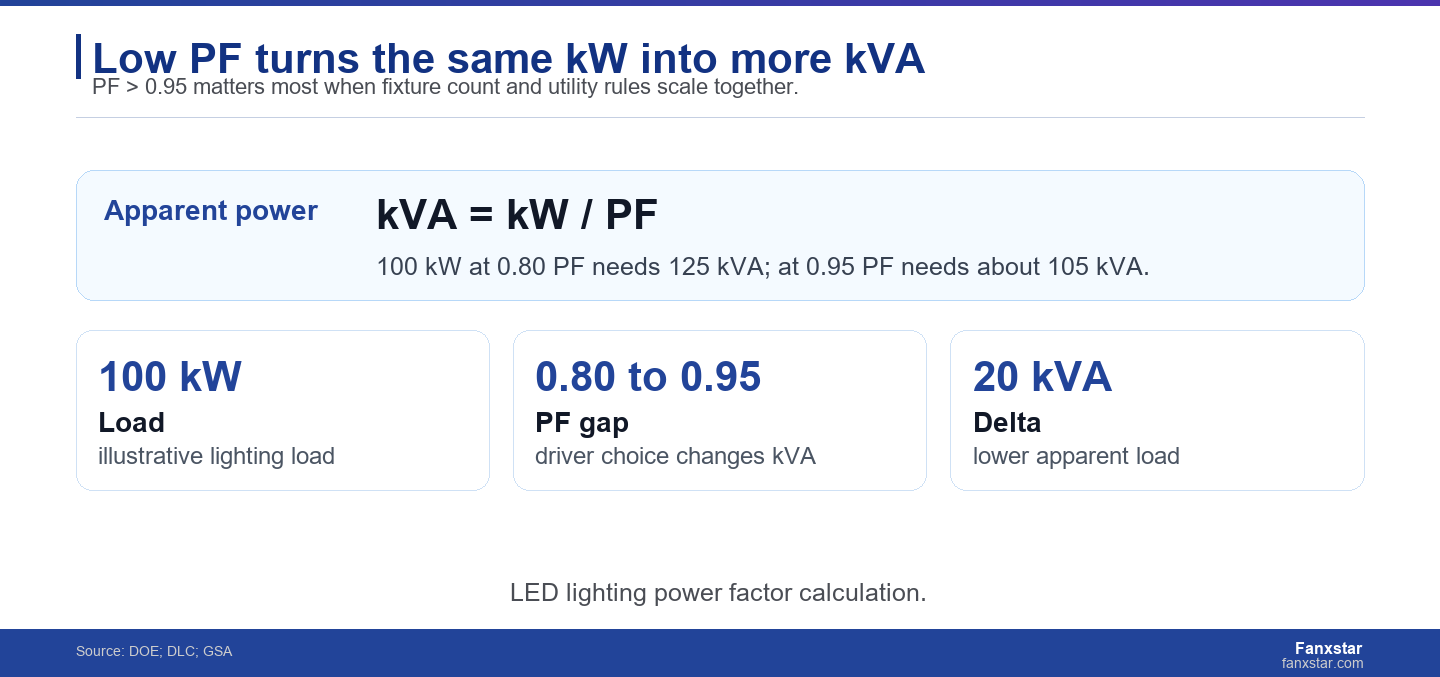
According to DOE power factor guidance, PF equals kW divided by kVA. Using that relationship, a 100 kW illustrative lighting load at 0.80 PF needs 125 kVA, while the same 100 kW at 0.95 PF needs about 105 kVA. The difference is around 20 kVA. This calculation is illustrative, but it shows why a large project cannot treat PF as a tiny datasheet line.
| PF level | Illustrative apparent power for 100 kW | Buyer meaning |
|---|---|---|
| 0.80 | 125 kVA | The same real load needs more apparent capacity and may trigger utility or design concern. |
| 0.90 | 111 kVA | Often close to common LED program thresholds, but not always enough for stricter tenders. |
| 0.95 | 105 kVA | A stronger target for large projects when utility, panel, or tender rules value higher PF. |
| 0.98 | 102 kVA | Useful only when the claim is proven across dimming state, load range, and driver configuration. |
The decision implication is direct. If the project has a strict utility PF rule, limited electrical capacity, or a tender requirement, the buyer should specify the PF target clearly. If the project is small and the driver already meets normal program requirements, demanding PF > 0.98 may add cost or supplier friction without a real benefit. Good specification starts from the site constraint.
A practical PF > 0.95 trigger appears when at least one of 4 conditions is present: high fixture count, utility penalties or incentives, limited upstream capacity, or a formal project specification. Without one of those conditions, PF should still be checked, but it may not be the deciding factor.
PF should not be separated from THD and driver behavior
A high PF number alone is not a complete electrical-quality file. Buyers should also ask about total harmonic distortion, driver model, input voltage, load range, dimming state, and flicker behavior where relevant. A driver can look strong at full output and behave differently under dimming or at another voltage. If the project uses sensors, 0-10 V dimming, DALI, or scheduled dimming, the data should match those states.
According to DLC V5.1 technical requirement tables, all DLC-qualified luminaires in that table set include PF at least 0.9 and THD at 20 percent or less. This is useful because it shows PF and THD are paired in program evidence. It also shows why a PF > 0.95 demand should be treated as a project-specific stricter requirement, not as a vague mark of quality.
The buyer should ask whether PF is measured at rated voltage, full load, partial load, and dimming level. If the supplier provides only a catalog statement, ask for the test report or driver datasheet for the exact configuration. If the driver is later substituted, PF and THD evidence should be rechecked.
The trade-off is electrical margin versus sourcing flexibility. Locking a high-PF driver can protect the project, but it can also reduce substitution options during shortages. The answer is not to ignore PF. The answer is to state which substitutions need written approval and updated evidence.
When PF > 0.95 should be specified
Large projects need a stronger evidence file
PF becomes more important as fixture count rises. A 20-unit replacement may be handled through standard product requirements. A 2,000-unit warehouse or data center project has a different electrical footprint. The buyer should check panel schedules, utility billing terms, site power quality rules, and commissioning expectations. The more centralized the load, the more carefully PF should be documented.
According to FEMP LED luminaire purchasing guidance, commercial and industrial LED luminaires should be purchased with life-cycle value in mind. According to GSA LED and controls guidance, LED and controls decisions can affect life-cycle cost and performance. Together, these sources support a buyer habit: consider the long-term electrical and maintenance impact, not only the fixture wattage.
| Evidence item | Why it matters | RFQ wording |
|---|---|---|
| PF at full load | Baseline driver performance. | State PF minimum at rated voltage and full output. |
| PF under dimming | Some drivers behave differently at low output. | Provide PF and THD data for key dimming states if controls are used. |
| THD with PF | High PF alone does not prove clean electrical behavior. | Report PF and THD together for the exact driver. |
| Driver model lock | Substitution can change PF, THD, flicker, and compliance. | No driver substitution without written approval and updated evidence. |
| Project utility rule | Penalties and targets vary by site. | Confirm whether utility or tender requires PF above 0.95. |
A good RFQ does not simply say PF > 0.95. It says PF greater than 0.95 at rated voltage and full output, THD limit, dimming condition if controls are used, driver model, allowed substitutions, and required evidence before production. That wording turns a nice datasheet claim into a controlled purchasing requirement.
For data centers, industrial buildings, and large logistics sites, the buyer should also ask whether the driver behavior changes at low dimming states. If aisle lighting spends many hours at reduced output, full-load PF may not describe the operating state that the facility sees most often.
Avoid over-specifying PF where it does not change the decision
Not every LED lighting order needs a PF > 0.95 requirement. A small commercial order may only need products that meet the destination market, buyer specification, and normal program thresholds. If the buyer demands ultra-high PF without a site reason, the project may lose suppliers that would have met the real need. Over-specification is a hidden sourcing cost.
The better method is to place PF into a requirement ladder. First, meet applicable product and market requirements. Second, meet the project tender or utility target. Third, improve PF above the minimum when the electrical design benefits. Fourth, lock the driver and retest evidence when the product is customized. This ladder protects the project without turning PF into a slogan.
According to International Trade Administration special documents guidance, some imports may need special certificates tied to safety, standards, or other conditions. For lighting, PF evidence should travel with the broader document file when the destination market or tender requires it. The invoice, label, certificate, driver file, and test report should describe one product, not several similar versions.
A practical release rule is to treat driver substitution as an engineering change. If the supplier changes from Driver A to Driver B, the buyer should ask whether PF, THD, dimming, surge, flicker, certification, and warranty are still valid. If the answer is unclear, the change should pause production approval.
How Fanxstar buyers should write the PF requirement
Tie PF to driver selection and production release
Fanxstar projects involving warehouse lighting, data center lighting, LED lighting controls, or LED retrofit planning should specify PF alongside driver, dimming, voltage, certification, and sample evidence. This is especially important when the buyer wants a platform customized for a large project.
The RFQ should include target PF, allowed voltage range, THD limit, dimming protocol, output states, driver model preference if any, destination market, and whether the buyer requires a test report. If the project has a utility penalty clause or tender document, include that exact requirement. Suppliers can respond much more accurately when they know whether PF > 0.95 is a preference or a hard acceptance gate.
For ODM changes, ask whether the selected driver is part of the certified or documented configuration. Changing LED board current, driver wattage, emergency function, sensor control, or housing thermal path can affect the driver choice. If the PF evidence comes from a different configuration, the buyer should request updated confirmation before mass production.
According to SBA import and export guidance, businesses should understand import and export rules before international sales. The same discipline applies to electrical evidence: define the market, define the document need, and make sure the production fixture matches the file that will be used for approval.
Use a 3-gate review before shipment
Gate 1 is design release: confirm PF target, THD target, driver model, voltage, dimming state, and certification path. Gate 2 is sample release: confirm the sample uses the same driver and test conditions that the report describes. Gate 3 is shipment release: confirm the production label, packing list, and driver batch match the approved configuration.
This 3-gate review is not heavy paperwork for large projects. It is risk control. A low-PF or substituted driver may not be visible from the outside of a sealed luminaire. The buyer may discover the issue only after installation or utility review. By then, replacement is far more expensive than pre-shipment evidence. When a 100 kW illustrative project shifts from 0.80 PF to 0.95 PF, the apparent load drops from 125 kVA to about 105 kVA, so the electrical consequence is large enough to justify written driver control.
The final answer is balanced: PF > 0.95 is not magic, but it can be commercially important. Specify it when the project scale or rules justify it, pair it with THD and driver evidence, and prevent uncontrolled substitutions. That approach gives the buyer electrical confidence without turning the project into an over-specified procurement trap.
FAQ
What does PF > 0.95 mean for LED lighting?
PF > 0.95 means the LED driver uses apparent power efficiently enough that kVA is close to kW under the stated test condition. In large lighting projects, this can reduce apparent-power pressure and help meet utility or tender requirements. It should still be checked with THD, dimming state, voltage, and exact driver configuration.
Is PF > 0.95 required for every LED fixture?
PF > 0.95 is not required for every LED fixture because some program thresholds are lower and small projects may not need a stricter target. Buyers should specify PF > 0.95 when utility rules, electrical capacity, tender requirements, or large fixture counts make it commercially useful and worth documenting.
Why should PF and THD be reviewed together?
PF shows the relationship between real and apparent power, while THD describes harmonic distortion that can affect power quality discussions. A high PF number alone does not prove complete electrical quality. Buyers should request PF and THD evidence for the same driver, voltage, load, and dimming state used in the final fixture.
What should an ODM buyer request for power factor evidence?
An ODM buyer should request the target PF, THD limit, driver model, voltage range, dimming protocol, test report or driver datasheet, substitution rule, and sample match. If the driver changes after approval, ask whether PF, THD, flicker, certification, warranty, and label evidence remain valid.