
Power factor in LED lighting matters because buildings buy and distribute electrical capacity, not only useful watts. A low power factor may not make the fixture visibly dimmer, and it does not automatically mean the LED uses more real energy for the same output. It can still create buyer risk through higher apparent power, larger electrical infrastructure, utility penalties, driver quality questions, and weaker tender compliance.
The useful procurement question is not simply whether the specification says PF greater than 0.9. The buyer should ask at what voltage, load, dimming state, driver model, temperature, and product version the value was measured, and whether total harmonic distortion, inrush, surge protection, and certificate scope support the same luminaire being quoted.
Key Takeaways
- Power factor compares real power in watts with apparent power in volt-amperes; it is a capacity and quality signal, not a brightness rating.
- High PF can reduce kVA demand and avoid penalties, but it should be reviewed together with THD, driver quality, dimming, and load condition.
- A PF claim should match the final driver, voltage, wattage, dimming level, and production version.
- For LED lighting RFQs, buyers should request PF and THD evidence at the fixture level, not only a driver brochure.
What power factor changes in a lighting project
Watts and volt-amperes answer different questions
ENERGY STAR luminaire specifications define power factor as input power divided by voltage multiplied by current. In simpler procurement language, watts describe real power doing useful work, while volt-amperes describe how much electrical capacity the circuit has to carry. A fixture can have the same wattage but draw different current depending on driver design and power factor.
This distinction matters in large lighting projects. A few low-PF lamps may not change a small office decision. Hundreds or thousands of LED fixtures across a warehouse, parking garage, tunnel, retail chain, or data center service corridor can affect panel loading, transformer capacity, generator sizing, cable planning, and demand charges. The buyer may not see the problem on the lighted floor, but the electrical system sees it.
A poor explanation of power factor often claims that low PF simply wastes the buyer’s kWh. That is not precise enough. The real wattage still drives the energy meter in many billing situations. The risk is that low PF increases apparent power and can trigger capacity limits or utility penalties. A better article should help the buyer separate energy efficiency, electrical capacity, and driver evidence.
PF belongs beside THD, not alone
DLC V5.1 technical tables require qualified luminaires to meet power factor and THD thresholds. That pairing is important because LED drivers can shape current in ways that affect both apparent power and harmonic distortion. A buyer who requests only PF may miss a driver-quality problem that appears through THD, inrush current, dimming behavior, or electromagnetic compatibility evidence.
IEA 4E LED product tiers discuss displacement factor and total harmonic distortion as performance indicators for lighting products. Even when the buyer is not using those tiers as a formal requirement, the structure is useful: power quality should be reviewed as a set of electrical behaviors rather than one isolated number on a datasheet.
How low PF changes apparent load
An illustrative kVA calculation
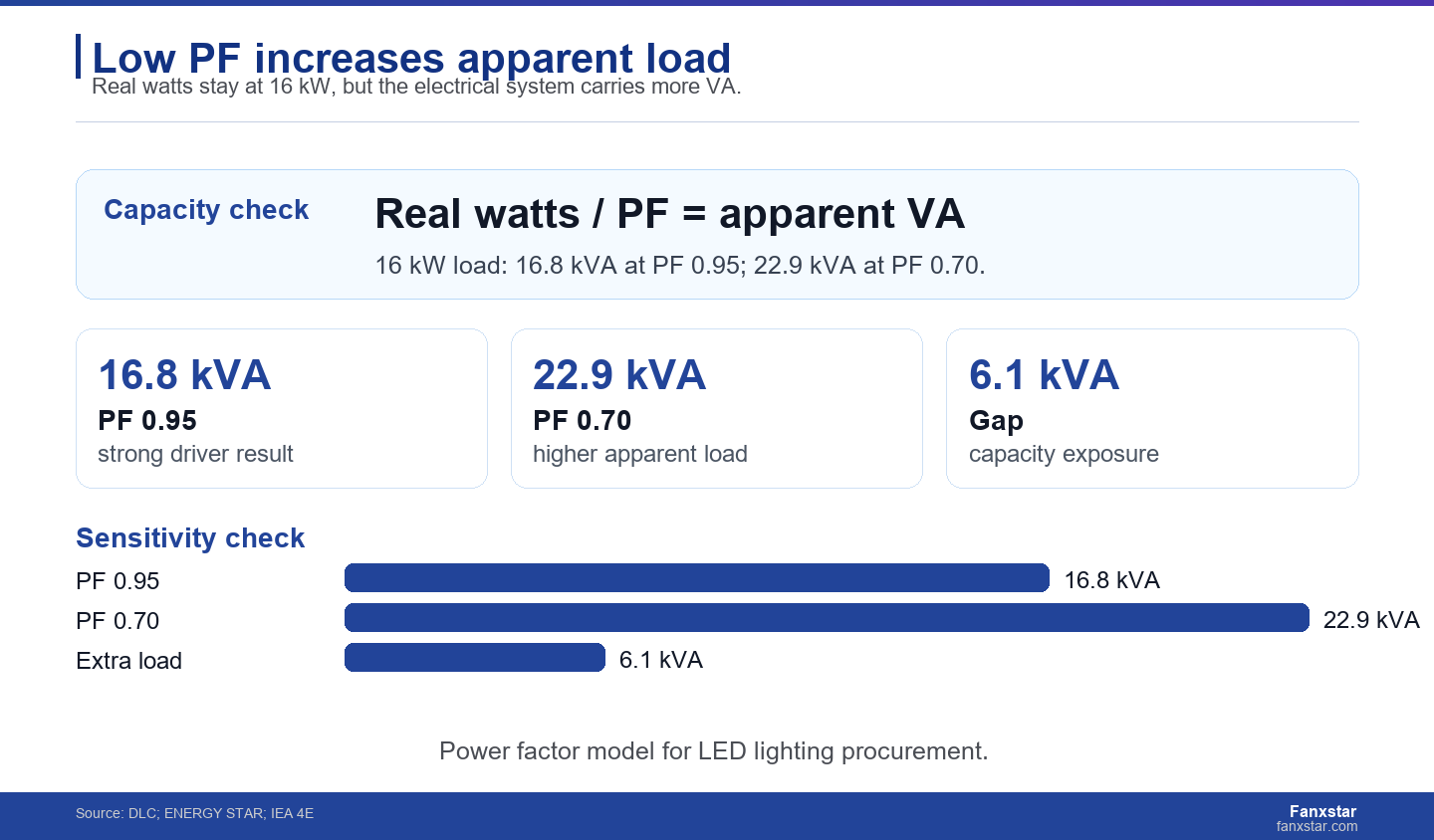
Use a 16 kW lighting load as a quick example. At PF 0.95, apparent power is about 16.8 kVA. At PF 0.70, apparent power is about 22.9 kVA. The same real lighting load can therefore require about 6.1 kVA more apparent capacity. For one small room this may be manageable; for a multi-branch facility it can become a design and operating issue.
That is why power factor can matter even when the LED fixture wattage looks attractive. A buyer may select a low-cost driver package, hit the lumen target, and still create a weak electrical story for a large rollout. The more fixtures in the project, the more important it becomes to align PF, THD, driver evidence, and electrical design assumptions.
EIA explains electricity price factors at a broad level, but individual commercial tariffs may also include demand or power-quality treatment. The buyer should ask the facility engineer or utility account manager whether low power factor penalties or kVA demand treatment apply. A generic article cannot know the local tariff, so the article should teach the buyer what to verify.
Dimming can change the measured result
Power factor is often best near rated load and can decline at very low load, depending on driver design. If a lighting project will use 0-10 V dimming, DALI, motion sensor standby, daylight harvesting, or emergency standby modes, the buyer should ask whether PF and THD evidence applies only at full output or also at the operating states that dominate real hours.
This matters for warehouses, garages, and corridors where lights spend many hours at 10%, 20%, or 30% output. The site may save energy through dimming while creating a different driver load condition. A strong RFQ asks for the driver behavior that matches the control sequence, not only the full-output datasheet value.
Standards and program thresholds buyers often see
PF greater than 0.9 is a common commercial signal
Many commercial LED luminaire specifications use PF greater than 0.9 as a shorthand quality threshold. It is not the only acceptable value in every market or product type, but it is common because it keeps apparent load closer to real load. When a tender states PF greater than 0.9, buyers should ask whether the value is for the full luminaire, the rated input voltage, and the relevant operating mode.
ENERGY STAR lamp specifications have different thresholds for certain lamp products, which shows why product category matters. A lamp requirement is not the same as a high-bay, waterproof linear light, emergency luminaire, or custom industrial fixture. Buyers should avoid copying a power factor threshold from one product category into another without checking the market and tender context.
The claim needs measurement context
A supplier may write PF greater than 0.95 on a quotation, but the buyer still needs context: input voltage, frequency, rated wattage, load percentage, driver model, test method, and whether the measurement is typical or guaranteed. If the project uses multiple wattages or dimming options, each version may need separate evidence.
For private-label or ODM projects, driver substitution is the main risk. The first sample may use a driver with excellent PF and THD. Production may later shift to another driver because of price, availability, or regional approval. Unless the buyer controls substitutions, the electrical evidence can separate from the product being shipped.
Power factor should be tied to fixture and project risk
Low-risk and high-risk situations are different
A small low-hour decorative product may not justify a long power-quality review. A high-hour commercial or industrial project should be treated differently. Warehouses, logistics centers, food plants, parking garages, data-center support areas, supermarkets, and public infrastructure can involve large fixture counts, long operating schedules, and formal acceptance documents. In those settings, PF evidence is part of the procurement file.
The buyer should also consider whether the lighting is connected to backup power, emergency systems, or sensitive electrical infrastructure. Poor driver behavior can complicate generator sizing, UPS planning, breaker selection, and nuisance trips. Power factor alone does not answer those questions, but it opens the right conversation with the electrical designer.
Do not trade away optical performance to chase a number
Power factor is important, but it does not replace optical design. A fixture with strong PF and poor distribution can still fail the project. A buyer should evaluate lumens, beam, glare, CCT, CRI, flicker, IP rating, thermal design, service access, and certification together. The correct driver package supports the lighting design; it should not become the only reason to choose a fixture.
ENERGY STAR describes LED lighting efficiency in terms of producing useful light more efficiently than older technologies. Power factor is related to the electrical input side, so buyers should not confuse it with luminous efficacy. A 150 lm/W fixture with weak PF and a 130 lm/W fixture with strong PF answer different questions: the first may use less real power for the light task, while the second may be cleaner from an apparent-load and driver-evidence perspective. The best project often needs both a strong optical package and a credible electrical package.
That distinction is useful during value engineering. If a supplier lowers cost by changing the driver, the buyer should ask whether the change affects real watts, PF, THD, dimming behavior, surge protection, warranty, and certification scope. If a supplier lowers watts by changing LED board current or optics, the buyer should ask whether output, glare, thermal stress, and lumen maintenance still meet the design. Power factor belongs in this wider release review, not in a separate electrical appendix that no one checks before the order is placed.
The strongest procurement file connects electrical quality to the actual use case. For a cold store, the driver must perform at the ambient temperature. For a parking garage, surge protection and controls may matter beside PF. For a production plant, flicker, EMC, and maintainability may matter. For a data-center service corridor, reliability, monitoring, and emergency behavior may matter. A single PF number cannot replace that project context.
RFQ language for power factor evidence
Minimum evidence to request
A practical RFQ can say: provide luminaire-level power factor and THD at rated input voltage, rated wattage, and planned dimming condition; identify the driver model; state whether substitutions are allowed; and confirm that PF and THD evidence applies to the shipped configuration. That sentence protects the buyer from a driver brochure that does not match the final fixture.
For larger orders, add inrush current, surge protection, EMC evidence, test report reference, and a requirement to notify the buyer before driver, LED board, dimming interface, or wiring changes. If the project has a mandatory tender threshold, quote the threshold directly and ask the supplier to show where the product meets it.
How to review a supplier answer
A strong supplier answer names the driver, fixture model, voltage, wattage, PF, THD, test report, and configuration boundary. A weak answer says only high PF, no problem, or uses a value from a different product family. Buyers should be especially careful when the supplier offers several driver options at different prices. The low-cost option may not have the same power-quality evidence.
If the project uses sensors or dimming, ask for standby behavior. If the project will be sold in a market with program thresholds or tender requirements, ask for the exact version that will be labelled and shipped. If the supplier cannot connect the evidence to the order, hold the technical approval until the gap is closed.
Fanxstar application fit
Where Fanxstar buyers should use this checklist
Power factor evidence is relevant across linear lighting platforms, weatherproof LED lights, motion sensor lighting, emergency lighting products, and custom LED lighting ODM service. It becomes especially important when the project involves high fixture counts, controls, emergency options, private-label changes, or formal tender thresholds.
Buyers can pair this topic with LED lighting controls for industrial facilities, LED certification checklist for ODM buyers, and custom LED lighting design options. Fanxstar can review the target voltage, wattage, driver, dimming mode, and market requirement before the sample is frozen, which is much easier than repairing the evidence file after production.
FAQ
Does low power factor increase kWh?
Low power factor does not automatically increase the real watts used by the fixture for the same light output. The bigger risk is higher apparent power, possible demand or penalty treatment, and weaker electrical capacity planning.
What is a good power factor for LED lighting?
Many commercial LED luminaire specifications use PF greater than 0.9 as a quality threshold, but the correct requirement depends on product type, market, tender, driver, load, and dimming condition.
Why should THD be checked with PF?
Power factor and total harmonic distortion both describe electrical behavior. A driver can meet one expectation while still creating another power-quality issue, so buyers should request both where the project is large or compliance-driven.
Can dimming change power factor?
Yes. Some LED drivers show different PF and THD behavior at low load or dimmed states. Buyers using standby dimming or occupancy controls should request evidence for the operating states that matter.
What should an ODM buyer write into the RFQ?
Ask for luminaire-level PF and THD at rated voltage, rated wattage, and planned dimming state; require the driver model and substitution rule; and confirm that the evidence applies to the final shipped configuration.








