Every procurement manager sourcing LED fixtures from China has received the same document: a glossy PDF bearing a TÜV or UL logo, promising IP65 or IP66 protection. The hard truth is that a significant portion of those certificates are either fabricated, misapplied, or genuinely earned — but for a product that no longer matches what actually ships to you. In high-stakes environments like food processing plants, cold storage facilities, or parking structures, a fixture that fails its IP rating doesn’t just cause maintenance headaches. It floods its driver during a pressure washdown and becomes a fire or shock hazard.
This guide walks through the structured verification process that industrial procurement teams and electrical engineers use to distinguish legitimate IP certifications from fraudulent ones — starting with the certificate itself, extending through manufacturer databases, and concluding with physical inspection protocols.
Key Takeaways
- A PDF certificate proves nothing on its own — every claimed IP65/IP66/IP68 certificate must be cross-referenced against the issuing body’s official public database before acceptance.
- Four distinct fraud types exist in LED certificate misrepresentation: nonexistent certificates, expired/revoked listings, model number substitution, and component-level certificates misapplied to complete fixtures.
- IP ratings degrade in service — gasket material quality, thermal cycling resistance, and UV exposure durability determine whether a fixture maintains its certified protection rating over its operating lifespan.
- Physical inspection protocols — including gasket continuity checks, pressure breather presence, and foamed-in versus manual gasket assessment — reveal manufacturing quality not captured in paperwork.
What an IP Rating Actually Certifies
The IEC 60529 Standard: Scope and Limitations
IP ratings are defined by IEC 60529, the international standard published by the International Electrotechnical Commission. The code consists of two digits: the first (0–6) describes protection against solid particle ingress; the second (0–9) describes protection against liquid ingress. An IP65 fixture has passed a dust-tight test plus a 6.3 mm water jet test. An IP66 fixture has passed the same dust test plus a more powerful 12.5 mm jet. An IP68 fixture is dust-tight and rated for continuous immersion beyond one meter at manufacturer-specified depth and duration.
Standard IP testing uses fresh water only. Salt water, cleaning chemicals, oils, and solvents are not covered by IEC 60529. A fixture rated IP66 is not automatically corrosion-resistant or chemical-resistant — those require separate certification or material documentation. One non-obvious fact about the water ingress digits: ratings beyond IPX6 are not cumulative. A fixture certified only to IPX7 (immersion) is not automatically compliant with IPX5 or IPX6 (jet resistance). Some manufacturers exploit this gap, advertising “IP67” fixtures that have only passed the immersion test — and will fail under a pressure wash because they were never tested for jet resistance. A fixture holding both ratings correctly designates them as IPX5/IPX7.
The Golden Sample Problem
Even when certificates are entirely genuine, there is a structural gap between what gets certified and what gets shipped at scale. Certification bodies test samples — typically hand-assembled, carefully prepared units representing best-case production quality. The factory’s mass-production run operates under different pressures: cost reduction, component substitution, accelerated assembly. This golden sample gap means that a valid certificate does not guarantee that the specific units arriving in your warehouse were assembled with the same gasket material, the same fastener torque, or the same quality cable glands as the tested sample. This explains why facilities managers sometimes observe certified IP65 fixtures failing ingress tests within 12 months — not because the certificate was fake, but because production quality diverged after volume ramp-up.
The Four Types of Certificate Fraud in LED Lighting
Type 1 — Nonexistent Certificate Numbers
The most brazen form: a certificate number that simply does not exist in any issuing body’s database. The document may look professionally formatted with correct logos and fonts, but the certificate number returns no results on Certipedia, UL Product iQ, or the Intertek ETL directory. Relatively easy to detect — the challenge is that many procurement teams never verify, accepting the PDF at face value.
Type 2 — Expired or Revoked Certificates
More subtle: the certificate number is real and appears in the database, but the listing shows “expired,” “cancelled,” or “withdrawn.” Certifications lapse when a manufacturer fails to pay the annual follow-up audit fee, when a factory audit reveals non-conformance, or when the relevant safety standard has been revised and the product no longer qualifies under updated requirements. Suppliers sometimes continue circulating old certificates for years after revocation.
Type 3 — Model Number Substitution
The most sophisticated and common form. A manufacturer holds valid UL certificates for model numbers A-B-C and A-X-Y. They then market a product with model number A-B-Y — close enough to look legitimate, different enough to be outside the scope of either certificate. The model number on the physical fixture and the model number on the certificate simply do not match, but visual similarity is designed to evade casual review. This was documented in a well-known industry exposé by a US LED manufacturer and has been confirmed as a persistent pattern by multiple compliance professionals.
Type 4 — Component Certificate Misapplication
A manufacturer presents the UL certificate for the LED driver (power supply) as evidence of certification for the complete luminaire. Driver certification and fixture certification are distinct processes testing different things. A UL-certified driver does not certify the weatherproofing of the housing, the wiring harness safety, or the compliance of the optical assembly. This type is especially prevalent in the LED batten and vapor-tight segments.
The Four-Step Verification Framework
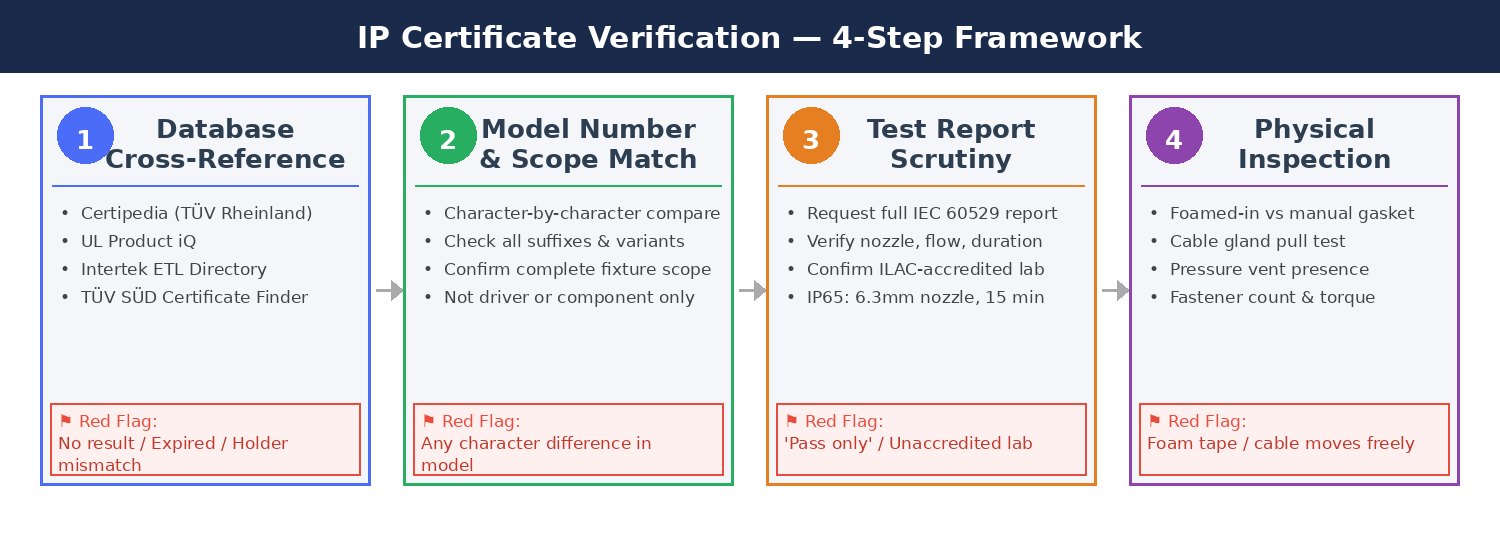
The four-step IP certificate verification framework used by industrial procurement teams
Step 1: Database Cross-Reference
Each major certification body maintains a public online database. These are the primary verification tools for global procurement:
| Issuing Body | Database | URL | Search By |
|---|---|---|---|
| TÜV Rheinland | Certipedia | certipedia.com | Certificate number / QR code |
| UL Solutions | Product iQ | productiq.ulprospector.com | File number, model number, CCN |
| Intertek (ETL) | ETL Listed Directory | intertek.com/directories | Control number, model number |
| TÜV SÜD | Certificate Finder | tuvsud.com | Certificate number, company name |
| SGS | Certificate Verification | sgs.com | Certificate reference number |
When a certificate number returns a valid result, confirm three things: the certificate holder name matches your supplier, the product model number exactly matches the model you are sourcing (including all suffixes and variants), and the certificate status is active rather than expired or suspended.
Step 2: Model Number and Scope Match
This step catches Type 3 fraud. Compare the physical fixture’s model number character-by-character against the model number on the certificate. Common substitution patterns include digits that differ by one, visually similar letters (B vs. 8, O vs. 0), and suffixes that have been added or removed. Also verify that the certification scope covers the complete luminaire — not just a component. The scope statement should read something like “LED luminaire for industrial/commercial use” rather than “LED driver module” or “power supply unit.”
Step 3: Test Report Scrutiny
Beyond the certificate, request the full IP test report. A legitimate IP65 test report will specify the nozzle diameter (6.3 mm for the water jet test), the flow rate (approximately 12.5 litres/minute), the test duration (at least 15 minutes from all practicable angles), and the nozzle-to-equipment distance (2.5–3 m for IP65). Reports that cite only “compliant” or “pass” without specifying these parameters are incomplete. Cross-check the laboratory against ILAC member accreditation lists — an IP test conducted by a non-accredited lab has no standing with customs authorities, project specifiers, or insurers.
Step 4: Physical Inspection
The most reliable indicator of genuine IP protection is the fixture’s own construction. Key indicators to assess on receipt of samples:
- Gasket type: Foamed-in-place gaskets provide superior elastic recovery over thermal cycles compared to manually fitted rubber strips or foam tape. A foamed gasket has a continuous, uniform profile; a manual insert shows seam joints and may show compression deformation at corners.
- Cable gland quality: IP-rated cable glands should be torqued to specification and rated to match the housing IP level. Pull-test the cable — it should require significant force to move.
- Pressure equalisation vent: IP66 and higher fixtures in thermal-cycling environments should have a PTFE membrane vent to prevent the “thermal vacuum” ingress effect. Absence in a hot-cold cycling application is a durability red flag.
- Fastener pattern: Count the fasteners on the housing cover. Sparse fasteners indicate shortcuts that compromise gasket compression uniformity across the sealing perimeter.
Why Certified Ratings Degrade in Service
The Thermal Vacuum Effect
When a fixture is powered on, internal air heats and expands. When it is powered off — or when a cold water jet hits the housing during cleaning — the internal air contracts rapidly, creating a negative pressure differential. If the gasket seal is not perfectly maintained, this thermal vacuum effect draws moist air and cleaning chemicals through micro-gaps that were not present at certification testing. This explains a common field outcome: a fixture that passes commissioning inspection but shows internal condensation and corrosion after 12–18 months in a washdown environment. The certificate was valid; the gasket material was simply not specified for that thermal cycling duty.
Gasket Material and UV Degradation
EPDM rubber is common in budget fixtures and performs adequately in moderate climates, but it begins to harden below -10°C and degrades under prolonged UV exposure. High-grade silicone gaskets maintain flexibility down to -40°C, resist UV degradation, and maintain compression set recovery across thousands of thermal cycles. For cold chain applications at -20°C or below, silicone gasket specification should be explicitly verified from the manufacturer’s material data sheet — not assumed from the IP rating.
UV exposure also degrades polycarbonate and acrylic lens materials. UV-induced yellowing can reduce light transmission by 15–30% over a fixture’s lifespan, and lens embrittlement can compromise the housing seal, effectively reducing in-service IP protection even when the certificate remains technically valid on paper.
Frequently Asked Questions
Is a CE mark sufficient as evidence of IP rating compliance?
No. CE marking is a manufacturer’s self-declaration of conformity with applicable EU directives and does not by itself confirm IP testing by an independent laboratory. CE marking should be treated as a prerequisite baseline, not as independent IP verification. Separate third-party IP test reports from an ILAC-accredited laboratory are required to confirm claimed ingress protection levels for procurement purposes.
What is the difference between “IP65 tested” and “IP65 certified”?
“IP65 tested” typically means the manufacturer conducted internal testing that yielded a pass result. “IP65 certified” means an accredited third-party laboratory conducted the test under IEC 60529 conditions and issued a formal certificate. For industrial applications in EU, UK, or Australian markets, third-party certification from an ILAC-member accredited lab is the accepted standard for project compliance and insurance purposes.
Can I field-test IP ratings on-site?
A practical field test using a calibrated pressure hose at the specified flow rate can identify obvious failures, but field testing results cannot replace formal certification documentation. Field testing cannot confirm dust tightness (which requires a controlled dust chamber with negative pressure differential) and cannot produce legally defensible compliance documentation. Use field testing as a quality gate on received shipments, not as a substitute for procurement-stage certificate verification.
How should IP requirements differ between cold storage and food processing?
Cold storage applications below -20°C require an appropriate IP rating (IP65 minimum; IP66 for hose-down areas) plus verified silicone gasket material rated for low-temperature flexibility. Food processing environments with caustic cleaning agents require additional verification that housing materials and gasket compounds are chemically compatible with the specific cleaning chemistry in use. Neither requirement is captured by the IP rating alone — request material data sheets and, where applicable, NSF or HACCP environment compatibility documentation alongside the IP certificate.
Industrial environments place real demands on weatherproof LED fixtures — demands that begin at the specification stage, not after installation. Fanxstar’s weatherproof LED range is built for cold chain logistics, food processing plants, parking structures, and industrial facilities, with 7–10 year warranties backed by traceable third-party certifications. Explore our weatherproof LED solutions, or contact our engineering team with your project specifications for a technical consultation.