For LED lighting buyers, the EU SLR question is not whether a supplier can name Regulation 2019/2020. The real decision is whether the exact shipped product can be classified, labelled, registered, and documented as the same model in the EU file.
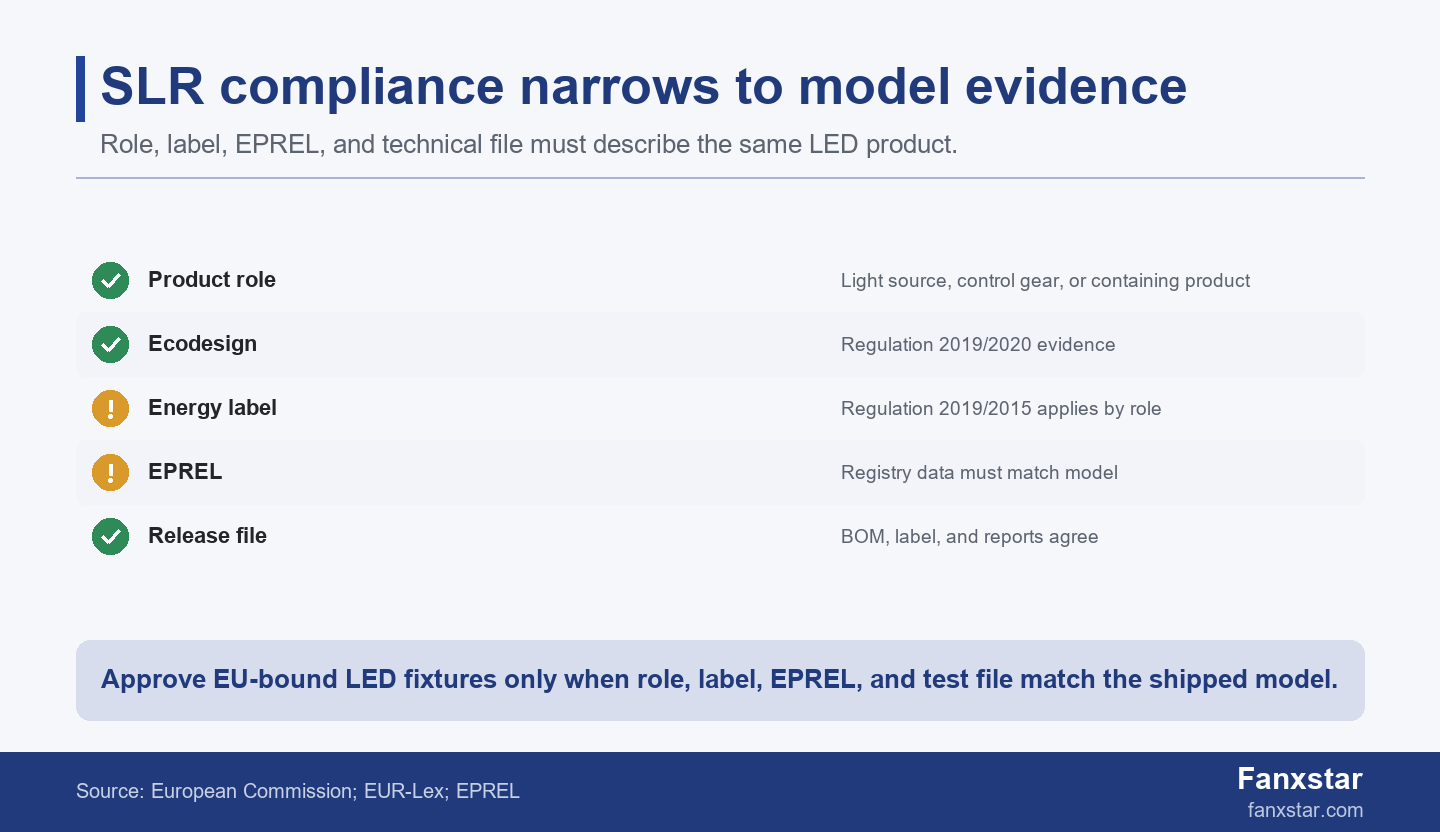
The European Commission lists Regulation (EU) 2019/2020 for ecodesign of light sources and separate control gears and Regulation (EU) 2019/2015 for energy labelling of light sources as the core lighting rules. That split matters because ecodesign, energy label, EPREL, and product role do not all answer the same buyer question. A supplier can be strong on one file and still weak on another.
Key Takeaways
- SLR is a buyer evidence problem: classify the product role first, then verify ecodesign, energy label, EPREL, and technical-file alignment.
- A luminaire may be a containing product while the light source inside it has separate labelling or registry duties, so product-role language must be checked before purchase.
- A label, report, or EPREL record is useful only when the model number, supplier identity, rated data, BOM, and shipped version match.
- For custom LED fixtures, the safest RFQ names which changes reopen SLR evidence review before the sample becomes a production reference.
What the EU SLR actually asks the buyer to verify
SLR is not a single certificate
Regulation (EU) 2019/2020 lays down ecodesign requirements for light sources and separate control gears. Delegated Regulation (EU) 2019/2015 covers energy labelling of light sources. These are related but different obligations. Ecodesign asks whether the product meets technical requirements. Energy labelling asks whether the market-facing label and product information are correct.
That distinction is why a buyer should not ask for a single SLR certificate and stop. The more useful request is a file map: product role, model number, light-source status, control-gear status, energy label, EPREL record, technical file, Declaration of Conformity where relevant, and the production version that those documents describe.
EUR-Lex summarizes the light-source ecodesign and labelling rules by separating ecodesign from energy labelling. The buyer’s practical rule is the same: do not treat one document as a substitute for all evidence. A report can support a performance claim, a label can support consumer-facing information, and EPREL can support registration visibility, but each must point to the same product.
According to Regulation (EU) 2019/2020, the rule covers both light sources and separate control gears, so a buyer should separate the luminaire body from the driver or control-gear question before asking for documents. According to Delegated Regulation (EU) 2019/2015, energy labelling is its own legal layer for light sources. Those 2 source checks prevent a common mistake: treating an SLR conversation as 1 generic certificate request.
The product role controls the rest of the file
| Buyer question | Why it matters under SLR | Evidence to request |
|---|---|---|
| Is the item a light source, separate control gear, or containing product? | The product role changes whether label, EPREL, and technical-file duties attach to the item itself. | Role statement, construction drawing, removable light-source note, model photos |
| Does the energy label match the model? | The label is a model-level claim, not a family marketing asset. | Energy label, EPREL registration, rated power and flux, supplier name |
| Is the control gear separate or integrated? | Separate control gear can have its own ecodesign evidence and replacement implications. | Driver model, control gear specification, wiring diagram, BOM freeze |
| Was the product version changed after testing? | LED board, diffuser, driver, and current changes can invalidate the evidence file. | Change log, sample photos, test report model match, final label proof |
The first mistake in EU-bound LED lighting procurement is classifying the product too late. A buyer may be purchasing a complete luminaire, but the regulation may still care about the light source inside it, whether that light source can be removed, and whether the control gear is integrated or separate. That role decision changes what the supplier must prove.
A useful SLR conversation starts with photos and construction, not with a certificate thumbnail. Ask whether the light source is removable, whether the driver is separate control gear, how the model is named, and what evidence follows the role classification. If the supplier cannot explain the role, the rest of the file may be copied from a similar but different SKU.
EPREL and the energy label must describe the same model
EPREL is a registry check, not a decoration
The European Commission describes EPREL as the European Product Registry for Energy Labelling, covering products bearing the energy label, including business-to-business products. For buyers, that means the registry is not just a consumer-facing database. It is a way to check whether the model identity, supplier identity, and label data look coherent.
The registry check should be tied to the purchase file. If the quote uses one model number, the label uses another, the product photo shows a different housing, and the driver in the sample is not the tested driver, the buyer has a model-control problem. Even if every individual document looks official, the release file is weak because the documents describe different products.
An energy label should therefore be read with a model-matching habit. Compare rated power, luminous flux, supplier name, model identifier, product photo, QR or registry data, and the exact fixture version. If a custom diffuser, LED board, driver, or current setting changes those values, ask whether the EPREL and label evidence also need to change.
According to EPREL, the registry covers products bearing the energy label, including business-to-business products. In a 12-model procurement file, that means the buyer should not verify only the 1 sample shown in a catalogue; the buyer should check whether each sold model identifier has a clear label or registry explanation.
Containing products create a common misunderstanding
Lighting buyers often use luminaire, fixture, lamp, light source, and control gear as casual terms. The regulation does not. A containing product can include a light source, while the light source can still carry energy-labelling implications. The supplier should explain which part of the product file is being treated as the light source and which part is the containing product.
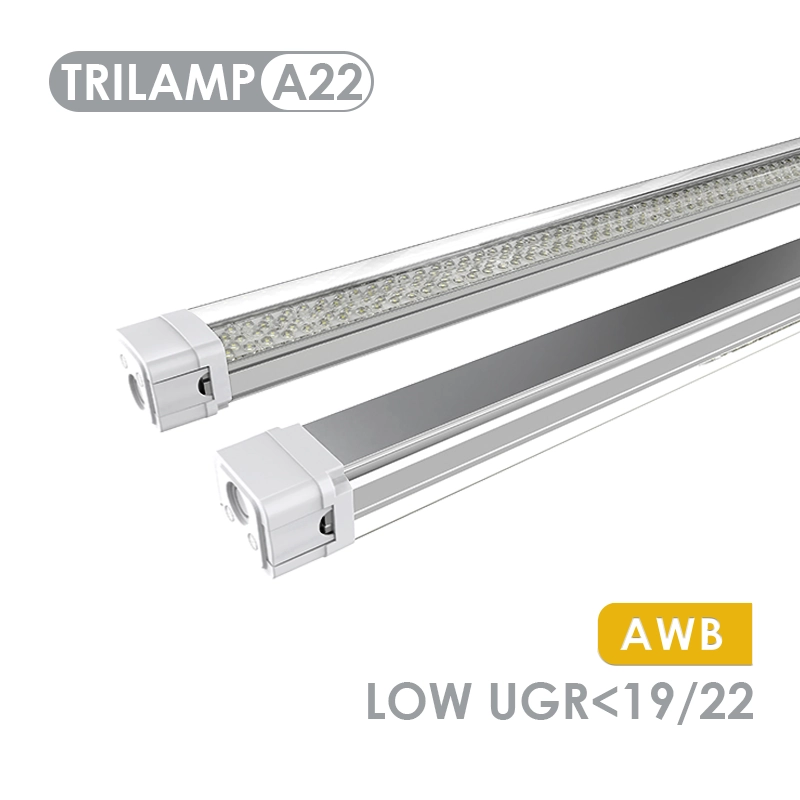
This matters most for custom or platform-based fixtures. A waterproof linear luminaire can use a platform housing but change LED board, diffuser, current, driver, emergency module, sensor, or label route. The more the product moves away from a standard SKU, the more carefully the buyer should ask whether the original label and technical file still apply.
According to the European Commission light sources page, the EU rules address light sources and separate control gears rather than every sales description a supplier may use. This means a buyer comparing 2 fixtures with the same housing should still ask whether the light source, driver, and product role are identical.
For Fanxstar projects, this role check belongs early in custom LED lighting ODM service discussions. If the buyer asks for a new CCT, optics, sensor, emergency function, or housing change, the RFQ should name the target EU market and ask which SLR evidence remains valid after the customization.
How to read SLR evidence before approving a sample
Ask for model-level evidence, not family-level claims
| File item | Good evidence | Weak evidence |
|---|---|---|
| SLR role classification | A clear statement of light source, separate control gear, or containing product role. | A quotation saying only ‘SLR compliant’. |
| Ecodesign proof | Regulation 2019/2020-linked technical file for the exact model. | Generic efficiency table without model reference. |
| Energy label and EPREL | Label, QR/registry data, supplier identity, and model number aligned. | Label image copied from another SKU. |
| Production release | BOM, driver, LED board, diffuser, rating label, and reports frozen together. | Sample report with no production change rule. |
The most useful SLR file is boring in the best way: the same model number appears across the label, registry, report, BOM, packaging label, and commercial documents. A family-level statement can help screen a supplier, but it should not release a shipment. The buyer needs the file for the model being purchased.
This is especially important when the supplier uses a product platform. A platform can reduce development time, but it also creates substitution risk. If the driver, LED board, optical cover, rated power, or control gear changes after sample approval, the buyer should ask which evidence file changes with it. The purchase order should state which changes reopen approval.
Use an illustrative mismatch calculation
Consider an illustrative 8-SKU project: 2 lengths, 2 CCTs, and 2 sensor options. If the supplier shows only 1 label and 1 report, the buyer has not proved all 8 shipped variants. Some variants may share evidence, but that sharing must be explained by model grouping, construction identity, and tested worst case. Otherwise, the missing variants become a customs, marketplace, or distributor risk.
The decision implication is simple. Count the commercial variants, then count the evidence variants. If the commercial file has more variants than the evidence file can explain, ask for a grouping rationale or narrow the order. That calculation is not a legal conclusion; it is a procurement check that prevents a buyer from treating one clean document as proof for every configured product.
Based on our analysis, a 24-unit pilot order with 3 wattages, 2 CCT options, and 4 sensor or non-sensor variants can create more evidence combinations than the buyer expects. If only 6 units are sampled and the remaining 18 units are treated as automatically covered, the buyer should ask which variant is the worst case and why the unsampled variants remain inside the same file boundary.
According to Regulation (EU) 2024/1781, the EU has also established a broader framework for setting ecodesign requirements for sustainable products. According to the European Commission ESPR implementation page, ESPR entered into force on 18 July 2024. The key insight for lighting buyers is not that SLR disappears; it is that EU product evidence is moving toward more structured model accountability.
According to International Trade Administration CE marking guidance, CE marking indicates that a product has been assessed by the manufacturer against applicable requirements. In practice, that assessment is only useful to the importer or distributor when the SLR role, label, report, and physical shipment can be reconciled in less than 30 minutes by someone outside the supplier’s sales team.
How Fanxstar buyers should brief an EU-bound lighting project
Give the supplier the market and configuration before asking for SLR evidence
Fanxstar’s strongest fit is not a generic SLR document request. It is an application-specific file for weatherproof LED lighting, vapor tight LED light fixtures, LED linear lighting, or special ODM fixtures where the buyer already knows the environment and target market. The buyer should send voltage, wattage target, CCT, optics, driver, sensor, emergency option, IP rating, label needs, and EU destination before sample approval.
That package lets the supplier answer a practical question: which parts of the existing platform evidence apply, which files need update, and which changes should be frozen before the sample becomes the production reference. Without that detail, SLR evidence can become a document exchange rather than a model-control process.
The late-stage path can stay soft and evidence-led. If a buyer is unsure whether a planned custom fixture remains inside the existing file, send the drawing, target market, role classification, and desired configuration to Fanxstar custom LED lighting ODM service so the team can map the next sample to the required evidence checks.
Build the release file before shipment
Before final balance, the buyer should collect the model-level release file: role classification, label artwork, EPREL evidence where applicable, test report, Declaration of Conformity where relevant, BOM, driver model, LED board, diffuser or lens material, rating label, production photo, carton mark, and change rule. Each file should describe the same shipped product.
The best SLR procurement habit is to write the substitution rule. If the supplier changes driver, LED board, diffuser, current, emergency module, sensor, housing, or label, which documents reopen? The answer should be written before mass production, because after shipment the buyer has less leverage and more downstream responsibility.
According to International Trade Administration CE marking guidance, CE marking indicates manufacturer assessment against applicable requirements. For an EU lighting buyer, the practical handover file should therefore be short but traceable: 1 role statement, 1 label path, 1 technical-file map, 1 change rule, and 1 named owner for post-sample substitutions.
FAQ
Is the EU SLR the same as an energy label?
No. The EU SLR shorthand usually points to ecodesign requirements for light sources and separate control gears, while the energy label is governed separately for light sources. Buyers should check both the technical ecodesign file and the label or EPREL evidence when the product role requires it.
Does every LED luminaire need an EPREL record?
Not every complete fixture is treated the same way, so the buyer should first classify whether the item is a light source, separate control gear, or containing product. EPREL evidence is useful when the product or light source falls under energy labelling duties, but the supplier must explain the exact role.
Can one SLR report cover a custom LED fixture family?
One evidence file may cover several variants only when the grouping is technically justified and the tested model represents the shipped versions. If CCT, driver, LED board, diffuser, current, or control gear changes affect rated data, the buyer should ask whether the file must be updated.
What should buyers request before approving EU-bound LED samples?
Request the model role, ecodesign evidence, energy label or EPREL record where applicable, technical file, Declaration of Conformity when relevant, BOM, driver and LED board details, final label artwork, and a written rule for changes after sample approval.