IP66 and IP69K answer different water-exposure questions in car wash tunnel lighting, so the buyer should start with the washdown profile before comparing fixture price. IP66 is usually the strong-water-jet discussion, while IP69K belongs only when the fixture is exposed to hot high-pressure cleaning conditions similar to the required test scope.
According to IEC ingress protection guidance, IEC 60529 ratings describe protection against dust, liquids, and access to hazardous parts across 2 visible IP digits. That makes the first buyer move very practical: write down what water, pressure, temperature, chemistry, cable entry, and maintenance will actually happen in the tunnel.
A car wash tunnel is harder than ordinary outdoor rain because spray direction, detergent, vibration, corrosion, and service cycles can attack the fixture. The IP number helps, but the rating does not replace material selection, cable sealing, installation discipline, and sample evidence.
Key Takeaways
- IP66 and IP69K are not interchangeable car wash tunnel lighting ratings; they answer different water-test questions.
- IP66 is commonly relevant for dust-tight fixtures exposed to strong water jets, while IP69K is triggered by hot high-pressure washdown requirements.
- Chemical detergents, corrosion, cable entry, mounting orientation, and repeated service are not solved by the IP number alone.
- Buyers should ask whether the report covers the exact fixture version, cable gland, sensor option, emergency option, and installation method.
- Fanxstar car wash tunnel projects should start with the cleaning profile, then match the waterproof, vapor tight, or custom ODM platform to the evidence needed.
IP66 and IP69K Solve Different Water Problems
IP66 is a strong-jet and dust-tight screening signal
According to E2S IP and NEMA rating guidance, the first IP digit covers solid objects and dust, while the second covers water ingress across 2 rating positions. IP66 combines IP6X dust-tight protection with strong water-jet protection. That is why it often appears in car parks, tunnels, damp industrial sites, and weatherproof LED lighting specifications.
In a car wash tunnel, IP66 can be a realistic starting point when the fixture faces strong jets, splash, mist, and dirty water but is not directly hit by hot high-pressure washdown. The buyer still needs the test report, fixture orientation, cable entry method, gasket structure, lens material, clips, and installation instructions. A fixture body tested in one configuration may not cover a modified cable-entry version.
IP66 should not be dismissed as low simply because IP69K sounds larger. If the real exposure is strong jets and detergent mist rather than hot high-pressure cleaning at close range, a properly designed IP66 fixture may be the more practical and economical choice. The point is to match the rating to the exposure, not to maximize the number.
IP69K is a washdown-specific question
According to the ISO 20653 preview, the standard applies to degrees of protection for electrical equipment enclosures on road vehicles, which creates a specific 2023 scope for IP code discussions. According to F2 Labs guidance on IP69 versus IP69K, the K suffix belongs to a different test context than a generic IP69 claim. For car wash buyers, that means IP69K should be discussed when hot high-pressure spray is a real part of the fixture exposure.
IP69K can be useful in heavy washdown environments, but it is not a magic durability label. It does not automatically prove detergent compatibility, salt resistance, UV stability, impact resistance, vibration survival, or service-life performance after repeated opening and closing. It also does not automatically solve cable-gland mistakes made during installation.
| Exposure question | IP66 relevance | IP69K relevance | Buyer caution |
|---|---|---|---|
| Dust and road grime | Strong, because IP6X is dust-tight | Also starts with dust-tight protection | Still check lens, clips, gasket, and cable entry |
| Strong water jets | Core reason to consider IP66 | May also handle stronger washdown depending on test scope | Ask for the exact report, not a label photo |
| Hot high-pressure cleaning | Not the main IP66 promise | Main reason to review IP69K | Confirm ISO 20653 or required project standard |
| Chemical detergent exposure | Not automatically proven | Not automatically proven | Ask for material and corrosion compatibility |
| Standing water or flooding | Not an immersion rating | Not an immersion rating by itself | Review IP67 or IP68 if submersion is credible |
Based on this comparison, the correct question is not which rating is higher. The correct question is what water event the fixture must survive and whether the supplier can show evidence for that exact event.
Car Wash Tunnels Add Chemistry, Heat, and Maintenance Risk
The wash environment is more than water
A car wash tunnel can combine sprayed water, detergent, wax, alkaline or acidic cleaning agents, road salt, vibration, humidity, thermal cycling, and repeated maintenance. IP testing focuses on ingress under defined water conditions; it does not automatically prove long-term compatibility with every chemical or corrosion environment. This is where many fixture comparisons become too thin.
According to NEMA enclosure type guidance, enclosure type documents provide general definitions and point users to NEMA 250 for complete information, so buyers should treat at least 2 rating languages as separate evidence systems. The same discipline applies when a buyer sees IP66, IP69, IP69K, or a NEMA type. The rating is a defined claim, not a complete life-cycle guarantee.
A buyer should ask for material evidence alongside ingress evidence. The housing, diffuser, stainless clip, screw, gasket, cable gland, mounting bracket, and breather or drain strategy all matter. A fixture can pass a water test and still disappoint if the lens yellows, the metal corrodes, the clips loosen, or maintenance breaks the seal after the first service event.
Cable entry is often the weak point
Car wash lighting often fails at the edges: cable glands, end caps, junctions, screws, sensor modules, and field penetrations. The tested enclosure rating may not cover a modified cable length, a different gland, a through-wiring version, or a sensor option unless the report scope says so. Buyers should treat cable entry as a tested product feature, not a small accessory.
Mounting orientation also changes risk. A fixture directly facing a spray path, mounted low near side equipment, or positioned where water sits on an end cap faces a different burden than a ceiling-mounted unit outside the direct spray cone. The RFQ should include location photos, spray direction, cleaning method, and the expected service interval.
| RFQ field | Why it changes the rating decision | Weak wording to reject |
|---|---|---|
| Nozzle pressure and distance | Separates occasional spray from high-pressure washdown | strong water |
| Water temperature | Hot washdown pushes the discussion toward IP69K-style evidence | normal cleaning |
| Cleaning chemistry | IP does not automatically prove detergent or chemical resistance | car wash chemical |
| Cable entry and orientation | A tested body can fail at the gland or field connection | standard cable |
| Mounting position | Direct spray and ceiling condensation create different risk | installed in tunnel |
| Maintenance access | Repeated opening can weaken sealing over time | easy service |
The weak wording column is important because it shows where misunderstandings start. Words such as waterproof, strong cleaning, or tunnel use are not enough. They should be replaced by pressure, temperature, cleaning chemical, distance, orientation, and cable-entry facts.
How to Choose Between IP66 and IP69K
Start with the cleaning profile, not the product page
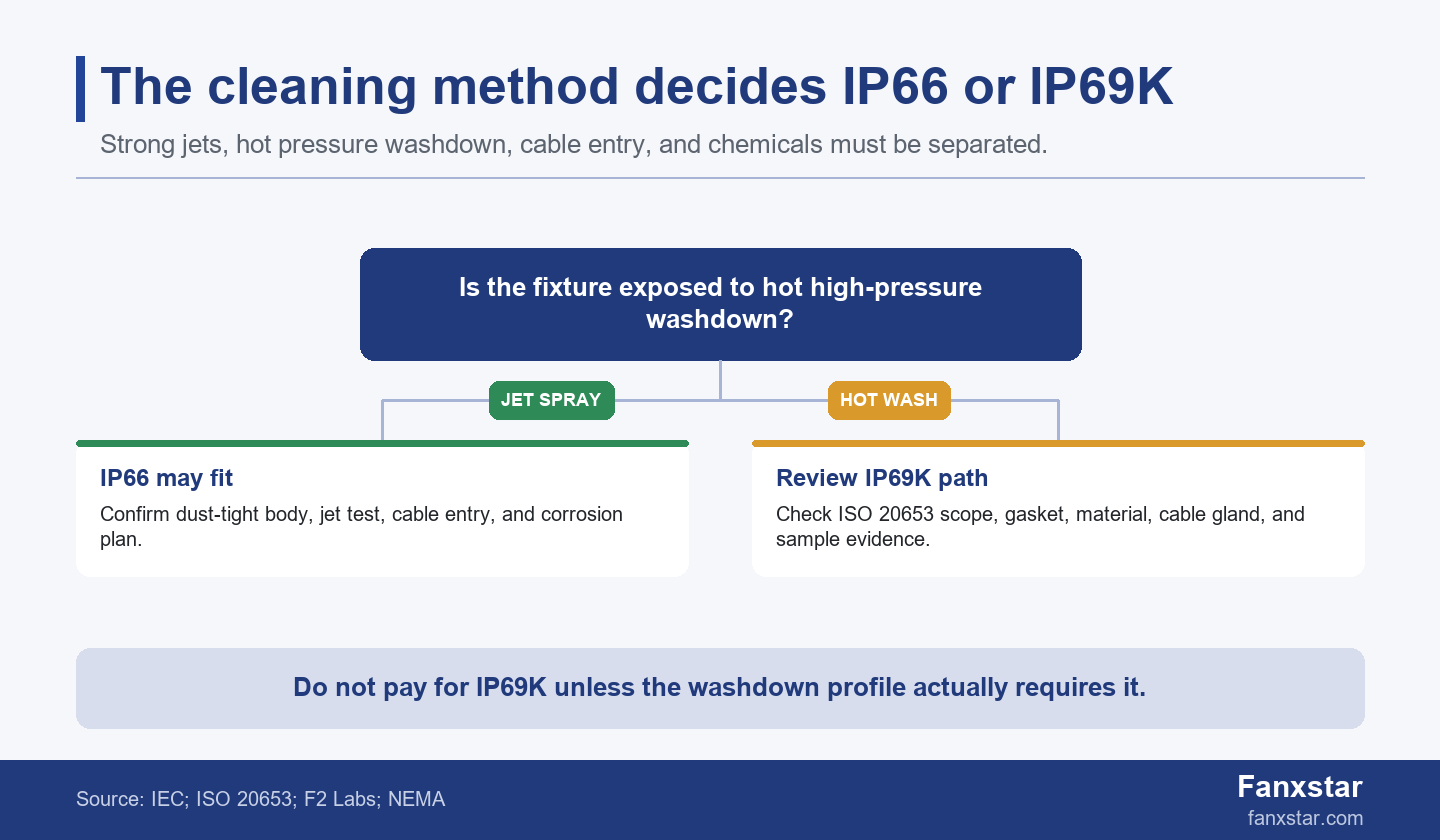
If the fixture is exposed to dust, mist, splash, and strong water jets but not close-range hot high-pressure washdown, IP66 may be the practical target. If the fixture is routinely hit by hot high-pressure cleaning, IP69K or a project-specific high-pressure washdown file becomes more relevant. If standing water or immersion can occur, neither IP66 nor IP69K alone answers that condition.
Illustrative decision model: assign the site one of three exposure levels before asking for a quote. Level 1 is mist and indirect splash; Level 2 is direct strong water jets; Level 3 is hot high-pressure washdown at close range. A Level 2 site may justify IP66 plus corrosion review. A Level 3 site should trigger IP69K evidence review plus material and cable-entry review. The model is a procurement screen, not a replacement for engineering approval.
According to International Trade Administration import documentation guidance, common trade files can include invoices, bills of lading, packing lists, insurance proof, and certificates of origin, which gives car wash buyers at least 5 document families to keep consistent. For car wash luminaires, documentation should match the exact product version being shipped: model, rating, cable entry, label, installation instruction, and any sensor or emergency option.
Do not over-specify IP69K when the real risk is elsewhere
Over-specification has a cost. It can narrow supplier options, increase price, extend sample time, or push the buyer toward a fixture that is stronger in washdown language but less suitable in optics, mounting, maintenance, or corrosion behavior. A car wash tunnel still needs the right beam, glare control, service access, driver life, and mechanical mounting.
Under-specification also has a cost. If the fixture is directly blasted by hot high-pressure cleaning and the buyer chooses a generic IP65 or IP66 product without evidence, failures can appear as water ingress, corrosion, flicker, driver damage, or gasket fatigue. The lost cost is not only the fixture price; it includes lift rental, shutdown time, warranty disputes, and customer-facing dark zones.
The right answer is a rating-and-evidence package. Name the target rating, but also request the test report scope, cable-entry method, material statement, installation limits, and sample test plan. That package makes the supplier decision more reliable than a single IP label.
Where Fanxstar Fits in Car Wash Tunnel Lighting
Match the platform to water exposure and service access
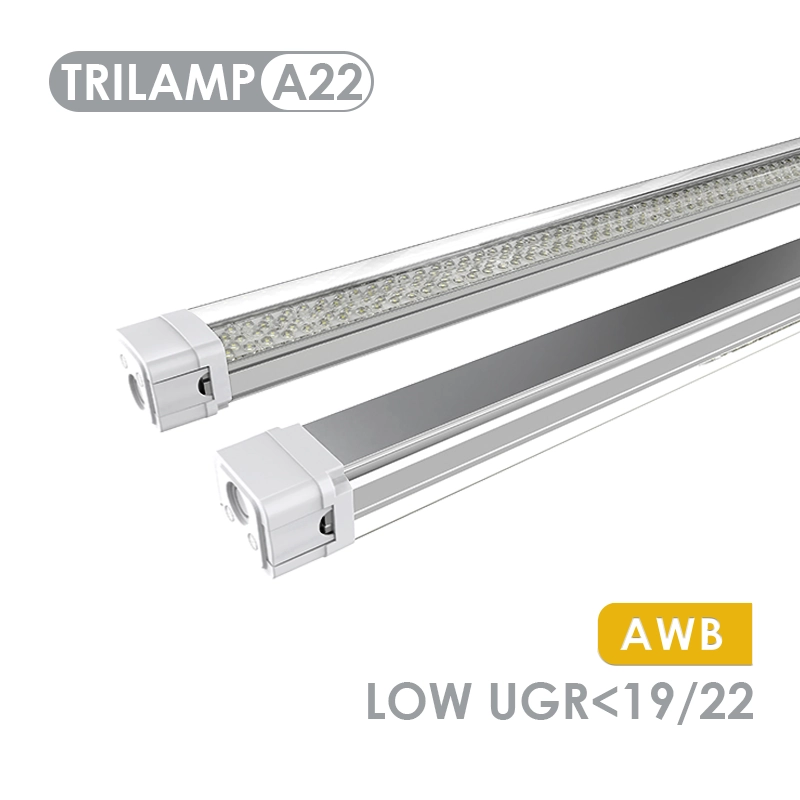
Fanxstar buyers can start from IP65 and IP66 waterproof LED lights, vapor tight LED light fixtures, aluminum weatherproof LED luminaires, and weatherproof LED lighting product platforms. The best platform depends on spray direction, pressure, temperature, detergent, mounting, cable entry, and service access.
A standard waterproof light may fit support rooms, equipment areas, or indirect spray zones. A heavier weatherproof or vapor tight structure may fit areas with more water and corrosion pressure. A custom ODM path may be needed when the car wash project requires a special cable entry, sensor, emergency function, mounting bracket, optical output, or higher washdown evidence.
Fanxstar’s role should be framed as product-version control. The buyer sends the cleaning profile and target evidence, then the supplier maps that requirement to a fixture platform or sample path. That is safer than asking whether the factory has IP69K lights in general, because the final product version matters more than a generic capability claim.
Send the tunnel profile before asking for a rating
According to International Trade Administration special-document guidance, some products need certificates for cleanliness, standards, safety, or health, so at least 4 evidence types can matter before a shipment clears a market. Lighting buyers should apply the same discipline internally: state which evidence the project needs before the sample is treated as approved.
A useful Fanxstar RFQ packet should include tunnel layout, spray direction, nozzle pressure and distance if known, water temperature, detergent exposure, operating hours, mounting height, target lux or fixture spacing, cable-entry preference, voltage, sensor or emergency requirement, and target market. If the buyer is uncertain, photos and a cleaning-method description are still better than a one-line IP request.
If the project needs a nonstandard housing, bracket, cable entry, or optical layout, use Fanxstar custom LED lighting ODM service to turn the exposure profile into a sample decision. The sample should prove the rating and product version that the buyer will actually install.
FAQ
Is IP69K always better than IP66 for car wash lights?
No. IP69K is relevant when the fixture faces hot high-pressure washdown conditions, while IP66 is focused on dust-tight protection and strong water jets. If the fixture is outside the direct high-pressure spray path, IP69K may add cost without solving the real risks of cable entry, corrosion, detergent compatibility, or optical layout.
Can IP66 lighting survive a car wash tunnel?
IP66 lighting can fit some car wash tunnel zones when the exposure is strong jets, mist, and damp operation rather than hot high-pressure washdown. The buyer should still confirm report scope, cable entry, material, mounting orientation, detergent exposure, and maintenance access. The exact fixture version matters more than the rating label alone.
Does IP69K prove chemical resistance?
No. IP69K relates to high-pressure, high-temperature water spray in a defined test context; it does not automatically prove resistance to detergents, wax, salt, UV, impact, or corrosion. Car wash buyers should ask for material compatibility and service-life evidence when chemicals or harsh cleaning agents are part of the environment.
What should be included in a car wash lighting RFQ?
Include tunnel location, spray direction, cleaning pressure, water temperature, detergent exposure, mounting height, cable-entry method, voltage, operating hours, optical target, corrosion concern, sensor or emergency requirement, and target market. Those details let Fanxstar recommend whether an IP66, IP69K-oriented, vapor tight, aluminum weatherproof, or custom platform is appropriate.