Vibration-proof railway tunnel lighting should be specified as a system evidence file because vibration requirement, mounting method, ingress protection, emergency-route role, maintenance access, and certificate scope must all fit the project standard before production release. Adding the word rugged to a datasheet is not enough. A tunnel luminaire must survive mechanical vibration, moisture, dust, cleaning, cable strain, restricted access, and long maintenance intervals.
For Fanxstar buyers, the shock and vibration claim should be tied to the actual assembly. According to IEC 61373, the standard specifies shock and vibration testing for railway vehicle equipment subjected to those stresses. That source is useful for vibration language when a project specification calls for it, but buyers should not casually claim IEC 61373 for every tunnel-mounted luminaire unless the product and project scope support it. Tunnel lighting also needs luminaire safety, ingress, emergency route, and maintenance evidence.
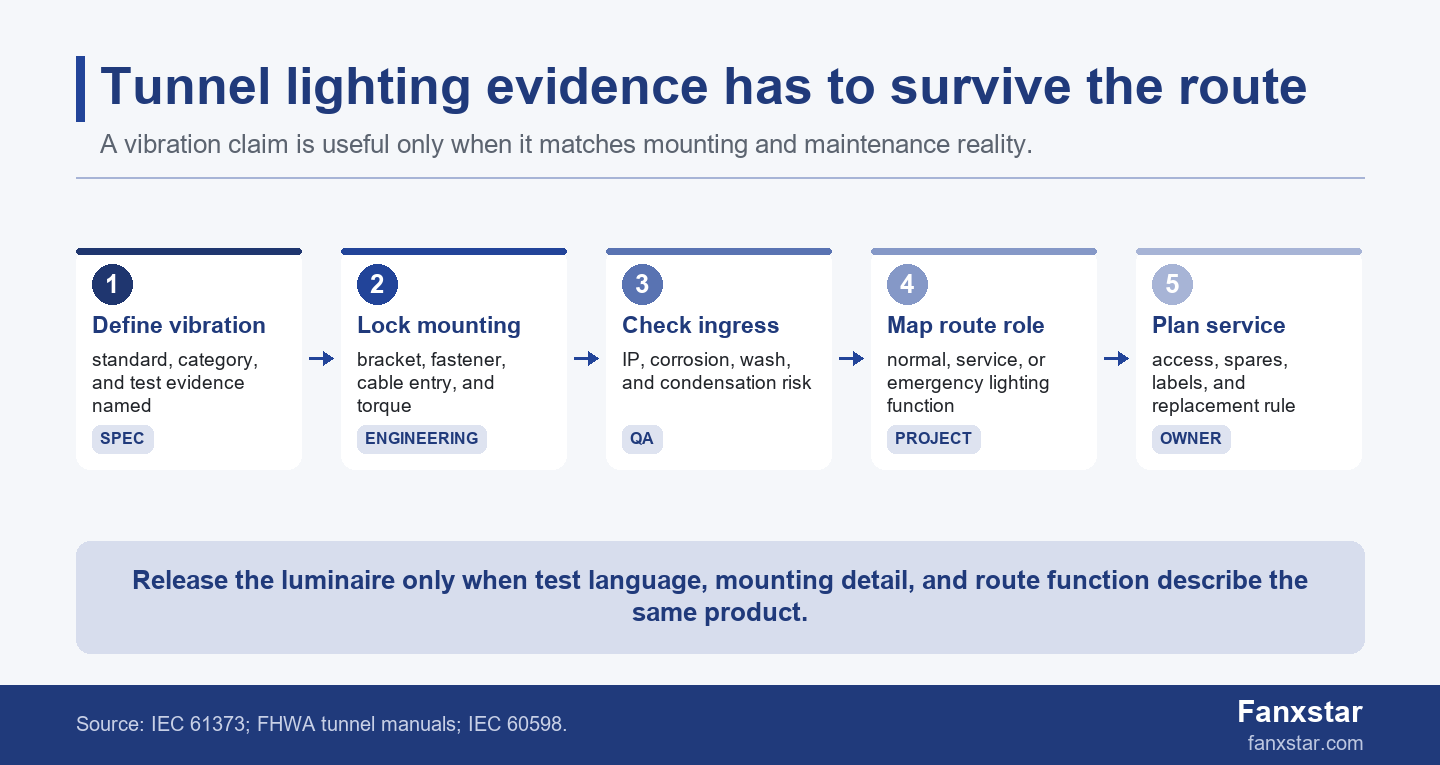
Government tunnel manuals such as FHWA TOMIE and the FHWA tunnel design manual are reminders that tunnel lighting belongs inside an operation and maintenance system. A lighting purchase should therefore connect product construction to inspection access, replacement rules, fire and life-safety coordination, and service continuity.
Key Takeaways
- Vibration-proof tunnel lighting should be specified by test evidence, mounting detail, cable entry, ingress protection, and service access together.
- IEC 61373 language should be used carefully and only where the project and product scope support it.
- Tunnel luminaires need a route role: normal lighting, service lighting, emergency lighting, or a combination with clear controls behavior.
- The strongest buyer file includes vibration requirement, IP evidence, bracket drawing, certificate scope, maintenance plan, and sample inspection.
Why vibration language needs careful boundaries
A railway vibration claim must name the test context
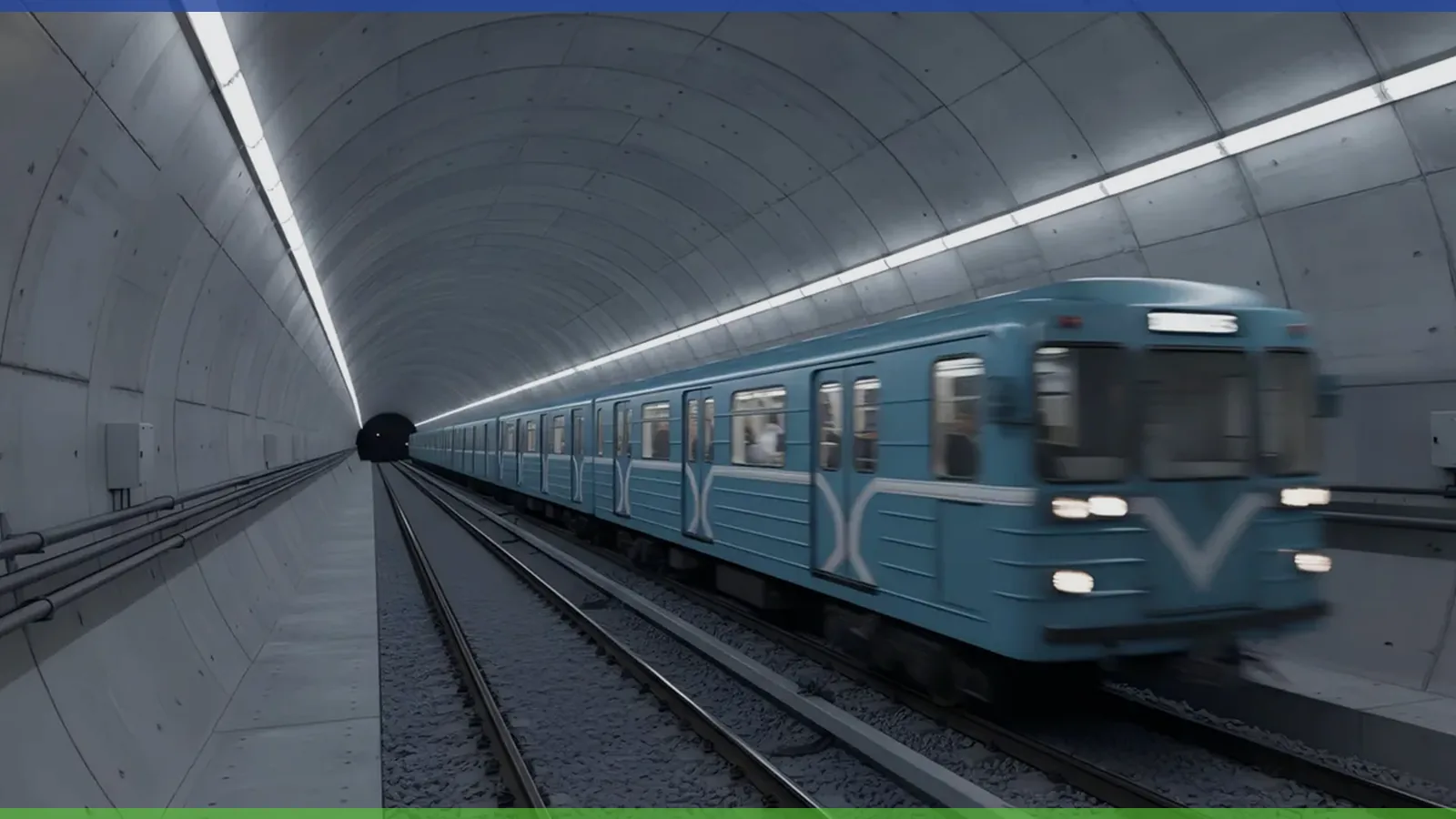
Railway projects often ask for vibration-proof fixtures because trains create repeated mechanical stress, pressure changes, cable movement, bracket fatigue, and access restrictions. The concern is valid, but the specification must be exact. A buyer should ask which standard, test category, mounting orientation, fixture version, and bracket assembly are covered by the evidence.
IEC 61373 is about testing items of equipment intended for railway vehicles that are subjected to shock and vibration. A tunnel luminaire fixed to infrastructure is not automatically the same equipment context. If a project requires IEC 61373 or equivalent vibration evidence, the supplier should explain the applicability and provide the matching test report or engineering evidence.
The practical buyer question is: what part is being tested? The luminaire body alone, the bracket, the cable entry, the driver compartment, the diffuser, or the complete mounted assembly? A fixture can have a strong housing and still fail at the screw, clip, gasket, cable gland, or terminal. A vibration-proof claim is only as strong as the weakest assembled point.
For that reason, the purchase file should include bracket drawings, fastener material, locking method, recommended torque, cable gland detail, diffuser retention method, and service procedure. These details may look less exciting than lumen output, but they decide whether the product stays stable in the tunnel. The key insight is that vibration evidence has to describe the installed assembly, not only the luminaire shell.
Ingress and corrosion are part of the same decision
Tunnel lighting rarely faces vibration alone. It may face condensation, dust, washdown, exhaust residue, cleaning chemicals, corrosion, insects, and temperature variation. If the fixture is selected only by vibration claim, the buyer can miss the environmental path that actually causes failure. In many tunnels, water and dirt attack the same seams that vibration loosens.
IEC 60529 supports evaluating enclosure protection through IP-code language, while IEC 60598-1 supports checking luminaire construction and safety. For tunnel projects, those two evidence lines should sit beside vibration evidence. The enclosure, mounting, and electrical construction all need to describe one product.
A useful site review asks 6 questions: Is the fixture exposed to dripping water? Is washdown used? Are brackets exposed to corrosion? Can cable glands face direct spray? Is condensation likely in driver compartments? Can maintenance teams reach the luminaire safely? If any answer is yes, the vibration file alone is not enough.
A common failure pattern is a product with a strong headline IP rating but weak installation detail. The cable entry is placed upward, the bracket traps water, or the diffuser clip is hard to inspect. After months of service, vibration and moisture work together. The better solution is to specify the entire mounted detail.
How to specify railway tunnel lighting evidence
Build the requirement from route role
A tunnel luminaire should be assigned a route role before the product is chosen. Is it normal tunnel lighting, service corridor lighting, emergency route lighting, cross-passage lighting, equipment-room lighting, or temporary maintenance lighting? Each role changes output, controls, redundancy, ingress, mounting, and inspection requirements.
FHWA tunnel fire and life safety guidance supports coordinating tunnel systems with life-safety needs. Lighting can affect exit visibility, signage, equipment access, and emergency response. A buyer should therefore separate normal operation from emergency mode and decide what the luminaire must do during each state.
| Evidence field | Why it matters | Buyer request |
|---|---|---|
| Vibration basis | Prevents vague rugged claims. | Standard, category, assembly scope, and report or engineering note. |
| Mounting detail | Most failures happen at bracket, fastener, or cable entry. | Bracket drawing, torque, lock method, material, and service access. |
| Ingress evidence | Water and dust can combine with vibration. | IP report, gasket design, cable gland orientation, and cleaning limit. |
| Route role | Normal, service, and emergency lighting have different behavior. | Mode map, control state, emergency requirement, and inspection interval. |
| Document match | Shipment files must match the approved fixture. | Certificate, label, invoice, and packing file aligned with ITA special documents guidance. |
This table should be completed before mass production. If the buyer waits until installation, the supplier may already have produced brackets, cable entries, and labels that do not match the final route role. Tunnel corrections are expensive because access time is limited and safety planning is strict.
Use samples to test installation reality
A railway tunnel lighting sample should include the mounting bracket and cable entry, not only the luminaire body. The buyer should check whether installers can mount it with available tools, whether the cable gland direction is protected, whether the diffuser can be opened safely, whether labels remain readable, and whether the driver can be serviced without removing too much hardware.
FHWA TOMIE emphasizes the operation, maintenance, inspection, and evaluation context of tunnels. That context changes the sample review. A beautiful product photo is less useful than a sample that can be inspected, cleaned, retightened, and replaced inside the tunnel’s maintenance window.
A sample file can use a 4-photo rule: front view, bracket view, cable-entry view, and service-open view. Add a short note for each photo: what is fixed, what can be customized, and what cannot change after certification. This simple record prevents later arguments about whether the shipped product matches the approved assembly.
According to FHWA TOMIE, tunnel work must be considered through operation, maintenance, inspection, and evaluation. According to the FHWA tunnel design manual, tunnel systems include lighting, electrical, control, and life-safety considerations. According to FHWA tunnel fire and life safety guidance, tunnel systems should be coordinated for emergency conditions. Based on our analysis, a 300-unit tunnel lighting order should sample at least 2 mounting locations: the highest-vibration zone and the hardest service-access zone.
For ODM projects, ask whether the supplier can customize bracket length, cable entry, diffuser material, output, CCT, emergency module, sensor behavior, and label language without breaking the evidence scope. Some changes are easy; others require new testing or certificate review. The buyer should know that before ordering 500 units.
How Fanxstar buyers can prepare a tunnel lighting brief
Connect the tunnel brief to a product platform
Fanxstar tunnel discussions can start from tunnel lighting solutions, weatherproof LED lighting products, aluminum weatherproof LED luminaires, vapor tight LED fixtures, and emergency lighting products. The best starting platform depends on route role, ingress exposure, bracket geometry, and certificate market.
The buyer should provide tunnel type, railway or road context, mounting surface, bracket requirement, exposure, cleaning method, vibration requirement, voltage, control mode, emergency role, and maintenance access. If the specification mentions a shock or vibration standard, include the exact clause or project document so the supplier does not guess.
FEMP LED luminaire purchasing guidance supports evaluating luminaires as procurement assets. In tunnels, life-cycle value is especially important because shutdowns, access lifts, traffic control, and safety procedures can make maintenance labor much more expensive than the fixture price.
Release the order only after evidence and drawings agree
International shipment files should stay consistent. International Trade Administration import documentation guidance supports keeping invoices, packing lists, certificates, and special documents aligned. For tunnel lighting, the alignment should also include bracket drawings, cable-entry direction, label language, and emergency-module description where applicable.
A practical release checklist has 7 gates: route role, vibration basis, IP evidence, bracket drawing, wiring and cable entry, emergency or control behavior, and maintenance access. If one gate is missing, the buyer should pause and ask whether the product is truly ready for production.
According to IEC 60529, enclosure protection belongs to the IP-code evidence file. According to IEC 60598-1, luminaire safety requirements cover construction and electrical behavior. According to FEMP LED luminaire purchasing guidance, LED luminaires should be evaluated as procurement assets, not disposable parts. This means a tunnel fixture should not be approved until the evidence file connects the product body, bracket, cable entry, and route role.
The trade-off is standardization versus route-specific evidence. Standardizing one tunnel luminaire can simplify spares and reduce installer mistakes, but it can also hide different stresses at portals, curves, service rooms, and cross passages. A 1 km tunnel may contain several mounting and exposure conditions. The buyer can still choose one fixture family, but the release file should explain which brackets, cable entries, optics, and emergency options change by zone.
For maintenance teams, that zone note matters because the replacement fixture must match the local bracket, wiring, optic, and emergency behavior, not merely the catalogue family name.
It also helps procurement avoid buying spare fixtures that fit the electrical rating but fail the mounting or service-access condition at the actual tunnel location.
The same note should travel with the spare-parts list so future replacements do not silently change the approved assembly.
The strongest tunnel-lighting RFQ is not a demand for the most rugged fixture. It is a clear description of the tunnel’s stress pattern and service reality. When Fanxstar receives that information, the engineering discussion can focus on a product that fits the route, not a generic heavy-duty claim.
FAQ
Does IEC 61373 apply to every railway tunnel luminaire?
IEC 61373 does not automatically apply to every railway tunnel luminaire because the standard language must match the project specification and equipment context. Buyers should confirm whether the luminaire, bracket, and installed assembly are within the claimed evidence scope. If the project requires IEC 61373-style evidence, the supplier should explain applicability clearly.
What makes a tunnel light vibration-proof?
A tunnel light should be called vibration-proof only when the mounted assembly is supported by real evidence, not only a strong housing claim. The evidence should cover housing, bracket, fasteners, diffuser retention, cable entry, driver compartment, and the installation method. A weak bracket or cable gland can defeat a strong luminaire body.
Is IP rating enough for tunnel lighting?
IP rating is important for tunnel lighting, but it is only one part of the evidence file. Tunnel projects also need vibration, corrosion, mounting, emergency-route role, controls, service access, certificate scope, and maintenance checks. Water, dust, and vibration often interact, so the enclosure and mounting details must be reviewed together.
What should be included in a railway tunnel lighting RFQ?
A railway tunnel lighting RFQ should include tunnel type, mounting surface, bracket requirement, vibration basis, IP requirement, voltage, controls, emergency function, maintenance access, certificate market, and requested sample evidence. It should also state whether the buyer needs a complete mounted sample, not only a loose luminaire body.