In 2026 peak season, the useful lead-time question is not one factory date; it is whether forecast, sample, production, QC, and freight decisions are locked early enough to survive compressed capacity. A buyer who asks for one lead-time number in July 2026 is already asking too late. The better question is which decisions are still open: forecast quantity, product specification, sample approval, production slot, inspection file, freight booking, and receiving deadline.
Maersk North America market update for July 2026 described an early compressed peak season, frontloaded imports, tariff and fuel uncertainty, and tightening inland capacity. It also forecast June 2026 import volumes of 2.25 million TEUs, up 14.3 percent year over year. For lighting buyers, that means lead time is no longer only a factory answer.
Public freight indicators are useful for reading the wider market, but a buyer also has to clean up the order file. Freight volatility punishes unclear orders first because suppliers can move faster on projects where model, packaging, documents, and release rules are already fixed.
Key Takeaways
- A 2026 peak-season lead time should be treated as a chain of decision locks, not a single factory promise.
- Frontloaded imports and uneven ocean conditions make freight booking and inland capacity part of the lighting procurement calendar.
- Custom ODM lighting projects need earlier sample and BOM freeze dates than repeat catalog orders.
- The fastest order is usually the cleanest order: fixed model, approved sample, confirmed documents, and a realistic receiving window.
- Fanxstar buyers should send application, market, certification, sample target, and packaging needs before asking for a final date.
Why 2026 Peak Season Feels Compressed
Demand is not moving in one neat seasonal wave
C.H. Robinson July 2026 ocean update says July ocean freight is not one synchronized peak-season market. Some lanes are pulled forward by seasonal demand or tariffs, while others are constrained by service changes, blank sailings, port omissions, or container shortages. That is exactly why a generic lead-time quote can mislead buyers.
Lighting orders are especially exposed because they combine product configuration, packaging, electrical documentation, and freight timing. A buyer may believe the order is simple because the fixture family is familiar, but the lead time changes if the SKU needs a different driver, battery, motion sensor, label, carton, or destination document. Peak season magnifies those small differences because late changes compete with capacity that has already been reserved.
The first practical rule is to ask suppliers which part of the lead time is fixed and which part is conditional. Factory assembly time, component availability, sample approval, inspection schedule, document readiness, and freight booking should not be blended into one number. If the supplier says 35 days, the buyer should ask 35 days after which gate: deposit, artwork approval, sample sign-off, BOM freeze, or freight booking?
Planning windows are shorter when everyone waits for the same capacity
Maersk peak periods in logistics 2026 frames logistics demand as cyclical, with multiple rush periods during the year. The buyer takeaway is not to memorize every season; it is to understand that capacity becomes less forgiving when many orders try to move at the same time.
For lighting buyers, peak season starts before the container leaves the factory. It starts when component suppliers allocate drivers, batteries, housings, aluminum extrusions, and cartons. It continues when factories decide which orders receive line time. It tightens again when forwarders book space and inland carriers become scarce. A buyer who cleans only the freight side but leaves sample approval open is still late.
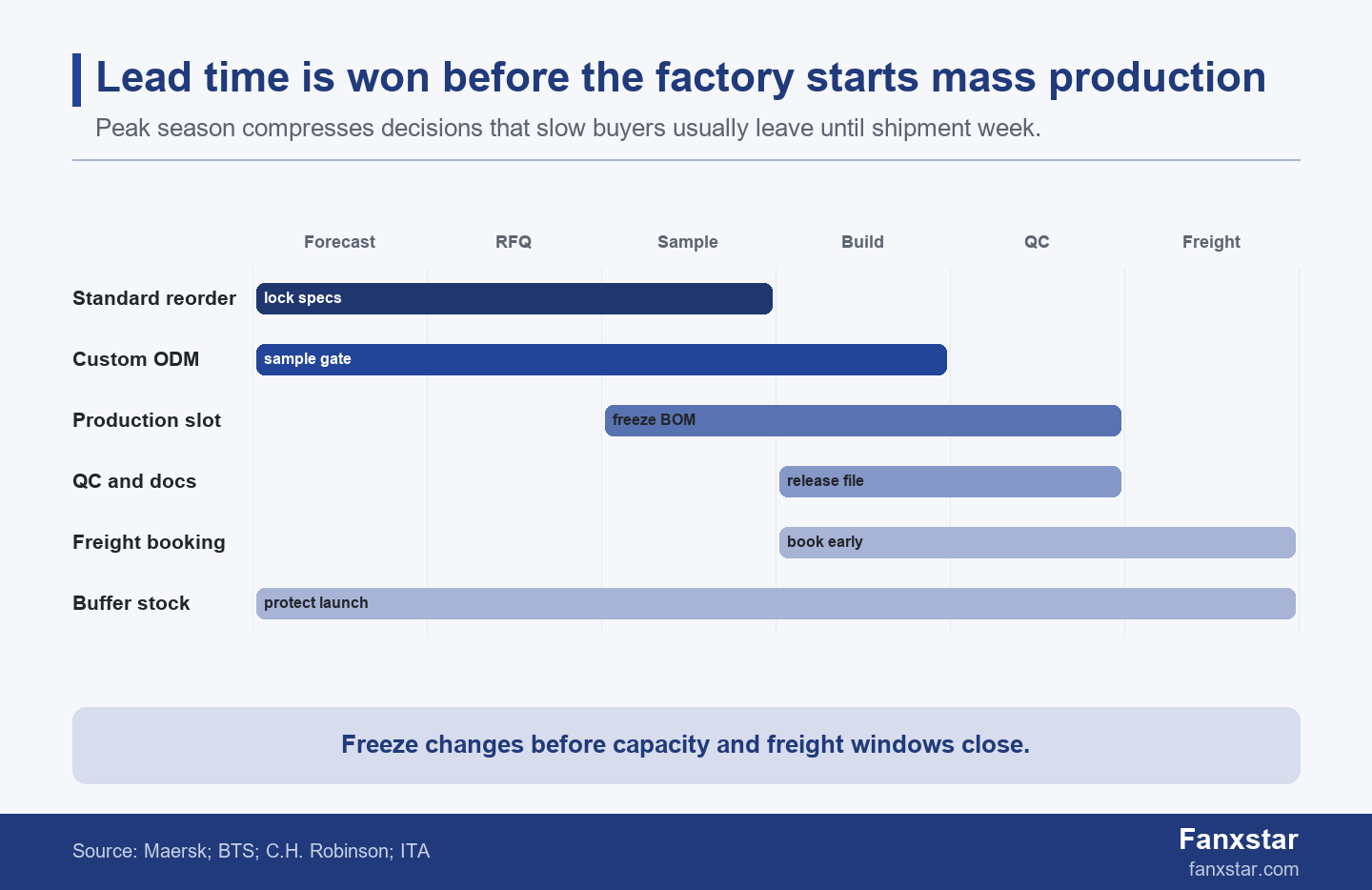
The Lead-Time Stack Buyers Should Manage
Forecast lock comes before price comparison
Many buyers treat forecast as a negotiation tool and keep it vague to preserve flexibility. That can be reasonable early in sourcing, but it weakens lead-time planning when capacity tightens. A supplier cannot reserve material, labor, or inspection slots for a project that might be 200 pieces or 2,000 pieces, standard packaging or private label, June delivery or September delivery.
A better RFQ gives ranges and decision dates. The buyer can say: budget range 800 to 1,200 units, first release 300 units, target delivery month, destination market, and final quantity date. That is enough for a supplier to identify material risk without pretending the whole order is final. The buyer still has negotiation flexibility, but the supplier has a planning signal.
| Lead-time layer | What to lock | What happens if it waits |
|---|---|---|
| Forecast | Model, quantity range, target market, delivery month | Supplier cannot reserve material or production slot. |
| RFQ | Voltage, certification, packaging, label, controls, application | Price looks fast but changes restart the clock. |
| Sample | Fixture body, driver, battery, sensor, CCT, lens | Mass production waits for decision proof. |
| Production | BOM freeze, QC plan, document file | Peak capacity goes to cleaner orders. |
| Freight | Route, booking window, Incoterms, receiving deadline | Finished goods may sit while space tightens. |
Sample approval is the hidden lead-time gate
The sample gate is where many lighting schedules lose time. A custom CCT change may look minor, but it can affect LED board choice, photometric file, label, or stock availability. A sensor change may require a different driver or housing clearance. An emergency pack change may affect battery space, wiring, charging behavior, and market documentation. The sample is not just a physical object; it is a decision record.
Fanxstar’s custom LED lighting ODM service is most useful when the buyer defines which layer is custom: CCT, optics, sensor, emergency function, housing, wiring, label, or packaging. If the project can use a platform fixture with limited change, the lead time can be shorter than a from-zero design. If the change affects certification or structure, the timeline must include sample and document gates.
A clean sample approval should state what was approved, what remains open, and what cannot change without restarting the clock. That protects both sides. The supplier can reserve materials with confidence, and the buyer can prevent quiet substitutions after a peak-season slot has already been assigned.
Freight and Documentation Are Part of the Same Calendar
A finished order can still miss the window
International Trade Administration import regulations page and ITA import documentation guidance are useful reminders that international delivery depends on rules and documents, not only cartons. A lighting order may be physically complete but still delayed by missing invoice details, certificate references, packing information, markings, or destination-specific requirements.
Peak season makes document discipline more important because there is less slack to fix a mismatch after goods are packed. If the buyer waits until shipment week to review carton marks, label language, declaration data, or certification references, the goods may lose both the factory release window and the freight window. The lead-time plan should therefore include a document review date before final QC.
For products such as emergency lighting, weatherproof fixtures, data-center linear lighting, or hazardous-location luminaires, documentation can be part of the product value. Buyers should ask whether the supplier can provide the files needed for the target market and whether any customization changes the file. The answer belongs before production release, not after the forwarder asks for paperwork.
Freight booking should start before final cartons are ready
The wrong question is whether freight is available on the final day. The right question is when the forwarder needs a confident ready date, carton volume, destination, Incoterms, and route preference. Peak freight planning is imperfect, but it becomes much worse when production schedules keep changing because the buyer has not frozen model or packaging details.
Maersk July 2026 market update advised early booking, routing review, and gateway flexibility in a market with tight space and uncertainty. A lighting buyer can translate that into practical behavior: give a ready-week range, request container or LCL options, review alternate ports, and decide which products can ship first if the order must be split.
The buyer should also ask whether the supplier’s lead time includes handover to forwarder or only ex-factory readiness. Those are not the same. Finished goods can sit in a warehouse if space is tight, documents are late, or pickup is not coordinated. The final commercial date should name the handoff point.
How to Build a Peak-Season Lighting Buffer
Use buffers where uncertainty is real, not everywhere
A buffer is not simply adding more days to every project. That hides the actual risk. A repeat standard SKU with stable packaging may need a smaller buffer than a new emergency lighting configuration with private label, battery documentation, and market-specific markings. A data-center linear fixture with sensor zones may need earlier controls confirmation than a basic warehouse replacement.
DOE LED manufacturing supply-chain report shows why supply chains can differ by product type and variation. Higher-variation luminaires often require more coordination than commodity lamps. The practical inference is that custom or specialty lighting orders need earlier decision freezes because the schedule depends on more than simple assembly.
| Order type | Planning posture | Suggested buyer behavior |
|---|---|---|
| Repeat standard SKU | Shortest path | Confirm stock, packaging, latest BOM, and freight slot before assuming last year’s date. |
| Platform ODM change | Moderate risk | Freeze sample changes early and ask whether the change affects certification or tooling. |
| New certified configuration | High risk | Treat sample, test file, and document readiness as separate gates before mass production. |
| Project handover deadline | Schedule critical | Hold buffer stock or approve split shipment before freight space becomes the bottleneck. |
A scenario estimate shows why a small delay can consume the launch buffer
Assume a buyer has an eight week retail or warehouse retrofit window and expects a four week production lead time plus two weeks freight and receiving. That leaves two weeks for sample approval, document correction, and unexpected delays. If sample approval slips by 10 days and freight booking slips by four days, the two week buffer is gone before installation begins.
The calculation is simple: 10 days of sample delay plus 4 days of booking delay consumes the full 14 day buffer. The point is not that every project will follow those numbers. The point is that peak-season buffers are usually consumed by decision latency, not only by factory output. Buyers should spend the buffer on real uncertainty, not on avoidable late approvals.
- 2.25 million TEUs: Maersk’s forecast for June 2026 U.S. import volume
- 14.3 percent: the year-over-year increase in that Maersk forecast
- 6 workstreams: forecast, RFQ, sample, production, QC, freight
- 10 day sample slip: can consume most of a two week project buffer
- 4 day booking slip: can finish the remaining buffer in the scenario
- 1 frozen BOM: lets supplier planning move from estimate to release path
How Fanxstar Buyers Should Ask for a Real Lead Time
Send a decision-ready RFQ instead of a one-line date request
A decision-ready RFQ should include product family, target application, voltage, CCT, optics, sensor or emergency need, certification market, packaging and label requirement, quantity range, sample target date, final delivery window, destination, and whether partial shipment is acceptable. That file lets the supplier separate fast standard work from slower custom gates.
Relevant Fanxstar starting points include LED linear lighting platform, weatherproof LED lighting product platform, LED emergency lighting product range, and LED lighting for AI data centers. Each product family has a different risk profile, so a single lead-time promise is weaker than a staged plan.
The buyer should also ask the supplier to state assumptions. Is the quote based on existing tooling, existing certificate scope, standard carton, standard driver, available battery, and normal freight? If yes, write those assumptions into the quotation. If the buyer changes one assumption later, everyone can see which gate reopened.
Use two dates: earliest ready date and decision-safe date
Fanxstar’s custom LED lighting ODM service can help when the buyer needs a platform recommendation, sample plan, or evidence list before peak season. The useful output is not only earliest possible date; it is the decision-safe date after sample approval, BOM freeze, document readiness, QC, and freight booking have been considered.
The earliest ready date is helpful for urgency. The decision-safe date is helpful for project planning. Buyers should ask for both, then choose based on the cost of missing the project window. A low-risk reorder may use the earliest date. A public-site, emergency-route, data-center, or food-processing project should usually respect the decision-safe date because rework after installation can cost more than a few days of planning.
The final rule is direct: if a supplier cannot say which decisions are still open, the lead time is not ready to rely on. In peak season, clarity is speed.
FAQ
What is a realistic lead time in 2026 peak season?
A realistic lead time depends on product type, sample status, BOM freeze, document readiness, production slot, freight route, and destination. Repeat standard SKUs can move faster than custom ODM configurations. Buyers should ask suppliers to separate factory build time from sample approval, QC, documents, and freight booking.
Why do lighting lead times change after quotation?
Lead times change when assumptions change. A new driver, battery, sensor, CCT, carton, certification market, label, or freight route can reopen the schedule. The quote should state which assumptions were used. If the buyer changes those assumptions, the supplier should revise the lead-time gate rather than quietly absorb the change.
How early should buyers book peak-season lighting orders?
Buyers should start before the final demand month by locking forecast ranges, product specifications, sample gates, and freight assumptions. The exact timing depends on order complexity, but custom or certified configurations need earlier approval than repeat standard orders. The safest approach is to freeze technical changes before production and freight capacity tighten.
Can Fanxstar shorten peak-season lead time?
Fanxstar can shorten uncertainty when the project fits an existing platform and the buyer sends a complete RFQ. Fast samples are more realistic when the application, market, voltage, CCT, optics, controls, packaging, and document needs are clear. If the project changes structure, certification, or wiring, the schedule must include evidence and approval gates.