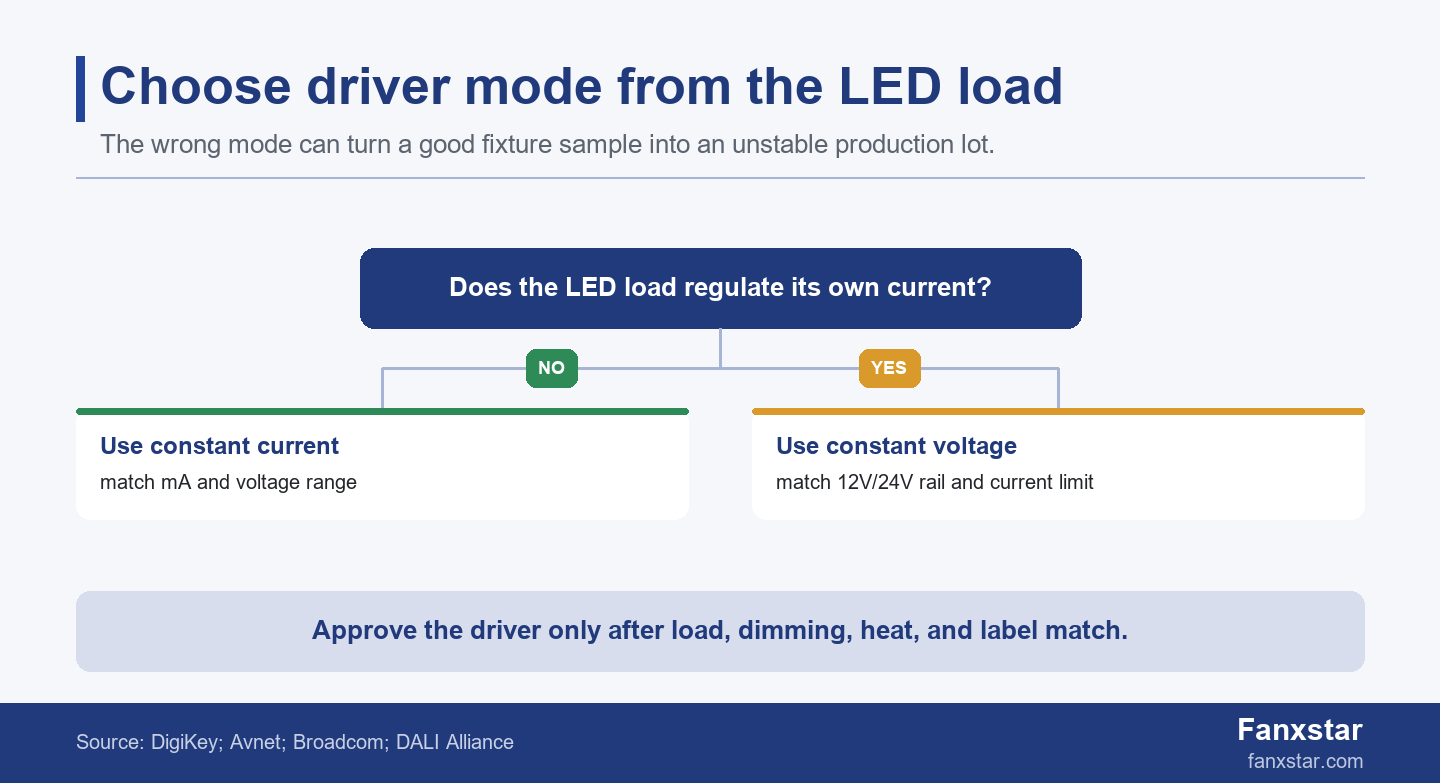
The constant-current versus constant-voltage decision should start from the LED load and production evidence, not from the cheapest driver label. A driver is not approved because it turns on the sample. It is approved when the LED load, output range, dimming behavior, heat, label, and production replacement rule all match.
According to DigiKey driver selection guidance, constant-current versus constant-voltage driver choice should follow the application need rather than a universal preference. That 2-part distinction is the buyer’s first filter before comparing price or lead time.
Key Takeaways
- Use constant current when the LED load needs regulated current and does not already control current internally.
- Use constant voltage when the load expects a fixed DC rail such as 12 V or 24 V and controls current at the strip or module level.
- The RFQ should state output current or voltage, power, dimming method, environment, driver location, label needs, and replacement rule.
- For Fanxstar ODM fixtures, driver choice should be frozen with the LED board, diffuser, thermal structure, waterproofing, and certification file.
The Simple Difference Buyers Need First
Constant current controls current and lets voltage vary within range
DigiKey constant-current versus constant-voltage guidance explains the driver decision around the application need rather than a universal winner. In practical lighting terms, constant-current logic is common for fixture modules where LED current determines brightness, heat, color stability, and lifetime risk. The buyer should check the mA rating and the allowed voltage range, not only the wattage.
According to Broadcom high-brightness LED driver guidance, current-sense feedback is part of controlled high-brightness LED driving. That matters because an LED array can be damaged or unstable when the driver mode does not match the load. A 700 mA module is not the same buyer problem as a 24 V strip.
Constant voltage controls voltage and leaves current limiting to the load
Avnet describes a constant-voltage LED driver as delivering a regulated output voltage across load conditions up to a maximum current limit. That is why constant-voltage supplies appear in strip, signage, channel, and modular systems where the LED product has its own current-limiting design.
The buyer mistake is treating 24 V as automatically safer or easier. A constant-voltage system still needs current capacity, voltage drop planning, wire length control, dimming compatibility, thermal checks, and protection against overloading. It is easier to extend a strip system, but easier extension is not the same as a finished fixture evidence file.
How to Choose Between CC and CV in an RFQ
Start from the LED load, not the driver catalog
| Load condition | Usually points to | Evidence to request |
|---|---|---|
| Bare LED board or fixed LED array | Constant current | mA rating, output voltage range, thermal test |
| LED strip or module with current regulation | Constant voltage | 12 V or 24 V rail, current limit, wiring length |
| Programmable fixture platform | Driver family review | programming file, dimming curve, sample setting |
| Outdoor or waterproof product | Environmental driver match | IP rating, surge, thermal, cable entry |
The most useful first question is whether the LED assembly regulates its own current. If it does not, the driver must do that job. If it does, the driver may provide a fixed voltage rail. The buyer should then move to secondary questions: dimming method, surge protection, ambient temperature, lifetime rating, mounting location, IP rating, and replacement availability.
According to DigiKey selection guidance, driver selection can include input voltage, output voltage and current, total power output, and dimming features. Those variables should be written into the RFQ before the supplier quotes. A low-priced driver is not comparable if one quote includes DALI dimming, surge protection, and waterproof rating while the other does not.
Use the label as evidence, then verify the sample
According to MEAN WELL product series data, LED driver families can include 12 V, 24 V, 36 V, 48 V, and 54 V constant-voltage options as well as current outputs such as 350 mA, 700 mA, and 1400 mA. That range shows why the driver label must be read against the load design, not treated as a generic box.
A buyer should request label photos before production: input range, output mode, output current or voltage, power limit, dimming method, certification marks, model number, temperature rating, and wiring diagram. Then the sample should run at the intended output, ambient condition, dimming level, and enclosure condition. A driver that passes on an open bench may fail inside a sealed fixture.
Where Driver Choice Affects Fanxstar ODM Fixtures
The driver interacts with heat, optics, and waterproofing
Driver selection changes more than electrical input. In a weatherproof LED lighting or vapor tight LED fixture, the driver location affects heat, cable entry, gasket pressure, service access, and certification evidence. In a linear fixture, driver choice can affect flicker, dimming smoothness, CCT stability, and emergency backup compatibility.
According to DALI systems guidance, DALI bus planning has device and power limits. That means a driver decision can also become a controls decision. If the buyer asks for DALI, 0-10 V, Triac, sensor dimming, or emergency mode after sample approval, the supplier may need to reopen the driver, wiring, label, and test file.
Freeze driver changes before production evidence is signed
Fanxstar buyers should treat driver changes as evidence changes. A different brand, output current, dimming type, surge rating, temperature rating, or cable exit can change performance and documentation. The production release file should include final driver model, LED board, diffuser, housing, label, wiring diagram, and inspection checklist.
If the project needs a driver change, send the load type, target output, dimming requirement, target market, installation environment, and sample test result through Fanxstar customization. The useful deliverable is a platform recommendation and a driver-evidence checklist, not a generic ‘CC or CV’ answer.
Procurement Mistakes That Create Driver Failures
Do not compare driver quotes without a load map
The strongest buyer insight is that CC versus CV is not a vocabulary test; it is a load-map decision. A quote that says 40 W driver is not comparable unless the buyer can see output mode, output current or voltage, operating range, dimming method, thermal rating, and whether the LED load has its own current regulation. Two drivers can both run one bench sample and still create different production risk.
According to Avnet LED driver guidance, constant-voltage drivers continue to supply output voltage up to a maximum current limit. That statement is useful because it reminds buyers that the load still decides current behavior. If a strip, module, or custom board does not manage current correctly, the power supply label cannot protect the system by itself.
Watch for dimming and emergency conflicts
Driver mode is often selected before the buyer finalizes dimming, sensor, and emergency requirements. That sequence creates risk. A constant-current driver may support one dimming protocol but not another; a constant-voltage supply may work with a strip system but complicate emergency backup or sensor zoning. If the order later adds DALI, 0-10 V, Triac, emergency output, or corridor dimming, the original driver evidence may no longer describe the final fixture.
According to DALI systems guidance, DALI planning includes bus power and device-count limits. That means the driver decision can pull the buyer into a controls decision. The RFQ should state whether the driver must only power the LEDs, communicate with a control bus, support sensor behavior, report diagnostics, or preserve emergency route behavior after power loss.
Separate sample success from production repeatability
A sample that lights up once is not a released driver decision. Production repeatability requires a frozen driver model, output setting, wiring diagram, thermal result, label, replacement rule, and inspection method. This is where many B2B orders lose consistency: the first sample used one driver, production substituted another, and the buyer only notices when dimming, flicker, brightness, or heat changes after installation.
According to Broadcom high-brightness LED driver guidance, high-brightness LED drive design uses feedback around current control. In buyer language, that means the output behavior needs engineering evidence, not just a working photo. A factory should be able to show how the selected driver keeps the LED load within its intended electrical and thermal boundary.
Replacement and Warranty Rules for LED Drivers
A replacement driver must match more than wattage
A common maintenance mistake is to replace a failed driver with any unit that has similar wattage. For LED fixtures, wattage is only one field. The replacement should match output mode, current or voltage range, dimming method, physical size, wiring layout, case temperature limit, ingress or enclosure condition, certification scope, and label requirements. If those fields differ, the fixture may still turn on while no longer matching its approved evidence file.
According to DigiKey product selection guidance, driver selection uses input voltage, output voltage and current, overall power output, and dimming features. Those fields are also replacement fields. A maintenance team that stores them in the handover file can avoid emergency substitutions that create flicker, overheating, uneven output, or warranty disputes.
Write the substitution rule before mass production
A good ODM release file says whether the driver brand and model are locked, whether equivalent substitution is allowed, who approves a substitute, and which tests must be repeated. The rule should be stricter for waterproof, emergency, sensor, high-temperature, or export-market fixtures because the driver interacts with enclosure heat, cable entry, labels, certification, and inspection records.
Fanxstar buyers can make this practical by asking for a driver change statement at three moments: before sample approval, before production start, and before shipment if a component shortage forces a substitution. The statement should name the old driver, new driver, changed electrical fields, changed mechanical fields, and whether the sample or report evidence needs to be updated. This small document prevents many later arguments.
Sample Tests Before Approval
Run electrical and visual checks together
A proper sample check records input voltage, output mode, output current or voltage, driver case temperature, LED board temperature, output at low and high dimming, flicker observation, audible noise, startup behavior, and failure behavior after a power interruption. For waterproof or industrial fixtures, add enclosure temperature and cable-entry checks.
According to DLC technical requirements, LED product qualification depends on product category and performance evidence. Even if the project is not on a DLC path, the habit is valuable: link the driver to the tested product version. A sample approval that cannot name the driver is not ready for repeat production.
Use a replacement rule for maintenance
The final order should state whether the driver can be substituted later and what evidence is needed if it changes. A maintenance team needs a replacement driver that matches output mode, output range, dimming behavior, size, wire layout, thermal conditions, and certification scope. Without that rule, a cheap replacement can create uneven light, overheating, flicker, or a label mismatch.
The buyer does not need to overengineer every fixture. A simple LED strip system may only need a clean 24 V supply and current capacity. A sealed industrial luminaire, emergency fixture, tunnel light, or data-center corridor product needs a stronger file because the driver affects reliability, control, and compliance evidence.
FAQ
Is constant current better than constant voltage?
Constant current is not universally better than constant voltage because the correct choice depends on the LED load. Constant current is usually right when the LED load needs a fixed current and the driver must regulate it. Constant voltage is usually right when the LED strip or module expects a fixed voltage and has current regulation built in.
Can I replace a constant-current driver with a constant-voltage driver?
A buyer usually should not replace a constant-current driver with a constant-voltage driver unless the LED load and fixture design are changed to match. A constant-current LED array expects current regulation from the driver, while a constant-voltage system expects current control elsewhere. Replacing one with the other can create overheating, flicker, failure, or unsafe operation.
What driver data should be in a B2B lighting RFQ?
A B2B lighting RFQ should include input voltage, output mode, output current or voltage, output power, dimming method, control protocol, ambient temperature, driver location, IP or enclosure need, certification market, label requirements, and replacement rules. Those fields let suppliers quote the same product rather than different driver assumptions.
When should Fanxstar review driver selection?
Fanxstar should review driver selection when a fixture involves ODM changes, waterproof housing, emergency backup, sensor control, DALI or 0-10 V dimming, high ambient temperature, or a target-market certification file. Send the LED load, application, target market, sample goal, and preferred control method before production release.