UGR is a project-context glare estimate, so a buyer should not treat a low-UGR product label as proof that the installed space will feel visually comfortable. The practical buyer question is not only what UGR means. It is whether the supplier can show how the fixture, layout, observer direction, room surface, and calculation method produce the claimed glare result.
CIE 117-1995 page on discomfort glare explains that the UGR formula recognizes observer position and direction of view. DLC UGR glossary describes UGR as a CIE-recommended discomfort-glare likelihood assessment method. Those two facts make the first rule clear: UGR belongs to a lighting installation context, not just a sticker on a luminaire.
Key Takeaways
- UGR estimates discomfort glare for indoor lighting; lower values generally indicate lower predicted discomfort under the modeled conditions.
- A catalog UGR claim should be treated as a screening signal until the buyer sees the photometric file, room assumptions, observer view, and calculation method.
- UGR is most useful for indoor visual comfort decisions, but it does not replace glare, contrast, flicker, uniformity, task, or sample review.
- LED luminaires with small bright sources can create high luminance contrast, so diffuser, lens, mounting height, and luminous area matter.
- Fanxstar buyers should define the target task and environment before asking for custom optics or low-glare diffuser changes.
What UGR Measures and What It Does Not Measure
UGR is about predicted discomfort glare, not overall lighting quality
According to DLC Understanding Unified Glare Rating resource, the resource explains why UGR is required for Premium qualification and how DLC evaluates UGR. The reason this matters to buyers is that UGR has become a useful shorthand in LED purchasing, but shorthand can become misleading when it is separated from the calculation context.
UGR is not a complete lighting-quality score. It does not by itself prove correct task illuminance, low flicker, good color rendering, safe emergency lighting, low reflected glare, or a comfortable work environment. It answers a narrower question: under specified calculation conditions, how much discomfort glare is predicted from the luminaires in the visual field?
According to EN 12464-1 overview, workplace lighting requirements are framed around humans in indoor workplaces. That is the right framing. UGR is one piece of a workplace lighting decision, not a replacement for task, contrast, uniformity, wall brightness, ceiling brightness, controls, or field review.
A low value is only meaningful when the assumptions are visible
A buyer should ask what the UGR value is based on. Was it a standard UGR table? A project-specific software calculation? A manufacturer data sheet? A generic product claim? Does it assume a certain room size, reflectance, mounting height, luminaire spacing, observer direction, and number of fixtures? If those assumptions are missing, the UGR number is too loose for procurement approval.
The danger is false precision. A supplier can say the fixture is low UGR, but if the buyer changes mounting height, spacing, diffuser, LED board, output package, or room surface, the result can change. The value becomes stronger when the same product, same layout, and same optical configuration appear in the calculation and sample file.
Why LED Fixtures Make UGR Claims Easy to Misread
High luminance contrast can matter more than fixture wattage
According to CIE report on non-uniform source luminance, UGR was developed in 1995 and LED designs can create high luminance contrasts that challenge average-source-luminance assumptions. That is a useful warning for modern buyers. A compact LED source behind a clear or poorly diffused optic can feel harsh even when the fixture wattage is moderate.
The buyer should therefore examine the visible luminous area and optical system. A larger luminous area, better diffuser, lens, louver, indirect component, or controlled beam can reduce perceived glare, but each option also affects efficiency, cost, cleaning, IP rating, dust collection, and fixture depth. Low glare is not free; it is a design trade-off that should be visible in the sample and datasheet.
According to DLC SSL V5.0 and V5.1 definitions, the practical UGR range is from 10 to 30 for most lighting systems. This means the buyer can use the number as a directional screening tool, but the decision rule is to compare it with the application target and modeled room rather than reading it as a universal comfort guarantee.
The phrase UGR below 19 is not a universal promise
| UGR claim | What it can mean | Buyer evidence to request |
|---|---|---|
| UGR below 19 | A design or table result under defined conditions, often used for office-style glare control. | Room layout, observer position, photometric file, luminous area, and calculation method. |
| Low-glare diffuser | The optical component reduces source brightness or spreads light. | Sample photos, luminance data where available, and comparison with final LED board. |
| Anti-glare lens | Lens geometry controls high-angle brightness. | IES file, beam distribution, sample view from real mounting height. |
| Comfortable lighting | A broader outcome involving glare, flicker, contrast, uniformity, CCT, and task need. | Mockup, calculation, control settings, and user task review. |
Many buyers search for UGR below 19 because the number is widely associated with office visual comfort. The problem is that an office desk, a cleanroom corridor, a retail backroom, a warehouse aisle, and a parking service area do not have the same visual task. Some spaces may need stricter glare control; others may prioritize impact resistance, washdown, emergency route visibility, or high mounting height.
A useful supplier answer sounds like this: under these room dimensions, reflectance assumptions, mounting height, spacing, and observer directions, the calculation produces the stated result. A weak answer sounds like this: the product is low UGR because the catalog says so. The difference is not wording. It is whether the buyer can reproduce or verify the claim.
How to Evaluate Low-Glare LED Lighting Evidence
Move from label to layout before approval
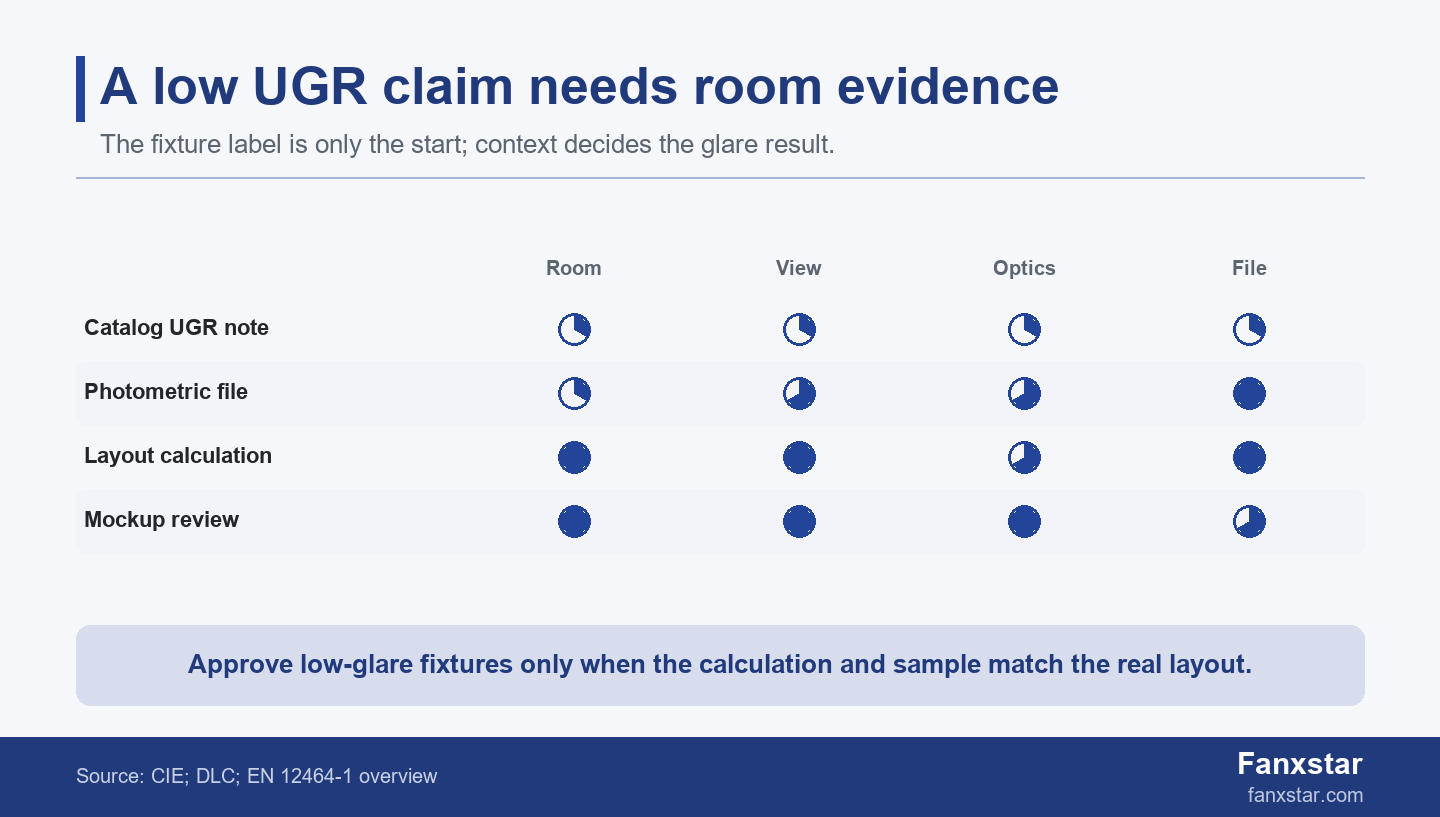
A buyer can use a four-step evidence ladder. First, read the catalog or datasheet claim. Second, request the photometric file and optical configuration. Third, ask for a layout calculation using the real room and mounting height. Fourth, review a sample or mockup from the likely viewing direction. Each step removes a different uncertainty.
According to DLC UGR resource, evaluation can include luminous-area modeling. This is especially relevant when the luminaire has visible LED points, small apertures, aggressive lenses, or a narrow distribution. The claim becomes stronger when the luminous area and optics used in the calculation match the fixture that will be shipped.
According to CIE 190:2010 UGR tables page, the report covers calculation and presentation of UGR tables for indoor lighting luminaires. In practice, that gives buyers a second question after reading a low-UGR claim: was the value taken from a standard table, a product file, or a project-specific calculation?
Check glare controls against the rest of the fixture design
Low-glare optics can affect other requirements. A deeper louver may reduce high-angle brightness but collect dust in a food or industrial environment. A heavy diffuser may reduce glare but also reduce output and change thermal behavior. A narrow beam may protect one viewing direction but create contrast bands at the floor. A control setting may reduce glare at full output but fail when the system is dimmed or scheduled incorrectly.
For this reason, the buyer should not approve low-glare design in isolation. The release file should connect UGR or glare evidence with lumen output, power, CCT, CRI, beam angle, diffuser material, IP rating, cleaning exposure, thermal file, and installation height. A visually comfortable fixture that fails the environment is still the wrong fixture.
Where UGR Fits in Industrial, Commercial, and Specialty Lighting
Office-style UGR thinking does not transfer cleanly to every site
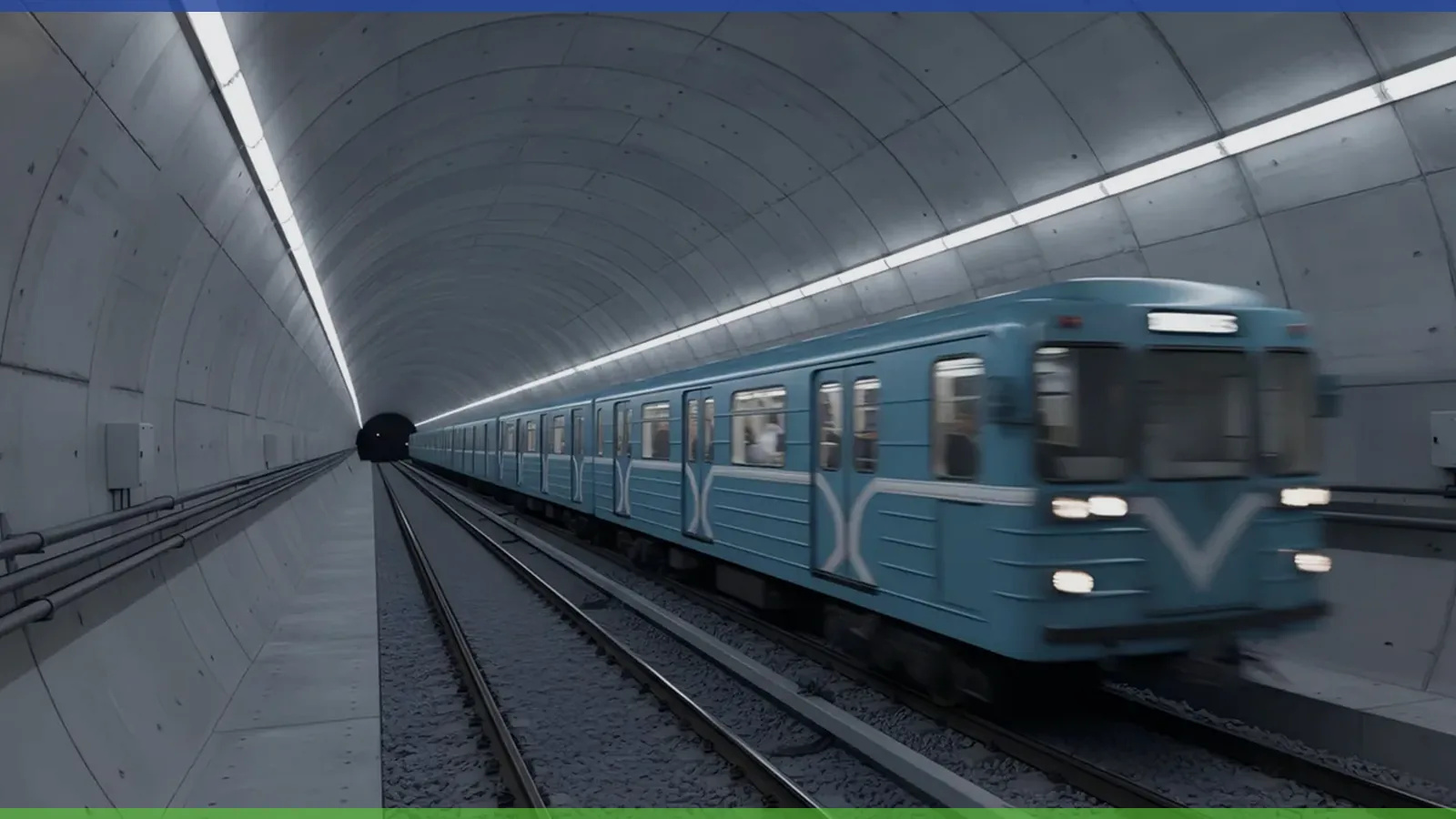
UGR is most commonly discussed in indoor workplace and office-style applications, but Fanxstar buyers often work in harsher settings: food processing, damp corridors, data center service routes, cold storage, parking structures, tunnels, and industrial backrooms. In those spaces, visual comfort still matters, but it competes with washdown, low temperature, emergency visibility, sensor zones, impact risk, and service access.
According to DLC solid-state lighting requirements page, product categories and technical requirements organize commercial LED evidence. A low-glare panel, a waterproof downlight, a vapor-tight linear fixture, and an emergency batten may require different evidence files. The buyer should define whether UGR is the primary acceptance criterion or a supporting comfort metric beside safety and application fit.
Use mockups when occupant experience is a project risk
Some glare problems are obvious only when a person stands in the real space. A data center corridor may look fine on a plan but feel harsh at the technician’s eye level. A supermarket backroom may pass average illuminance but create reflection on packaging. A cleanroom or food washdown area may need a sealed diffuser that changes the visual feel. A mockup helps catch these issues before production.
The mockup should not be a beauty test only. Record mounting height, spacing, wall and ceiling finish, dimming level, observer position, and product version. If the sample uses a temporary driver, open housing, or different diffuser, it is not the same glare evidence as the production fixture. The buyer should ask what will remain identical in the mass-production build.
Fanxstar RFQ Language for Low-Glare LED Projects
Define the task and optic change before asking for a UGR number
Fanxstar can discuss low-glare requirements when the buyer names the real task: office-like work, service corridor, data hall, food preparation, retail backroom, parking route, or cleanroom support. Relevant starting points include LED linear lighting platforms, waterproof LED downlights, vapor tight LED light fixtures, and custom LED lighting ODM service.
The RFQ should include target UGR or glare limit if specified, mounting height, fixture spacing, observer direction, ceiling and wall reflectance, target lux, CCT, diffuser preference, cleaning exposure, IP need, and whether a sample review is required. That information lets Fanxstar compare diffuser, lens, housing, and output choices without pretending that one low-glare label solves every application.
Keep low-glare customization inside the evidence boundary
If the buyer changes diffuser material, lens pattern, LED board, wattage setting, driver, housing, or mounting accessory, the glare evidence may need review. A fixture can keep the same external shape while changing the luminous area or luminance distribution. That is why optical customization should be treated as a technical change, not only a style preference.
For a project that also needs controls or sensors, use LED lighting controls for industrial facilities to frame dimming, occupancy zones, and daylight response. Glare can improve or worsen under control settings. A low-glare fixture at full output may still need scenes, commissioning, or sensor logic to stay comfortable across shifts and tasks. This means UGR belongs in the commissioning file as well as the luminaire file when a buyer expects dimmed or sensor-led operation.
FAQ
What does UGR mean in LED lighting?
UGR means Unified Glare Rating, a method for estimating discomfort glare from an indoor lighting installation. It considers factors such as luminance, background, observer position, and view direction, so the value depends on both the fixture and the modeled room context rather than the product name alone.
Is a UGR below 19 always required?
A UGR below 19 is not always required because the correct target depends on the application, standard, specification, and task. It is often discussed for office-type visual comfort, but buyers should not copy one number across warehouses, cleanrooms, retail spaces, and service corridors without checking the project requirement.
Can a luminaire have a fixed UGR rating?
A luminaire can have UGR table data or a catalog claim, but the installed result still depends on room size, reflectance, mounting height, spacing, observer direction, and product configuration. Treat the catalog number as screening evidence, then ask for layout calculation and sample review before approval.
What should Fanxstar review for a low-glare sample?
Fanxstar should review the task, mounting height, spacing, target illuminance, diffuser or lens choice, CCT, IP requirement, cleaning exposure, control strategy, and sample viewing direction. Optical changes should be checked before production because they can affect output, glare, thermal behavior, and certification evidence.