Lighting spectrum can influence poultry egg production, but it works only inside a complete lighting program where photoperiod, intensity, uniformity, dimming, fixture durability, and flock management are already controlled. The most costly lighting-spectrum mistake is to treat color as a magic input. Egg production responds first to a stable light program; spectrum, Kelvin, and red content matter only when the flock receives the right hours, intensity, uniformity, dimming transition, feed, health, and environment.
According to University of Minnesota Extension, hens need at least 12 to 14 hours of light each day to continue laying eggs. According to Penn State Extension, mature laying hens should be managed around a 16-hour light day for winter egg-production support. Those numbers explain why a buyer should define the lighting program before comparing fixture spectrum claims.
For commercial farms, poultry specialists and veterinarians should set flock-management targets. A lighting supplier can help with spectrum, optics, fixture durability, dimming, mounting, and sample testing, but lighting cannot compensate for poor nutrition, disease pressure, ventilation, heat stress, or incorrect flock age management.
Key Takeaways
- Photoperiod is the first production lever: many layer programs work around 14 to 16 hours of light after sexual maturity, depending on breed, housing, and management advice.
- Red-rich or warm-spectrum lighting can support the laying phase, but Kelvin and CRI alone do not prove poultry-relevant spectral output.
- Uniformity and dimming matter because sudden darkness, glare, and patchy light can create stress and uneven bird behavior.
- Poultry fixtures need durability evidence for dust, ammonia, corrosion, cleaning, and maintenance access, not only a spectrum label.
- Fanxstar’s practical role is ODM lighting adaptation: spectrum target, waterproof or sealed housing, wiring, dimming, sensor integration, sample evidence, and application fit.
Spectrum Works Inside the Photoperiod Program
Day length is the control frame for egg production
According to University of Minnesota cold-weather poultry guidance, chickens should have about 14 hours of light daily for optimal egg production in winter conditions. According to Hy-Line Understanding Poultry Lighting, 16 hours is the standard light level for maximum production in its commercial layer lighting discussion. The useful buyer range is therefore not one universal number; it is a managed program by age, breed, housing, season, and production goal.
Spectrum becomes meaningful after that program is stable. If the farm has 10 hours of light one week, 15 hours the next, evening lights that shut off suddenly, or dark rows near feeders, a warmer lamp cannot solve the underlying inconsistency. The first procurement task is to ask whether the site can control time, intensity, transitions, and coverage.
This is also why a lighting quote should include a layout and control plan, not only fixture wattage. The buyer needs to know where the light is measured, when it turns on, how it dims, and whether birds experience abrupt transitions. The biological signal is a daily pattern, not a product brochure.
A practical synthesis from these sources is that the most useful pre-purchase metric is not the advertised spectrum alone. It is whether the farm can keep the intended program within a narrow daily window for weeks at a time. A fixture with a good red-rich spectrum but poor timer integration, uneven beam spread, or unreliable dimming can create less predictable production conditions than a simpler fixture installed in a measured, stable program. For that reason, the sample approval record should include timer settings, dimming curve, mounting height, measurement points, and photos of dark areas before a farm-wide rollout.
Spectrum should be described as red-rich evidence, not a vague color name
According to Hy-Line W-36 management guidance, laying flocks use warm lights in the 2700 to 3500 K range to ensure sufficient red spectrum light. According to Hy-Line cage-free Leghorn guidance, all laying hens need sufficient red spectrum to achieve optimal performance and the ideal warm color temperature is 2700 to 3000 K. These are practical signals, but the buyer should not reduce the entire decision to Kelvin.
Kelvin is a human-visible color appearance metric. It does not fully show the spectral peak or the distribution of red, green, and blue energy reaching the bird. A fixture can be labelled warm and still have poor poultry layout, poor dimming, poor sealing, or poor uniformity. Request spectral data when spectrum is a selling point, and measure bird-level light after installation.
Why Red-Rich Light Can Help and Where Claims Go Too Far
Red spectrum supports the reproductive signal, but it is not the whole production system
In layer lighting, red-rich light is often used because longer wavelengths are associated with reproductive stimulation. The buyer should use that insight carefully. Egg output is also affected by genetics, age, feed, body weight, disease, temperature, stocking density, ventilation, stress, and the shift from pullet rearing to laying. A spectrum upgrade cannot override those constraints.
According to SARE project records, research work has investigated artificial lighting to increase photoperiod length for pasture-raised laying hens. That framing is important because the project focus is photoperiod length, not a single lamp color. Commercial lighting decisions should therefore combine day length and spectrum instead of treating them as substitutes.
A strong claim is measurable: the farm defined the light schedule, measured intensity, selected a red-rich lay-phase spectrum, controlled dimming, and tracked egg production against flock records. A weak claim is decorative: the supplier says red light increases eggs without showing how the product fits the flock program and building layout.
Overlighting can create a welfare and behavior problem
More light is not always better. Long light periods, high intensity, glare, or sudden transitions can increase stress and behavior problems. The buyer should not ask for maximum brightness. Ask for the right level at bird height, uniform coverage, controlled dimming, and a program that aligns with flock age and breed guidance.
According to Penn State Extension winter lighting guidance, mature laying hens are managed toward 16 hours of light per day for winter production support. That number should be used as a managed target, not an invitation to leave lights on continuously. The buyer should confirm the program with poultry management professionals.
| Decision signal | Buyer implication |
|---|---|
| 14-16 hours | Common layer programs use a controlled day length rather than random supplemental light. |
| 2700-3500 K | Warm lay-phase lighting is a practical proxy, but spectral data is stronger. |
| 1 layout survey | Bird-level lux and dark zones matter as much as fixture wattage. |
| 0 abrupt shutoffs | Dimming and morning light planning reduce avoidable stress. |
| 5 site risks | Dust, ammonia, corrosion, washdown, and access affect fixture reliability. |
| 1 sample test | Confirm spectrum, dimming, sealing, and mounting before farm-wide rollout. |
Fixture Design Matters as Much as Spectrum
Bird-level light is a layout problem
A poultry house is not a clean showroom. Fixtures hang above birds, feed lines, litter, dust, humid air, cleaning equipment, and sometimes corrosive atmospheres. If a product creates bright strips near the mounting line and dark areas along feeders, the farm may see uneven bird behavior even when the lamp spectrum looks appropriate on paper.
Buyers should request a lighting layout that includes mounting height, fixture spacing, beam angle, dimming plan, bird-level measurement points, and maintenance access. If the house has cages, aviaries, tiers, or open-sided sections, the measurement plan should reflect those conditions. A single lux reading at the center of the building is not enough.
| Lighting variable | Useful buyer question | Common mistake |
|---|---|---|
| Photoperiod | How many light hours are required for this flock age and housing type? | Buying a red lamp while day length is unstable. |
| Spectrum | Is the lay phase receiving enough warm red-rich light? | Using Kelvin as the only spectrum proof. |
| Intensity | What lux is measured at bird level and feeder level? | Reading one point near the lamp and ignoring dark zones. |
| Uniformity | Are bright and dark patches causing behavior or production variation? | Spacing fixtures by habit instead of measurement. |
| Durability | Can the fixture survive dust, ammonia, cleaning, corrosion, and service access? | Treating poultry lighting as ordinary indoor lighting. |
Durability protects the lighting program from drift
Spectrum and intensity drift when fixtures age, lenses get dirty, seals fail, drivers run hot, or cleaning chemicals attack materials. Poultry buyers should ask how the luminaire handles dust, ammonia, humidity, corrosion, pressure washing if used, and cleaning intervals. A fixture that is difficult to clean or service can slowly become a different light source than the one originally specified.
Fanxstar’s relevant product starting points include specialty LED grow lights, vertical farming LED lights, and sealed platforms such as weatherproof LED lighting product platform. For poultry-like custom projects, the practical discussion should center on spectrum target, lens, sealing, corrosion resistance, wiring, mounting, dimming, and sample evidence rather than a generic grow-light label.
This keeps the business fit honest. Fanxstar should not claim to solve poultry nutrition or flock management. The credible value is custom specialty lighting hardware that helps the farm implement a professionally defined lighting program.
How to Specify Poultry Lighting for Egg Production
Write the RFQ around the flock program
The RFQ should state bird type, flock age, housing type, target photoperiod, desired warm-spectrum range, intensity target at bird level, dimming schedule, mounting height, cleaning method, ambient temperature, corrosion exposure, voltage, cable entry, and maintenance access. If the farm uses a consultant or breed-specific management guide, include the relevant target page or schedule.
According to Hy-Line Understanding Poultry Lighting, Kelvin and CRI do not express the spectral peak intensity in red, green, and blue spectra that are important for poultry growth and production. This is a useful RFQ warning. Ask for spectral evidence when spectrum is a deciding claim, and ask for layout evidence when production uniformity is the deciding claim.
If a supplier cannot explain how the fixture will be dimmed, measured, cleaned, and serviced, the quote is not ready. If it can provide a small sample zone with measured light levels and a practical maintenance plan, the buyer has a better basis for farm-wide procurement.
Use a sample zone before changing the whole house
A sample zone reduces risk because poultry lighting changes can affect behavior and production. Choose a representative row or area, install the proposed fixtures, verify dimming, measure bird-level light, watch dark-zone behavior, and compare output data with a control area where possible. Keep the trial long enough to account for flock age and daily variability.
Use Fanxstar custom LED lighting ODM service when the project needs spectrum adaptation, sealed housing, lens changes, wiring, mounting, dimming, or sample support. The sample file should include photos, product specification, spectral target, control setting, measured lux map, and maintenance notes. That file is more valuable than a simple claim that a color increases egg production.
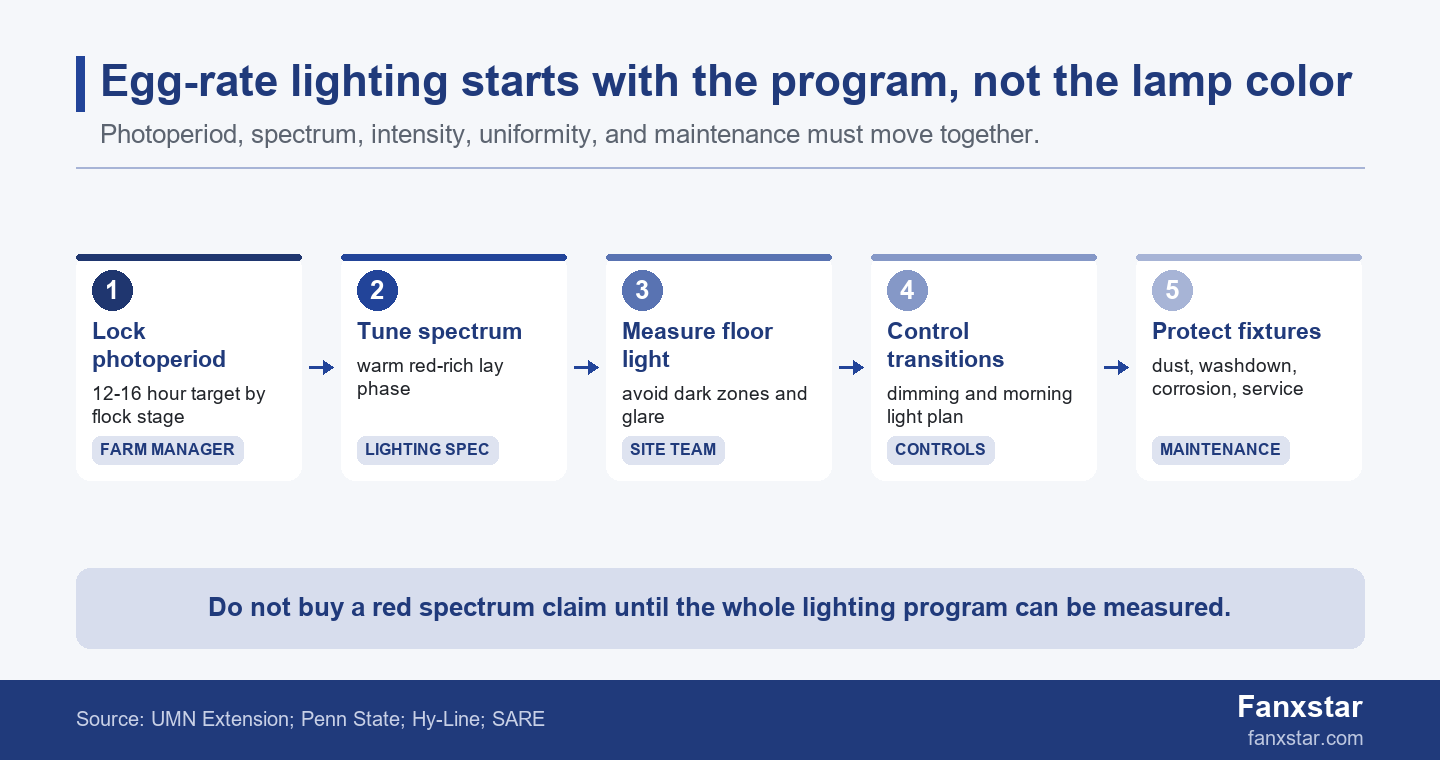
The decision rule is practical: lock the photoperiod, prove the spectrum, measure the light, control the transition, and protect the fixture. When those five checks are in place, spectrum can become a useful tool instead of a fragile promise.
FAQ
What light spectrum is best for laying hens?
Warm, red-rich light is commonly recommended for the laying phase, often around 2700 to 3500 K depending on breed guidance and housing. Buyers should still request spectral data, bird-level intensity, uniformity checks, and dimming behavior because Kelvin alone does not prove a poultry lighting program.
How many hours of light do hens need for egg production?
Many layer programs use about 14 to 16 hours of light after maturity, but the exact program depends on breed, age, season, and housing. Do not increase light suddenly without poultry-management advice. Stable timing and smooth transitions are as important as the fixture itself.
Can red light increase egg production by itself?
No single color guarantees higher egg output. Red-rich light can support the reproductive lighting signal, but egg production also depends on photoperiod, nutrition, genetics, health, temperature, stress, and flock age. Treat red spectrum as one part of a measured program.
Can Fanxstar make poultry lighting fixtures?
Fanxstar can discuss custom specialty lighting hardware, including spectrum target, sealed housing, wiring, mounting, dimming, and sample evidence. Poultry production targets should come from flock-management professionals, while Fanxstar’s role is to help translate those targets into a reliable lighting product configuration.