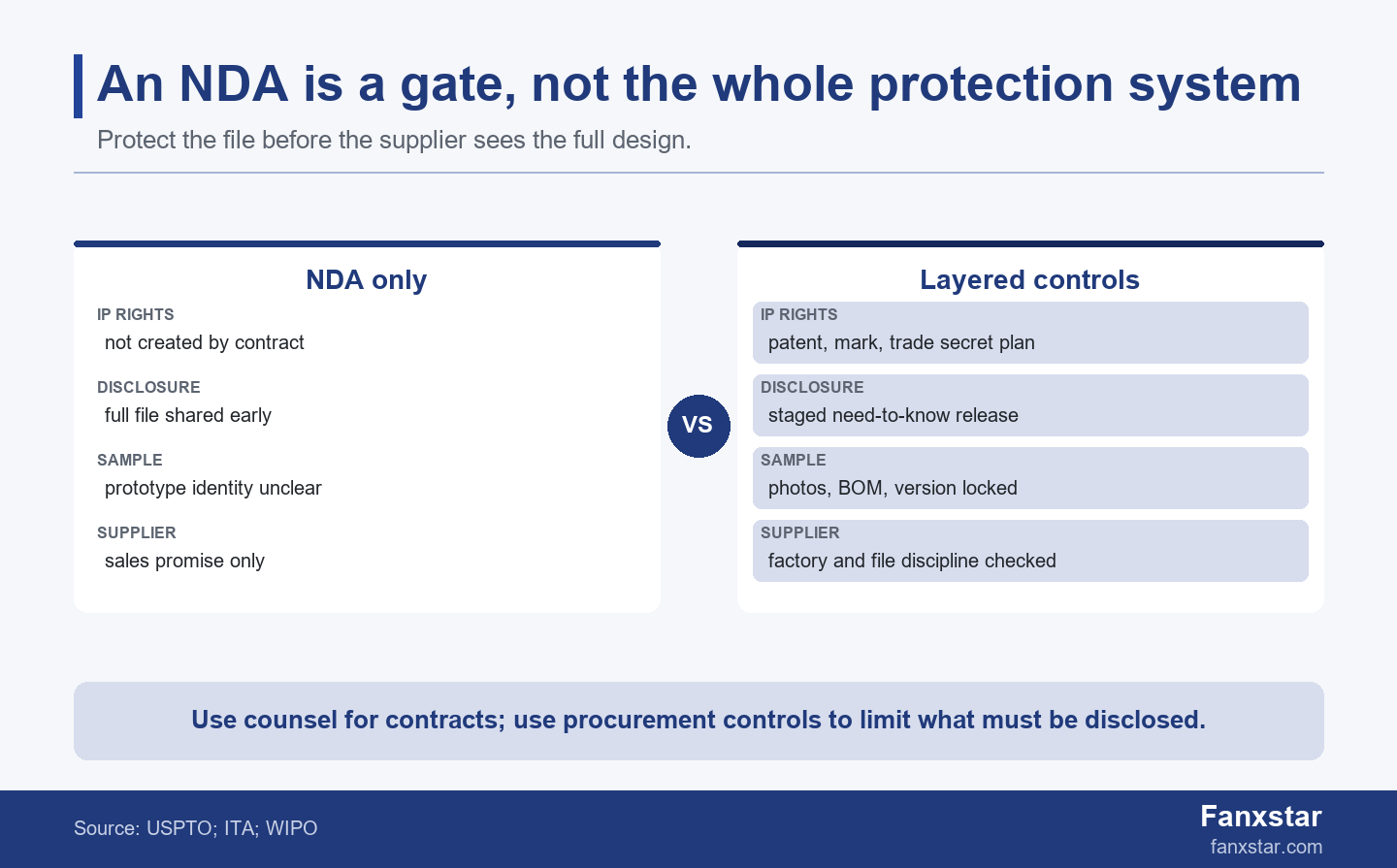
A China NDA helps only when it is part of a layered protection plan: registered rights where possible, trade-secret discipline, staged disclosure, supplier due diligence, and a sample file that proves exactly what was shared. The practical mistake is believing that a signed NDA makes an unregistered design, complete drawing package, supplier conversation, and sample trail safe by itself. A better approach is to decide what can be protected legally, what should remain secret, and what must be disclosed only after the supplier has earned the next stage.
USPTO China IPR Toolkit advises rights holders to create a basket of IP rights, including patents, trade secrets, trademarks, and copyrights. International Trade Administration China IP guidance points companies to USPTO China IP resources and China IP attaches. That outside guidance supports a simple buyer rule: do not make an NDA carry the whole protection burden.
Key Takeaways
- An NDA is useful for confidential discussions, but product designs usually need a broader protection plan before drawings, BOMs, molds, or sample details are shared.
- For China sourcing, many buyers discuss NNN-style terms with counsel because non-use and non-circumvention risks can matter as much as simple nondisclosure.
- Trade-secret value depends on secrecy discipline, so buyers should stage disclosure and keep a record of what each supplier received.
- Fanxstar custom LED lighting projects work best when the buyer shares enough constraints for engineering feasibility without releasing unrelated design know-how.
- Qualified counsel should review contract language, jurisdiction, and enforcement strategy before the buyer relies on an NDA or NNN document.
Why an NDA Alone Is Not Enough for Product Designs
A contract controls behavior; it does not create every IP right
WIPO trade secret guidance explains trade secrets as IP rights on confidential information. That idea is important because confidentiality has to be preserved in practice. If the buyer circulates the full design package to every quoting supplier, saves files in uncontrolled channels, or fails to mark revisions, the later dispute becomes harder to prove.
ITA protect intellectual property guidance advises companies to protect IP before entering foreign markets. The timing matters. A buyer who waits until after a sample leak, copycat listing, or distributor conflict has already lost leverage. Before contacting suppliers, decide what should be registered, what should remain secret, what can be shown, and what should be split across stages.
An NDA can be a useful gate. It can define confidential information, permitted use, return or destruction of documents, subcontractor restrictions, and dispute process. But it cannot substitute for patent filing deadlines, trademark strategy, trade-secret controls, supplier due diligence, or a clean sample record. If the design is commercially important, the document should sit inside a broader file.
NDA and NNN questions should go to counsel, not a sourcing checklist
Many China-focused buyers hear that an NNN agreement may be stronger than a basic NDA because non-use and non-circumvention risks can matter in manufacturing relationships. That may be true in some contexts, but the contract form, language, jurisdiction, enforceability, and remedies are legal questions. A lighting buyer should not copy a template from a search result and assume it solves the problem.
The procurement team can still do useful work before counsel is involved. It can define what information is sensitive, which supplier roles need access, whether subcontractors may see files, how samples will be identified, what design elements are standard, and what evidence is needed if a dispute occurs. Counsel can draft better terms when the business team has already mapped the disclosure risk.
The Protection Stack Before Sharing LED Lighting Designs
Use layers because each layer stops a different failure
| Protection layer | What it controls | Buyer action before sharing files |
|---|---|---|
| IP rights portfolio | patents, trademarks, copyrights, trade secrets where applicable | Ask counsel which rights can be registered or documented before supplier disclosure. |
| NDA or NNN agreement | confidentiality, use limits, non-circumvention, non-use, jurisdiction choices | Use local counsel and do not rely on a generic one-page template. |
| Staged disclosure | how much design detail each supplier sees | Share function and constraints first; release drawings only when the supplier passes screening. |
| Sample identity file | what was shared, built, changed, and approved | Record photos, BOM, drawing revision, labels, reports, and deviations. |
| Supplier due diligence | who receives the file and who can manufacture it | Check factory role, subcontracting, engineering access, and document control. |
According to USPTO China IPR Toolkit, a basket of IP rights can include patents, trade secrets, trademarks, and copyrights. In an ODM lighting project, that basket might translate into registered marks for the brand, patent or design strategy for protectable features, trade-secret discipline for process or optical details, and clear ownership terms for drawings and tooling. The NDA is only one layer in that basket.
The strongest buyer file names the asset before naming the supplier. A bracket design, diffuser texture, sensor placement, driver configuration, label artwork, mold file, or application drawing can have different protection value. Treating all of it as one confidential bundle encourages oversharing. Classify it, then share only what the stage requires.
Staged disclosure protects feasibility and speed at the same time
| Stage | File to share | File to hold back |
|---|---|---|
| Supplier screening | application, target market, performance goal, public product reference | core drawings, custom optics, tooling files, unique BOM |
| Feasibility review | limited dimensions, material targets, certification need, sample objective | full release package and final label artwork |
| Sample development | controlled drawing revision, critical dimensions, test criteria | future roadmap and unrelated product concepts |
| Production release | locked BOM, label, packing, inspection criteria | new model concepts not needed for this order |
Staged disclosure is not about distrusting every supplier. It is about giving each supplier the information needed for the current decision. Early screening may need application, dimensions, target market, performance goal, and photos of the installation environment. It does not always need the final tooling drawing or complete BOM. Feasibility review may need more detail, but still not every unrelated design file. A 4-stage disclosure plan creates a timeline: screening file, feasibility file, sample file, and production release file.
How This Applies to Custom LED Lighting ODM Projects
Lighting designs mix standard parts and sensitive choices
A custom LED lighting design often combines public and private elements. A linear housing shape may be common. The buyer’s specific optic, sensor position, emergency module layout, cable-entry method, mounting bracket, label, driver configuration, or application packaging may be more sensitive. The buyer should identify which parts are standard sourcing information and which parts create competitive advantage.
For Fanxstar-type work, use custom LED lighting ODM service after defining the design boundary. Share the application, target certification market, environment, target output, mounting, sensor or emergency need, and sample objective. Hold back unrelated future designs or final tooling files until the supplier has passed the right contract and technical gates.
A good ODM conversation does not require the buyer to hide everything. The supplier needs enough information to advise whether an existing platform can be adapted, whether no tooling fee is possible for eligible platform-based customization, and whether a 7-10 day sample target is realistic. The balance is to share constraints first and release the most sensitive detail only when the project stage requires it. A practical first package can stay under 10 pages when it focuses on application, dimensions, target market, sample goal, and non-sensitive performance limits.
Sample identity prevents later confusion
The sample file should record drawing revision, photos, BOM, diffuser, driver, LED board, housing, cable entry, label, packaging, test reports, and any deviation from the design target. This helps both sides. The buyer can prove what was shared and approved. The supplier can avoid accidental substitutions. The production team can reproduce the sample without relying on memory.
According to ITA import regulations guidance, imported products may face documentation, safety, quality, and conformity checks. That is not an NDA rule, but it supports the same discipline: the business file should be clear enough for manufacturing, import, and after-sales questions. Confidentiality and product evidence should not live in separate worlds.
Based on our analysis, a useful design-protection log should connect 1 sample unit, 1 drawing revision, 1 supplier contact owner, and 1 approval date before production. In a 30 days sample sprint, the buyer can also separate the 12 months product roadmap from the immediate build file, require a 48 hours approval window before any new disclosure, and keep a 3 years archive of what was shared if the design has long commercial value. These numbers are illustrative controls, not legal deadlines.
A practical disclosure-control estimate can be simple. Based on our analysis, 1 owner should approve every design package before it leaves the buyer’s team. Based on our analysis, 1 drawing revision should map to 1 sample identity. Based on our analysis, 30 days is a useful window for a controlled sample sprint. Based on our analysis, 48 hours is a realistic approval target before any new file is shared. Based on our analysis, 12 months of roadmap details should stay outside the first supplier package. Based on our analysis, 3 years of disclosure records can help reconstruct what was shared. Based on our analysis, 2 supplier tiers can separate full technical files from limited quoting files.
Use the estimate as a disclosure-control checklist. Based on our analysis of this scenario, 1 owner should approve every outgoing file package. Based on our analysis of this scenario, 1 drawing revision should map to 1 physical sample. Based on our analysis of this scenario, 30 days can frame the first sample sprint. Based on our analysis of this scenario, 48 hours is a practical approval window before new disclosure. Based on our analysis of this scenario, 12 months of roadmap detail should stay out of the first package. Based on our analysis of this scenario, 3 years of records can reconstruct disclosure history. Based on our analysis of this scenario, 2 supplier tiers can reduce unnecessary file exposure. Based on our analysis of this scenario, 1 approval date should be attached to each sample release.
Supplier Due Diligence Before the Design File Leaves Your Team
Check who will actually see the file
Before sending drawings, ask who receives the files, whether engineering is internal, whether subcontractors are used, where tooling is made, who owns sample photos, how file access is controlled, and whether the supplier can return or destroy files if the project stops. The answer may be different for a factory, trading company, design partner, toolmaker, or assembly subcontractor.
The buyer should also separate sales access from engineering access. A sales team may need the application and target performance. Engineering may need limited drawings. Production may need the final controlled release package. Subcontractors may need only the portion relevant to their task. A single email with the complete design package is convenient, but it removes the buyer’s ability to control exposure.
Make the contract and RFQ say the same thing
A legal agreement and a purchase RFQ should not contradict each other. If the contract says files may not be used outside the project, the RFQ should avoid encouraging the supplier to share the design broadly for alternate quotes. If the contract restricts subcontractors, the RFQ should ask whether outside tooling, testing, or assembly partners will be used. If the buyer wants sample photos protected, the sample plan should say so.
ITA import documentation guidance lists common trade documents such as invoices, bills of lading, packing lists, and certificates of origin. For an ODM buyer, the lesson is that international transactions run on documents. The design-protection file should be documented with the same seriousness: version history, approval signatures, sample photos, and supplier access records.
A Practical Pre-Sample Checklist for Buyers
Decide what must be protected before asking for a quote
Before the first supplier call, classify the design into 4 groups: public information, supplier-needed constraints, sensitive technical details, and never-share material unrelated to the project. Then decide which group is needed at each stage. This keeps the sourcing process fast without handing out the full product roadmap too early. For a 30-day sample sprint, that classification can prevent the buyer from sharing a 12-month product roadmap just to answer a feasibility question.
Use a simple decision rule. If a file helps the supplier answer feasibility, share the smallest version that answers feasibility. If a file is needed only for tooling or final production, do not release it during supplier screening. If a file is not needed for this project, keep it out of the conversation entirely. Oversharing is usually a process failure, not a supplier requirement, and a 3-question check can stop it: who needs this file, what decision does it enable, and what harm follows if it leaves the project group?
Use Fanxstar with a clean design boundary
When discussing a specialty lighting project with Fanxstar, anchor the conversation to the real application: weatherproof lighting, linear lighting, food processing lighting, parking garage lighting, or another specialty environment. The more clearly the buyer separates application constraints from proprietary design knowledge, the easier it is to recommend a platform without exposing unnecessary detail.
The strongest opening package includes target market, installation photos or drawings, performance goal, certification need, sample deadline, and the design boundary. It should also state whether the project requires a confidentiality agreement before deeper technical disclosure. That makes the conversation more professional for both sides and reduces the chance that sensitive detail is shared too early.
FAQ
Is an NDA enough to protect a product design in China?
An NDA is usually not enough by itself. Buyers should also consider registrable IP rights, trade-secret controls, staged disclosure, supplier due diligence, and sample identity records. Contract language should be reviewed by qualified counsel for the specific jurisdiction and project.
What is the difference between an NDA and an NNN agreement?
An NDA usually focuses on confidentiality, while an NNN-style agreement is often discussed for non-disclosure, non-use, and non-circumvention concerns. The right form depends on local law, deal structure, and enforcement strategy, so buyers should use counsel rather than copying a generic template.
What should be shared with an ODM supplier before signing a contract?
Before contract protection is in place, share only what is needed for early feasibility: application, target market, performance goals, rough dimensions, and non-sensitive constraints. Hold back final drawings, tooling files, unique BOMs, and unrelated future designs until the supplier has passed the right gates.
How can Fanxstar review a custom lighting project without seeing everything?
Fanxstar can often begin with application conditions, target output, certification market, mounting, sensor or emergency needs, and sample goals. More sensitive drawings or design details can be shared later under the buyer’s chosen contract and disclosure process.