An exclusive distributorship can motivate a distributor to invest in a market, but it becomes risky when territory, product scope, performance duties, service ownership, competition limits, and exit rules are not defined before the exclusivity starts. The real question is not whether exclusivity is good or bad. The useful question is whether the distributor has earned a defined right through market evidence and whether the supplier has protected product scope, service quality, minimum performance, compliance, and exit options.
FTC exclusive dealing guidance says exclusive dealing and requirements contracts are common and generally lawful, while FTC exclusive supply guidance warns that exclusive purchase agreements may raise concerns when they prevent newcomers from competing for sales. That balance is why B2B suppliers should review exclusivity with counsel and write commercial safeguards into the deal.
Key Takeaways
- Exclusive distributorship can motivate market investment, inventory, training, and after-sales service when the territory and product scope are narrow enough to manage.
- The main risk is locking a supplier or buyer into one channel before performance, local compliance, service capacity, and reporting discipline are proven.
- Minimum targets should measure real market development, not only one opening purchase that wins exclusivity and then goes quiet.
- For Fanxstar, exclusivity should be considered by product platform, application, country, term, and service capability rather than as a blanket global promise.
- Competition, agency, franchise, and distributor laws vary by market, so counsel should review exclusivity, termination, and channel restrictions before signature.
What an Exclusive Distributorship Agreement Really Does
Exclusivity trades channel freedom for partner commitment
International Trade Administration sales channels guidance says companies can use agents, representatives, or distributors to find buyers or sell products in foreign markets. That is the basic commercial reason exclusivity exists. A distributor may invest more in marketing, inventory, local certification support, training, and after-sales service if it knows another partner cannot immediately take the developed accounts.
The supplier gives up flexibility in return. It may be unable to sell directly, appoint another dealer, serve online inquiries, or support a project outside the distributor’s effort. If the distributor performs well, that trade-off can be profitable. If the distributor underperforms, the supplier may lose time, inquiries, reputation, and market feedback while still being blocked by the agreement.
This is why a good exclusive agreement should define the right precisely. Exclusive for which products? Which territory? Which customer segment? Which online channel? Which project type? Which term? Which minimum target? Which service responsibility? Those 8 questions should be answered before the first contract draft. If they are vague, the agreement can create conflict even when both sides entered it with good intentions.
Exclusive distributor is different from sales agent
A distributor usually buys and resells products, takes inventory risk, manages local customer relationships, and earns margin. A sales agent or representative may introduce opportunities and earn commission without taking ownership of goods. Confusing those roles creates problems in pricing, warranty, tax, after-sales service, and termination.
SBA market identification guidance frames market choice as part of export planning. For a lighting manufacturer, the channel role should match the market entry plan. A distributor may be useful when local stock, after-sales support, and repeated project development matter. A lighter agent model may be safer when the market is still unproven.
Pros and Cons of Exclusive Distributorship
The benefits are real only when duties are measurable
| Agreement issue | Potential upside | Potential downside | Buyer/supplier control |
|---|---|---|---|
| Territory | Distributor invests because the market is protected | Supplier loses alternate channels too early | Limit by country, segment, product line, and term |
| Minimum targets | Both sides know what performance is expected | Targets can be unrealistic or easy to game | Use annual volume, project pipeline, inventory, and payment quality |
| Inventory | Local stock improves service and lead time | Slow stock can age or block new versions | Define model scope, rotation, warranty, and phase-out |
| After-sales service | Distributor can handle local support quickly | Brand reputation suffers if service is weak | Require training, spare parts, response time, and reporting |
| Competition limits | Channel focus can improve brand building | Excessive restrictions can create legal risk | Review with counsel and keep terms proportionate |
The strongest argument for exclusivity is commitment. A distributor that invests in showroom samples, local language materials, channel relationships, code familiarity, project visits, warranty handling, and inventory wants protection. The supplier benefits when that investment creates local demand that would not happen through passive inquiries.
The weakness is that exclusivity can reward promise instead of performance. A distributor may ask for a full country before proving one region. It may request every product line before learning one category. It may place one opening order, then wait for inbound leads. A supplier should tie rights to measurable activity and reserve the right to shrink, pause, or terminate exclusivity when evidence is weak. In an illustrative 12-month trial, a supplier might require 3 proof signals before expansion: paid orders, qualified project pipeline, and documented after-sales response.
Competition and channel rules need early review
FTC manufacturer-imposed requirements guidance says reasonable price, territory, and customer restrictions on dealers are legal, while also explaining the competition balance behind those restrictions. A B2B article cannot decide legality for every market, but it can set the right habit: review exclusivity, territory, resale restrictions, online limits, and minimum targets before the contract is signed.
International distribution can also touch local agency, franchise, competition, tax, product liability, import, and warranty rules. If the distributor operates in a regulated market or wants exclusive rights tied to public-sector projects, the legal review becomes more important. Do not let a commercial handshake become a hidden legal structure that neither side understands.
How to Decide Whether Exclusivity Is Earned
Use staged rights instead of a full lock-in on day one
| Stage | Rights granted | Evidence needed to expand |
|---|---|---|
| Open reseller | no exclusivity | qualified inquiries, payment discipline, market feedback |
| Trial distributor | limited project or product support | sample wins, inventory plan, after-sales process |
| Limited exclusive | narrow territory, product line, or period | minimum targets, service proof, compliance support |
| Full exclusive | broader territory or channel rights | measured sales, brand discipline, local support, clean reporting |
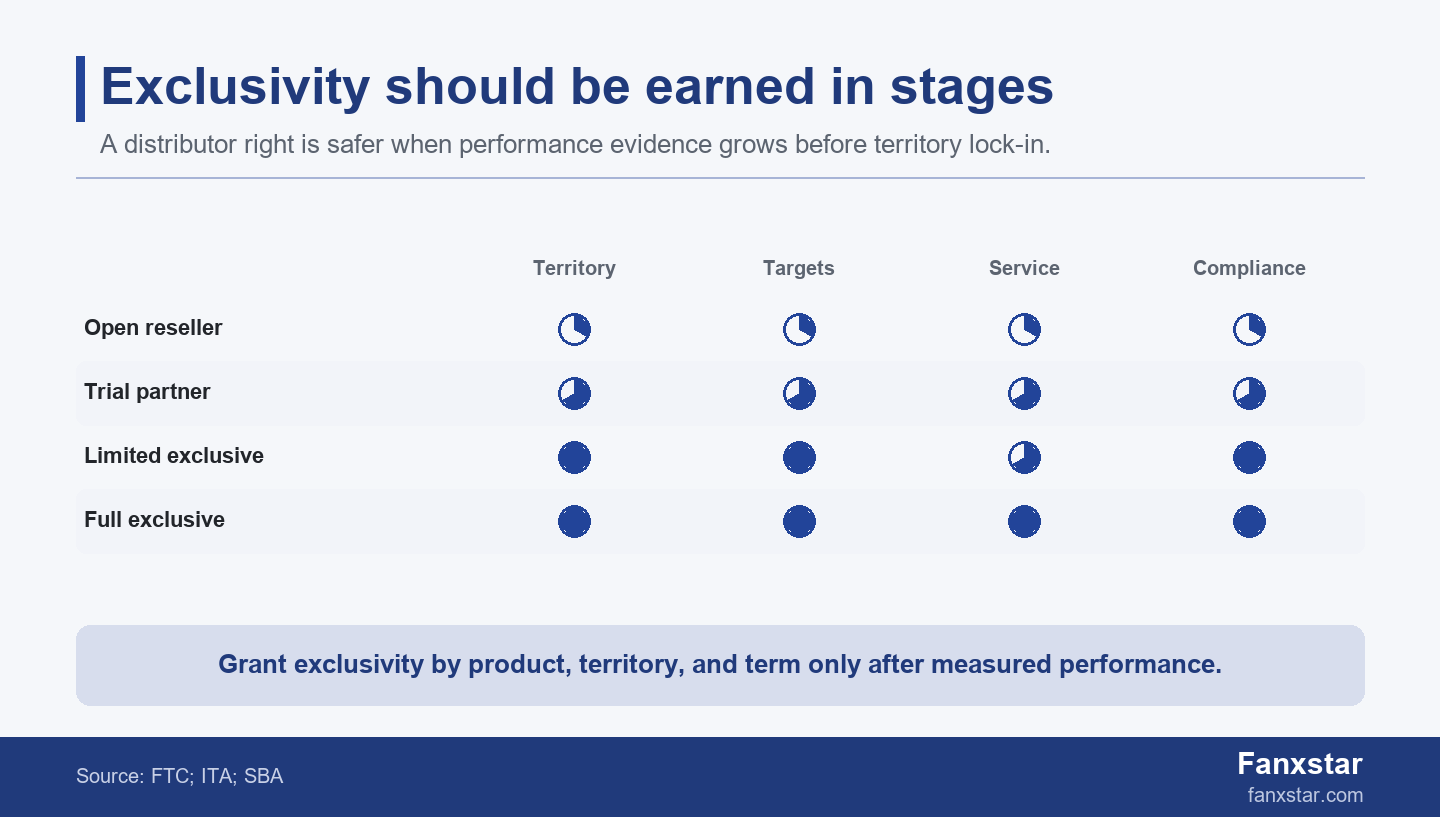
A staged model protects both sides. The distributor can prove demand, support capability, payment discipline, and market knowledge. The supplier can measure whether the partner is creating value beyond simply holding a territory. If the distributor performs, rights can expand. If not, the relationship can remain non-exclusive without a major conflict. A practical staging calendar can use a 90-day onboarding review, a 6-month pipeline review, and a 12-month renewal decision instead of giving permanent rights at the first meeting.
Based on our analysis, an illustrative lighting-distributor trial should define 3 orders, 100 units, or a named project pipeline before a territory expands. A distributor that requests 2 years of exclusivity with only 1 opening order is asking the supplier to carry most of the market risk. A healthier structure gives the distributor 90 days to prove account access, 6 months to prove repeat demand, and 12 months to earn a broader renewal.
For a commercial-readiness estimate, make the exclusivity gate measurable. Based on our analysis, 3 orders should carry more weight than 1 introductory order. Based on our analysis, 100 units can prove basic demand better than a single sample request. Based on our analysis, 90 days is enough to check account access and response discipline. Based on our analysis, 6 months can show whether the pipeline turns into repeat demand. Based on our analysis, 12 months is a fair renewal point for a limited territory. Based on our analysis, 2 years of exclusivity should require documented performance, not only optimism. Based on our analysis, 6 commercial controls should be written before any exclusive territory starts.
Use the estimate as a staged-deal checklist. Based on our analysis of this scenario, 3 orders should be a stronger gate than 1 sample request. Based on our analysis of this scenario, 100 units can prove basic market pull. Based on our analysis of this scenario, 90 days can test account access and response discipline. Based on our analysis of this scenario, 6 months can separate real demand from optimistic forecasts. Based on our analysis of this scenario, 12 months is a fair first renewal gate. Based on our analysis of this scenario, 2 years should require stronger performance proof. Based on our analysis of this scenario, 6 commercial controls should be written before launch. Based on our analysis of this scenario, 1 territory should start narrow before expanding.
Minimum targets should include quality, not only volume
Volume matters, but it is not enough. A distributor may hit an early purchase target by overstocking, then stop developing the market. Better targets combine sales volume, project pipeline, payment history, inventory freshness, local service response, sample activity, marketing activity, and reporting quality. If the supplier has technical products, training and after-sales capability should count too.
For LED lighting, the target should also separate standard catalog products from customized or project-based products. A distributor who is strong in retail downlights may not be ready for weatherproof industrial fixtures, emergency lighting, data center service corridors, or food processing projects. Exclusivity by product family is safer than exclusivity by brand name alone.
Exclusive Distribution for B2B LED Lighting Products
Lighting distribution depends on local service and evidence
B2B lighting is not only a box-moving business. A distributor may need to answer application questions, manage samples, support local certification or documentation, coordinate warranty claims, keep spare parts, train installers, and help customers choose between weatherproof, linear, motion sensor, emergency, grow, or specialty products. Those duties justify exclusivity only when the distributor can actually perform them.
According to ITA import documentation guidance, international trade files commonly include invoices, bills of lading, packing lists, and certificates of origin. For lighting, the channel file may also include test reports, declarations, labels, installation instructions, and local compliance documents. A distributor who cannot manage documentation should not receive broad exclusivity for technical product categories.
For Fanxstar, the strongest distribution fit may involve defined categories such as weatherproof LED lighting, linear lighting, emergency lighting, or custom specialty LED lighting ODM. Each category may require different inventory, technical support, and application knowledge. One agreement should not pretend those categories are identical.
ODM and custom products need special boundaries
Exclusive distribution becomes more complicated when the product is custom. If a buyer requests a private-label fixture, a new housing, a modified sensor layout, or a project-specific certification route, the supplier must decide whether that opportunity belongs to the distributor, the end customer, or a separate ODM relationship. The agreement should define project registration, account ownership, design ownership, tooling rights, and margin rules.
Use Fanxstar custom LED lighting ODM service as a separate conversation when exclusivity touches custom development. A distributor may represent Fanxstar in a territory, but the product-development file still needs controlled drawings, sample gates, certification scope, and change-control rules. Exclusivity should not allow either side to blur the difference between selling an existing product and creating a new one.
Contract Terms Buyers and Suppliers Should Clarify
Define the right, the duty, and the exit
A practical agreement should define territory, product lines, customer segments, online sales, direct key accounts, minimum purchase or sales targets, reporting cadence, inventory commitments, marketing duties, sample policy, training, warranty service, spare parts, payment terms, trademark use, confidentiality, compliance duties, and termination. At minimum, the 6 commercial controls should be product scope, territory, term, target, service duty, and exit rule. The most important terms are the ones that explain what happens when performance is weaker than expected.
The exit rule should be clear before the relationship starts. Can exclusivity be reduced to non-exclusive status? Is there a cure period? What happens to inventory, samples, customer leads, warranty claims, and marketing materials? Can the supplier serve strategic accounts directly? Can the distributor sell competing products? The answers should not be discovered during a dispute.
Use Fanxstar with a defined market-development plan
A distributor approaching Fanxstar should bring more than a request for exclusive rights. A stronger proposal names the target market, product category, customer segments, first-year project pipeline, sample plan, local certification questions, service process, inventory plan, and marketing commitments. Relevant company and trust context can start from Fanxstar company and certification profile and Fanxstar lighting guides and insights.
The final decision rule is staged and evidence-based: start non-exclusive or limited, measure the distributor’s real contribution, then expand rights only where the partner has proven market creation, service, documentation, and payment quality. Exclusivity should be a reward for performance, not the first condition of a conversation.
FAQ
What is an exclusive distributorship agreement?
An exclusive distributorship agreement gives one distributor defined rights to sell a supplier’s products in a territory, channel, or product scope. The exact meaning depends on the contract, so the agreement should define territory, term, products, direct sales, online sales, targets, and termination.
What are the main benefits of exclusivity?
The main benefits are stronger distributor commitment, local inventory, market development, training, after-sales service, and brand focus. Those benefits appear only when the distributor has measurable duties and the supplier can verify performance over time.
What are the risks of exclusive distribution?
The risks include channel lock-in, weak sales after an opening order, blocked direct accounts, service failures, legal issues, and difficult termination. Suppliers should avoid broad exclusivity before the distributor proves market demand, service capacity, and reporting discipline.
When should Fanxstar consider an exclusive distributor?
Fanxstar should consider exclusivity only for a defined product category, territory, and term after the distributor proves project pipeline, payment quality, technical support, local service, and documentation capability. Custom ODM opportunities should have separate project and design-control rules.