When you source LED lighting from a manufacturer, you are not just buying a product — you are inheriting their labor practices, environmental footprint, and business ethics. Buyers in Europe, North America, and Australia are increasingly held responsible for what happens in the factories that produce their goods, thanks to expanding supply chain due diligence legislation including Germany’s LkSG (Supply Chain Act), the UK Modern Slavery Act, and the EU Corporate Sustainability Due Diligence Directive (CSDDD). A Supplier Code of Conduct (SCoC) is the foundational document that makes your expectations legally binding and operationally enforceable. This guide explains what a robust SCoC must contain, how to audit against it, and how to make compliance a genuine competitive advantage rather than a paper exercise.
Key Takeaways
- A Supplier Code of Conduct is now a legal necessity in many markets — the EU CSDDD and Germany’s LkSG require brands to document and enforce supplier standards across their entire value chain.
- Over 75% of global brands already require social compliance audits from their Chinese suppliers, according to FactoryFollow’s 2025 audit data — overtime violations are the most common issue, found in 65% of factories inspected.
- The RBA Code of Conduct Version 8.0 (effective January 1, 2024) remains the gold standard for electronics and lighting supply chains; aligning your SCoC with its labor, health & safety, environment, and ethics pillars gives you instant credibility with enterprise buyers.
Why Your Business Needs a Supplier Code of Conduct
The Regulatory Pressure Has Arrived
Supply chain compliance is no longer voluntary. Germany’s Act on Corporate Due Diligence Obligations in Supply Chains (LkSG), which came into force in January 2023, requires companies with 1,000+ employees to conduct human rights and environmental due diligence — and to cascade those requirements to direct suppliers. The EU’s Corporate Sustainability Due Diligence Directive (CSDDD), agreed in 2024, extends similar obligations across member states by 2026–2027. For lighting distributors and importers selling into these markets, this means that your Chinese LED supplier’s labor conditions are now, effectively, your legal exposure.
Beyond regulatory risk, procurement professionals who work with Fanxstar Technology regularly cite reputational risk as their primary concern. A single viral social media post documenting poor factory conditions can erase years of brand equity overnight.
The Business Case Beyond Compliance
Companies with strong ESG (Environmental, Social, Governance) performance demonstrate 25% higher stock returns on average, per FactoryFollow’s 2025 industry benchmarking data. More practically, ethical manufacturers tend to produce higher quality goods: factories that invest in worker dignity, training, and safety generally maintain tighter production disciplines. A well-structured SCoC is not just a shield — it is a supplier selection filter that helps you identify the partners worth building long-term relationships with.
The Five Core Pillars of an Effective Supplier Code of Conduct
Pillar 1 — Labor and Human Rights
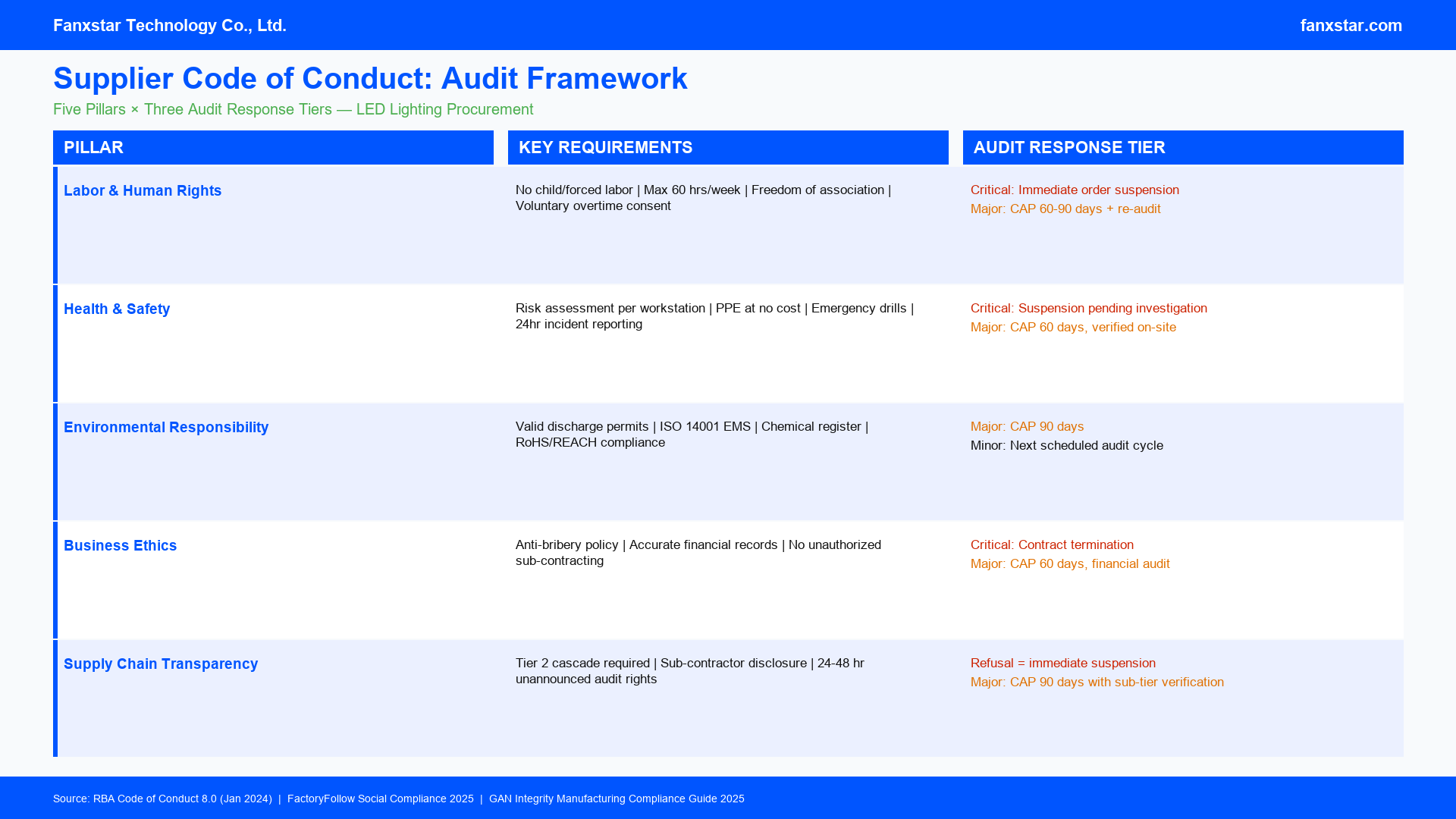
This is the non-negotiable foundation. At minimum, your SCoC must prohibit: child labor (aligned with ILO Convention 138, minimum age 15 or local law if higher), forced or bonded labor including debt bondage through recruitment fees, and excessive working hours beyond legal limits. The RBA Code of Conduct Version 8.0 specifies that workers shall not be required to work more than 60 hours per week including overtime, with at least one day off every seven days.
According to FactoryFollow’s analysis of 500+ factory audits in China, overtime violations appear in 65% of factories inspected — making this the single most common compliance failure. Your SCoC must specify: maximum weekly hours, overtime pay rates, voluntary overtime consent, and the right to refuse overtime without retaliation. Workers must be free to terminate employment with reasonable notice and without financial penalty.
Pillar 2 — Health, Safety, and Working Conditions
For LED lighting manufacturers, the relevant hazards include chemical exposure (flux, solvents, phosphor compounds), electrical testing areas, high-temperature soldering stations, and lifting operations for heavy fixtures. Your SCoC should require suppliers to: maintain documented risk assessments for each workstation, provide personal protective equipment at no cost to workers, post emergency evacuation procedures in all languages spoken by workers, and report workplace injuries within 24 hours.
The Responsible Business Alliance (RBA) Code of Conduct, which serves as the reference standard for electronics and lighting manufacturing, specifically requires that suppliers have a documented safety management system, conduct regular safety drills, and train workers before they begin work on new processes — not after an incident occurs.
Pillar 3 — Environmental Responsibility
LED lighting manufacturers must navigate RoHS (Restriction of Hazardous Substances), REACH regulations for the EU market, and waste management requirements for substances including lead solder (in non-compliant processes), PCB etching chemicals, and packaging waste. Your SCoC environmental requirements should cover:
- Valid environmental permits for all discharge points (wastewater, air emissions)
- ISO 14001 environmental management system (or equivalent) for medium-to-large suppliers
- Documented chemical inventory and hazardous waste disposal records
- Energy and carbon reporting, increasingly required by EU buyers under the Carbon Border Adjustment Mechanism (CBAM)
At Fanxstar, our manufacturing operations in Shenzhen operate under Guangdong Province’s environmental management framework, with documented compliance across wastewater, solid waste, and chemical handling — a baseline we expect all our component suppliers to meet or exceed.
Pillar 4 — Business Ethics and Anti-Corruption
This pillar addresses bribery, kickbacks, accurate record-keeping, and conflict of interest management. For B2B lighting sourcing from China, the most relevant risks are: inflated invoices to extract funds from joint ventures, falsified compliance certifications, and undisclosed sub-contracting to non-approved factories. Your SCoC must require suppliers to maintain accurate financial records, prohibit gifts above a defined threshold to purchasing personnel, and obtain written approval before sub-contracting any production.
The RBA Code of Conduct Version 8.0 (effective January 1, 2024) provides a complete ethics framework covering anti-corruption, intellectual property protection, fair business practices, and whistleblower protections — making it an efficient reference point rather than building your ethics section from scratch.
Pillar 5 — Supply Chain Transparency and Sub-Contractor Management
Single-factory compliance is insufficient if your LED driver supplier sources components from a sub-tier with forced labor. Your SCoC should cascade requirements to at least Tier 2 — meaning your direct supplier must impose equivalent standards on their critical component suppliers. This should include: mandatory disclosure of all sub-contractors, a prohibition on unauthorized outsourcing, and the right for you or a third-party auditor to inspect sub-contractor facilities on reasonable notice.
| SCoC Pillar | Key Requirements | Audit Evidence |
|---|---|---|
| Labor & Human Rights | No child/forced labor, max 60 hrs/week, freedom of association | Payroll records, time cards, worker interviews |
| Health & Safety | Risk assessments, PPE, emergency drills, incident reporting | Safety records, training logs, facility walk-through |
| Environment | Valid permits, ISO 14001, chemical management, waste records | Environmental permits, discharge reports, chemical register |
| Business Ethics | Anti-bribery, accurate records, no unauthorized sub-contracting | Financial records, contract review, certification verification |
| Supply Chain Transparency | Tier 2 cascade, sub-contractor disclosure, audit rights | Supplier list, sub-contracting agreements, site access confirmation |
Choosing the Right Audit Framework
BSCI, Sedex/SMETA, and SA8000: Which Applies to Your LED Supplier?
Three frameworks dominate social compliance auditing for manufacturing supply chains in China. The right choice depends primarily on your buyers’ requirements and target markets.
BSCI (Business Social Compliance Initiative, now Amfori BSCI) is the standard required by most European retailers and preferred by EU-market distributors. It covers 13 areas including freedom of association, fair remuneration, health and safety, and the environment. Audits are valid for 2 years and results are shared across the Amfori platform — so one audit can satisfy multiple European buyer requirements simultaneously.
Sedex SMETA (Supplier Ethical Data Exchange Membership Ethical Trade Audit) is widely accepted by UK and US retailers. It covers four pillars: labor standards, health and safety, environment, and business ethics. A 4-Pillar SMETA audit is increasingly the global minimum for any supplier selling to English-speaking markets. Sedex SMETA audit results are stored on the shared platform and transferable to multiple buyers, reducing audit duplication.
SA8000 (Social Accountability 8000) is the most rigorous — a full management system standard requiring ongoing surveillance audits. It is appropriate for suppliers seeking to differentiate on ethical standards, particularly those producing for buyers with premium positioning or selling into markets with strict modern slavery regulations. SA8000 certification validity is 3 years with semi-annual surveillance.
For OEM/ODM customers building private-label LED lighting programs, we recommend requiring at minimum a current BSCI or SMETA audit from direct manufacturers and a self-assessment questionnaire from critical component suppliers. This provides a documented compliance baseline without creating unrealistic burdens on smaller sub-tier suppliers.
Unannounced Audits: The Only Way to Get Real Data
Announced audits have a well-documented limitation: factories that know an audit is coming can temporarily improve conditions, coach workers on scripted answers, and present curated records. According to FactoryFollow’s social compliance audit research, the most effective fraud detection technique is the unannounced audit — and any factory that refuses unannounced visits or requires weeks of advance notice should be treated as high-risk. Your SCoC should explicitly reserve the right to conduct unannounced audits, ideally with 24–48 hours notice maximum for operational coordination, and include this right in the supplier contract.
Operationalizing Your Supplier Code of Conduct
From Document to Contract Obligation
A Supplier Code of Conduct that lives only in a PDF is not a compliance program — it is a liability document. To be effective, the SCoC must be: signed by a legal representative of the supplier, incorporated by reference into the purchase agreement, translated into the supplier’s primary operating language (Simplified Chinese for Shenzhen-based manufacturers), and reviewed with the supplier’s operations management — not just their sales team.
A critical implementation step often overlooked: train your own purchasing staff. Buyers who source primarily on price and treat compliance as a separate department’s problem will undermine your SCoC regardless of how well it is written. The GAN Integrity 2025 manufacturing compliance guide identifies “fragmented accountability between procurement and compliance teams” as the leading operational failure mode in supplier ethics programs.
Corrective Action Plans: What Happens When a Supplier Fails
Most factories audited for the first time will have findings. The question is not whether issues exist — it is whether your supplier has the culture and management system to fix them. A well-constructed SCoC should define three response tiers:
- Critical violations (Zero-Tolerance): Child labor, forced labor, physical abuse, life-threatening safety hazards. Immediate suspension of purchase orders pending investigation and verified remediation — or termination.
- Major non-conformances: Wage violations, excessive overtime, inadequate safety documentation. Corrective Action Plan (CAP) with 60–90 day deadline and verification audit.
- Minor findings: Documentation gaps, incomplete training records. CAP with 90–180 days, verified at next scheduled audit.
Document every CAP and its resolution. This creates the due diligence trail required by LkSG, CSDDD, and other frameworks — demonstrating that you identified a risk, required remediation, and verified the outcome.
Practical SCoC Template Structure for LED Lighting Buyers
What to Include in Your Document
A functional Supplier Code of Conduct for B2B LED lighting procurement should run 4–8 pages and include at minimum: scope and applicability (which entities it covers, including sub-contractors), reference standards (ILO conventions, RBA Code of Conduct 8.0, applicable local labor laws), substantive requirements by pillar (labor, health & safety, environment, ethics, supply chain), audit rights and methodology, corrective action procedures and timelines, and consequences for non-compliance including termination rights.
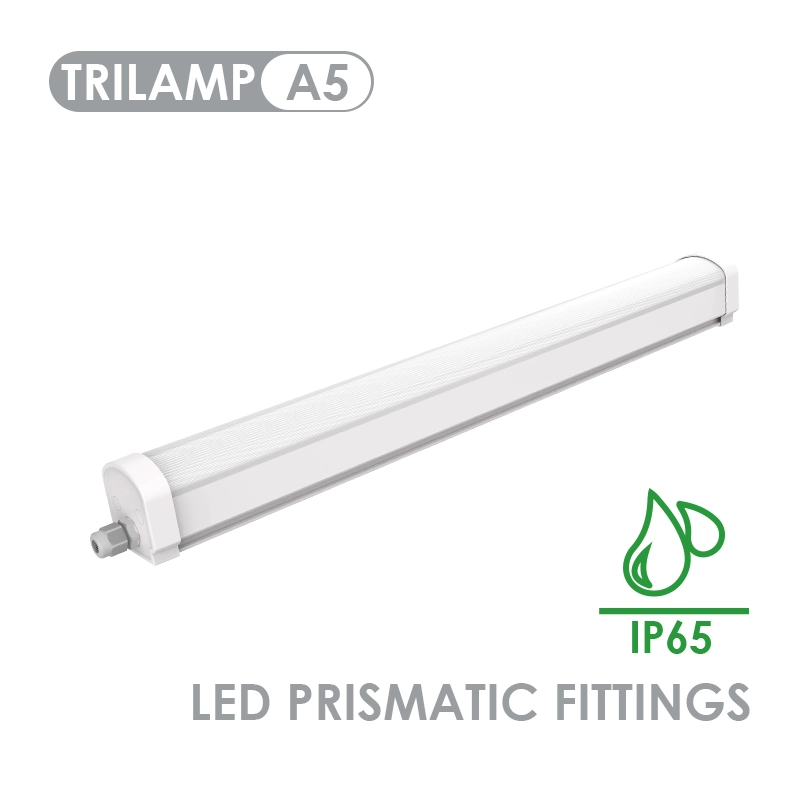
For certification-specific requirements, reference the relevant product standards directly: CE marking for EU markets, ENEC for safety-critical luminaires, and RoHS/REACH for chemical compliance. Fanxstar’s weatherproof lighting products carry UL, ETL, ENEC, TUV, CB, CE, ERP, and SAA certifications — each representing a verified standard that aligns with specific market compliance requirements.
Common Mistakes That Undermine Supplier Code of Conduct Programs
Applying the Same Requirements to All Suppliers Regardless of Risk
A Tier 1 LED module manufacturer supplying 80% of your volume deserves intensive audit scrutiny. A local packaging supplier providing cardboard boxes does not. A risk-based approach — scoring suppliers by volume, geographic risk, product category risk, and audit history — ensures you concentrate audit resources where they matter most. The JS Sourcing factory audit methodology recommends prioritizing audits based on a formal risk matrix rather than rotating through all suppliers on a fixed schedule.
Forgetting That Workers Are Your Best Audit Data Source
Document review can be falsified. Facility walk-throughs can be staged. Worker interviews — conducted in private, in the worker’s language, by an auditor with no facility management present — are the hardest to fake. GIM Inspection’s social compliance audit framework emphasizes structured worker interviews as the primary mechanism for detecting falsified records and coached responses. Your SCoC should explicitly state that workers may be interviewed privately and that facilitating worker access is a contractual obligation.
Frequently Asked Questions
Do small LED suppliers need to comply with a Supplier Code of Conduct?
Yes — though the compliance mechanisms can be scaled to their size. Small suppliers may not be able to afford SA8000 certification, but they can sign your SCoC, complete a self-assessment questionnaire, and submit to periodic on-site audits. The requirement should be proportionate: a factory with 50 workers does not need the same management system infrastructure as one with 2,000, but the substantive protections — no child labor, safe working conditions, honest pay records — apply equally regardless of factory size.
How often should I audit my LED manufacturer’s compliance with the SCoC?
Standard practice for medium-high risk suppliers is annual formal audits with mid-year self-assessment questionnaires. For critical suppliers (high volume, single-source, or those with prior findings), bi-annual audits are advisable. At minimum, trigger an audit whenever: you receive a credible complaint about working conditions, the supplier changes ownership or management, production is relocated to a different facility, or a major sub-contractor is added without prior notice.
What if my supplier refuses to allow audits?
Treat refusal as a critical red flag. No legitimate manufacturer operating to professional standards should refuse a buyer’s right to audit — it is equivalent to refusing a financial audit in any other business context. If a supplier refuses, the immediate action is to suspend new purchase orders and issue a formal notice requiring audit access within 30 days. If access is still denied, the relationship should be terminated. The precedent of allowing audit refusal permanently compromises your compliance program.
Is the RBA Code of Conduct applicable to LED lighting manufacturers?
Yes. Though the RBA originated in the electronics industry, its Code of Conduct 8.0 (effective January 2024) is explicitly designed to be applicable beyond electronics. LED lighting manufacturing — which involves electronic components, PCB assembly, driver electronics, and chemical processes — maps directly to the RBA’s scope. Many enterprise LED buyers reference RBA 8.0 as their baseline standard precisely because it covers the full manufacturing context.
If your procurement team is evaluating LED lighting partners with verified compliance infrastructure, contact the Fanxstar team to discuss our audit readiness, certifications, and compliance documentation — including our RoHS, REACH, and product safety certification portfolio across all product categories.