Alibaba is useful for discovering suppliers, but a direct factory relationship is usually stronger once the buyer needs controlled engineering, repeat orders, certification evidence, or custom LED lighting changes. The wrong choice is treating either route as automatically safe. The route only works when the order terms, product file, and inspection evidence match the risk.
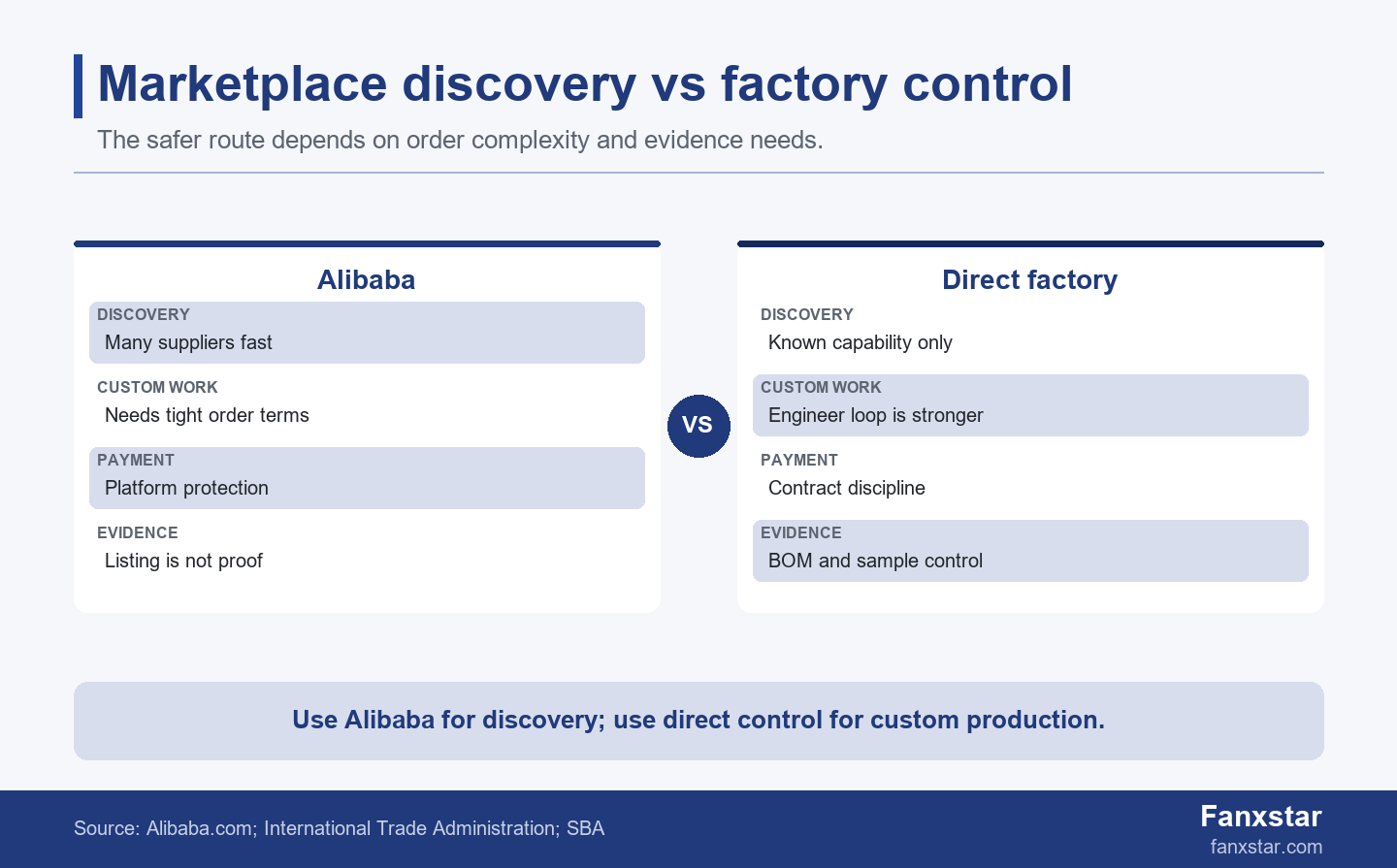
Alibaba Trade Assurance can help structure payment and dispute protection, while International Trade Administration import regulation guidance reminds buyers that imported products still need documentation, safety, quality, and conformity checks. For LED lighting buyers, the decision is not marketplace versus factory in the abstract. It is whether the buying path can prove the exact fixture version being shipped.
Key Takeaways
- Alibaba is strong for supplier discovery, early price sensing, and first samples, but weak if the buyer mistakes platform signals for product evidence.
- Direct factory buying is stronger for custom LED lighting, repeat production, certification files, and change control, but it requires supplier due diligence.
- Trade Assurance is useful only when the order terms define the exact product, quality criteria, delivery terms, and dispute evidence.
- For Fanxstar-type ODM projects, the best path is often Alibaba or web discovery first, then direct technical RFQ, sample gate, and documented production release.
The real difference between Alibaba and direct factory buying
Alibaba solves discovery; it does not finish procurement
Alibaba is valuable because it compresses discovery. A buyer can search many suppliers, compare broad price ranges, message vendors, request samples, and use platform tools such as Verified Supplier information. That is helpful for a first shortlist, especially when the buyer does not yet know the supplier landscape.
The risk is that discovery signals can feel like qualification. A badge, response speed, product photo, or low sample price does not prove that the shipped LED fixture will match the requested driver, lens, CCT, certification label, waterproof structure, or packaging. For simple stock items, the gap may be manageable. For custom LED lighting, the gap can become a product failure.
Direct factory buying solves control only when the factory is real
A direct factory relationship gives the buyer more room to discuss BOM, drawings, tooling, sample revisions, certificates, production dates, and after-sales changes. It can also reduce layers between the buyer and the engineer who understands the product. That is why repeat B2B lighting programs often move toward direct factory communication after discovery.
Direct buying is not automatically safer. A factory website can still exaggerate capability, a trading company can present itself as a manufacturer, and an engineering promise can fail if it is not written into the purchase file. The buyer has to verify business identity, production capability, certification scope, and the exact product version. Direct contact gives more control, but only if the buyer uses that control.
Pros and cons by order type
The best route changes with the order’s complexity
| Buying route | Best use | Main risk | Control gate |
|---|---|---|---|
| Alibaba discovery | Finding many suppliers quickly, comparing broad price ranges, ordering simple samples | Profile badges can be mistaken for product evidence | Verify supplier identity, exact model, order terms, and sample match |
| Alibaba Trade Assurance order | Small or first-time orders where platform payment and dispute process matter | Protection still depends on written terms and evidence | Put specs, photos, drawings, tolerances, and delivery terms into the order |
| Direct factory order | Repeat programs, custom products, private label, certification files, and engineering change control | Weak supplier due diligence can expose the buyer | Audit capability, freeze BOM, test sample, inspect shipment |
| Direct ODM partnership | Projects needing product adaptation, special housing, sensors, optics, or market-specific certification | Slow or costly if the RFQ is incomplete | Use a staged sample and evidence release plan |
Alibaba supplier verification services can reduce some early screening uncertainty, but it should not replace product-specific evidence. In LED lighting, the buyer still needs model number, electrical rating, driver, LED board, lens, housing, IP rating, certificate scope, and production version to match the order. A verified business can still ship the wrong technical variant if the order file is loose.
Trade Assurance depends on written terms
Trade Assurance is most useful when the buyer converts expectations into objective order terms. Instead of writing ‘good quality LED linear light,’ write CCT range, lumen output, wattage tolerance, IP rating, driver brand or approved equivalent, lens material, packaging, label language, delivery date, inspection method, and photos or drawings attached to the order. The platform cannot enforce a requirement that the buyer never stated.
For custom lighting, add a sample identity rule. The approved sample should be linked to photos, driver, LED board, housing, diffuser, wiring, label, and test report. If production changes any critical part, the supplier should declare the change before shipment. This turns a dispute from an opinion into an evidence question.
Cost, timing, and dispute exposure model
A lower unit price can become expensive after 3 missed controls
Consider an illustrative 500 unit LED lighting order. If the Alibaba quote is 4 percent lower but the order omits driver model, lens material, and inspection criteria, the apparent saving can disappear after one failed sample revision, one delayed shipment, or one rework claim. The direct factory route may quote higher at first because engineering, sample review, and document matching are being priced honestly. The comparison should include unit price, sample fee, courier cost, inspection cost, delay cost, rework risk, and the buyer’s internal time.
The risk is not that marketplaces are bad or factories are good. The risk is a route that does not match the order complexity. In practice, simple stock products can benefit from platform speed and payment structure. A custom LED product with a changed driver, diffuser, housing, wiring, or label needs a release plan with at least 3 checkpoints: pre-sample confirmation, pre-production freeze, and pre-shipment inspection. Without those checkpoints, a 4 percent cheaper quote can become a 20 percent project problem.
A buyer can make the comparison practical by assigning each risk a cost. A missed sample week may cost 7 days. A failed pre-shipment inspection may cost one extra inspection fee and a delayed sailing. A wrong label may cost the whole batch if the destination market rejects it. This means the route decision should be made with a small risk ledger, not only with the quoted unit price.
According to Alibaba Trade Assurance, the platform covers stages of the purchasing journey and can mediate order disputes. According to ITA import documentation guidance, import files can include invoices, bills of lading, packing lists, certificates of origin, and other certificates. Those 2 facts point to the same rule: payment protection and import readiness are different controls.
According to Alibaba Verified Supplier, assessment reports can be produced by third-party inspection companies. According to Alibaba supplier verification services, verification can include legal registration and buyer safeguards. Those 2 platform signals reduce identity uncertainty, but they still do not prove the LED driver, diffuser, label, IP test, or production sample that will arrive in a 500 unit lighting order.
Dispute evidence has to be created before there is a dispute
A buyer cannot wait until goods arrive to create proof. If the order says only ‘IP65 LED batten, good quality,’ a dispute becomes subjective. If the order includes IP rating, wattage tolerance, CCT tolerance, driver, LED board, diffuser material, label photo, packaging rule, and inspection method, the buyer has a file that can be judged. The decision rule is to write the dispute evidence before the deposit, not after the defect.
For repeat LED buyers, the best route often changes over time. The first 1 or 2 orders may use marketplace discovery, platform messaging, and protected payment. Once the buyer knows the supplier, product, and market, the next orders should move toward direct technical control: locked BOM, named certificates, production photos, shipment inspection, and after-sales agreement. This staged route gives the buyer discovery speed without sacrificing engineering control.
The file should also name who approves changes. Sales may approve a price, engineering may approve a driver, quality may approve inspection photos, and logistics may approve packing. If all 4 roles are collapsed into one chat thread, accountability disappears. A simple responsibility table makes either Alibaba or direct factory ordering safer because each approval has an owner and a date.
According to SBA import and export guidance, buyers should understand documentation and logistics before importing or exporting. According to ITA special import documents guidance, some products may need certificates tied to standards, safety, health, or other conditions. That makes a 4 role approval file more than administration; it is the record that tells the buyer whether a price approval, engineering approval, inspection approval, and shipping approval are all describing the same goods.
Import and compliance responsibility still belongs to the buyer
Marketplace payment protection is not market compliance
The ITA import documentation overview lists documents such as invoices, bills of lading, packing lists, insurance proof, certificates of origin, and other certificates when needed. Those documents are separate from marketplace payment protection. A buyer can pay safely and still import a product with the wrong certificate, missing label, or incomplete technical file.
The ITA special documents page also notes that certain products may need certificates related to standards, safety, health, or other conditions. LED lighting buyers should translate that into a document checklist before ordering: CE, UL, ENEC, SAA, RCM, RoHS, EMC, LVD, IP, photometric, warranty, and installation evidence depending on the market and fixture type.
According to International Trade Administration import regulation guidance, import procedures can include documentation, standards, safety, and quality checks. The buyer should treat those checks as separate from payment safety: a 7 day sample, a 30 percent deposit, and a clean platform chat do not prove the product can enter the destination market.
The buyer should define release evidence before deposit
Release evidence is the information that must be true before the final balance or shipment. It may include product photos, nameplate photo, packing list, carton marks, certificate numbers, test report model match, production date, inspection photos, function test, waterproof structure check, and spare parts list. If the buyer waits until goods arrive, the leverage is weaker.
SBA guidance on import and export laws points businesses toward understanding import rules before international sales. For lighting buyers, the practical translation is simple: do not let the supplier’s platform profile become your compliance file. Build a release file that your forwarder, customs broker, project manager, and after-sales team can understand.
When direct factory is better for LED lighting
Custom engineering needs a direct technical loop
Direct factory communication is usually better when the product needs custom LED lighting ODM service: custom CCT, optics, diffuser, sensor integration, emergency backup, cable entry, private label, waterproof structure, or a certification route for a target market. These issues require engineering clarification, not only sales chat.
The direct loop lets the buyer ask why a driver was selected, whether the housing can handle a temperature range, how the gasket is assembled, which parts are locked after sample approval, and what lead time applies after the design freeze. Those are difficult questions to manage through a marketplace listing alone, especially when the product is not a standard SKU.
According to DLC technical requirements, commercial LED product evidence can include requirements for product category, testing, and performance reporting. For a custom factory order, that outside reference becomes a useful buyer habit: identify the category, freeze the configuration, and keep the tested or documented version tied to the shipment version.
Fanxstar fit starts after the buyer knows the constraint
Fanxstar is a stronger fit when the buyer can describe the application: wet location, food processing, cold storage, data center corridor, tunnel, parking garage, emergency route, or custom linear platform. Relevant starting points include weatherproof LED lighting, LED linear lighting, and custom lighting design options. The buyer should send the target market, drawings, test expectations, and sample objective rather than only asking for a catalog price.
A useful direct-factory conversation should end with a sample plan: what will be built, what can be changed, which evidence will be checked, what the sample does not prove, and what must be verified again before mass production. That plan is where direct buying becomes safer than a marketplace quote.
FAQ
Is Alibaba safe for ordering LED lighting?
Alibaba can be useful for finding suppliers and structuring a protected first order, but safety depends on written specifications, verified supplier identity, payment terms, inspection evidence, and the exact product version. It should not replace technical due diligence.
When should buyers go direct to a factory?
Go direct when the order involves repeat production, custom engineering, private label, certification files, or component control. Direct buying gives more access to engineers and production evidence, but only when the buyer verifies the factory and freezes the product file.
Does Trade Assurance guarantee LED product quality?
Trade Assurance can support payment protection and dispute handling, but it does not automatically define product quality. The buyer must write objective quality criteria, delivery terms, drawings, photos, test expectations, and model details into the order.
What evidence should be checked before shipment?
Check product photos, model and label match, certificate scope, driver and LED board, packing list, carton marks, inspection results, function tests, and any market-specific documents. For custom lighting, also check whether production matches the approved sample.