EN 62471 is not a generic LED safety label; it is an optical hazard evidence check tied to the exact lamp, luminaire, output mode, and product version. The practical buyer question is not whether LEDs are generally safe. It is whether the optical radiation file matches the exact product that will be installed, cleaned, serviced, and viewed in the target application.
According to IEC 62471, the standard covers optical radiation from 200 nm through 3000 nm, including LEDs but excluding lasers. According to CIE, the purpose is a standardized technique for evaluating potential radiation hazards. Those 2 facts turn the search query into a release decision: verify the measured product, not a marketing sentence.
Key Takeaways
- EN 62471 should be checked as a report-scope question, not as a generic LED safety badge.
- Blue-light hazard risk depends on spectrum, radiance, distance, viewing condition, and exposure time.
- A report is weak when it names a module or old sample while the shipped luminaire has a different LED, optic, driver, CCT, or output mode.
- Fanxstar buyers should include EN 62471 expectations in the RFQ when waterproof, industrial, public-area, medical-adjacent, or high-output fixtures may create closer viewing exposure.
What EN 62471 Actually Decides for LED Lighting
It classifies optical radiation risk, not overall electrical safety
IECEE describes IEC 62471 as guidance for evaluating photobiological safety of lamps and lamp systems including luminaires. That is a narrower and more useful scope than many buyers assume. It does not replace electrical safety, EMC, RoHS, IP, thermal, or installation evidence. It asks whether the emitted optical radiation creates a hazard under defined conditions.
According to UL guidance on photobiological safety, the assessment process can be understood in 3 stages: measure radiance or irradiance, compare weighted values with exposure limits, and assign a risk group. This matters because a blue-looking LED is not automatically dangerous, and a white LED is not automatically harmless. The risk file depends on measured output and the classification method.
Blue-light hazard is a viewing-condition problem
The buyer should ask where people will actually see the light emitter: a worker looking into a high-bay during maintenance, a shopper seeing a downlight directly, a technician servicing a tunnel fixture, or a food-line operator working near sealed luminaires. The same LED package can create different practical exposure questions when the lens, distance, CCT, beam angle, and mounting height change.
According to IEC 62471, the standard uses exposure limits and reference measurement techniques. That means the useful buyer language is not ‘blue light safe’ as a universal phrase. It is ‘tested under this configuration and classified for this risk group.’ For B2B LED lighting, that wording is safer because it forces the supplier to name what was actually measured.
How Buyers Should Read a Photobiological Safety Report
Check the product identity before reading the result
| Evidence item | What it proves | Buyer risk if missing |
|---|---|---|
| IEC/EN 62471 test report | The optical hazard classification method and product scope | A sales claim may not describe the measured luminaire. |
| Risk group statement | Whether the product is Exempt, RG1, RG2, or higher | The buyer cannot set label, distance, or user-warning expectations. |
| Tested configuration | LED, driver, lens, CCT, output mode, and distance | An ODM change can make the old report weak. |
| Label and instruction match | The report, label, and product version describe the same item | The shipped fixture may carry evidence from another version. |
A report that does not identify the final product version is only partial evidence. The buyer should compare the report model, fixture photo, LED board, lens or diffuser, CCT, power setting, driver, and mounting mode against the sample. If the report names a light engine while the order is a sealed fixture, ask whether the luminaire assembly has changed the optical output or viewing condition.
According to CIE, the standard is about evaluating potential radiation hazards from lamps and lamp systems. In procurement terms, a lamp system can be changed by a lens, housing, reflector, output mode, or driver setting. That is why report identity is the first check, before the buyer debates whether RG0, RG1, or RG2 wording is acceptable.
Treat risk group as a release instruction
Risk group language should change what happens next. A low-risk result may support normal approval when the report matches the product. A higher-risk result may require user information, mounting-distance discipline, shielding, lower output mode, revised optics, or a different application choice. The mistake is to collect a risk group and then behave as if every group carries the same release decision.
According to UL guidance on photobiological safety, risk-group determination follows measurement and comparison with exposure limits. A buyer can convert that sequence into 3 approval gates: measured configuration, risk classification, and release condition. If any gate is unclear, hold the sample approval until the supplier explains what was measured and what the result permits.
Where ODM Changes Break the Evidence File
Changing the optical path can reopen the safety question
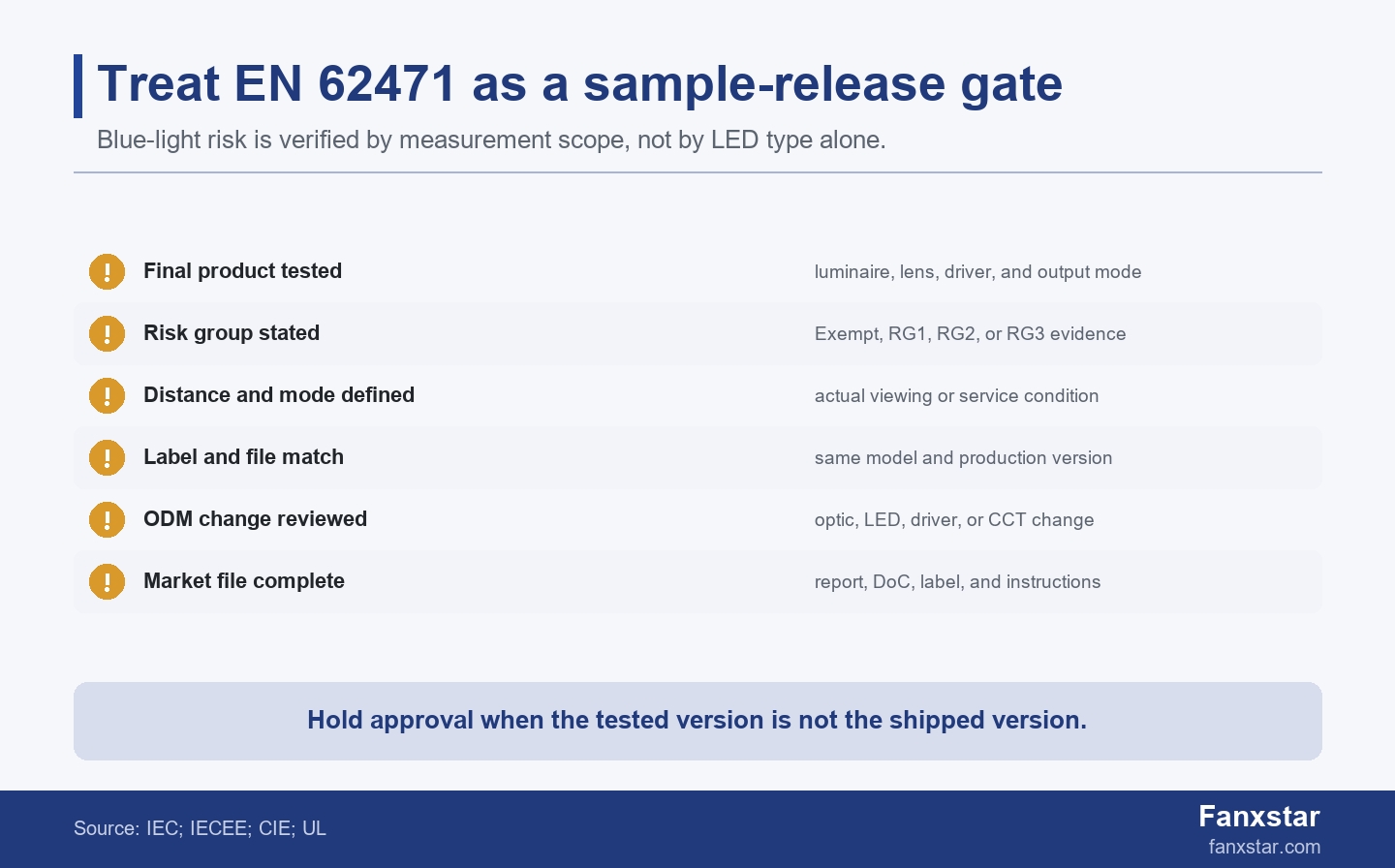
ODM lighting changes often look small in a quote but large in an optical file. A higher-output LED board, narrower lens, clear cover instead of frosted diffuser, higher CCT, different driver current, or emergency mode can change radiance and viewing conditions. If the buyer approves the original report without reviewing those changes, the production evidence may describe a safer or weaker version than the shipped product.
According to DLC technical requirements, LED product evidence can depend on test method, reporting, and product categorization. Even when a project is not seeking DLC listing, the same discipline applies: a changed optical part should trigger a question about whether the previous photobiological report still represents the product.
Use Fanxstar as a platform-evidence partner when the fixture changes
Fanxstar should be brought into the conversation when the buyer is adapting weatherproof LED lighting, LED linear lighting, waterproof downlights, or a specialty ODM fixture where lens, CCT, driver, housing, output, or installation distance may change. The useful request is not a generic safety promise. It is a version-specific evidence packet for the target market and application.
If the project also needs electrical, market, or warranty evidence, pair this topic with Fanxstar’s LED lighting certification checklist for ODM buyers. Send the drawing, LED/CCT target, lens material, output mode, target market, and sample use case before asking whether EN 62471 evidence is enough. That lets the supplier decide whether an existing platform file can be used or whether the changed sample needs review.
Procurement Scenarios That Change the EN 62471 Question
Public access makes viewing distance part of the specification
The strongest buyer insight is that EN 62471 becomes more important when ordinary people or service teams can view the emitting surface closely. A high-bay luminaire in a locked industrial ceiling, a downlight over a cashier lane, and a portable work-site fixture do not create the same viewing pattern. The supplier should therefore state the tested condition and the intended installation boundary, not only the LED wattage.
IEC 62471 is closely aligned with CIE S 009 terminology because both are used around photobiological safety evaluation for lamps and lamp systems. For procurement, that standards lineage is useful because it moves the buyer away from color-temperature folklore. A 5000 K product is not automatically unacceptable, and a 3000 K product is not automatically cleared; the decision comes from the measured product, distance, output mode, and risk group.
Maintenance and cleaning can create closer exposure than normal operation
Many lighting specifications only describe the normal user position, but maintenance creates a different exposure case. A technician may look into a fixture while replacing a driver, a cleaner may work close to a waterproof luminaire, and a commissioning engineer may test maximum output before diffusers or shields are finally fixed. These moments should be reflected in instructions, labels, and sample-release evidence when the product has higher output or a narrow optical path.
According to DOE FEMP LED purchasing guidance, procurement guidance can classify commercial and industrial luminaires by application categories such as indoor linear ambient, high-bay, low-bay, and troffer. That category thinking helps buyers decide when a photobiological report needs extra attention. A category with frequent service access, close viewing, or public exposure deserves a stronger report-scope check than a remote fixture that is never viewed directly.
A report date is not enough when the product platform keeps changing
Buyers often archive a report and assume the evidence is permanently solved. That assumption breaks when an ODM platform changes LED bin, lens texture, driver current, diffuser material, CCT mix, emergency output, or label language. The useful procurement habit is to tie each report to a version record. If the product changes, the release file should say whether the old report still applies, whether a lab opinion is needed, or whether the sample must be retested.
This is especially important for multi-market orders. A fixture may be sold as one family while different countries receive different cable entries, labels, output settings, or diffuser grades. A buyer who asks only for one EN 62471 file may miss that the tested version and shipped version are no longer identical. Version control is a low-cost discipline compared with a delayed launch or an argument after goods arrive.
Buyer Release Checklist Before Shipment
Ask for the report file before the final sample is approved
The best time to request EN 62471 evidence is before the buyer locks the sample, not after the goods are packed. Ask for the report number, test standard, tested model, risk group, product photos, tested distance or condition, report date, and any user instruction that follows from the result. Then compare those items with the order file and final sample.
According to International Trade Administration import regulations, imported products can require documentation, safety, quality, and conformity checks. For LED lighting, photobiological evidence is one layer of that documentation stack. A buyer can have correct customs papers and still have weak optical safety evidence if the report belongs to the wrong configuration.
Use a simple hold-release rule
Release the order when the report, label, instruction sheet, sample, and shipped product all describe the same LED version. Hold the order when the supplier changed LED package, lens, CCT, driver current, emergency mode, or optical accessory after the report. Investigate when the report is for a component but the buyer is purchasing a luminaire.
This rule is deliberately stricter than a normal catalog review because photobiological safety is invisible to the naked eye. A fixture can look clean and still have an unresolved report-scope problem. The buyer does not need to become a lab expert; the buyer does need to ask whether the evidence file matches the product being approved.
FAQ
Is EN 62471 required for every LED luminaire?
EN 62471 is not requested in the same way for every market or every fixture, but it is a practical evidence request when optical exposure, public use, high output, close viewing, or ODM changes create risk. Buyers should ask which standard, tested product version, risk group, viewing condition, and market requirement apply before treating the report as release evidence.
What is blue-light hazard in LED lighting?
Blue-light hazard is the potential retinal risk from optical radiation in the blue region under defined exposure conditions. The buyer should not judge it by color appearance alone. The practical check is whether a lab report identifies the exact lamp or luminaire, output mode, viewing condition, risk group, and any installation or user-warning boundary.
Can a component report cover a finished fixture?
A component report can support a finished fixture only when the supplier can show that the finished product does not change the relevant optical condition. A lens, diffuser, reflector, CCT, driver current, or housing change can affect the evidence. Buyers should ask for a written bridge explanation when the report names a module but the order is a final luminaire.
What should I send Fanxstar before asking for EN 62471 evidence?
Send the target market, product drawing, LED and CCT target, output mode, lens or diffuser material, mounting condition, viewing distance, and sample objective before asking for EN 62471 evidence. That package helps Fanxstar decide whether an existing platform report is relevant, whether a change statement is enough, or whether the modified fixture needs additional review.