For LED manufacturers and distributors targeting the United States, the Department of Energy’s Compliance Certification Management System (CCMS) is not optional background paperwork — it is a mandatory precondition for legal market entry. Under 10 CFR Part 429, every manufacturer of a covered LED product must certify each basic model to DOE via CCMS before distributing that product in US commerce. Failure carries enforcement exposure ranging from tens of thousands to hundreds of thousands of dollars in penalties per enforcement action. This guide explains who must register, what the process involves, the September 2024 General Service Lamp (GSL) rule change that caught many manufacturers off guard, and the common failure modes that trigger DOE enforcement.
Key Takeaways
- CCMS certification is a legal prerequisite to US market distribution for covered LED products — not a voluntary quality programme or post-sale formality.
- In September 2024, DOE reversed prior guidance and required all General Service Lamp (GSL) manufacturers to certify to CCMS within approximately 210 days — this caught many importers unprepared.
- Private labelers and importers who sell LED products under their own brand name in the US are treated as manufacturers under 10 CFR Part 429 and bear full certification obligations.
What Is CCMS and Why Does It Exist
The Regulatory Framework
The Compliance Certification Management System is the US Department of Energy’s mandatory online platform for receiving, tracking, and publicly displaying certification reports from manufacturers of covered products. It operates under the Energy Policy and Conservation Act (EPCA) and its implementing regulations at 10 CFR Parts 429, 430, and 431. The system requires manufacturers to submit standardized certification reports — using DOE-provided Excel templates specific to each product category — certifying that each basic model meets the applicable energy conservation standard set out in 10 CFR Part 430 (for consumer products including general service lamps) or Part 431 (for commercial and industrial equipment).
The regulatory requirement is fulfilled upon submission of a certification report that complies with 10 CFR Part 429. The CCMS public certification database — which displays submitted data — is a secondary output; the DOE makes clear that the database has no independent legal significance. What matters legally is the act of timely, compliant submission.
Annual Renewal Requirement
CCMS certification is not a one-time event. Under 10 CFR 429.12(d), manufacturers must re-certify annually, with the deadline for most product categories set at 1 March each year. When a model is discontinued and no longer being manufactured or sold, the discontinuation must be reported in the next annual certification report. The system is designed to maintain a current, accurate picture of what is actually on the US market for energy enforcement purposes.
Who Must Register
Covered LED Products
CCMS registration requirements apply to any manufacturer, importer, or private labeler distributing the following LED product types in US commerce: General Service Lamps (GSLs — A-lamps, R-lamps, and other replacement bulbs meeting the GSL definition), LED modules intended for use in luminaires as covered equipment, and commercial LED lighting equipment subject to standards under 10 CFR Part 431. The specific product classification determines which DOE template applies and which energy conservation standard must be met.
For General Service Lamps, the minimum backstop standard is 45 lumens per watt (lm/W) — a threshold that virtually all modern LED A-lamps exceed easily, but which eliminates less efficient technology types from the market. Understanding whether a product falls within the GSL definition requires careful review of 10 CFR 430.2’s definition, which covers lamps primarily used to provide ambient illumination in residential or commercial settings with specific lumen, voltage, and base-type criteria.
The Importer and Private Labeler Problem
The most frequently overlooked aspect of CCMS compliance for companies sourcing from Chinese LED manufacturers is the importer’s responsibility. When a US-based company purchases LED products from an overseas manufacturer and places them on the US market — whether under the manufacturer’s original brand or a private label — the US entity becomes the “manufacturer” for CCMS purposes if the overseas manufacturer has not already certified the products to DOE. Each brand selling covered products must certify separately: a Chinese factory’s CCMS registration for products sold under its own name does not cover those same products when sold under a US distributor’s private label.
The September 2024 GSL Rule Change
What Changed and Why It Matters
Prior to September 2024, DOE’s position was that General Service Lamp manufacturers were not required to certify in CCMS until the effective date of new efficiency standards (scheduled for July 2028). In a significant reversal, DOE published a final rule withdrawing the prior guidance and requiring all GSL manufacturers to certify to CCMS within approximately 210 days of publication. This created urgent administrative work for any manufacturer, importer, or private labeler distributing LED replacement lamps in the US who had not previously engaged with CCMS.
The new certification requirement applies to companies that domestically manufacture LED lamps, and to companies that import LED lamps either as standalone products or bundled with light fixtures. The 210-day window moved faster than many industry participants had planned, and companies without proper test reports on file — or who had not previously registered with CCMS — faced an immediate gap requiring both testing and administrative work simultaneously.
Penalties for Non-Compliance
DOE enforcement on manufacturers that have failed to test and/or certify covered products has historically resulted in significant penalties. Publicly available information on prior DOE enforcement actions documents penalties ranging from tens of thousands to hundreds of thousands of dollars per action. These penalties are not hypothetical. The DOE’s Office of Enforcement actively monitors market distribution and conducts market surveillance testing of covered products. Importers and private labelers who are functionally the “manufacturer” under EPCA are fully exposed to this enforcement risk — the fact that the physical product was manufactured overseas does not transfer the compliance obligation to the foreign factory.
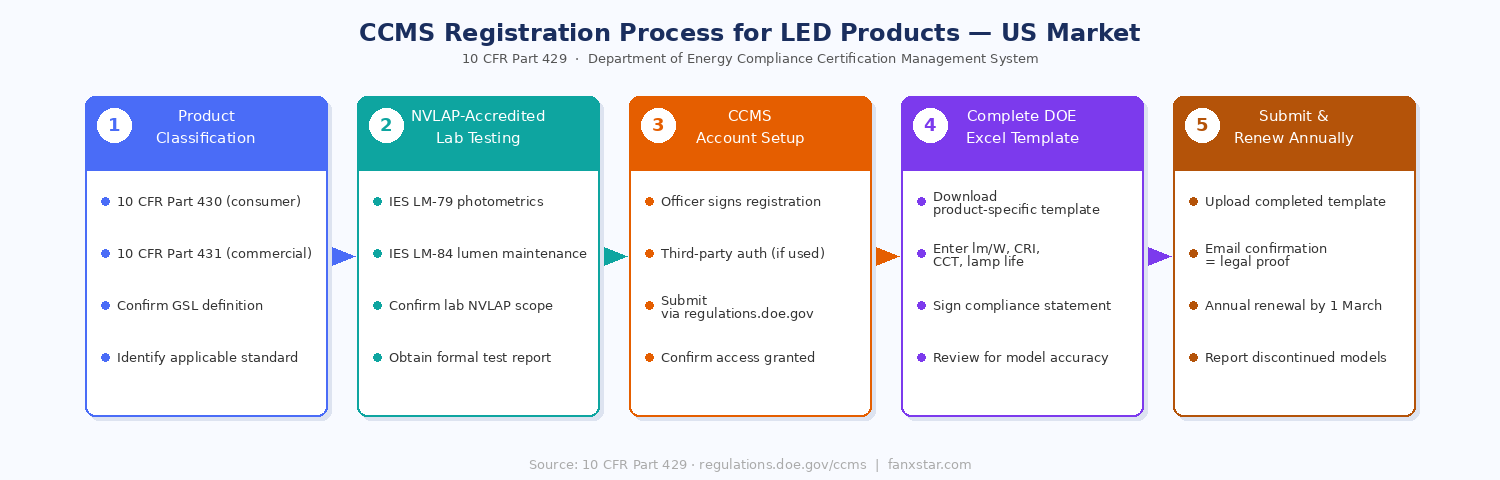
The Five-Step CCMS Registration Process
Step 1: Confirm Product Classification
Before any testing or registration, confirm the correct product classification under 10 CFR Part 430 (consumer products) or Part 431 (commercial and industrial equipment). The classification determines which energy conservation standard applies, which testing procedure must be used, and which DOE certification template is required. For LED products, the most commonly relevant classifications are: General Service Lamps (§ 430.32(dd)), Integrated LED Lamps (§ 429.56), and commercial LED equipment under Part 431. Misclassification is a common early error that can invalidate an entire certification submission.
Step 2: Test with an NVLAP-Accredited Laboratory
Certification reports must be based on testing conducted in accordance with the applicable DOE test procedure — for LED lamps, this means IES LM-79 (electrical and photometric measurements) and, for lumen maintenance claims, IES LM-84 or LM-80 data from accredited laboratories. For DOE purposes, testing must be conducted by a laboratory accredited under NIST’s National Voluntary Laboratory Accreditation Program (NVLAP) for the Energy Efficient Lighting Products program, or a laboratory accredited by an ILAC MRA-signatory body with the specific test scope. Chinese LED manufacturers frequently use SGS, Intertek, TÜV, or other accredited labs in China for this testing — as long as the laboratory’s NVLAP or ILAC accreditation scope covers the specific test methods, the test data is acceptable for CCMS submission.
Step 3: Register for CCMS Access
Access to the CCMS submission portal requires a registration form signed by an officer of the company, submitted to DOE at regulations.doe.gov. If a third party (such as a trade association, test laboratory, or compliance consultant) will submit reports on the manufacturer’s behalf, a separate Third Party Authorization form must be filed — signed by the authorizing executive of the manufacturer company. Third party submitters reduce administrative burden but do not reduce the manufacturer’s legal responsibility; the manufacturer remains legally accountable for the accuracy and completeness of every certification report, regardless of who submits it.
Step 4: Complete the DOE Excel Template and Compliance Statement
Product-specific Excel certification report templates are available at regulations.doe.gov/ccms/templates.html. These templates collect performance data (lumen output, wattage, efficacy in lm/W, power factor, CRI, CCT, lamp life), model identifiers, testing laboratory information, and the compliance statement — a legally binding declaration, signed by a company official, that the reported data is true, accurate, and complete, and that all models comply with the applicable energy conservation standard. The compliance statement carries legal weight under the Energy Policy and Conservation Act; false statements expose signatories to additional liability.
Step 5: Submit and Renew Annually by 1 March
Completed templates are uploaded to CCMS via the online portal. The system automatically sends an email confirmation upon submission — this email is the manufacturer’s proof of having met the regulatory requirement. Annual re-certification must be filed by 1 March each year for products remaining in current production. Discontinued models must be reported in the annual report following the cessation of production and sales.
CCMS vs. Other US Lighting Requirements
| Requirement | Governing Body | Mandatory? | What It Covers |
|---|---|---|---|
| CCMS Certification | DOE (10 CFR Part 429) | Yes — before distribution | Energy efficiency compliance; energy conservation standards |
| UL/ETL Safety Listing | UL Solutions / Intertek (NRTL) | Required by most AHJs | Electrical safety; required for NEC-compliant installation in most jurisdictions |
| FTC Lighting Facts Label | FTC (16 CFR Part 305) | Yes — for covered GSLs | Consumer disclosure; lumen output, watts, life, CCT, CRI — fulfillable via CCMS submission |
| ENERGY STAR | EPA | Voluntary | Enhanced performance verification for rebate eligibility and utility programme participation |
| DLC QPL Listing | DesignLights Consortium | Voluntary | Commercial lighting efficiency; required for commercial utility rebates in most US states |
| FCC Part 15 | FCC | Yes — for RF-emitting products | Electromagnetic interference; required for LED drivers with switching power supplies |
Common Failure Modes in CCMS Compliance
No Registration at All
The most straightforward failure mode: distributing covered products in the US without any CCMS registration. This is most common among importers and private labelers who assumed that their Chinese supplier’s certifications covered their compliance obligations. They do not. Every brand distributing covered products in the US must have its own CCMS registration and certification reports, regardless of what certifications exist at the manufacturing factory level.
Expired Certification
Annual renewal by 1 March is a hard deadline. Products distributed in the period between a missed annual renewal deadline and a late submission are technically in violation of 10 CFR 429.12 for that distribution period. Companies managing large SKU portfolios sometimes miss individual product line renewals due to staff turnover, systems gaps, or oversight. A documented internal calendar system with ownership assigned to specific models reduces this risk.
Model Mismatch Between Certificate and Current Production
When a product’s driver is updated, wattage adjusted, or LED chip platform changed, the existing CCMS certification may no longer accurately represent the current product. Under DOE rules, the “represented value” of a product’s performance must reflect actual current production units. If the certified efficacy was achieved with a driver that has since been changed to a lower-cost component, the certification is no longer accurate — and continuing to sell the product under the original certification creates enforcement exposure.
Non-NVLAP Laboratory Data
Test data used for CCMS certification must come from laboratories with the appropriate accreditation. Photometric test reports from Chinese laboratories without NVLAP or equivalent ILAC MRA accreditation for the relevant test methods cannot form the basis of a compliant CCMS submission. This is a particularly common issue for companies that have used in-house testing or lower-cost Chinese labs that hold ISO 9001 quality management certification but not NVLAP accreditation for the specific LM-79 test scope.
Frequently Asked Questions
Does CCMS apply to industrial LED luminaires, or only replacement lamps?
CCMS applies to both, but under different regulatory parts. General Service Lamps (replacement bulbs) fall under 10 CFR Part 430, which covers consumer products. Commercial LED lighting equipment — including high-bay luminaires, troffer replacements, and other commercial-class fixtures — falls under 10 CFR Part 431 (commercial and industrial equipment). The specific covered equipment categories and their applicable energy conservation standards are defined in Part 431 subparts. Not all industrial LED luminaire categories are currently subject to a promulgated standard — check the current DOE coverage list to confirm whether a specific commercial luminaire type has an applicable standard requiring CCMS certification.
Can my Chinese manufacturer certify CCMS on my behalf?
Only if the product is being sold in the US under the manufacturer’s own brand name. If the product is being sold under your private label or brand, you are the manufacturer for CCMS purposes and must certify the products yourself (or use an authorized third-party submitter with a Third Party Authorization form on file with DOE). The Chinese factory’s CCMS registration for their branded products does not extend to products sold under your brand. This is a firm legal boundary under 10 CFR 429.12.
If my product exceeds the energy conservation standard by a large margin, do I still need to certify?
Yes. CCMS certification is required regardless of how much a product exceeds the minimum standard. The certification obligation is not contingent on the product being close to the efficiency threshold — it applies to all covered products in scope. The certification process is also how DOE verifies that represented efficacy values are based on real test data rather than manufacturer claims, which is a separate value from mere compliance with the minimum standard.
What is a “basic model” for CCMS purposes?
A basic model is a group of individual products that are essentially identical in function, design, and energy characteristics, but may differ in non-energy-related attributes such as colour, finish, or packaging. The critical insight for certification planning: products that differ in wattage, CCT, lumen output, or driver design are typically separate basic models requiring separate certification report entries — they cannot be grouped as a single basic model even if they share a common housing platform. When in doubt, DOE’s default position is to treat products with different certified efficacy representations as separate basic models.
Preparing LED products for the US market?
Fanxstar’s OEM/ODM team has experience preparing technical documentation packages for international markets, including photometric data from accredited laboratories and product specifications aligned with regulatory requirements. Learn about our OEM/ODM engineering services or contact us to discuss your US market entry documentation needs.