Factory managers today stand at a critical crossroads. As aging infrastructure meets aggressive sustainability mandates and Industry 4.0 demands, the “retrofit or replace” decision has shifted from a simple maintenance question to a high-stakes strategic pivot. For many U.S. manufacturers, the “wait and see” approach is no longer viable; the path chosen today impacts long-term profitability and the factory’s license to operate in a decarbonizing economy.
Key Takeaways
-
Economic Tipping Point: When modernization costs exceed 50-60% of new construction value, or structural limits (like ceiling height) hinder automation, replacement is often the pragmatic choice.
-
Decarbonization Efficiency: Retrofitting can reduce embodied carbon by up to 60%, making it a primary strategy for meeting Net Zero 2030 targets.
-
Energy Impact: Lighting retrofits alone can reduce energy use by 25-35%, while deep HVAC retrofits can cut consumption by up to 80%.
-
Operational Continuity: Phased retrofits and “Bluefield” migration patterns minimize “dark days,” allowing production to continue while systems are upgraded.
-
ROI of Intelligence: Integrating IoT and AI-driven controls provides a faster path to ROI than total replacement, often reducing Energy Use Intensity (EUI) by over 40%.
Understanding the Core Concepts
What Is a Factory Retrofit?
Retrofitting means updating existing equipment with new technology without removing the original infrastructure. It involves adding advanced features—such as digital controls, smart sensors, or energy-saving LED components—to older machines. This approach is highly cost-effective and reduces downtime, making it ideal for facilities that require gradual modernization within a limited budget.
What Does System Replacement Entail?
Replacement involves acquiring entirely new equipment and infrastructures when the current systems can no longer support modern operations or meet safety regulations. It usually means a “blank slate” start, allowing for the integration of high-bay robotics, advanced smart automation, and compliance with the latest environmental standards from day one.

Key Decision Factors for Factory Upgrades
1. Cost and Capital Expenditure (CapEx)
Retrofitting usually requires less upfront investment and avoids major spending on new machinery. However, managers must balance short-term savings with long-term profitability. A “Deep Retrofit” (costing $15 – $50+ per square foot) can achieve 30% – 60% energy savings with a payback period of 5-10 years. In contrast, replacement has a higher initial cost but may lower the total cost of ownership by drastically reducing maintenance and energy waste over 20+ years.
2. Sustainability and Decarbonization
The built environment is responsible for about 42% of global CO2 emissions. Existing building reuse significantly reduces carbon emissions compared to new builds by preserving “embodied carbon”—the energy already spent on existing concrete and steel. Meeting Net Zero 2030 targets often favors the retrofit path unless the old structure is so inefficient that it cannot support renewable energy integration.
3. Operational Continuity and “Bluefield” Migration
The greatest deterrent to modernization is the specter of “dark days.” A strategic retrofit allows for phased modernization, whereas a total replacement risks supply chain disruption. Many managers now use “Bluefield” migration patterns, migrating mission-critical operations in parallel with the retrofit to achieve nearly zero downtime.
4. Worker Productivity and Lighting Quality
Upgrading to commercial LED lighting has a direct impact on the bottom line. Studies show an 8.3% improvement in visual tasks and a 15% drop in absenteeism after high-quality lighting upgrades. Furthermore, flicker-free lighting and automation features support a safer, more comfortable work environment that reduces error rates in production processes.
|
Upgrade Method |
Energy Savings (%) |
Est. Payback Period |
Lifespan Added |
|---|---|---|---|
|
LED Lighting Retrofit |
25% – 35% |
6 months – 2 years |
10+ years |
|
Control System Retrofit |
15% – 25% |
2 – 4 years |
10 – 15 years |
|
Full System Replacement |
50% – 70% |
7 – 12 years |
25 – 50+ years |
Technical Limits: When Replacement is Pragmatic
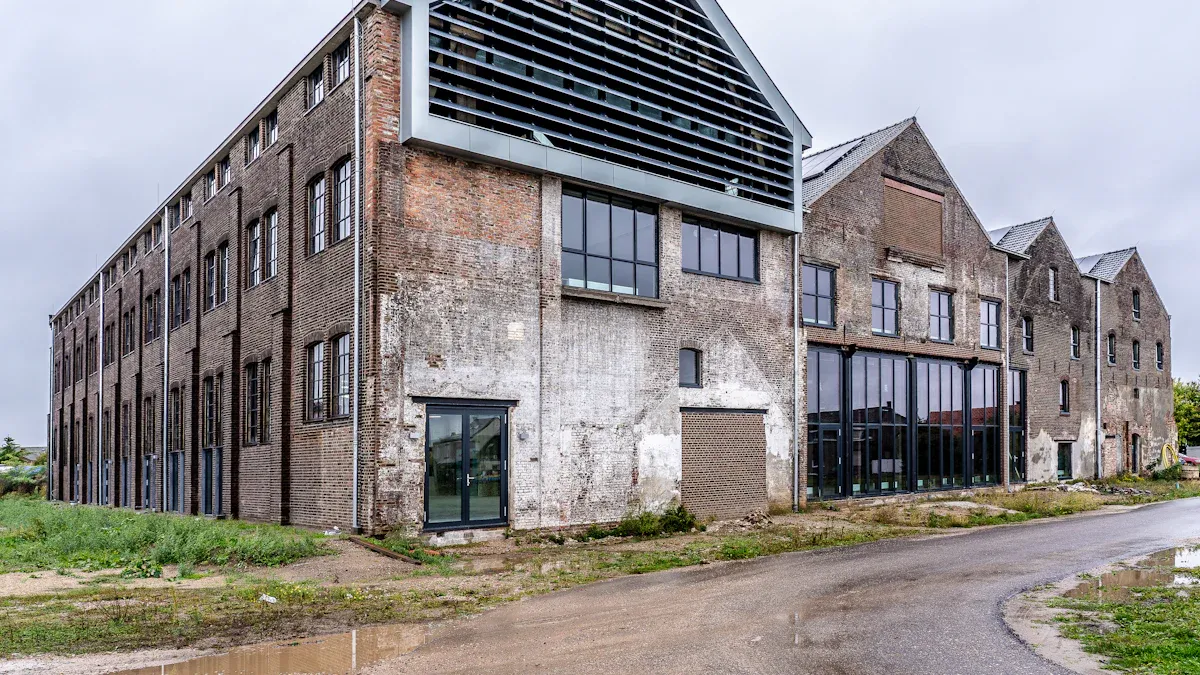
Despite the benefits of retrofitting, factories reaching the 40-to-50-year mark often encounter “structural dead ends.” You should consider full replacement if:
-
Ceiling Height/Column Spacing: The old layout prevents the installation of modern overhead cranes or high-density robotic cells.
-
Foundation Capacity: The ground cannot support the vibration or weight of modern Industry 4.0 machinery.
-
Modernization Cost Tipping Point: If modification costs approach 60% of new build costs, the replacement cost typically offers a higher ROI through optimized workflow and reduced insurance premiums.
-
Regulatory Compliance: Aging components fail to meet critical safety standards like IEC 62061 or ISO 13849, and cannot be economically brought up to code.
The Role of IP Ratings and Harsh Environments
For factories in the food, chemical, or mining industries, durability is non-negotiable. When choosing fixtures—whether for retrofit or replacement—managers must prioritize IP (Ingress Protection) ratings and impact resistance. High IP ratings (e.g., IP65, IP66, IP69K) protect lighting systems from dust, water, and high-pressure hosedowns. Modern waterproof batten solutions offer tool-free maintenance and high IK ratings, ensuring that the investment survives the harsh reality of industrial production.
Strategic Decision-Making Checklist
Facility managers can use this expert checklist to bridge the gap between initial reactions and final investment decisions:
-
Assess Structural Integrity: Can the existing shell support new automation loads and HVAC ductwork?
-
Map Stakeholder Tolerance: Can the business survive a 6-12 month halt for a new build, or is phased retrofitting required for continuity?
-
Analyze Lifecycle Modeling: Does the embodied carbon saving of a retrofit outweigh the operational efficiency of a new build over 20 years?
-
Evaluate “Intelligence” Needs: Is it a root problem (structural) or a symptom (outdated controls)? Band-aids on terminal structural issues provide no ROI.
-
Review Compliance Fines: Factor in the cost of doing nothing—including regulatory penalties and rising maintenance “creep” on legacy parts.
“Retrofitting is like putting a modern engine in an old truck; it runs better, but some old parts remain. Replacing is like buying a new truck built for today’s roads, with advanced automation and safety features already integrated.”
FAQ
1. How does retrofitting help with Net Zero 2030 targets?
Retrofitting preserves the embodied carbon present in the building’s concrete and steel. By avoiding new construction, you eliminate the massive carbon spike associated with new materials while upgrading systems to be highly energy-efficient.
2. When is a factory “too old” to retrofit?
Age is less important than layout. If a building’s column spacing or ceiling heights cannot accommodate modern robotics, it has reached a structural dead end where replacement is more cost-effective.
3. How much can lighting quality affect productivity?
High-quality LED lighting improves visual acuity and reduces fatigue. Studies show that lighting upgrades can boost productivity by 6% to 15% and significantly lower error rates in production lines.
4. Are smart systems only possible with full replacement?
Not at all. Many smart features, like automated emergency testing, motion sensors, and daylight harvesting, can be integrated into existing systems through modular retrofits.
5. What role do IP ratings play in industrial upgrades?
IP ratings define the fixture’s resistance to dust and moisture. In harsh industrial environments, choosing high IP-rated fixtures is essential for safety, durability, and minimizing maintenance downtime.