The cost of replacing ballasts is rarely just the price of a new ballast. A commercial buyer also pays for labor, access equipment, lamps, disposal, downtime, repeat failures, compatibility risk, and the lost opportunity to move the space to a cleaner LED platform. The decision is not whether one failed fluorescent fixture can be repaired. The decision is when repair has become a more expensive path than retrofit or replacement.
A useful ballast-cost decision separates three choices: keep repairing the old fluorescent system, install an LED retrofit that still depends on part of the existing fixture ecosystem, or replace the luminaire with an LED platform designed for the application.
Key Takeaways
- Ballast replacement cost should include labor, access, repeat visits, lamps, disposal, downtime, and energy use, not only the hardware.
- Type A LED tubes can be fast but still depend on ballast compatibility and future ballast health.
- Type B or Type C retrofits remove or change the ballast dependency but introduce wiring, safety, and documentation requirements.
- When many fixtures are old, dirty, inaccessible, or mismatched to the task, full LED luminaire replacement often becomes the cleaner B2B decision.
Why Ballast Replacement Looks Cheap but Ages Poorly
The invoice hides repeat access cost
A ballast repair can look attractive when one fixture fails. The material cost may be lower than a new luminaire, and the team may already know how to perform the repair. That view changes when the buyer looks at the ceiling as a fleet. If 200 fixtures are the same age, one failed ballast can be the first signal of a wider maintenance cycle. The real comparison becomes one truck roll versus a planned upgrade, not one part versus another part.
DOE guidance on upgrading linear fluorescent fixtures to LED notes that LED systems can reduce energy consumption, maintenance and operation costs, and improve lighting quality compared with most fluorescent systems. It also points out that fluorescent equipment may become harder or more expensive to replace as manufacturers reduce fluorescent production. That long-term supply angle is exactly why a ballast repair should be treated as a life-cycle decision.
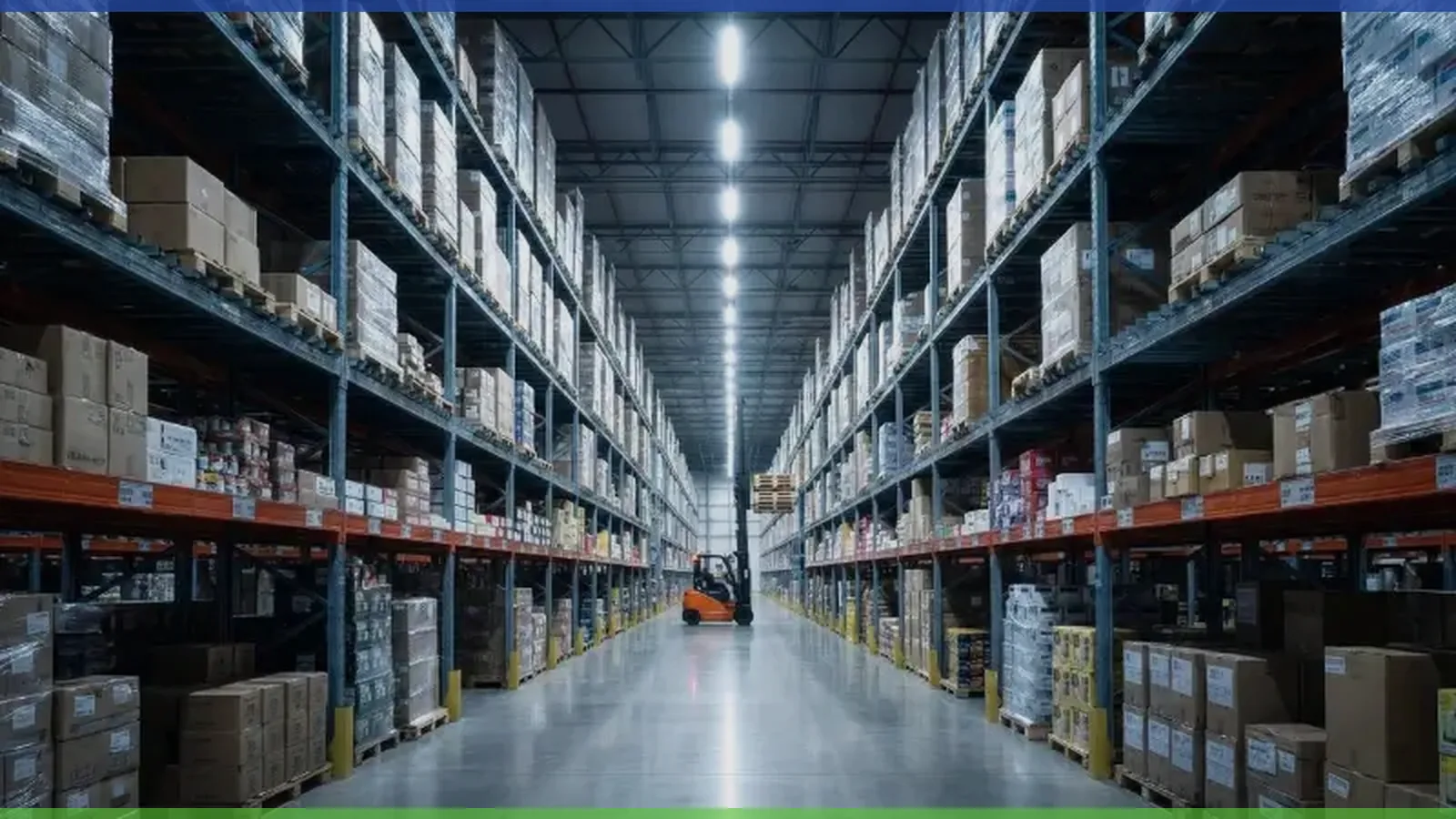
Access can dominate the cost. A ballast above a warehouse aisle, cold room, high-bay service corridor, parking deck, supermarket sales floor, or active production line may require a lift, lockout planning, night work, sanitation coordination, or traffic control. The invoice for one ballast does not show the management time and disruption needed to reach it. When access is expensive, avoiding future visits can justify a larger upgrade.
Energy price changes make old wattage harder to ignore
The energy side also matters. EIA lists 2025 U.S. average retail electricity prices at 13.41 cents per kWh for commercial customers and 8.62 cents per kWh for industrial customers. Local rates vary, but the calculation method is stable: watts saved times operating hours times electricity price. In a facility running long hours, a small wattage difference across many fixtures can outweigh the apparent savings from another ballast repair.
The buyer should model two baselines. First, what does the old fluorescent system cost if repaired and operated for another three to five years? Second, what would an LED retrofit or replacement cost over the same period? Include electricity, labor, parts, disposal, and access. The second baseline often exposes that the cheapest part today is not the cheapest system tomorrow.
The Four Upgrade Paths Buyers Should Compare
Path 1: Replace the ballast and keep the fluorescent system
This path can be reasonable when the building has a short remaining lease, very few failures, available replacement parts, acceptable light quality, and no near-term renovation. It is less attractive when failures are recurring, lamps are aging, fixtures are dirty or yellowed, or access is difficult. A ballast replacement does not solve old lenses, poor distribution, mercury lamp disposal, poor controls, or mismatched light levels.
The buyer should also consider whether the old system still supports the work being done. A warehouse converted to e-commerce picking, a school converted to flexible learning, or a food site with stricter sanitation expectations may no longer be well served by old fluorescent optics. Repairing the ballast restores the old system; it does not improve the system.
Path 2: Type A LED tubes with the existing ballast
DOE LED troffer retrofit guide explains that Type A tubular LED lamps operate with the existing fluorescent ballast and can be installed with little mechanical or electrical change. That can make them fast, especially where labor is the main constraint. The limitation is that the ballast remains part of the operating system. If compatibility is poor or the ballast later fails, the buyer may face another visit.
Type A can be useful for staged retrofits, leased spaces, or projects where minimum disruption is the priority. It should not be sold internally as the same life-cycle decision as a new LED luminaire. The buyer still needs compatibility lists, ballast condition checks, light-level confirmation, and a plan for what happens when old ballasts fail after the lamps are installed.
Path 3: Type B or Type C retrofit
Type B and Type C approaches remove or change the ballast dependency. The OSTI record for DOE best practices on upgrading fluorescent troffers to LED describes guidance that considers installation costs, operating costs, desired light levels, and performance criteria. These paths can improve long-term control over the system, but they require qualified electrical work, labeling, wiring discipline, and documentation so future maintenance crews understand what is inside the fixture.
The risk is not only installation cost. It is future confusion. A building with mixed Type A, Type B, fluorescent, and new LED fixtures can become a maintenance trap if drawings, labels, and spares are not controlled. For multi-site buyers, standardization may be worth more than a small material saving.
Path 4: Replace the complete luminaire
Complete LED luminaire replacement becomes stronger when the old housing, lens, reflector, socket, ballast, thermal path, or controls interface is already weak. New fixtures can also align optics, sensors, emergency functions, corrosion protection, and service access around the current application. The trade-off is higher upfront cost and more planning. The reward is a cleaner platform with fewer inherited constraints.
For industrial and commercial sites, this path is often easier to justify when lighting quality and access risk matter as much as energy. A new linear platform for a warehouse aisle, vapor tight fixture for a food plant, or sensor-ready parking fixture can remove several old-system problems at once.
Hidden Costs That Belong in the Ballast Decision
Disposal and legacy ballast risk can change the answer
Older fluorescent systems can create disposal and safety considerations. EPA guidance on PCB-containing fluorescent light ballasts recommends removing PCB-containing ballasts as part of a complete lighting retrofit, and also notes that fluorescent bulbs may contain mercury. EPA current page on PCB-containing fluorescent light ballasts continues to advise removal of PCB-containing fluorescent light ballasts from fixtures in relevant buildings. A buyer does not need to become a hazardous-waste expert to recognize the procurement implication: old lighting work should include a responsible removal and disposal plan.
Even when PCB risk is not present, disposal logistics can still matter. Lamps, ballasts, packaging, access equipment, and night labor are real costs. If a site handles food, medicine, public operations, or clean manufacturing, the timing and containment plan can matter as much as the electrical parts.
Lighting controls can shift the payback
A ballast repair normally restores on/off fluorescent operation. An LED platform can add dimming, occupancy sensing, daylight response, emergency behavior, or zone control. These features are not free, and they should not be added blindly, but they can change payback in spaces with long idle periods or varying occupancy. Fanxstar’s industrial lighting controls guide is useful when the upgrade decision also involves sensors, dimming, or zone planning.
Controls should be modeled separately from wattage reduction. If the old fluorescent system runs 14 hours per day and the new LED system runs fewer full-output hours because of sensors, the buyer needs to show both effects. That separation prevents overclaiming and helps decide whether a basic LED fixture, sensor-ready fixture, or networked control system is appropriate.
A Practical Cost Model for B2B Buyers
Use a three-year repair-versus-upgrade view
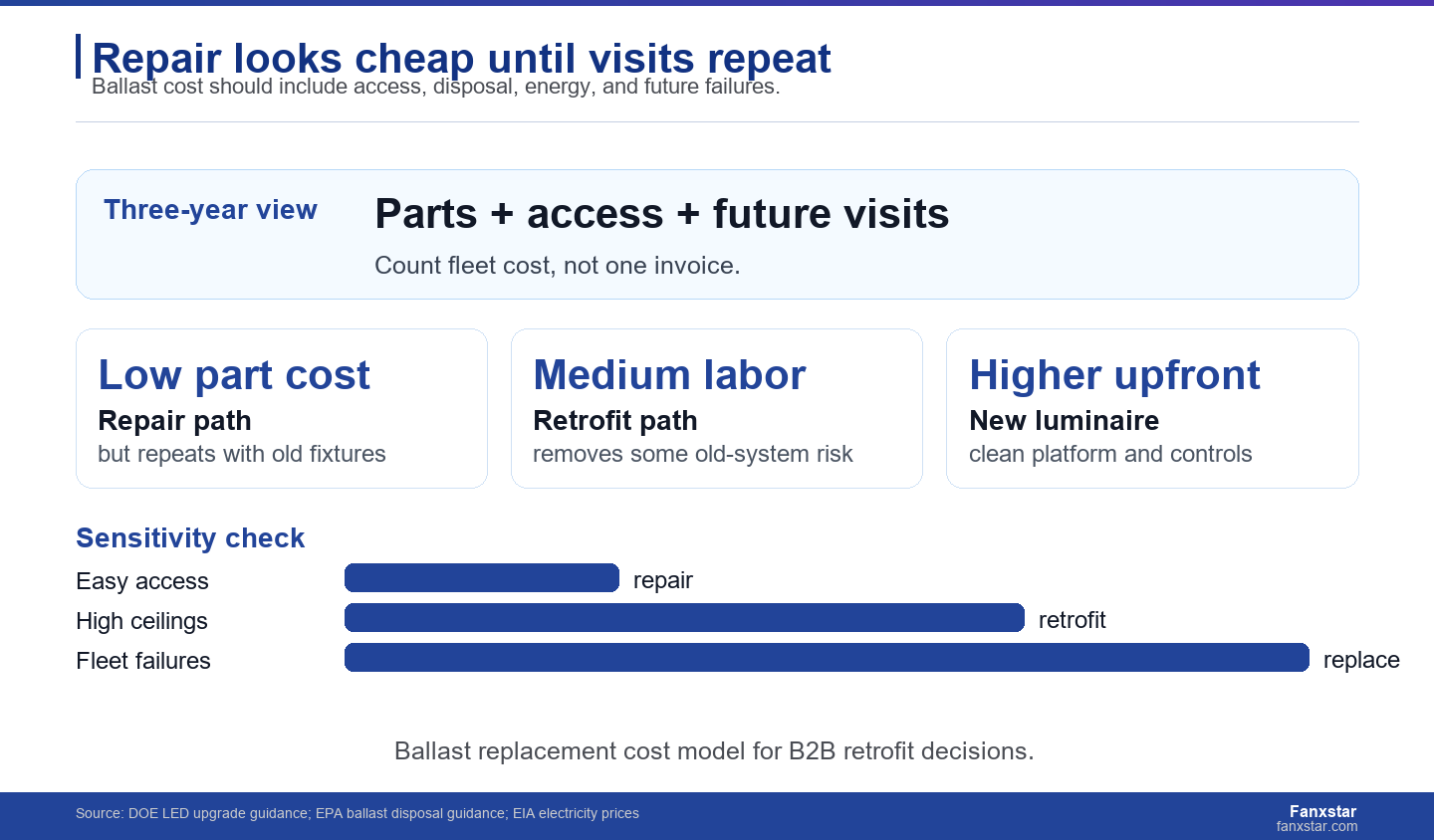
Start with a simple three-year worksheet. Count fixtures, average wattage, operating hours, electricity rate, expected ballast failures, access cost per visit, ballast and lamp material, disposal cost, and expected upgrade cost. Then compare total cost for three paths: repair as failures occur, planned LED retrofit, and complete LED replacement. The goal is not perfect forecasting. The goal is to make hidden assumptions visible before the team spends money one fixture at a time.
For example, if a facility has 120 old fixtures and expects 20 ballast-related visits over three years, the access and labor cost alone may justify a planned project. If the site also runs long hours, the energy difference pushes the decision further toward LED. If the building is temporary or has very low annual hours, repair may remain rational. The calculation should decide, not a slogan.
Make the worksheet honest by adding failure clustering. Ballasts installed in the same renovation often age together, so a repair history that looks random in month one can become a wave in year two. Also include the cost of visual inconsistency. Replacing lamps and ballasts one area at a time can leave mixed color, uneven output, and different maintenance histories across the same facility. Those are not just appearance issues when workers use the space for inspection, picking, cleaning, or public access.
Do not ignore light level and distribution
DOE’s school-focused guidance is still useful beyond schools because it warns buyers to consider light levels, fixture output, distribution, and controls when upgrading fluorescent systems. A retrofit that saves energy but creates glare, dark aisles, or uneven shelves can create operational complaints. A new luminaire with the right optics can solve those problems, but only when the buyer shares mounting height, task plane, aisle layout, and reflectance assumptions.
For warehouses and commercial sites, align the retrofit plan with the task. A backroom, parking garage, logistics aisle, supermarket prep area, and data-center service corridor all have different priorities. The most economical choice is the one that meets the task for the longest period with the fewest unplanned visits.
Fanxstar Application Fit
Fanxstar buyers comparing ballast replacement against LED retrofit can start from linear lighting platforms, warehouse and logistics LED lighting guidance, parking garage LED lighting guidance, and food-processing lighting guidance. Those pages help translate the cost question into fixture form: linear aisle lighting, vapor tight washdown fixtures, parking fixtures, emergency-capable products, or sensor-ready platforms.
For an ODM or multi-site procurement, share the fixture count, old lamp type, mounting height, operating hours, access limits, target market, control preference, and failure history before asking for a quote. Fanxstar can then help compare whether the project should stay close to the old fixture geometry, move to a retrofit-like platform, or shift to a new LED luminaire family through customization support.
FAQ
Is replacing a ballast cheaper than replacing the whole fixture?
For one easy-to-reach fixture, often yes. For a facility with many aging fixtures, repeat failures, long operating hours, or high access cost, the life-cycle cost can favor LED retrofit or complete luminaire replacement.
Are Type A LED tubes always the easiest upgrade?
They can be fast because they use the existing ballast, but that also means compatibility and future ballast health matter. The buyer should check ballast lists, operating conditions, light levels, and the plan for future failures.
When does full luminaire replacement make more sense?
It makes more sense when old housings, lenses, sockets, ballasts, optics, controls, or access conditions are already weak. It is also stronger when the site needs better distribution, sensors, sealing, emergency options, or standardization across many fixtures.
Should disposal be included in the retrofit budget?
Yes. Fluorescent lamps and some old ballasts can require controlled handling. Include removal, disposal, documentation, and work scheduling in the project budget instead of treating them as afterthoughts.
What information should a buyer send before requesting an LED replacement plan?
Send fixture count, old lamp and ballast type, mounting height, operating hours, photos, access restrictions, electricity rate if available, target light level, control needs, emergency requirements, and the expected project horizon.