T8 fluorescent tubes are obsolete for many parking garages because the problem is no longer just replacing a lamp. Garage owners need uniform light, low maintenance, sensor zoning, emergency-route visibility, lower operating cost, cold-start reliability, and fewer service disruptions. A fluorescent tube in an old housing cannot easily deliver that full system value, especially when the garage operates long hours and maintenance access is expensive.
According to FEMP purchasing guidance for commercial and industrial LED luminaires, federal acquisition guidance includes commercial and industrial LED luminaire categories such as indoor linear ambient, high-bay, low-bay, and troffers. According to ENERGY STAR lighting upgrade guidance, commercial lighting upgrades include parking garage lighting among the applications where LEDs can reduce electricity use. Those sources point buyers toward luminaire-level decisions, not only tube-level substitution.
Key Takeaways
- T8 fluorescent tubes are often the wrong baseline for garage upgrades because they keep buyers focused on lamps instead of visibility, controls, and service risk.
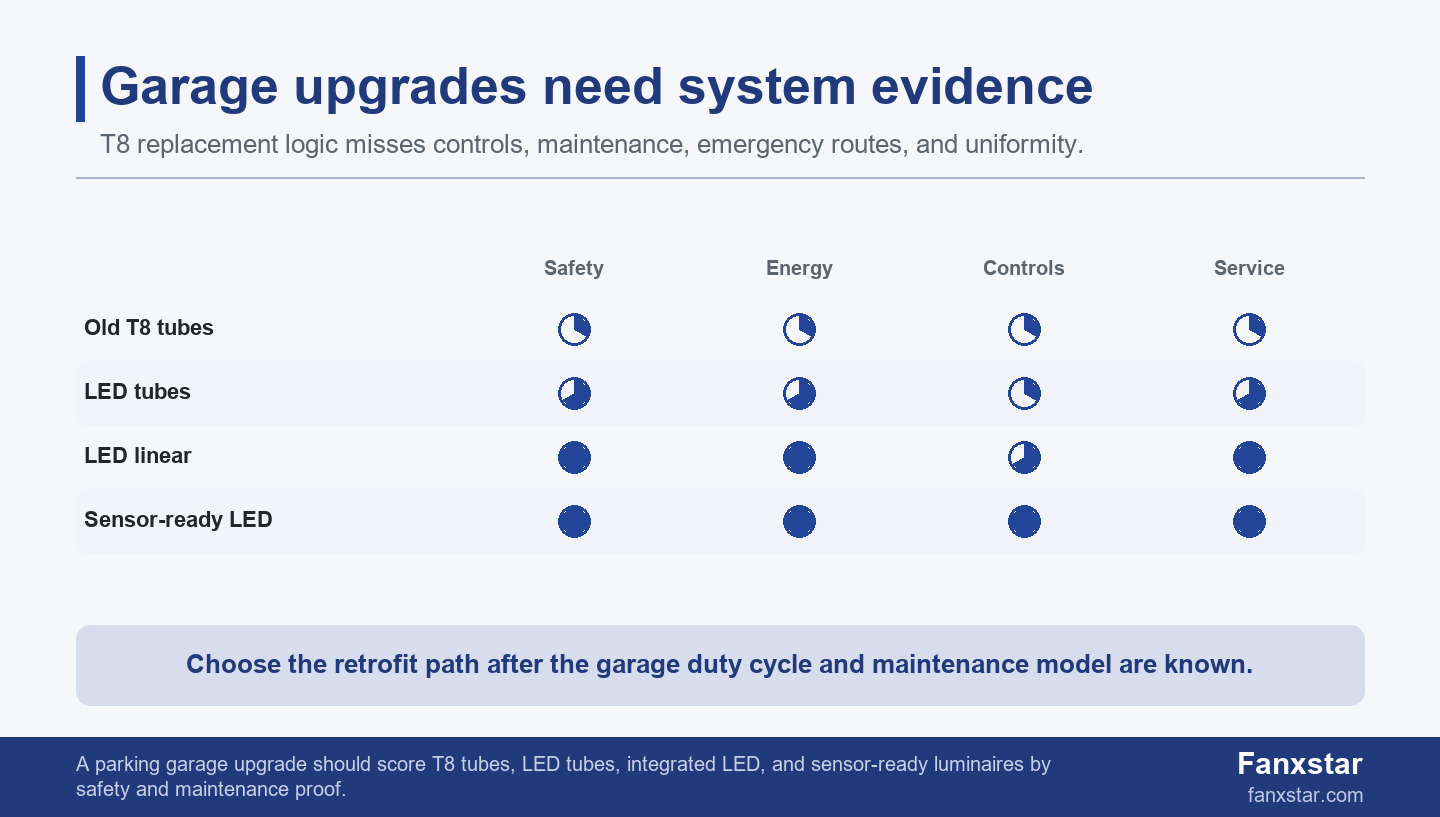
- LED tubes can be a transitional choice, but integrated LED linear or sensor-ready luminaires usually give better control over optics, sealing, wiring, and maintenance.
- A parking garage LED upgrade should compare energy, uniformity, sensor zones, emergency routes, installation labor, and future service access.
- Fanxstar is most relevant when the garage needs weatherproof linear platforms, sensor options, emergency-aware planning, or a custom retrofit package.
Why T8 Fluorescent Tubes No Longer Fit Many Parking Garages
The old lamp-replacement question is too small
A parking garage is a long-hour, public-facing, maintenance-sensitive environment. Fixtures may run 12 hours, 18 hours, or even 24 hours per day depending on the facility. Light quality affects driver confidence, pedestrian visibility, camera performance, and perceived safety. Maintenance affects lane closures, lift access, labor cost, and tenant complaints. A T8 fluorescent tube comparison usually ignores these system-level factors.
According to GSA LED lighting and controls guidance, LED and control decisions should be considered around life-cycle cost and energy efficiency. That is the correct frame for garages. A cheap tube that leaves poor controls, old sockets, weak optics, or high service frequency may not be cheaper over the real operating period.
The key question is not whether an LED tube can fit into a T8-style opening. The better question is whether the final system gives the garage the light distribution, dimming or sensor behavior, emergency-route support, weather resistance, and maintenance access it needs. If the answer is no, the old T8 housing is setting the wrong boundary for the project.
Fluorescent weaknesses become visible in garage duty cycles
Fluorescent systems can suffer from lamp aging, ballast issues, cold-temperature behavior, flicker complaints, broken sockets, and repeated relamping. Parking garages amplify these weaknesses because fixtures are numerous, mounted overhead, and exposed to dust, humidity, vibration, vehicle exhaust, and open-air temperature changes. Even if a single lamp is inexpensive, the repeated service cost can be high.
According to International Trade Administration import regulations guidance, import rules and documentation can vary by country and product type. Parking garage LED upgrades are often purchased as commercial building products, so the buyer should confirm market documentation before shipment instead of assuming that a lamp replacement invoice is enough for every fixture, driver, sensor, or emergency option.
| Retrofit path | Best use case | Main risk |
|---|---|---|
| LED tube in existing body | low-disruption relamp with known fixture condition | old socket, ballast bypass, thermal, and wiring quality |
| Integrated LED linear fixture | garage needs better uniformity and lower service burden | requires layout and mounting review |
| Sensor-ready LED luminaire | garage has variable occupancy and long operating hours | needs zoning, hold time, and commissioning plan |
| Emergency-aware upgrade | public routes, exits, or high-consequence areas | must align with local code and emergency system design |
LED Tube, Integrated LED, or Sensor-Ready Fixture?
LED tubes are not always wrong, but they are limited
LED tubes can make sense when the existing fixture body is in good condition, the wiring path is clear, the garage wants minimal disruption, and the buyer understands ballast compatibility or bypass requirements. They are less attractive when housings are corroded, lenses are yellowed, sockets are weak, or the garage wants better optical distribution and sensor zoning. The buyer should inspect the old fixture before deciding that a tube replacement is enough.
According to DLC solid-state lighting technical requirements, commercial LED products are evaluated through defined categories and technical requirements. For garage buyers, this supports a simple rule: compare the finished installed system. A tube in an old housing, a new integrated linear luminaire, and a sensor-ready weatherproof fixture are not the same product category in practical operation.
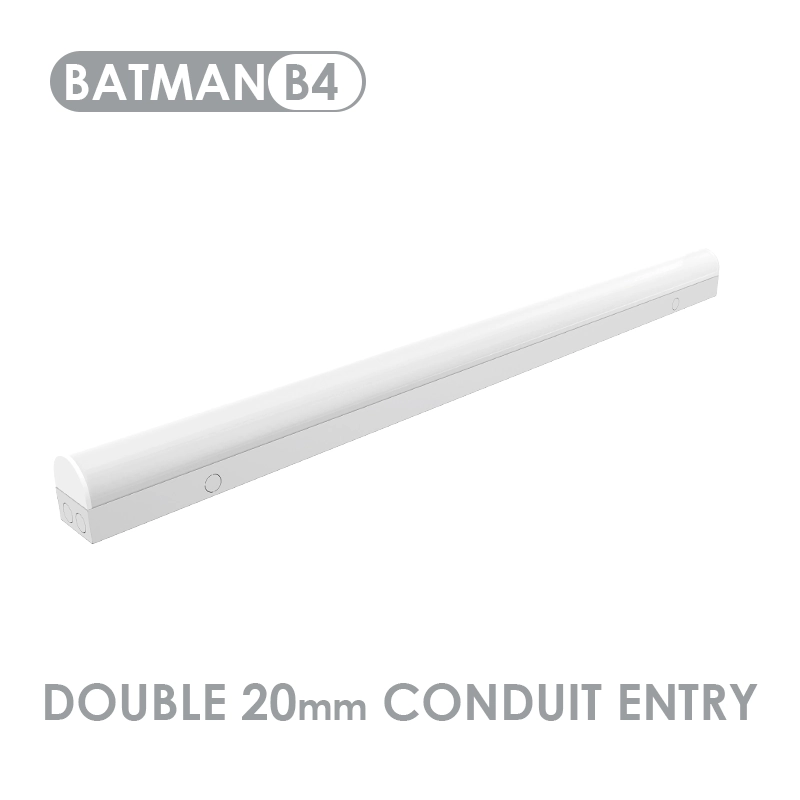
If the old fixture has poor spacing, poor lens condition, or glare, changing only the lamp may preserve the same visual problem with a new light source. Integrated LED luminaires give the buyer more control over optics, driver, sealing, cable entry, sensor mounting, and emergency options. That extra control matters when the garage is public, open to weather, or difficult to service.
Sensor-ready LED fixtures change the operating model
Many garages do not need every zone at full output all night. Entrances, ramps, pedestrian paths, elevator lobbies, and occupied decks can be separated into zones. A sensor-ready LED system can hold background light and raise output when occupancy is detected, if local code and safety requirements permit. That kind of operation is difficult to achieve cleanly with a simple fluorescent relamp.
According to FEMP LED luminaire purchasing guidance, LED purchasing guidance considers commercial and industrial luminaire categories rather than treating light sources as isolated components. A garage upgrade should do the same. The buyer should specify fixture type, output, distribution, controls, sensor location, emergency boundary, and commissioning plan before comparing price.
How to Build the Parking Garage LED Upgrade Checklist
Start with the garage map
Before selecting fixtures, map the garage into use zones: entry, exit, ramp, parking bay, pedestrian route, elevator lobby, stair approach, payment area, service room, and exterior transition. Each zone may need different light level, distribution, glare control, emergency behavior, and sensor logic. A single tube replacement approach often ignores those differences and treats the garage as one large ceiling.
The checklist should include mounting height, fixture spacing, existing circuiting, available conduit, ceiling exposure, moisture or corrosion risk, camera locations, sensor line of sight, emergency route, operating schedule, and maintenance access. If the garage remains open during retrofit, installation phasing and disruption risk should also be part of the purchase decision.
According to ENERGY STAR lighting upgrade guidance, LEDs can greatly reduce electricity used in commercial buildings. For garages, the value is stronger when energy reduction is combined with lower relamping, better controls, and fewer maintenance closures. A pure watt comparison misses much of the upgrade value.
Ask for evidence that matches the installed product
A garage buyer should request photometric files, wattage, delivered lumen output, CCT, CRI, distribution, driver details, surge protection if required, IP or environmental rating, sensor behavior, emergency compatibility, mounting accessories, and warranty boundary. If the fixture is weatherproof or vapor tight, ask whether the lens, clips, end caps, and cable entry are included in the rating evidence.
According to International Trade Administration import documentation guidance, shipment and import records can include several documents such as invoices, bills of lading, packing lists, and certificates of origin. The LED upgrade file should also stay aligned: the quote, approved sample, photometric data, installation drawing, packing list, and invoice should point to the same fixture version.
According to International Trade Administration special document guidance, some products may require certificates related to standards, safety, health, or other special conditions. That does not mean every parking garage luminaire needs the same file, but it does mean the buyer should ask about the target market, certificate scope, emergency function, and control gear before the order is released. A retrofit that mixes old housings, new LED tubes, bypass wiring, and sensors can create documentation gaps if no one owns the final system boundary.
For retrofit projects, the buyer should also ask what happens if the driver, sensor, LED board, lens, or mounting accessory changes during production. A substitution that saves cost can change light distribution, dimming behavior, sensor reliability, or maintenance access. Version control is not paperwork for its own sake. It protects the final garage performance.
According to the SBA import and export laws guidance, companies should understand import and export rules before international sales. The procurement insight for parking garages is that a lighting upgrade is not only a carton of lamps. It is a set of fixtures, drivers, controls, installation instructions, certificates, and service promises that must remain consistent from sample to shipment.
Where Fanxstar Fits Parking Garage LED Upgrades
Use the platform that matches garage exposure
Fanxstar buyers can start from parking garage lighting application guidance, linear LED lighting platforms, weatherproof LED lighting products, and motion sensor lighting options. For open garages, weatherproof or vapor tight linear platforms may be more suitable than a dry-location tube retrofit. For enclosed garages, optics, controls, and maintenance access may dominate the decision.
A Fanxstar garage brief should include fixture quantity, mounting height, spacing, existing lamp type, circuit map, operating hours, target CCT, sensor zones, emergency route, moisture or corrosion exposure, and installation constraints. With that information, a supplier can recommend whether the project should use a simple replacement path, integrated LED linear fixtures, or a sensor-ready weatherproof platform.
If the project involves private label, special wiring, sensor integration, emergency options, or phased replacement kits, Fanxstar custom LED lighting ODM service can define a sample package before volume production. The buyer should request a mockup or pilot zone when the garage is large, public, or difficult to service.
Define success before comparing price
Success should be written as a performance and maintenance outcome: better visibility, lower energy use, fewer service visits, reliable sensor behavior, stable emergency-route lighting, and a documented product version. Once those outcomes are defined, the price comparison becomes more honest. A cheap lamp replacement can still lose if it leaves the garage with old sockets, weak optics, no controls, and repeated access costs.
This is the main reason T8 fluorescent tubes feel obsolete in garage planning. They keep the buyer debating lamp compatibility while the real project questions are about fixture spacing, glare, sensor grouping, emergency route confidence, wet or dusty exposure, and how often maintenance teams must return. A better LED upgrade brief names those outcomes first, then allows the supplier to recommend a product platform that can actually prove them.
A practical release file includes the selected fixture, photometric layout, sensor sequence, mounting accessories, wiring note, emergency boundary, IP or environment rating, sample approval, and shipment version. When that file is complete, the buyer can retire the old T8 tube logic and manage the garage as a modern LED lighting system.
FAQ
Are T8 fluorescent tubes obsolete for parking garages?
For many garages, yes. The issue is not only lamp technology. Modern garage projects need LED efficiency, uniformity, controls, lower maintenance, emergency-route planning, and better environmental durability. A simple T8 replacement often leaves too many system problems untouched.
Are LED tubes a good parking garage retrofit?
LED tubes can work when existing housings, sockets, wiring, and spacing are in good condition and the buyer wants minimal disruption. They are weaker when the garage needs better optics, sensors, sealing, emergency options, or a lower long-term maintenance burden.
What LED fixture type is best for parking garages?
Integrated LED linear or weatherproof linear fixtures are often stronger choices than lamp-only retrofits because they control optics, driver, sealing, mounting, and sensor options together. The best type depends on mounting height, exposure, wiring, zones, and maintenance access.
What should a parking garage LED RFQ include?
Include existing fixture type, mounting height, spacing, operating hours, target CCT, sensor zoning, emergency routes, environmental exposure, installation phasing, photometric requirements, and evidence needed for the final product version.