UGR19 versus UGR22 is often presented as a simple quality ladder: UGR19 good, UGR22 acceptable, higher values bad. That shortcut is not enough for LED lighting procurement because Unified Glare Rating is an installation judgment. The real question is whether the glare target fits the task, the room, the optic, and the installed viewing angle.
Lighting Analysts describes UGR calculation as discomfort-glare prediction for interior electric lighting, while CIE notes that LED source luminance can complicate UGR prediction. That matters because a low-glare claim is strongest when it is supported by layout-specific evidence, not just a line in a product table.
Key Takeaways
- UGR19 is normally the more conservative visual-comfort target for prolonged desk, screen, or precision work, but it still needs room assumptions and photometric evidence.
- UGR22 can be reasonable for circulation, reception, backroom, service, and occasional-task zones when the installed view is not glare-sensitive.
- Buyers should not accept productivity or health-percentage claims unless the source, setting, and measurement method are clear; glare control is best treated as a comfort and task-support requirement.
- For LED linear and weatherproof fixtures, the RFQ should freeze lens, diffuser, LED current, mounting height, and layout assumptions before sample approval.
What UGR19 and UGR22 actually mean for buyers
UGR is a system result, not a sticker on the fixture
Lighting Analysts UGR calculation guidance treats UGR as a calculation for interior lighting applications from electric light sources. The word calculation is the buyer’s anchor. A fixture can have a useful optical design, but the final UGR result depends on room dimensions, mounting height, surface reflectance, luminaire spacing, viewing position, and where the brightest part of the optic sits in the user’s field of view.
This is why a product page that says UGR less than 19 is not a complete approval file. The buyer should ask: in what room, at what mounting height, with which spacing, which luminaire output, which surface reflectance, and which observer position? If those assumptions do not match the project, the number may not describe the installed result.
HSE workplace lighting guidance also frames lighting as task-dependent, with color, contrast, and glare among the factors to consider. The same logic applies to UGR19 and UGR22. The target should follow the task and risk, not the other way around.
UGR19 is stricter, but it is not automatically the best value
UGR19 is usually preferred where people work for long periods at desks, screens, control panels, classroom tables, or detailed visual tasks. It gives the buyer a tighter glare-control target and is easier to justify when discomfort would create complaints or reduce task confidence. In an office-like environment, UGR19 is often the practical starting point.
UGR22 is not a failed specification. It can be reasonable for corridors, support spaces, reception edges, backrooms, storage zones, industrial service corridors, and areas where visual tasks are shorter or viewing angles are less sensitive. The risk appears when UGR22 is used to save money in a space where users face bright luminaires or glossy screens for hours.
| Area type | UGR19 buying logic | UGR22 buying logic |
|---|---|---|
| Long screen work | Usually the safer target when users face screens for long periods. | Only acceptable when layout, brightness, and screen reflections are proven. |
| General support zones | Useful when the budget supports stronger comfort and consistency. | Often workable for corridors, reception edges, storage, and occasional tasks. |
| Industrial service areas | Use when inspection or prolonged focused work occurs. | Use when orientation and maintenance tasks are the main visual requirement. |
| Retail and backroom spaces | Use around counters, offices, and detailed work positions. | Use for general aisles or support areas after glare and CRI are checked. |
Why glare evidence matters more than comfort slogans
Avoid unsupported productivity percentages
CCOHS lighting ergonomics guidance lists glare, insufficient light, poor contrast, poor distribution, and flicker as common lighting problems. It also notes that too much or too little light may strain eyes and cause discomfort. That is enough to justify careful glare control, but it is not the same as proving a fixed percentage improvement in worker productivity.
For SEO content and procurement pages, the safer statement is this: better glare control can reduce visual friction and complaints when it is paired with sufficient illuminance, contrast, distribution, flicker control, and task-appropriate layout. The article should not promise a 10 percent or 15 percent productivity gain unless the specific study and workplace match the project.
CIE’s 2019 report summary is especially useful for LED buyers because it says UGR can underestimate discomfort from highly non-uniform source luminance. That does not make UGR useless. It makes the sample view more important. A slim LED optic, clear lens, or high-output linear fixture can look different in a real room than it looks in a calculation table.
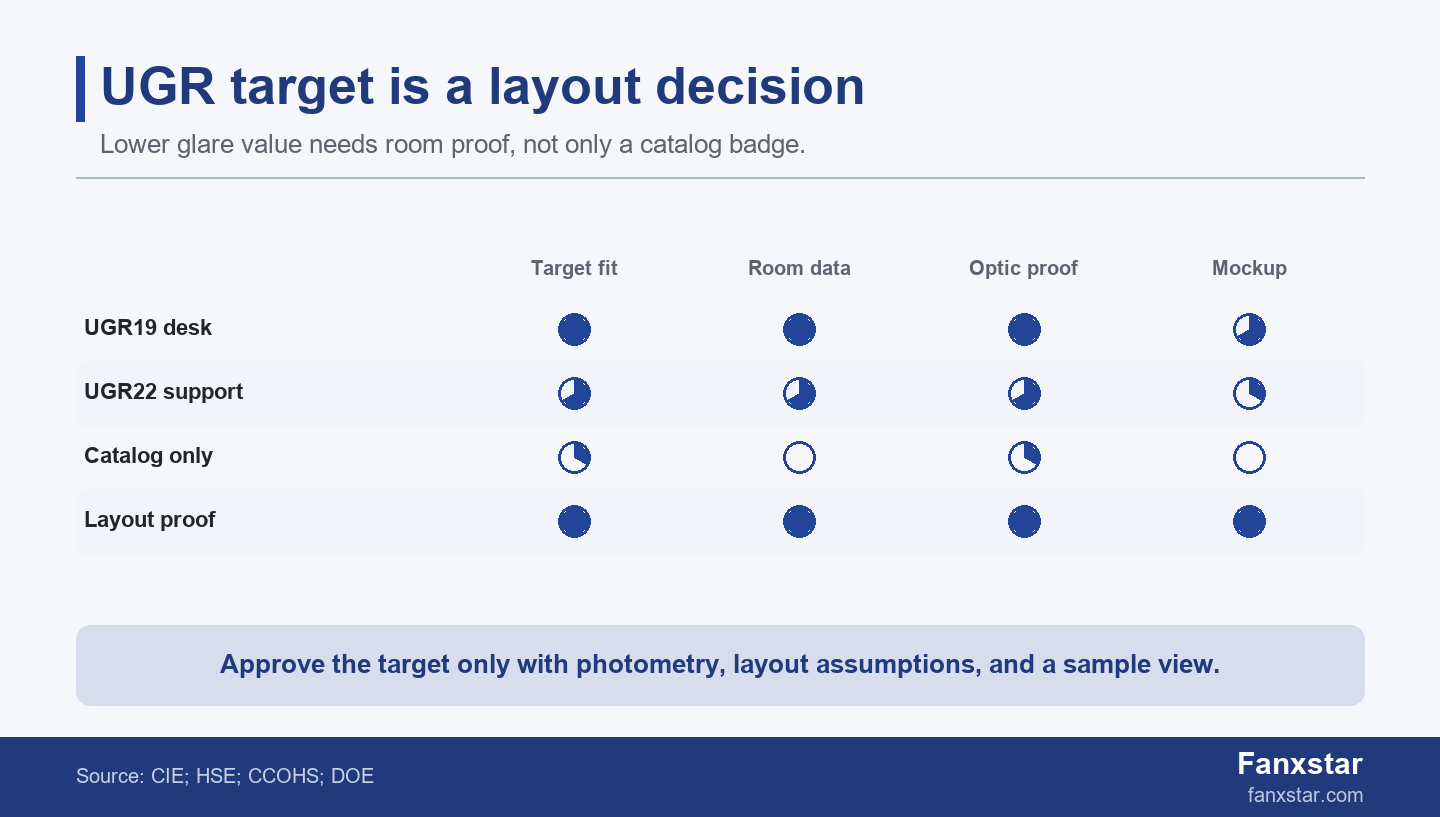
A buyer can test glare before a full rollout
A practical glare review does not need to be complicated at the first stage. Stand or sit where the user will be. Look toward screens, whiteboards, glossy desks, shelving, and the normal line of sight. Check whether bright source images appear in reflections. Ask whether the fixture face feels harsh from normal working positions, not only from directly below the luminaire.
For a larger project, require a photometric file and a layout calculation. The calculation should list fixture model, lumen package, optic, mounting height, spacing, room reflectance, workplane, and target positions. If the supplier cannot state the assumptions behind the UGR claim, the buyer should treat the number as marketing until proven.
Evidence to request before choosing UGR19 or UGR22
Make the RFQ describe the same room the fixture will serve
| Buyer check | What to ask for | Why it matters |
|---|---|---|
| Task and zone | Desk work, screen work, circulation, reception, service corridor, or warehouse support area. | A UGR target has no meaning until the visual task and viewing direction are named. |
| Photometric evidence | IES/LDT file, UGR table, beam distribution, luminance or optic notes, and fixture spacing. | UGR is calculated for a lighting system, not proven by a short catalog phrase. |
| Room assumptions | Mounting height, reflectance, workplane height, furniture layout, ceiling type, and observer positions. | Changing the room can change the glare result even when the fixture model is the same. |
| Sample view | Installed mockup or pilot zone with screens, glossy surfaces, and normal eye positions checked. | LED sources can create discomfort that a simplified number may not reveal. |
| Change rule | Driver, LED board, lens, diffuser, current, and mounting changes that reopen visual comfort review. | A low-glare sample can become a different product after value engineering. |
The most common procurement failure is comparing 2 fixture quotes without comparing the assumptions behind them. Supplier A may quote a UGR19 optic at lower lumen output. Supplier B may quote a UGR22 optic at higher output. Supplier C may quote a product family with no layout calculation at all. Those are not equal proposals.
A better RFQ includes the zone type, ceiling height, target workplane, fixture spacing, desired illuminance, surface reflectance assumptions, control plan, and whether screens, glossy desks, metal racks, glass doors, or stainless work surfaces are present. The supplier can then propose optics and output that fit the room rather than guessing from a single number.
Protect the approved sample from silent substitutions
Once a low-glare sample is approved, the buyer should freeze the optical parts that created the result. Lens material, diffuser texture, LED board spacing, drive current, reflector, louver, housing depth, and mounting accessory can all change perceived brightness. A supplier may see a substitution as minor because the wattage stays the same. The user may see it as a brighter, harsher fixture.
For Fanxstar projects, relevant starting points include A3 selectable beam weatherproof lighting, LED linear battens, and custom LED lighting design options. If a project needs a lower-glare optic for a service corridor, office-adjacent production zone, retail backroom, or data center support area, the useful request is a sample with the final lens and mounting method, not only a catalog UGR badge.
The buyer insight is that a UGR decision becomes weak when 1 number is separated from 6 physical facts: mounting height, spacing, surface reflectance, viewing angle, diffuser luminance, and task duration. A quote for UGR 19 at 300 lux and a quote for UGR 22 at 500 lux are not a clean comparison. They are 2 different lighting designs unless the room and target workplane are normalized.
DOE school lighting guidance cites 300 to 500 lux on classroom work surfaces, and CCOHS lighting ergonomics guidance lists 75 to 300 lux for computer tasks and 500 to 1000 lux for medium-contrast small visual tasks. Those ranges are not office-spec substitutes, but they show the procurement principle: light level and glare target must be selected together.
According to CIE glare research summary, UGR was developed in 1995 to predict discomfort glare, and LED luminaires with non-uniform source luminance can create prediction limits. According to HSE lighting at work guidance, close accurate work and corridor movement do not need the same lighting conditions. According to GSA LED controls guidance, new LED fixtures can improve glare control and distribution when they are selected as a system.
According to DLC technical requirements, LED product evidence belongs in tested reporting pathways, not only marketing labels. According to EN 12464-1 summary from Performance in Lighting, indoor workplace lighting requirements include visual tasks such as display screen equipment. The key insight is that a UGR 19 or UGR 22 target should sit inside a complete lighting file, not outside it.
According to CCOHS lighting ergonomics guidance, common lighting problems include glare, insufficient light, poor contrast, poor distribution, and flicker. According to Lighting Analysts UGR calculation guidance, UGR is used to predict discomfort glare in interior electric-light applications. According to DOE school lighting guidance, a pilot-style review is useful when glare and flicker are difficult to judge from product paperwork alone.
A practical UGR19 vs UGR22 procurement scenario
Compare three quotations by assumptions, not by headline
Assume a buyer receives 3 offers for an office-adjacent service area. Supplier A proposes UGR 19 at 28 W per fixture, Supplier B proposes UGR 22 at 35 W, and Supplier C proposes a low-price 40 W fixture with no UGR table. If the buyer sorts by price, Supplier C wins. If the buyer sorts by glare value only, Supplier A wins. If the buyer sorts by evidence, the team first checks whether all 3 offers use the same 3.0 m mounting height, the same 0.8 m workplane, the same room reflectance, and the same target illuminance.
The practical outcome may be different from the headline. Supplier A may use fewer lumens and need more fixtures to reach the target. Supplier B may achieve the needed 500 lux with acceptable comfort because the space is not screen-heavy. Supplier C may be rejected because it cannot prove the installed visual result. The decision is not UGR 19 versus UGR 22 in isolation; it is comfort, energy, fixture count, evidence, and user task together.
The second insight is that glare risk rises when the room has screens, glossy tables, polished concrete, stainless shelves, glass partitions, or bright windows. A UGR table does not see every reflection that a user sees. For those rooms, the buyer should ask for a mockup photograph from at least 4 eye positions: seated desk, standing entry, screen-facing position, and normal maintenance route.
Use acceptance language that the supplier can actually follow
A strong RFQ can state: the proposed layout must meet the agreed maintained illuminance target, include a UGR table or equivalent glare calculation for the stated room, use the final lens and LED board, and pass a pilot-zone visual review before mass production. It can also state that driver current, diffuser material, LED pitch, reflector, louver, or mounting method changes require written review.
The decision rule is to approve the installed visual outcome, not the lowest number printed in a catalog. This acceptance language gives both sides a clean release gate. The buyer is not demanding perfection. The supplier is not guessing whether a change is allowed. The file says which parts matter and how the result will be checked. That is the difference between a low-glare product claim and a controllable lighting procurement file.
FAQ
Is UGR19 better than UGR22?
UGR19 is the stricter glare target and is usually better for prolonged desk, screen, classroom, control-room, and precision work. UGR22 can be acceptable for less glare-sensitive zones such as corridors, support areas, storage, and occasional-task spaces when the layout and installed view are checked.
Can a fixture itself be UGR19?
A fixture can be designed for low-glare performance, but UGR is calculated for a lighting installation. Buyers should ask for the photometric file, UGR table, room assumptions, mounting height, spacing, and sample view that support the claim.
Does UGR19 guarantee better health or productivity?
No single UGR value guarantees a health or productivity result. Lower glare can support visual comfort when combined with adequate illuminance, contrast, flicker control, and good layout, but percentage claims need project-specific evidence.
What should an LED lighting buyer ask before approving low-glare samples?
Ask for the final lens or diffuser, LED board, driver current, photometric file, room calculation, mounting method, CCT, CRI, control plan, and a change rule that says which substitutions reopen glare review.