If your emergency lighting products are destined for the U.S. market — or any market that references U.S. life safety codes — UL 924 is not optional. It is the product safety standard that gatekeepers the entire emergency lighting supply chain: from procurement managers at hospital systems and commercial developers to building inspectors applying the NFPA 101 Life Safety Code and the International Building Code. A product that is simply “UL certified” is not automatically UL 924 compliant. These are separate certifications with distinct performance tests, and confusing them is one of the most common — and costly — mistakes LED manufacturers make when entering the North American market.
This article explains what UL 924 actually requires, how it interacts with the broader ecosystem of U.S. building codes, where it differs from the international IEC 60598-2-22 standard, and what the 2022 regulatory changes mean for LED emergency luminaires sold today.
Key Takeaways
- UL 924 is a dedicated emergency performance standard — separate from general luminaire safety certifications like UL 1598. A product must be specifically tested and listed to UL 924 to be compliant for U.S. emergency lighting applications.
- The core performance floor is strict: 90 minutes of illumination, 10-second transfer to emergency mode, 1 footcandle average egress illuminance with no point below 0.1 fc.
- In 2022, UL significantly changed how emergency power detection is evaluated, making several previously accepted wiring methods non-compliant. Many products currently on the market have not yet been updated.
- UL 924 requires hardwired internal battery backup that cannot be accidentally removed or bypassed — a design requirement with direct implications for how emergency LED modules are integrated into fixtures.
- UL 924 is gaining traction beyond North America, particularly in the Middle East, South Asia, and parts of East Asia, making it strategically valuable for manufacturers targeting multiple export markets.
The Regulatory Ecosystem: Why UL 924 Matters
How UL 924 Fits Into U.S. Building Codes
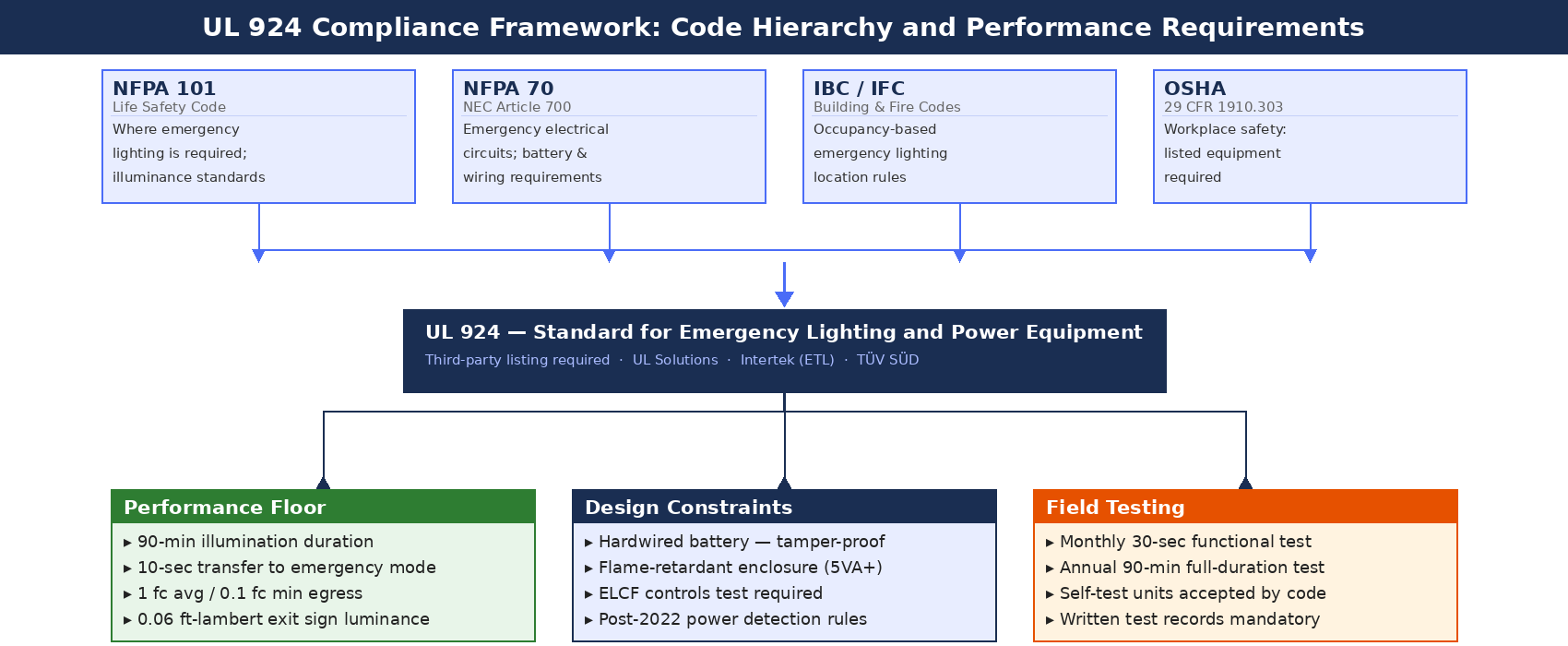
UL 924 does not operate in isolation. It sits at the intersection of several overlapping regulatory frameworks that together define where emergency lighting must be installed, how it must perform, and what products can be used to achieve compliance.
The primary code references for UL 924 compliance are: NFPA 101 (Life Safety Code), which establishes where emergency lighting is required and its illuminance performance criteria; NFPA 70 (National Electrical Code), Article 700, which governs the electrical systems that power emergency circuits; NFPA 1 (Fire Code); and the International Building Code (IBC) and International Fire Code (IFC). When building inspectors and Authorities Having Jurisdiction (AHJ) review an installation, they cross-reference all of these. A UL 924-listed product satisfies the product-level requirement across all of them simultaneously — which is precisely why specifiers insist on UL 924 listing rather than accepting unlisted alternatives.
NEC 110.3(B) adds an important installation layer: equipment that is UL listed must be installed strictly according to the manufacturer’s installation instructions. This means that a UL 924-listed luminaire is only compliant when mounted within the spacing, height, and orientation parameters tested during certification. Unless installation instructions specify otherwise, UL 924 luminaires are tested at a maximum mounting height of 7.16 feet (approximately 2.18 meters) — higher than that, the tested illuminance levels at the walking surface may not be achievable, and the listing is effectively voided.
UL 924 vs. UL 1598: Understanding the Distinction
This confusion trips up manufacturers repeatedly. UL 1598 is the safety standard for luminaires generally — covering electrical insulation, wiring, thermal performance, and fire resistance. A luminaire might be UL 1598 listed, meaning it is a safe, well-constructed fixture. But UL 1598 says nothing about whether that fixture will perform for 90 minutes during a power failure.
UL 924 covers emergency system functionality specifically. It tests whether the product actually delivers emergency illumination under power failure conditions — including battery backup performance, transfer time to emergency mode, output during the 90-minute discharge period, and the integrity of the emergency activation mechanism. A luminaire certified only to UL 1598 with an internal battery is not a UL 924-listed product unless it has completed UL 924-specific testing. This distinction matters enormously at final inspection when the AHJ asks to see the listing documentation.
Core Technical Requirements of UL 924
Performance Floor: Duration, Illuminance, and Transfer Time
UL 924 establishes three non-negotiable performance thresholds for emergency luminaires:
| Parameter | UL 924 Requirement | Application Note |
|---|---|---|
| Illumination duration | Minimum 90 minutes on full charge | Applies to both emergency lights and exit signs with battery backup |
| Transfer time to emergency mode | Within 10 seconds of power loss | Immediate activation required upon circuit failure |
| Egress illuminance | Average 1 fc along egress path; minimum 0.1 fc at any point | Per NFPA 101; UL 924 validates the product can achieve this |
| Exit sign luminance | Minimum 0.06 foot-lamberts | Measured across the face of the sign |
| Exit sign viewing distance | Minimum 100 feet (approx. 30 meters) | If actual viewing distance differs, it must be marked on the sign |
| Exit sign letter height | Minimum 6 inches tall; ¾ inch letter stroke width | Red or green letters; ⅜ inch spacing between characters |
The 90-minute duration requirement is not simply a battery capacity specification — it is a tested, validated performance under actual discharge conditions. The battery must be internally hardwired and cannot be designed in a way that allows accidental removal or substitution. This is a deliberate design constraint: if a maintenance contractor replaces an emergency LED tube with a standard tube, the emergency capability must be physically impossible to lose accidentally. Products where the emergency battery can be disconnected without specialized tools do not pass UL 924 review.
The Emergency Lighting Control Functionality (ELCF) Test
One area where UL 924 goes beyond general luminaire standards is its evaluation of controls. UL 924 includes the Emergency Lighting Control Functionality (ELCF) test — a procedural evaluation that checks how the emergency lighting system responds when normal power is interrupted, how lighting controls interact with emergency circuits, and whether intelligent lighting systems (dimming, switching, occupancy control) correctly override to emergency mode during a power failure.
This is directly relevant to manufacturers of LED emergency luminaires with integrated DALI 2.0 or 0–10V dimming — a common feature in Fanxstar’s emergency batten and spotlight range. Lighting controls that dim or switch off luminaires during normal operation must not interfere with emergency activation. The ELCF test verifies this behavior explicitly.
The 2022 Power Detection Changes: A Critical Update
In 2022, UL substantially revised the requirements for how emergency lighting equipment detects the presence — and loss — of normal power. The revised standard now requires an active input signal to confirm that normal power is present. Many previous designs relied on passive methods (essentially, the emergency module would activate whenever it stopped receiving normal-mode current) — which could produce false emergency activations during intentional switching events or energy management operations.
The 2022 changes made many previously accepted wiring approaches non-compliant. Products certified before May 2022 may no longer meet current UL 924 requirements, and a substantial portion of the market had not yet updated their product listings. Manufacturers sourcing components for UL 924-compliant emergency LED luminaires should confirm that drivers, battery modules, and control gear are listed under the post-2022 standard revision, not just against older versions.
Exit Signs vs. Emergency Luminaires: Different Requirements Under the Same Standard
Exit Sign Requirements
UL 924 covers two distinct product categories that are sometimes confused: emergency luminaires (the lighting units that illuminate egress paths) and exit signs (the directional signage that guides occupants to exits). Both must be UL 924 listed, but the technical requirements differ in important ways.
For exit signs, UL 924 specifies letter size (6-inch minimum height, ¾-inch stroke width), color (red or green — specific jurisdictions may mandate one over the other), luminance (0.06 foot-lamberts minimum), and viewing distance (100 feet). Exit signs must provide 90 minutes of illumination during power failure, whether through internal battery backup or connection to the building’s emergency power supply.
UL 924A (the Outline of Investigation for Emergency Signs With Alternative Visual Designs) provides a certification path for exit signs that use non-standard visual formats — an option relevant for manufacturers supplying markets where local customs or design standards call for alternative signage. This is noted as particularly relevant in Middle Eastern markets where UL 924A is accepted alongside traditional UL 924.
Floor Proximity Egress Path Marking
A third category gaining relevance in high-occupancy buildings is floor proximity egress path marking — low-level illuminated or luminescent strips mounted at or near floor level to guide evacuation even when smoke fills the upper parts of corridors. Products in this category are certified to ANSI/UL 1994 (Luminous Egress Path Marking Systems), a companion standard to UL 924. Bottom mounting height for these markers must place the bottom of the sign between 6 inches and 18 inches above the floor.
Testing and Maintenance Requirements in the Field
Mandatory Testing Cycles
UL 924 compliance is not a one-time certification event — it requires an ongoing testing and documentation program in the building where the products are installed. The NFPA 101 Life Safety Code specifies three acceptable testing approaches, all of which UL 924-listed products must support:
- Manual functional testing: Monthly 30-second tests and an annual 90-minute full-duration test. Written records of all tests and any failures must be maintained.
- Automated self-testing: Self-testing units must conduct at least a 30-second test every 30 days with a visual status indicator, plus an annual 90-minute test. A test history report must be available.
- Computer-based self-testing: Software-managed test scheduling and automated reporting, meeting the same monthly and annual intervals.
Self-testing emergency luminaires — a feature already common in European IEC 62034-compliant products — significantly reduce the maintenance burden for facility managers, particularly in large commercial or industrial installations. For Fanxstar’s emergency lighting range, the integration of self-test functionality makes products more competitive in both the U.S. and EU markets simultaneously, since IEC 62034 and UL 924’s self-test provisions serve essentially the same operational purpose.
UL 924 vs. IEC 60598-2-22: What Manufacturers Need to Know
Side-by-Side Comparison
For manufacturers already certified to IEC 60598-2-22 (the international emergency luminaire standard used throughout Europe, Australia, and much of Asia), adding UL 924 certification is a strategic expansion — not a full restart. The standards share the same underlying logic but diverge on performance thresholds and procedural requirements in ways that matter at the product design stage.
| Parameter | UL 924 (North America) | IEC 60598-2-22 (International) |
|---|---|---|
| Illumination duration | 90 minutes minimum | 1 hour minimum (some markets require 3 hours) |
| Transfer time | Within 10 seconds | Within 0.5–5 seconds depending on application type |
| Egress illuminance | 1 fc average / 0.1 fc minimum | 1 lux average / 0.5 lux minimum (per EN 1838) |
| Controls evaluation | ELCF test required | IEC 62034 auto-test systems (separate standard) |
| Self-certification | Third-party listing required (UL Solutions, Intertek, etc.) | Manufacturer self-declaration + CE mark (EU model) |
| Geographic reach | U.S., Canada (with CSA C22.2 No. 141), Middle East, South Asia | EU, UK, Australia (AS/NZS 60598.2.22), most IEC-aligned markets |
The most practically significant difference is the duration floor: UL 924’s 90-minute minimum is more demanding than IEC’s 1-hour baseline. Battery packs designed to meet IEC 60598-2-22 with a 60-minute runtime will fail UL 924 testing. Manufacturers planning dual certification must design to the more demanding 90-minute threshold from the outset — adding battery capacity is far easier at the design stage than retrofitting certified products.
UL Solutions, which administers UL 924 listing, also explicitly supports dual certification — testing to both UL 924 and IEC 60598-2-22, IEC 61347-2-7, and IEC 62034 within a single engagement. For manufacturers targeting both European and North American markets, this is the most efficient route to dual market access.
Global Expansion of UL 924 Acceptance
UL 924 is no longer exclusively a North American standard in practice. Its rigorous performance thresholds, third-party listing model, and alignment with evolving LED and battery technologies have driven adoption in markets historically served by IEC standards. The Middle East, South Asia (including India), and parts of Southeast Asia increasingly specify or accept UL 924-listed products — particularly for large commercial and industrial projects designed to U.S. building code frameworks. For a manufacturer already building to the 90-minute, 10-second transfer standard, the incremental cost of UL 924 listing relative to the market access gained is highly favorable.
The Certification Process for LED Emergency Luminaires
What Gets Tested and How
UL 924 certification requires a full product submission to a Nationally Recognized Testing Laboratory (NRTL) — organizations such as UL Solutions, Intertek (ETL), or TÜV SÜD that are recognized by OSHA to conduct safety testing. The certification process evaluates both the safety of the fixture itself (typically against UL 1598 or applicable component standards) and the emergency system functionality specific to UL 924.
The core UL 924-specific tests include: battery backup performance over a 90-minute simulated discharge; transfer time measurement from normal power interruption to full emergency illumination; photometric measurement at the walking surface to confirm illuminance meets the 1 fc / 0.1 fc requirement; exit sign luminance and viewing distance measurement (where applicable); ELCF test for products with integrated controls; and flame-retardance evaluation of enclosure materials (UL 924 requires 5VA, 5VB, V-0, V-1, V-2, or HB rated thermoplastics for enclosures).
Following successful testing, UL conducts an Initial Production Inspection (IPI) at the manufacturing facility — in China, this is conducted by UL’s regional inspectors. The factory inspection verifies that the production line, components, and processes match the tested configuration. Ongoing follow-up inspections typically occur at least four times per year to maintain the listing.
Component vs. System Certification
One nuance of UL 924 relevant to modular emergency LED products: the standard distinguishes between complete luminaire certification and component certification. Battery packs, LED drivers with emergency capability, and control modules may carry their own UL 924 component certifications — but these do not make the final luminaire a UL 924 listed product by themselves. The assembled luminaire must be tested as a complete system. This matters for manufacturers who want to market emergency add-on modules or retrofit kits: the module’s component listing does not extend to the luminaires it is installed in without a separate system-level evaluation.
Practical Implications for Industrial and Commercial Emergency Lighting
Weatherproof Emergency Luminaires in U.S. Applications
For manufacturers of weatherproof and industrial-grade emergency lighting — the intersection of IP-rated enclosures and UL 924 emergency performance — the North American market presents a product gap that is genuinely underserved. Most U.S.-market emergency luminaires are designed for dry indoor environments. Wet locations, parking structures, cold storage facilities, and industrial processing areas have a legitimate need for IP65/IP66-rated emergency luminaires that also carry UL 924 listing.
Products combining IP ratings with UL 924 emergency listing represent a dual-certification design challenge: the sealed enclosure must be compatible with battery serviceability requirements, thermal management of the battery during the 90-minute emergency discharge, and the waterproofing requirements of wet location listings under UL 1598. In our experience working with cold chain and industrial facility clients in Europe, the technical requirements for dual IP/emergency certification are achievable — but require deliberate engineering from the outset rather than adapting a non-emergency IP product after the fact.
The U.S. market for weatherproof emergency luminaires aligns naturally with Fanxstar’s core competency: IP-rated enclosures, LiFePO4 battery integration, and industrial-grade construction. For Fanxstar’s emergency lighting range, view the full emergency lighting product portfolio to understand the current certified range and its compatibility pathways for North American market development.
Frequently Asked Questions
Is UL 924 legally mandatory, or just recommended?
In practice, UL 924 listing is effectively mandatory for emergency lighting sold into the U.S. market. While federal law does not directly mandate UL 924 by name, NFPA 101, the IBC, OSHA regulations, and most state and municipal fire codes require “listed” emergency lighting equipment — and UL 924 is the nationally recognized listing standard for this product category. AHJs will almost universally require UL 924 listing during inspections, and most distributors and specifiers will not purchase unlisted products.
Does UL certification for a luminaire automatically mean UL 924 compliance?
No. This is one of the most common misunderstandings in emergency lighting procurement. A luminaire may be UL listed to UL 1598 (general luminaire safety) or UL 8750 (LED equipment) without having undergone the emergency-specific testing required by UL 924. Buyers should verify that the product is specifically listed to UL 924, not just “UL listed” in general terms. The UL Product iQ database allows specification of the exact standard against which a product is listed.
What changed in UL 924 in 2022, and why does it matter?
In May 2022, UL revised the requirements for how emergency lighting equipment detects normal power. The revised rules require a positive input signal to confirm normal power presence, rather than relying on passive detection. This change made many previously accepted product designs non-compliant. Manufacturers who have not yet updated their product listings post-2022 may be shipping products that no longer meet current code. Always confirm the date of a product’s UL 924 listing and verify it was evaluated under the current standard edition.
Can a product certified to IEC 60598-2-22 be sold in the U.S. without UL 924?
In most cases, no. IEC 60598-2-22 certification supports CE marking for European markets and acceptance in IEC-aligned markets globally, but it does not satisfy U.S. code requirements. U.S. AHJs require UL 924 listing specifically. Manufacturers targeting both EU and U.S. markets should pursue dual certification — UL Solutions supports combined testing under both standards.
How long does UL 924 certification take, and what is the typical cost?
The full UL 924 certification process typically takes 8–16 weeks from sample submission to listing issuance, depending on product complexity, test queue wait times, and the number of clarifications required. Costs vary by laboratory and product type, but manufacturers should budget for testing fees, initial production inspection costs (including laboratory travel costs for China-based factories), and ongoing annual follow-up inspection fees. Engaging a compliance consultant familiar with UL’s testing protocols before product development begins significantly reduces the risk of costly redesigns during the certification process.
Specifying Emergency Lighting for U.S. or International Projects?
Fanxstar designs emergency LED luminaires — from maintained battens to Spitfire spotlights — with integrated LiFePO4 battery backup, DALI 2.0 compatibility, and self-test functions currently certified to IEC standards for EU/UK/AU markets. Our engineering team works directly with distributors and project developers to understand certification targets for new markets, including North America.
Explore the Emergency Lighting Range → | Discuss Your Project Requirements →