LED technology is inherently more RoHS-friendly than the legacy lighting it replaces — it contains no mercury, no hexavalent chromium in its core construction, and no high-temperature lead solders in standard designs. But “more RoHS-friendly” is not the same as automatically RoHS-compliant. The Restriction of Hazardous Substances Directive (EU Directive 2011/65/EU) applies to every electrical and electronic product placed on the EU market, and LED luminaires are firmly within scope. The directive restricts ten substances across the entire product — including plastics, PCB substrates, solder joints, enclosures, cable insulation, and connectors — and it requires manufacturers to maintain technical documentation proving compliance for ten years after placing a product on the market. This guide explains what RoHS compliance actually requires for LED lighting manufacturers, what has changed through the 2024 updates, and how procurement teams should verify it in their supply chains.
Key Takeaways
- RoHS currently restricts ten substances in LED lighting: six original heavy metals/flame retardants plus four phthalates added under RoHS 3 — all with maximum concentration values (MCVs) of 0.1% by weight, except cadmium at 0.01%.
- RoHS compliance is primarily a manufacturer self-declaration backed by technical documentation and supplier material declarations — no third-party certification body is required, but evidence must be complete and auditable.
- The key 2024 update narrows the cadmium exemption for LED chips (entry 39(a) expires November 2025; new entry 39(b) applies with stricter limits). Lead exemptions in solders and glass/ceramic components are also expiring between 2026 and 2027.
- RoHS is now effectively a global compliance standard: 20+ jurisdictions including China, South Korea, India, Saudi Arabia, and several US states have enacted equivalent regulations.
The RoHS Directive: What It Is and Why It Applies to LED Lighting
Regulatory Origin and Evolution
The RoHS Directive originated as EU Directive 2002/95/EC (RoHS 1), which took effect on 1 July 2006. It was replaced by Directive 2011/65/EU (RoHS 2) on 2 January 2013, which broadened the product scope to include all electrical and electronic equipment, cables, and spare parts. A 2015 amendment (2015/863/EU — often called RoHS 3) added four phthalates to the restricted substance list, bringing the total to ten. Most recently, the EU published Delegated Directive (EU) 2024/14161 in May 2024, amending exemptions for cadmium in LED chips. The European Commission has described RoHS as complementary to the WEEE Directive: RoHS restricts hazardous substances during product design and manufacture; WEEE governs the recycling and disposal of the resulting waste at end of life.
The directive now restricts ten substances in all EEE — including lighting products. Unlike earlier product safety directives, RoHS 2 is a full CE marking directive under the EU’s New Legislative Framework: a product bearing CE marking must comply with RoHS in addition to the Low Voltage Directive, EMC Directive, and any other applicable EU legislation. RoHS compliance is not optional for any product in scope — and all LED luminaires are in scope.
Why LED Technology Does Not Eliminate RoHS Risk
The popular assumption that LED lighting is automatically RoHS-compliant because it contains no mercury is only partially correct. The LED light source itself — the semiconductor die on the LED chip — may contain no mercury, and standard LED designs do not use mercury at any stage. But a complete LED luminaire is a complex electromechanical assembly: the PCB substrate carries solder joints; the driver and control gear contain electrolytic capacitors, resistors, and MOSFETs with plastic packaging; the enclosure may use plastic compounds containing flame retardants; wiring uses PVC insulation that may historically have contained lead stabilizers; and connector terminals may use hexavalent chromium surface treatments. Each of these materials and components must comply with RoHS limits at the homogeneous material level. A single non-compliant component anywhere in the product makes the entire luminaire non-compliant.
The Ten Restricted Substances and Their Limits in LED Luminaires
Maximum Concentration Values (MCVs) and Where Each Substance Appears
The RoHS Directive specifies Maximum Concentration Values (MCVs) as a percentage by weight of the homogeneous material — the smallest portion that could be mechanically separated from the product. All ten restricted substances must remain below their respective MCVs in every homogeneous material used in the product:
| Substance | MCV (% by weight) | Common Locations in LED Luminaires | Risk Level |
|---|---|---|---|
| Lead (Pb) | 0.1% | Solder joints, PCB glass, PVC insulation stabilizers | High — multiple locations |
| Cadmium (Cd) | 0.01% | Quantum dot LEDs (display), some NiCd battery contacts, plastic pigments | Medium — use of quantum dots |
| Mercury (Hg) | 0.1% | Not present in standard LED sources; legacy fluorescent drivers (if retrofitted) | Low for pure LED |
| Hexavalent Chromium (Cr-VI) | 0.1% | Metal surface treatments, anti-corrosion coatings on fasteners and enclosures | Medium — corrosion-treated parts |
| PBB / PBDE | 0.1% each | Flame retardants in PCBs, plastic enclosures, wiring | Medium — older plastics |
| DEHP / BBP / DBP / DIBP (phthalates) | 0.1% each | PVC cable insulation, plastic gaskets, soft plastic components | High — widespread in PVC |
For weatherproof and industrial LED luminaires — the product types most critical to B2B lighting specifiers in harsh environments — lead and phthalates carry the highest compliance risk. Lead historically appeared in PCB solder joints, and while most modern LED PCBs use lead-free solder, the driver’s own PCB (sourced from a separate component supplier) may not be identical in specification. Phthalates are pervasive in PVC-based cable insulation and gasket compounds. For IP66-rated weatherproof enclosures with silicone or EPDM gaskets, verifying the phthalate content of the sealing compounds is part of a complete RoHS compliance assessment.
How RoHS Compliance Works in Practice — for LED Manufacturers
The Self-Declaration Model and What It Actually Requires
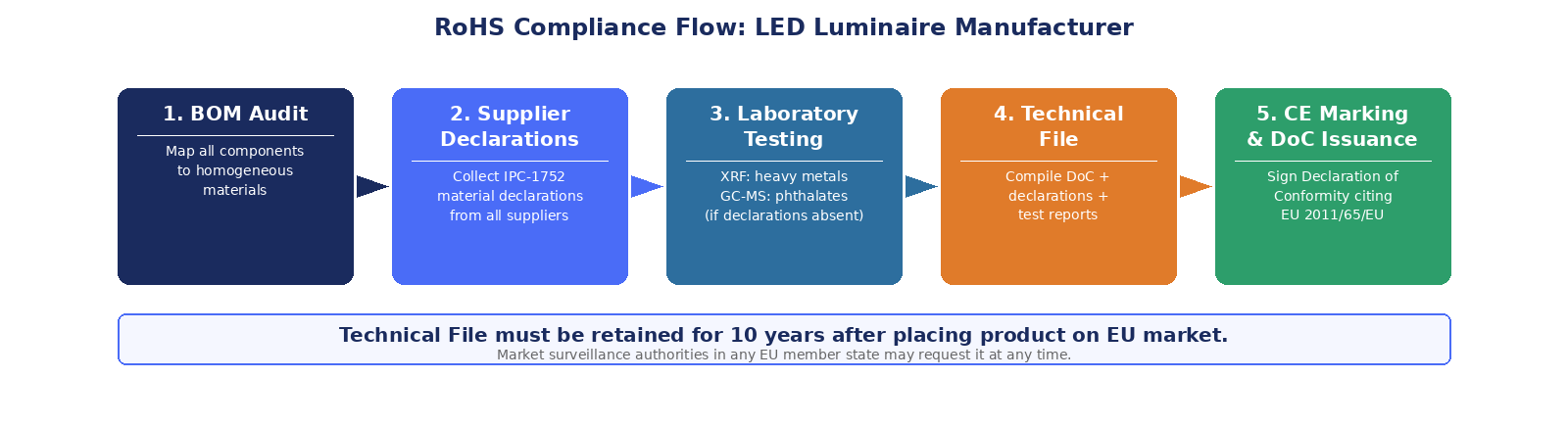
RoHS compliance does not require a third-party certification body. Manufacturers self-declare compliance by issuing a Declaration of Conformity (DoC) for the product — a legal document signed by the manufacturer or their EU authorized representative that asserts the product meets the applicable EU directives, including RoHS. The DoC must identify the product, cite the relevant directive (2011/65/EU), reference any harmonized standards applied (notably EN IEC 63000:2018, the active harmonized standard for RoHS technical documentation), and be signed with legal accountability. Critically, “self-declaration” does not mean “no evidence.” According to Compliance Gate, manufacturers must compile a complete Technical File that includes material declarations, test reports, and compliance certificates from suppliers, and retain this documentation for ten years after placing the product on the EU market. Market surveillance authorities in EU member states can request this documentation at any time, and inability to produce it constitutes non-compliance regardless of the DoC.
The Supply Chain Compliance Process
RoHS compliance flows upstream through the supply chain. Because the MCV applies at the homogeneous material level, the manufacturer of a finished LED luminaire cannot determine compliance from visual inspection or component datasheets alone — they must receive and evaluate material declarations from every component supplier in the BOM. The IPC-1752 standard provides a standardized format for supplier material declarations that is widely used in the electronics industry. For LED luminaire manufacturers working with complex BOMs — LED modules, drivers, PCBs, enclosures, wiring harnesses, gaskets, thermal interface materials, and control gear — maintaining an up-to-date, complete set of supplier declarations is the foundation of defensible RoHS compliance. When a critical component changes (a driver substitution, a PCB substrate change, a new enclosure material) the entire compliance assessment must be re-evaluated for the affected portions of the BOM.
Testing Methods: XRF and Beyond
When supplier declarations are absent or insufficient, or when a material’s composition is genuinely uncertain, laboratory testing is required. X-ray fluorescence (XRF) spectroscopy is the standard non-destructive screening method for heavy metals — lead, cadmium, mercury, hexavalent chromium, and the PBB/PBDE bromine signature can all be detected by XRF. However, XRF has limitations: it cannot reliably detect phthalates (organic substances) or differentiate between hexavalent and trivalent chromium without supplementary testing. For the four phthalates added under RoHS 3 — DEHP, BBP, DBP, and DIBP — advanced analytical methods including gas chromatography-mass spectrometry (GC-MS) are required. Manufacturers who are supplying EU buyers with industrial LED products and are asked to provide third-party test reports as part of procurement qualification typically need both an XRF screening report and GC-MS analysis for phthalates to satisfy a complete RoHS evidence package.
2024–2026 RoHS Updates That Affect LED Lighting Manufacturers
The Cadmium Exemption Change (Entry 39 — Effective November 2025)
The most directly LED-relevant recent RoHS update is the change to the cadmium exemption for LED chips. The European Commission published Delegated Directive (EU) 2024/14161 on 21 May 2024, which narrowed the cadmium exemption. The previous exemption (entry 39(a) in Annex III) — which permitted cadmium in color conversion applications in LEDs for display and projection — expires on 21 November 2025. The new, narrower exemption (entry 39(b)) applies only to cadmium in quantum dots that are directly deposited on LED chips, with strict additional limitations on scope and quantity. According to TÜV SÜD, this affects LED component suppliers using cadmium quantum dots in display systems. For general LED luminaire manufacturers using standard GaN LED chips without cadmium quantum dot enhancement, this change does not affect compliance status — but component sourcing teams should verify their LED module specifications explicitly, as cadmium quantum dot LED modules do exist in the supply chain.
Expiring Lead Exemptions (2026–2027)
Several long-standing exemptions for lead in solder alloys, glass, and ceramic components are scheduled to expire between 2026 and 2027 unless renewed by the European Commission. The most relevant for LED lighting manufacturers include exemptions for lead in certain high-temperature solder alloys and lead in glass dielectric layers in specific electronic component types. Manufacturers whose LED drivers or control gear incorporate components that rely on these exemptions should audit their BOMs against the exemption expiry schedule and engage their component suppliers to confirm whether substitute materials are available or whether exemption renewal applications have been submitted. Waiting until an exemption expires to discover that a component in the driver’s power stage relies on it can result in supply chain disruption and forced product redesign on very short notice.
The Recycled PVC Lead Labeling Requirement (From May 2026)
From 28 May 2026, any electrical components containing recycled PVC with lead content at or above 0.1% must carry an explicit label stating the presence of lead at that concentration level. This labeling requirement affects wiring, cable assemblies, and any component housings using recycled PVC. For LED luminaire manufacturers sourcing cable harnesses from component suppliers who use recycled PVC in cable insulation, this creates a new compliance documentation requirement — either confirming that the recycled PVC used in supply chain cables is below the 0.1% threshold, or ensuring appropriate labeling is in place. This is a transparency-oriented requirement rather than a substance ban, but it does add a new supply chain documentation obligation that was not present in the original RoHS framework.
RoHS as a Global Compliance Requirement
National Equivalents Across Fanxstar’s Key Markets
While RoHS originated as an EU directive, equivalent regulations have now been adopted across the majority of B2B LED lighting export markets. According to Nemko, RoHS-equivalent regulations are now mandatory in the EU, UK (UK RoHS, mirroring EU RoHS), China (China RoHS — GB/T 26572), South Korea (K-RoHS), India, Saudi Arabia, Turkey, Vietnam, and multiple US states including California, New Jersey, and Illinois. While the specific substances and MCVs across these jurisdictions are broadly aligned with the EU version, there are differences in scope, enforcement mechanisms, and documentation requirements. China RoHS, for example, uses the same ten substances and MCVs as EU RoHS but has distinct labeling requirements under SJ/T 11364 — products that contain restricted substances above the MCV must include a compliance table in Chinese identifying which components contain which substances.
Practical Implication: EU RoHS as the Baseline
For manufacturers targeting multiple export markets simultaneously, EU RoHS compliance typically represents the most rigorous documented standard — and achieving it creates a solid compliance foundation that covers the equivalent requirements in most other jurisdictions. A complete EU RoHS technical file, with full supplier declarations, test reports, and a DoC signed against 2011/65/EU, provides the evidence base needed to satisfy procurement qualification questions from buyers in Europe, Australia, the Middle East, and North America alike. The additional steps for China RoHS (labeling table in Chinese) and UK RoHS (post-Brexit equivalent DoC) are administrative overlays on this foundation rather than separate compliance programs.
What B2B Buyers Should Actually Check When Evaluating LED Lighting Suppliers
The Four Documents That Matter
Procurement managers and electrical engineers evaluating LED lighting suppliers for industrial facility projects should request and review four specific documents for RoHS due diligence. First, the Declaration of Conformity — verifying that it explicitly cites EU Directive 2011/65/EU, references EN IEC 63000 as the harmonized standard applied, and is signed by an authorized representative. Second, the material declarations or compliance statements for key sub-components — the LED driver, the LED module/PCB assembly, and the wiring harness, at minimum. Third, a third-party test report covering XRF heavy metal screening and GC-MS phthalate analysis — not all suppliers maintain these proactively, but for LED products specified into food processing, cold chain, or healthcare environments where chemical exposure risk is elevated, they represent appropriate procurement due diligence. Fourth, confirmation of component exemption tracking — whether the supplier maintains an active BOM review process for exemption expiry dates, particularly relevant given the upcoming 2026–2027 lead exemption expirations.
For OEM/ODM partners developing custom LED products with Fanxstar’s engineering team, RoHS compliance documentation is built into the product development process. Component selection follows RoHS-compliant sourcing guidelines, LED drivers and modules are sourced from suppliers who maintain current material declarations, and DoC documentation is prepared as part of the certification package delivered alongside the product. Buyers working on their own certification programs with EU market access requirements can review Fanxstar’s quality and certification credentials and discuss specific documentation requirements directly with the engineering team.
Frequently Asked Questions
Is RoHS compliance mandatory for LED lighting sold outside the EU?
In the EU, yes — mandatory under Directive 2011/65/EU for all EEE placed on the EU market. Outside the EU, the requirement depends on the specific jurisdiction. The UK has its own post-Brexit UK RoHS requirement that mirrors the EU directive. China, South Korea, India, Saudi Arabia, Turkey, and several US states have enacted equivalent regulations. For B2B LED lighting manufacturers targeting European distributors, EU RoHS compliance is non-negotiable. For global export, treating EU RoHS as the baseline compliance standard covers the substance restriction requirements of most other national equivalents.
How often does a manufacturer need to update their RoHS documentation?
RoHS compliance must be re-evaluated whenever: a component in the BOM changes (material, substrate, surface treatment, or supplier); an exemption used in the current compliance assessment expires; the RoHS directive is amended to add new restricted substances or change MCVs; or the product design changes in a way that introduces new materials or components. Practically, this means maintaining a living BOM compliance tracker with exemption expiry dates flagged, and conducting a full compliance review at each major product revision cycle. The EU’s ongoing review of RoHS — including the December 2023 European Commission review report — signals continued evolution of restricted substance scope, and manufacturers should monitor the EU Commission’s RoHS directive page for new delegated directive publications.
Does RoHS apply to spare parts and replacement LED drivers?
Yes — RoHS 2 (Directive 2011/65/EU) explicitly includes spare parts and replacement components within scope. A replacement LED driver supplied as a spare part for an LED luminaire must comply with RoHS just as the original product does. This is particularly relevant for manufacturers who offer 7–10 year warranty programs on weatherproof industrial luminaires — replacement drivers sourced over that extended warranty period must be verified against current RoHS requirements, not just the version in force at the original product launch date.
Can a product be both CE-marked and non-RoHS-compliant?
Technically, no — but practically this occurs in the market more often than it should. Since RoHS 2 became a CE marking directive, the CE mark on an EEE product is supposed to affirm compliance with RoHS in addition to the LVD and EMC directives. A product whose CE marking was applied without verifying RoHS compliance is technically mismarked. EU market surveillance authorities can and do take enforcement action against products with non-compliant CE marking, including ordering product recalls and imposing financial penalties. Buyers in procurement roles should not treat CE marking as automatic evidence of RoHS compliance — requesting the DoC and asking specifically whether it cites 2011/65/EU is the only reliable verification step.
Fanxstar’s LED products are manufactured under ISO 9001:2015 quality management with RoHS compliance built into the component sourcing and production process — including LED drivers, PCB assemblies, and wiring harnesses sourced from suppliers who maintain current material declarations. For OEM/ODM partners requiring a full RoHS compliance documentation package for EU market entry, our engineering team can discuss documentation structure and evidence requirements. Contact us to discuss your compliance and specification requirements.